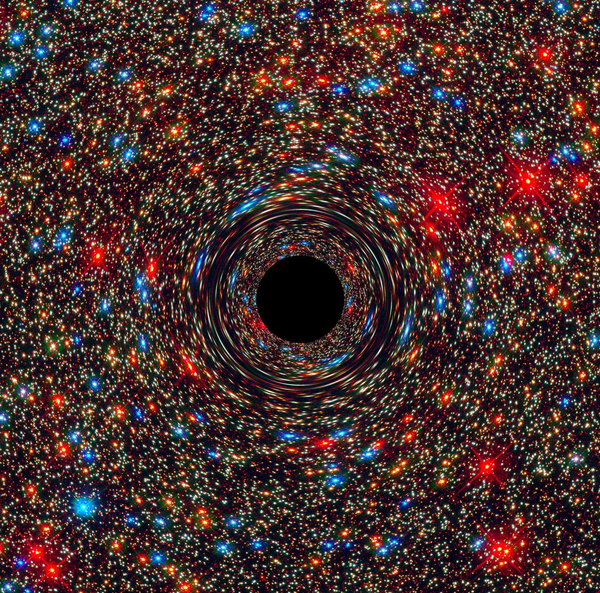
Why a Flat Universe Could Still Be a Donut
Episode 1: The Universe Is Shaped Like a Donut. Probably.
I like science that leaves room to imagine. When things that seemed unrelated turn out to share a hidden pattern — that moment feels like finding one of the world's secrets. Which opens a door I didn't know was there. Which leads somewhere unexpected. Which eventually leads back to me.
You're in the kitchen. You drop a piece of paper on the counter — flat, ordinary, the kind of thing you've stopped seeing because you see it every day. You look at it and think: flat. Obviously flat. A flat thing is a flat thing.
But here's a question you've probably never asked: how big is it?
Not the paper. The flatness.
Because if I told you that piece of paper is actually the surface of something enormous — that it wraps around, that if you walked far enough in one direction you'd end up back at your own kitchen from the other side — you'd laugh. You'd flip the paper over. You'd say, look, it ends here. I can see the edge.
Now imagine you couldn't see the edge.
Imagine you were an ant on that paper, and the paper was the size of a country. You'd walk and walk. Every measurement you took would say: flat. Every triangle you drew would have angles adding up to exactly 180 degrees, the way they're supposed to on a flat thing. You'd send out little ant scientists with little ant rulers, and they'd come back with graphs, and the graphs would say: yes, confirmed, this is flat.
And they would all be right. And they would all be missing something.
Because flat doesn't tell you the shape. Flat only tells you the curvature. Those are different words, and we mix them up constantly, and it matters more than you'd think.
A piece of paper is flat. A piece of paper rolled into a tube is also flat — the geometry on its surface hasn't changed, you can still draw your triangles, the angles still add up. Take that tube and bend it into a donut, gluing the ends together. Still flat, in the only sense that mathematicians care about. You, walking on the surface, would never feel a hill. You'd just, eventually, come home.
This is the part that broke my brain the first time I heard it. I always assumed "flat" meant "infinite, going on forever, like a tablecloth with no edges." I assumed it the way you assume the floor is solid. Nobody told me. It just sat there in my head as a fact.
It is not a fact. It was never a fact. Flat is a local thing. Shape is a global thing. You can have one without knowing anything about the other.
And now think about where you actually live.
You live inside something. Something we measure, very carefully, with telescopes and satellites and the faint afterglow of light that's been traveling for thirteen billion years. We measure the triangles. We measure the angles. And we get back the answer: flat. As flat as we cantell. Flat to within a margin of error that keeps getting smaller every decade [1].
And everyone — including a lot of physicists, honestly — hears "flat" and thinks "infinite." Goes on forever. No edges, no wrapping, no coming home from the other side.
But you already know the trick now. You saw it with the paper.
Flat doesn't mean infinite. Flat just means the triangles work out. Flat is what the ant measures. Flat is the local report from inside the thing. The actual shape — whether it goes on forever or curls back on itself in some direction we haven't checked — that's a completely separate question. And the wild part, the part I keep turning over in my head when I should be sleeping, is that our best measurements cannot tell the two apart.
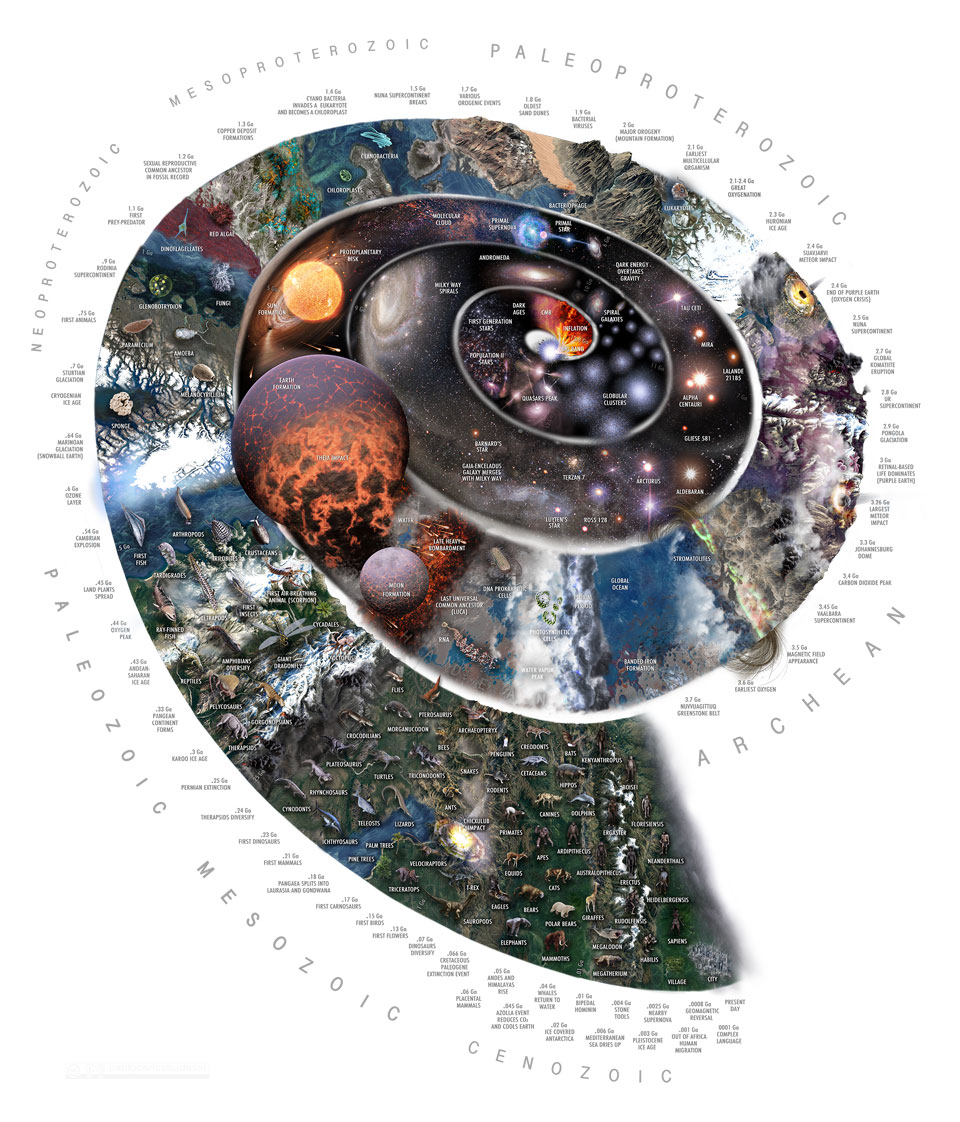
📷 Time Spiral — NASA/ESA (NASA APOD, Public Domain)
We have built instruments that can detect the temperature of empty space to a millionth of a degree [2]. We have mapped the oldest light in existence. And the question "is the universe infinite, or does it loop back on itself like a donut" is still — genuinely, embarrassingly, beautifully — open.
You live inside a piece of paper. Nobody has checked the edges.
Okay. Pac-Man.
You remember Pac-Man. Yellow circle, eating dots, ghosts chasing him through a maze. And there's that thing he does — the thing every kid noticed and then forgot to be amazed by. He runs off the left side of the screen and pops out on the right side. He runs off the top and appears on the bottom.
Where did he go? What was on the other side?
Nothing. There is no other side. The screen is the whole universe. It just connects to itself.
Now here's the part that broke my brain when I finally understood it. Pac-Man's universe is flat. Genuinely, mathematically flat. If Pac-Man were a tiny geometer running around with a protractor, every triangle he drew would have angles that add up to exactly 180 degrees [1]. Parallel lines would never meet. The geometry would be the same boring Euclidean geometry you learned in high school *1 and tried to forget.
But his universe is also finite. He can't escape it. And if he kept running in one direction, he'd eventually come back to where he started.
Flat. Finite. Loops back on itself.
That's a donut.
Not the round-and-puffy donut shape you're picturing — that's a donut sitting in our three-dimensional world, and it's curved, because we've embedded it in space. I'm talking about the donut as an idea. A shape that, from the inside, feels completely flat, but is secretly connected to itself. Mathematicians call it a torus *2, which is a fancier word for the same thing and also, I think, a missed branding opportunity.
Here's the trick. Take a flat piece of paper. Glue the left edge to the right edge — you get a tube. Now glue the top of the tube to the bottom. If you could do this without stretching anything (you can't, not in our three dimensions, but mathematically you can), you'd have a torus. A donut. A surface that is everywhere flat and has no edges and no center and is still, somehow, finite.
That's Pac-Man's world.
And the thing I cannot stop thinking about — the thing that made me start writing this whole series — is that our universe might be the exact same trick. Just with one more dimension thrown in.
When cosmologists *3 measure the shape of space, they measure how triangles behave. They look at light from the early universe and check whether parallel lines stay parallel. And as far as we can tell, on the scales we can see, space is flat [2]. Triangles add up to 180. Parallel lines do their thing.
But here's what people miss when they hear "the universe is flat." They picture an infinite sheet of paper stretching forever in every direction. They picture endlessness. They picture a thing without edges because it just goes on and on and on.
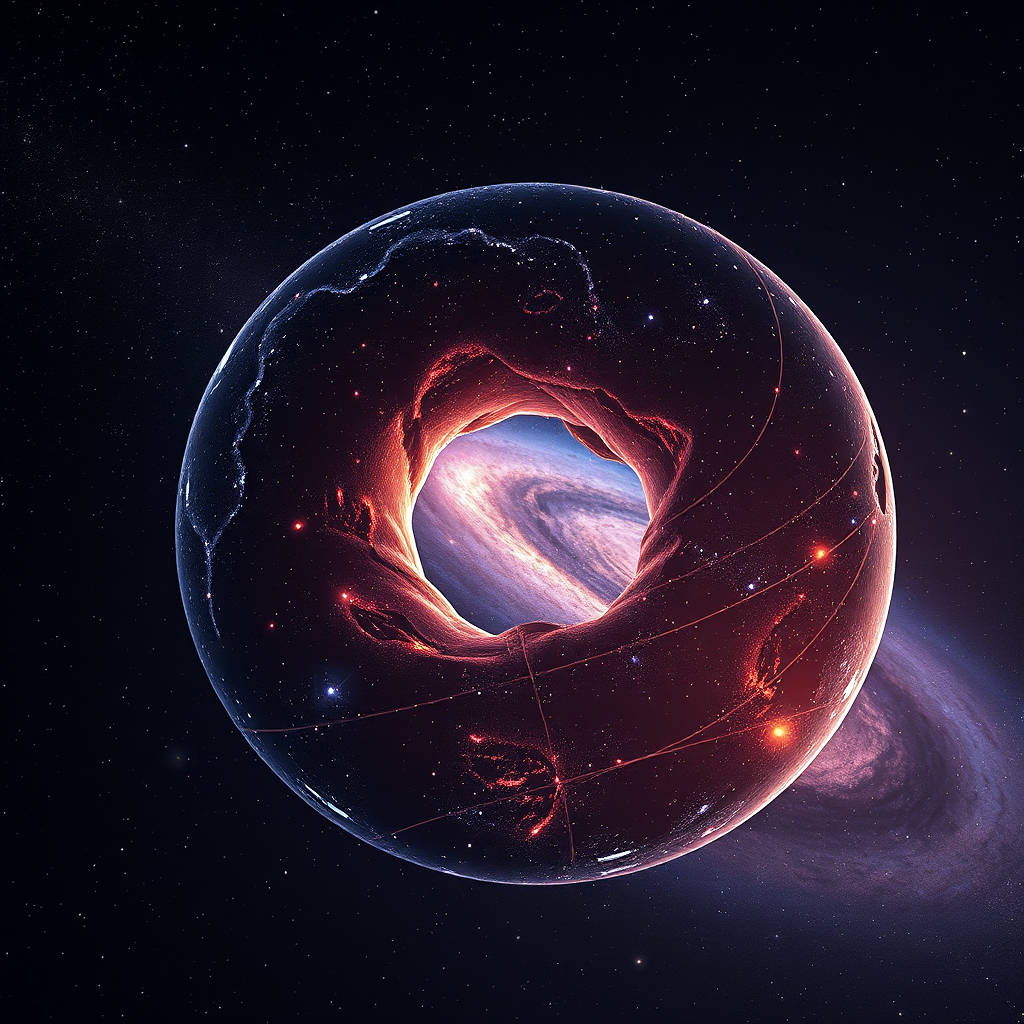
AI-generated image — a conceptual visualization
That's one option. It's not the only option.
Because flat doesn't mean infinite. Pac-Man's screen is flat and it's the size of a screen. You could have a flat universe that's the size of a galaxy, or the size of a billion galaxies, or the size of everything we've ever seen and a little bit more. The geometry tells you about angles and parallel lines. It does not tell you whether the thing wraps around.
That's a separate question. A completely separate question. And we keep forgetting to ask it.
Think about what this would mean. If our universe is a three-dimensional donut — a three-torus, if you want the technical name *4 — then somewhere out there, in some direction, there's a line you could fly along, and if you flew long enough, and nothing else changed, you would arrive back at Earth. From the other side. Like Pac-Man coming back around.
You wouldn't notice anything strange along the way. No wall. No edge. No moment where reality flickered and reset. Just stars, and more stars, and eventually a familiar-looking solar system with a familiar-looking blue planet, and a familiar-looking you, sitting in a kitchen, looking at a piece of paper.
Okay, not you. You'd be long dead. The trip would take longer than the universe has existed [3]. This is a thought experiment, not a travel plan.
But the geometry would allow it. The geometry might even require it.
And here is the part that I find genuinely disorienting, in a way I can't quite shake. When you look up at the night sky, you assume you are looking at different things in different directions. A star here, a galaxy there, each one a separate object sitting in its own separate spot. But in a donut universe, some of those points of light might be the same object, seen from different angles. The same galaxy, its light having traveled around the loop in two different directions, arriving at your eye as two different stars [4].
You'd be looking at one thing and seeing two.
Which raises a question I don't know how to stop asking: how would we ever tell?
So this is where it gets weird, and I want to walk you through it slowly because it took me a long time to understand why physicists were even allowed to suggest this.
Here's the standard story you've heard. The universe is flat. We measured it. Done.
And that's true. We did measure it. The Planck satellite, which spent years staring at the oldest light in existence, gave us a number: the universe is flat to within about 0.4%[1]. Which sounds definitive. Flat means infinite, right? An infinite sheet of paper, stretching forever?
No. And this is the thing nobody told you.
Flat is about curvature *1. Curvature is local. It's what you measure when you draw a triangle and add up the angles. On a flat surface, they add to 180 degrees. On a sphere, more. On a saddle, less. That's it. That's what "flat" means in cosmology. It's a statement about the geometry right here, right now, in the patch we can see.
It says nothing about the shape of the whole thing.
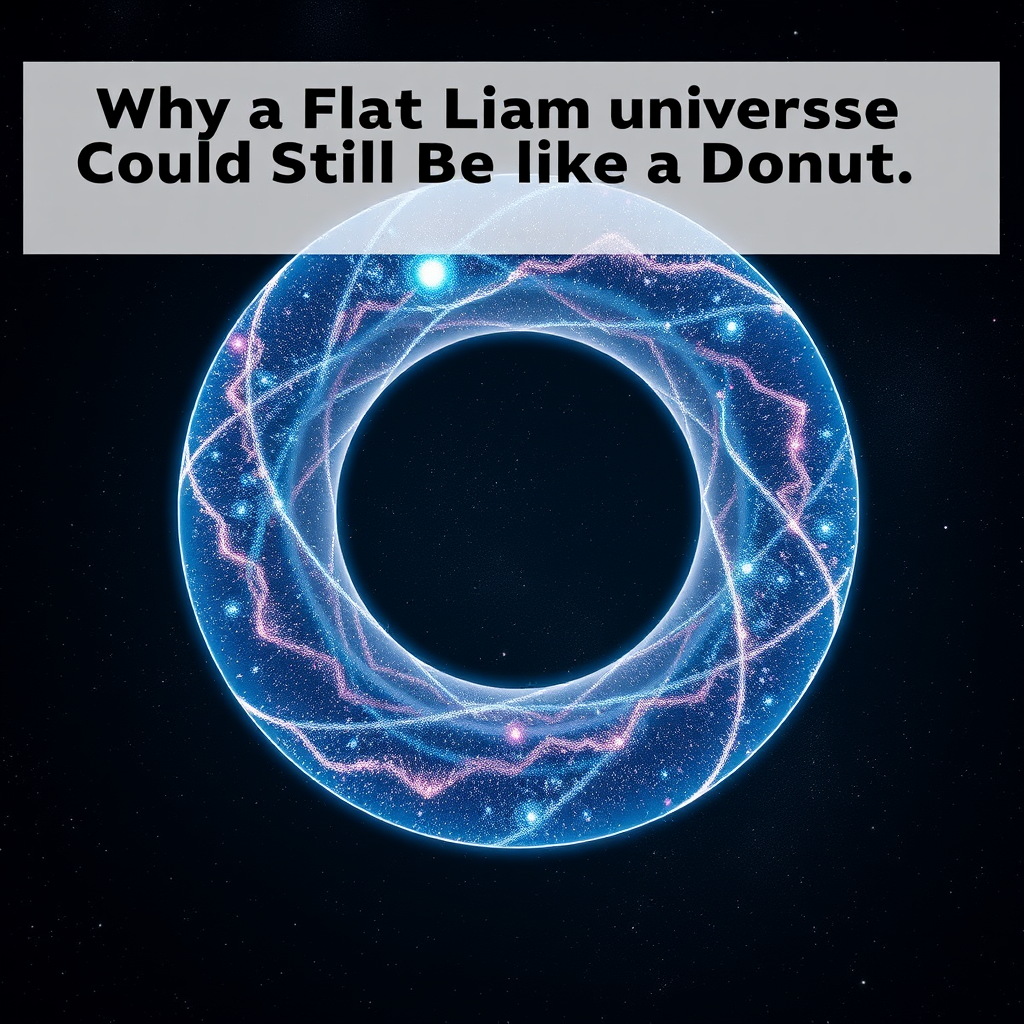
AI-generated image — a conceptual visualization
This is the part that broke me when I first heard it. A cylinder is flat. Take a piece of paper, roll it into a tube — you didn't stretch it, you didn't tear it, the triangles you drew on it still add up to 180 degrees. An ant living on the surface of that cylinder, doing geometry, would conclude: flat. And the ant would be right. But the ant would also be wrong about the universe being infinite, because if it walked far enough in one direction, it would come back to where it started.
A donut — a torus, mathematicians call it *2 — is the same trick in two directions. Locally flat. Globally finite. Globally wrapped.
Now. The cosmologists who think about this stuff seriously have a name for these wrapped-up flat shapes. They call them "compact topologies" *3. There are exactly ten of them in three dimensions that are flat and finite[2]. Ten ways the universe could be shaped like a flat thing that closes back on itself. The simplest one — the one everyone reaches for first — is the 3-torus. A donut, but in three dimensions. Walk far enough in any direction and you come home.
In 2023, a team of cosmologists published a paper that made me sit up. The group calls itself COMPACT — Collaboration for Observations, Models and Predictions of Anomalies and Cosmic Topology — and one of the lead authors is Glenn Starkman at Case Western Reserve[3]. The paper's argument is direct: we have never actuallyruled out a finite, wrapped-up universe. Not even close. The assumption that the universe is infinite is just that — an assumption.
Yashar Akrami, another member of the collaboration, put it bluntly in an interview: "The standard model of cosmology assumes that the universe is infinite. But that's just a simplification. We don't really know."[4]
Think about that. The standard model — the one in every textbook, the one feeding into every prediction — assumes infinity not because we measured infinity, but because infinity is mathematically easier. It's the simplest thing that's consistent with the flatness we see. And in science, the simplest thing consistent with the data is usually the thing you go with. Until you check.
The COMPACT group is checking.
Here's how you'd check, in principle. If the universe wraps around, then light from a distant galaxy could reach you from two different directions. You'd see the same galaxy twice — once "directly," and once after the light went the long way around. Like standing in a hall of mirrors, except the mirrors are just the universe being shaped like a donut.
So people looked. In the early 2000s, a team led by Jean-Pierre Luminet, a French cosmologist with a real talent for making this stuff feel like poetry, searched the cosmic microwave background *4 for these repeated patterns. The cosmic microwave background — I should explain that, because I throw it around like everyone knows it — is the light left over from when the universe was about 380,000 years old. It's everywhere. It's the oldest thing you can see. And it carries a kind of fingerprint of the universe's shape, because the patterns frozen into it depend on how big the universe was when the light got loose.
Luminet's team found something strange. The largest patterns in the cosmic microwave background — the biggest temperature wiggles, the ones that should be loudest — were weirdly quiet[5]. As if the universe wasn't big enough to hold them. As if some of the lowest notes were missing because the instrument was too small to play them.
He proposed a specific shape to explain it. Not a donut, actually — a weirder one, called a Poincaré dodecahedral space. Imagine the universe as a soccer-ball shape where opposite faces are glued together. Walk through one pentagonal face and you come out the opposite one, slightly rotated. Luminet's paper, published in Nature in 2003, argued this shape fit the data better than infinite flat space[6].
The result was controversial. It still is. Other cosmologistslooked at the same data and said: maybe, maybe not. The missing big patterns could be a statistical fluke. We only have one universe to look at, one cosmic microwave background to measure, and when you're asking questions about the largest scales, you only get one sample. Statisticians call this cosmic variance *5. It means we will never have more data on the biggest scales than we already have. Ever.
That's a strange thought, by the way. There are questions about the universe that we have already gathered all the evidence for, and the evidence isn't enough, and there is no more coming. Not in a thousand years. Not in a million. The sky has shown us what it's going to show us.
Anyway. The hunt for repeated patterns continued. In 2004, a team led by Neil Cornish at Montana State used a different method — they looked for "matched circles" in the cosmic microwave background. The idea is elegant: if the universe wraps around, then the sphere of oldest light you're looking at intersects itself somewhere. And along that intersection, you'd see the same temperature pattern in two different rings of sky[7]. Like two photographs of the same fence taken from different angles — the fence looks the same in both pictures because it is the same fence.
They didn't find the rings. At least, not the obvious ones. Cornish's group concluded that if the universe is a 3-torus, it has to be bigger than about 24 billion light-years across[8]. Which is big, but — and this is the part nobody emphasizes enough — it's not that much bigger than the part we can see, which is about 93 billion light-years across in diameter. The donut, if it exists, could be only a little larger than our view of it. We could be living inside a finite universe whose far walls are just barely out of sight.
Or just barely in sight, and we haven't noticed.
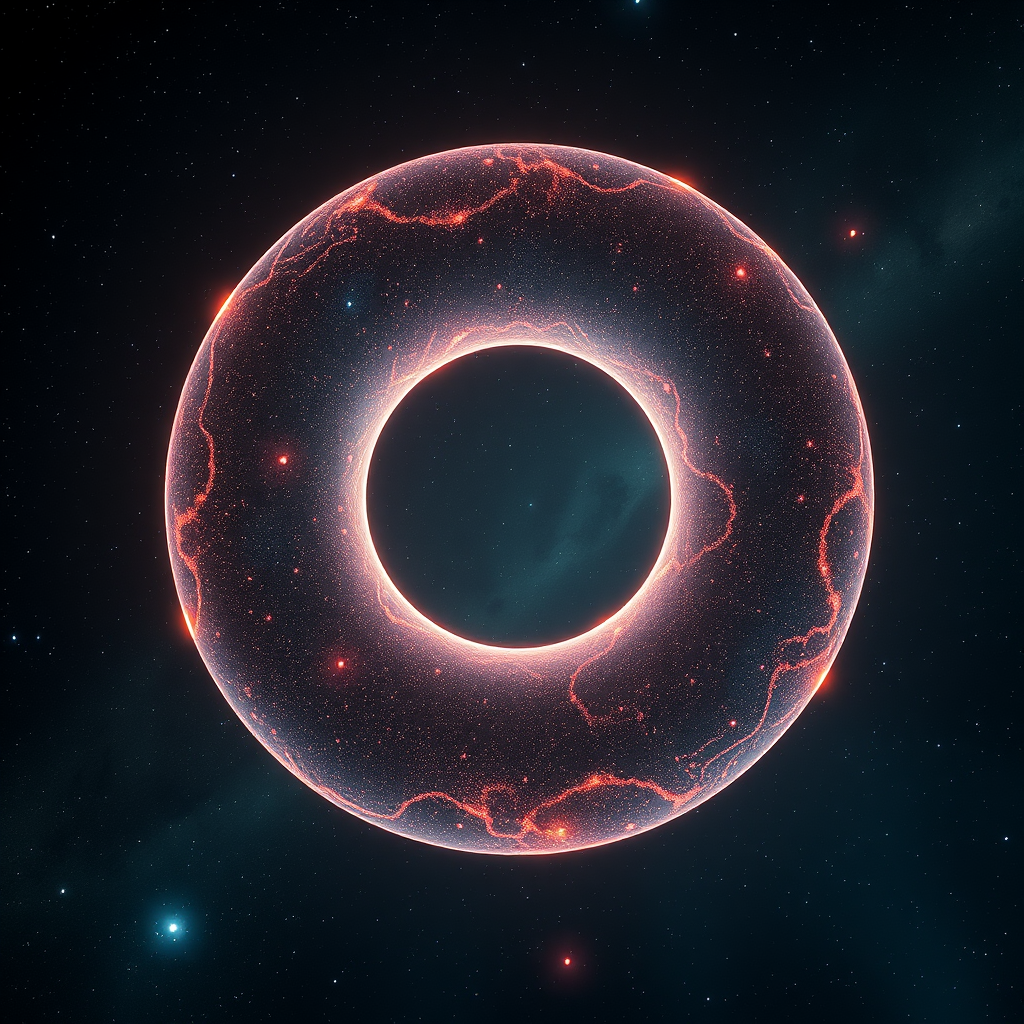
AI-generated image — a conceptual visualization
That's where the COMPACT collaboration comes in. Their argument is that the previous searches were too narrow. They looked for specific shapes — the most symmetric, simplest donuts — and the searches were designed in ways that could miss subtler topologies. The 2023 paper, with authors including Starkman, Akrami, and others from institutions across Europe and North America, argues that "non-trivial topology remains a viable possibility" and that current data does not rule out a wide range of compact shapes[9]. They're running new simulations, new searches, using better tools.
One of the things they point out is striking. The cosmic microwave background has some features — anomalies, cosmologists call them — that don't quite fit the standard infinite-universe
Here's the part nobody really tells you when they say "the universe is flat."
We don't know how big it is.
I mean we know how much of it we can see. The observable universe is about 93 billion light-years across[2]. That's the bubble of stuff whose light has had time to reach us since the Big Bang. Beyond that bubble? We have no information. Zero. Light from out there hasn't arrived yet, and if the universe keeps expanding the way it's expanding, it never will.
So when we measure the universe and say "flat," what we actually mean is: the part we can see looks flat. To within 0.4%. Which is a pretty good measurement of our patch.
But here's the thing about flatness. A donut*1 is flat too.
Not the donut you're picturing — not the squishy ring with sprinkles. Mathematicians have this concept of a flat torus, which is what you'd get if you took a sheet of paper and glued the top edge to the bottom and the left edge to the right, all without stretching anything[3]. Pac-Man's universe. Locally flat everywhere. Globally, it loops.
If you were an ant on that surface, every measurement you made would say "flat." Triangles would add up to 180 degrees. Parallel lines would stay parallel. You'd write papers about how obviously flat your world was. And you'd be right. And also, if you walked far enough in one direction, you'd come home.
So when cosmologists say the universe is flat, they have not ruled out the donut. They've ruled out the donut smaller than what we can see.
A team of cosmologists actually went looking for this. The idea is: if the universe wraps around and the loop is small enough to fit inside our observable bubble, we'd see the same galaxy in two different directions. Or we'd see matching patterns in the cosmic microwave background*2 — the leftover heat from the Big Bang — like wallpaper that repeats[4].
They looked. They didn't find it. Which means if the universe is a donut, the loop is bigger than 98% of the observable universe[4]. Or it could be infinite. Or the loop could be just slightly larger than what we can see, and we'd never know.
That's the honest answer. We can't tell the difference between "infinite and flat" and "finite and flat and wrapping around just outside our view." Both fit the data. Both are allowed. The universe could be a donut. It could be a three-dimensional Pac-Man screen. It could be something weirder, with more handles, more loops, shapesshapes that don't have names in any language because nobody has needed to name them yet.
And here's what gets me. This isn't a gap we're going to fill. It's not like dark matter, where maybe next year someone builds a better detector and we figure it out. The light from beyond our bubble is never coming. The expansion is making the bubble effectively smaller over time, not bigger[5]. If the loop of the universe is just slightly too big for us to see now, it will be more too big tomorrow. And more the day after.
We are running out of time to know the shape of the thing we live in.
That should bother you a little. It bothers me. Not in a sad way — in a strange way. We grew up assuming that with enough effort, enough telescopes, enough math, we'd eventually know everything about the universe we're in. And it turns out the universe itself has a privacy policy.
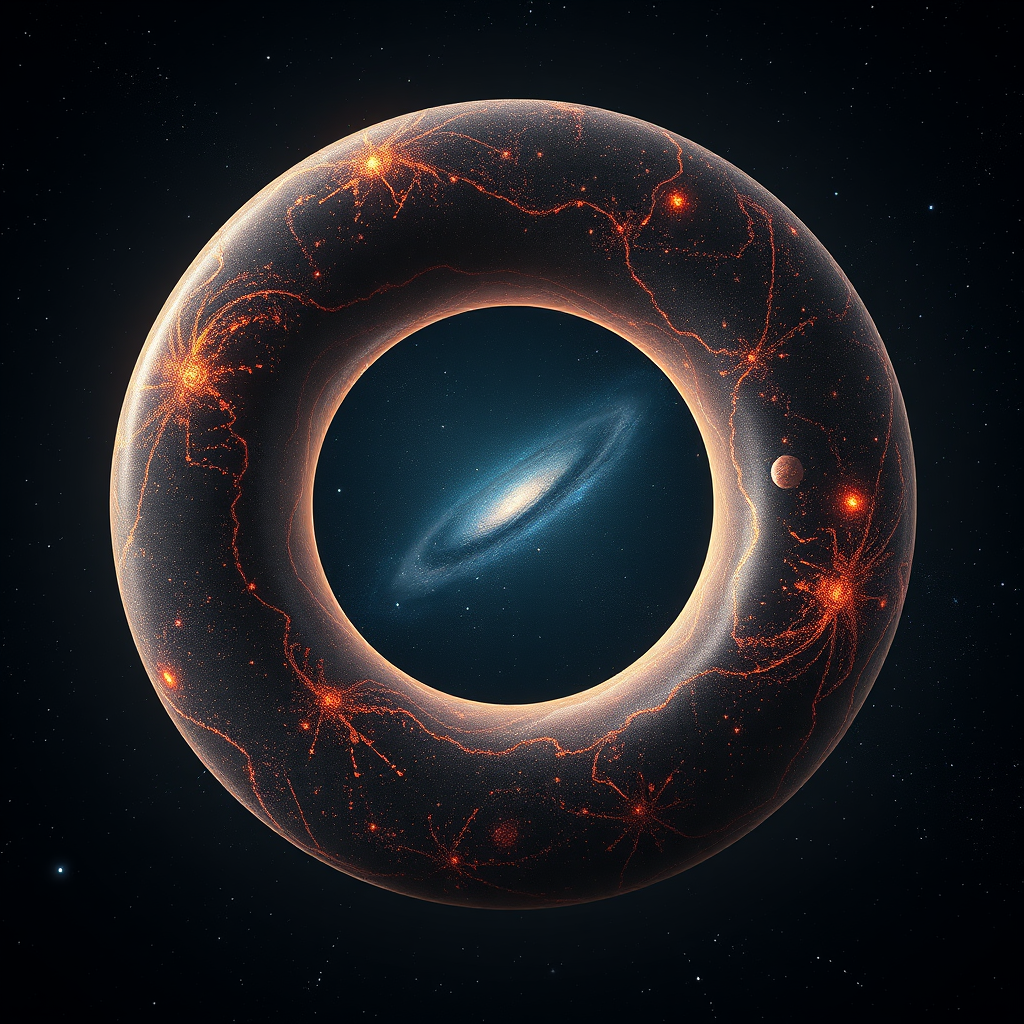
AI-generated image — a conceptual visualization
There are facts about our own home that are, in principle, off-limits. Not because we're not smart enough. Because the information physically cannot reach us.
So when someone tells you "the universe is flat," what they mean is something much smaller and much more honest than it sounds. They mean: the patch we can measure is flat. The rest is a shrug. The rest is a shape we are allowed to guess at but never confirm.
Which leaves us with a kind of cosmic Rorschach test. You can look at the data and see an infinite flat sheet stretching forever. Or you can look at the same data and see a donut so large its curvature is invisible to us, like how the Earth feels flat when you're standing on it because you're tiny and it's big.
Both pictures are allowed. Both are consistent with everything we've ever measured. The universe will not tell us which one is true.
And if you can't ever know whether your home is finite or infinite — if that question is permanently, structurally unanswerable — what does it even mean to say you live somewhere?
So here's where I've landed, sitting with this for weeks now.
The universe might be a donut. Or a flat infinite sheet. Or some weirder shape with more handles than I have words for[3]. We genuinely cannot tell from inside our 93-billion-light-year bubble. The math allows all of it. The data doesn't pick a winner.
And I keep coming back to this thing that bothers me, in a good way.
We talk about science like it's the business of answering questions. But the deeper you go, the more it becomes the business of finding better questions — questions you didn't know you were allowed to ask. "How big is flat?" is one of those. Nobody asks that in geometry class. Your teacher would look at you funny. But it turns out to be one of the most important questions you can ask about the thing you live inside of.
Here's what gets me. If the universe really does wrap around — if it's a donut, or a three-dimensional Pac-Man screen*1 — then somewhere out there, in a direction you could point to right now, there might be light that left our galaxy billions of years ago, traveled in a straight line, went all the way around, and is just now arriving back. A photograph of the Milky Way as a child. We just can't see it yet, because the universe is too big and the loop is too long[4]. Or maybe the loop isn't too long. Maybe we've already seen it and didn't recognize ourselves.
That's the thing about being inside something. You can't step out and look. You have to figure out the shape of your container from clues that leak through the walls.
Which brings me to where we're going next. Because if you want to know the shape of the universe, there's really only one place to look. Not the stars. Not the galaxies. Something older than both. The oldest light there is — light from when the universe was a baby, still glowing from the heat of its own birth. It's still here. It's all around you, right now, passing through your body as you read this.
And it remembers things we've forgotten.
So what is it trying to tell us?
TERMS EXPLAINED
- *1Curvature: How much a surface bends, measured from inside it. A flat surface has zero curvature — triangles drawn on it have angles that add up to exactly 180 degrees. A sphere has positive curvature; a saddle has negative.
- *2Shape (topology): The overall connectivity of a space — whether it has holes, loops, or edges. Two spaces can have identical curvature but completely different shapes, like a flat sheet and a flat donut.
SOURCES & REFERENCES
- [1]Planck Collaboration (2020). "Planck 2018 results. VI. Cosmological parameters." Astronomy & Astrophysics, 641, A6. — The universe's spatial curvature is measured to be consistent with flat, with uncertainty around 0.2%.
- [2]Fixsen, D. J. (2009). "The Temperature of the Cosmic Microwave Background." The Astrophysical Journal, 707, 916. — Precision measurements of the cosmic microwave background temperature to microkelvin sensitivity.
- [3]Weeks, J. (2001). "The Shape of Space." CRC Press. — Mathematical construction of the flat torus and how local flatness can coexist with global wraparound topology.
- [4]Cornish, N. J., Spergel, D. N., Starkman, G. D., & Komatsu, E. (2004). "Constraining the Topology of the Universe." Physical Review Letters, 92, 201302. — Search for matched circles in the CMB, ruling out small-scale topology below ~98% of the observable universe radius.
- [5]Krauss, L. M. & Scherrer, R. J. (2007). "The Return of a Static Universe and the End of Cosmology." General Relativity and Gravitation, 39, 1545–1550. — Accelerating expansion progressively removes distant regions from observability.
Inline citations [N] correspond to numbered references above.
A weekly journey from the present universe back to the Big Bang — and to what it means for us.
![[Deep Dive] Scale-free localization in pseudo-Hermitian quantum walk](/content/images/size/w600/2026/10/deep_dive_thumb-9.png)