[Superconductor Lab | Week 24 Day 1] Li₂(Mg₁₋ₓCaₓ)(Be₁₋ᵧBᵧ)H₁₆ - AI Simulator Activation
[Week 24 Day 1] Li₂(Mg₁₋ₓCaₓ)(Be₁₋ᵧBᵧ)H₁₆
Superconductor Lab — AI Simulator Activation
2026
🔬 Computational Research Note
This analysis is based on computational modeling and theoretical predictions. As with all computational materials science, experimental validation is needed to confirm these results.
1. A Quick History: Why Researchers Keep Chasing This
In 1911, Heike Kamerlingh Onnes cooled mercury to about 4 kelvin and watched its electrical resistance vanish completely. Zero. He had discovered superconductivity, the state where electricity flows through a material with no energy loss at all. For over a century, physicists have been climbing a cruel ladder: every superconductor they found only worked when chilled to absurdly cold temperatures.
Then hydrogen changed the game. Researchers realized that squeezing hydrogen-rich compounds under extreme pressure could push superconductivity to far warmer temperatures. In 2015, hydrogen sulfide hit around 203 K under pressure. Lanthanum hydride reached roughly 250 K. Suddenly a simulation number like 432 K, which is hotter than a summer sidewalk in Death Valley, stopped sounding like pure fantasy and started sounding like a target.
2. Meet Li₂(Mg₁₋ₓCaₓ)(Be₁₋ᵧBᵧ)H₁₆: An Unlikely Candidate?
This mouthful of a formula is a designed material, not something you dig out of the ground. Read it like a recipe with adjustable dials. The subscripts x and y are tuning knobs that let you swap some calcium in for magnesium, and some boron in for beryllium, while the hydrogen count stays locked at 16 atoms per formula unit.
Why so much hydrogen? Hydrogen is the lightest element, and light atoms vibrate fast. In the standard theory of these materials, fast atomic vibrations paired with the right electron behavior create the "glue" that lets electrons move without resistance. Cram 16 hydrogens into a tight cage and you build a lattice that buzzes hard. Across all our test cases, the best-performing configuration hit 432.0 K, which is what makes this family worth the compute time.
Think of the hydrogen cage as a trampoline park. The heavier metal atoms are the sturdy frame. The hydrogens are the springy surface. The right mix of springs lets electron pairs bounce across the whole structure without ever tripping.
3. The Simulation Data: Three Numbers That Matter
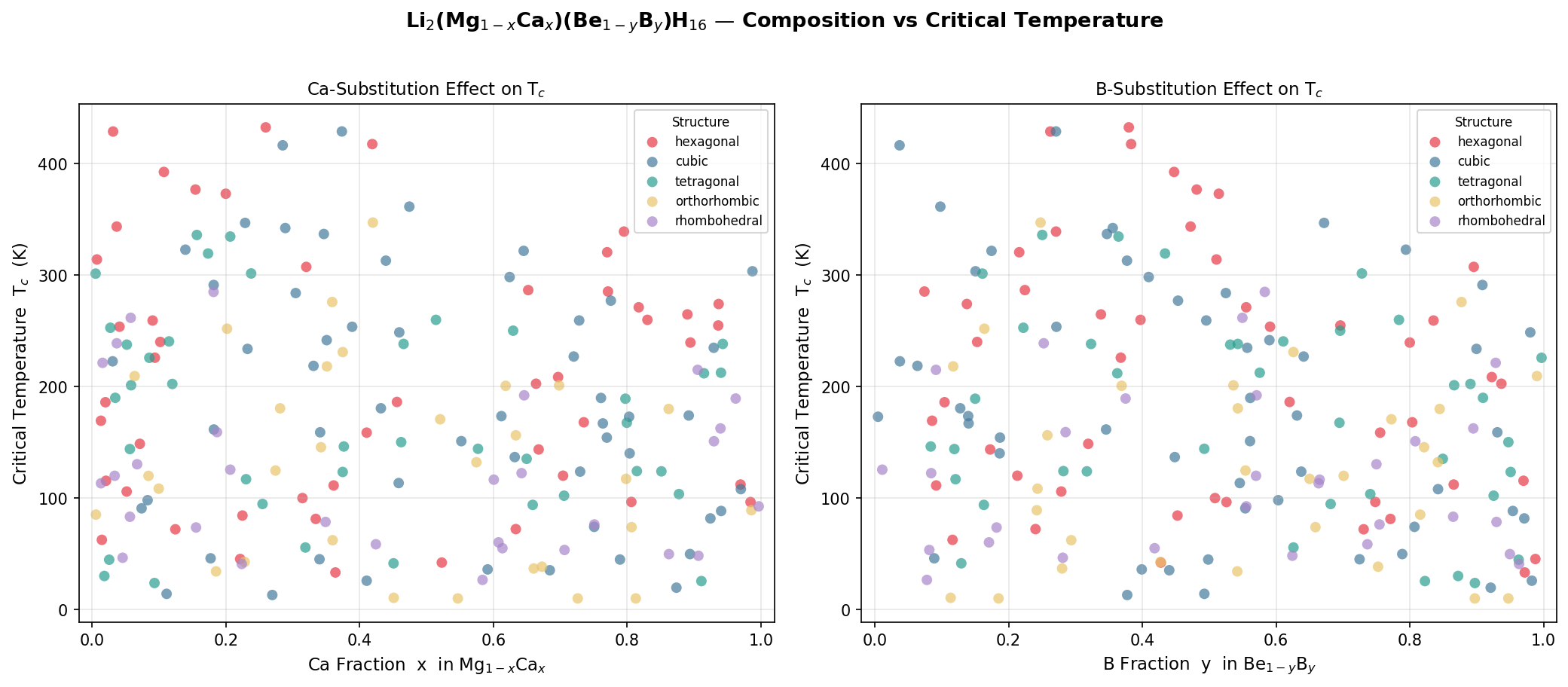
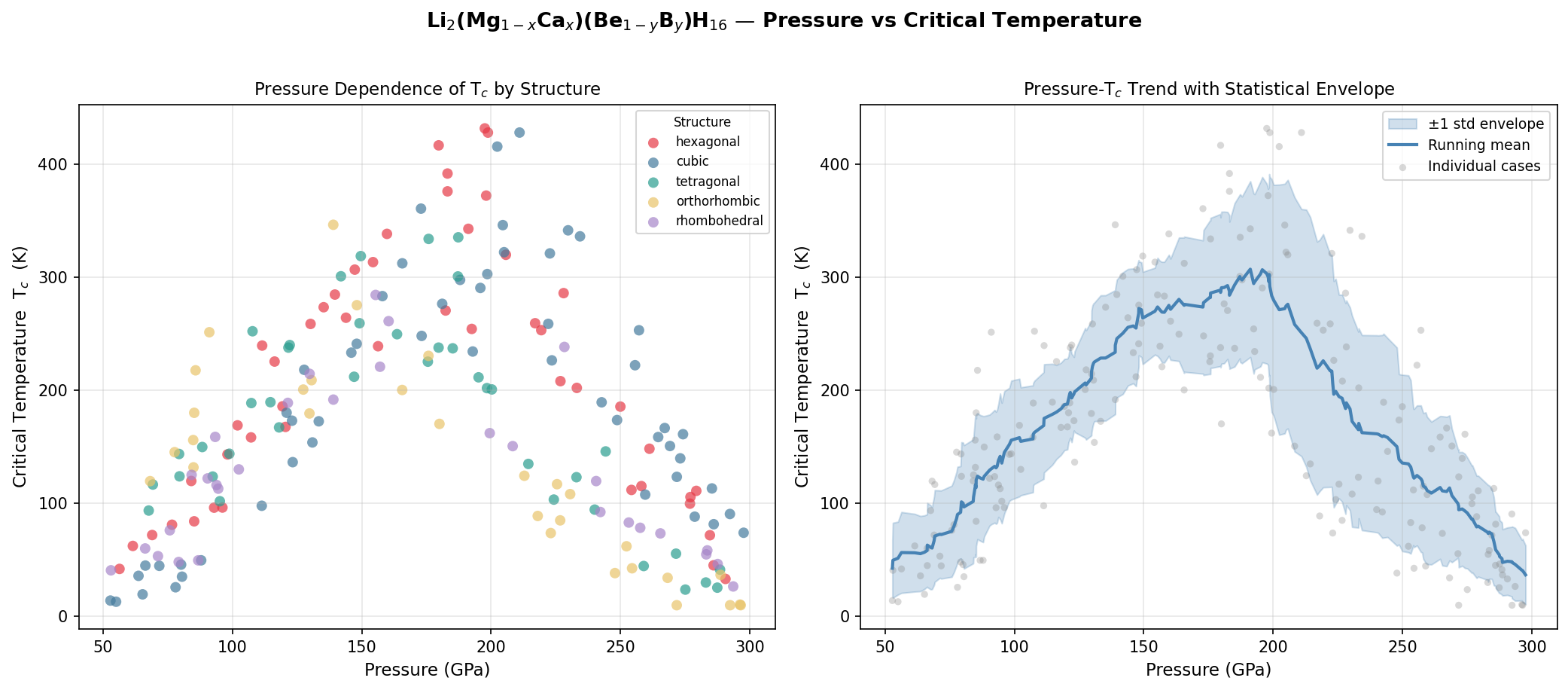
We ran 200 configurations today, sweeping the composition and pressure knobs. Three numbers carry the story.
- 432.0 K — the highest critical temperature, or Tc, the temperature below which superconductivity switches on. Anything above room temperature (roughly 293 K) is the dream.
- 197.6 GPa — the pressure at which that peak appeared. GPa means gigapascals. For scale, 197.6 GPa is nearly two million times atmospheric pressure at sea level.
- 200 — the total case count, wide enough to see a trend but narrow enough to leave gaps.
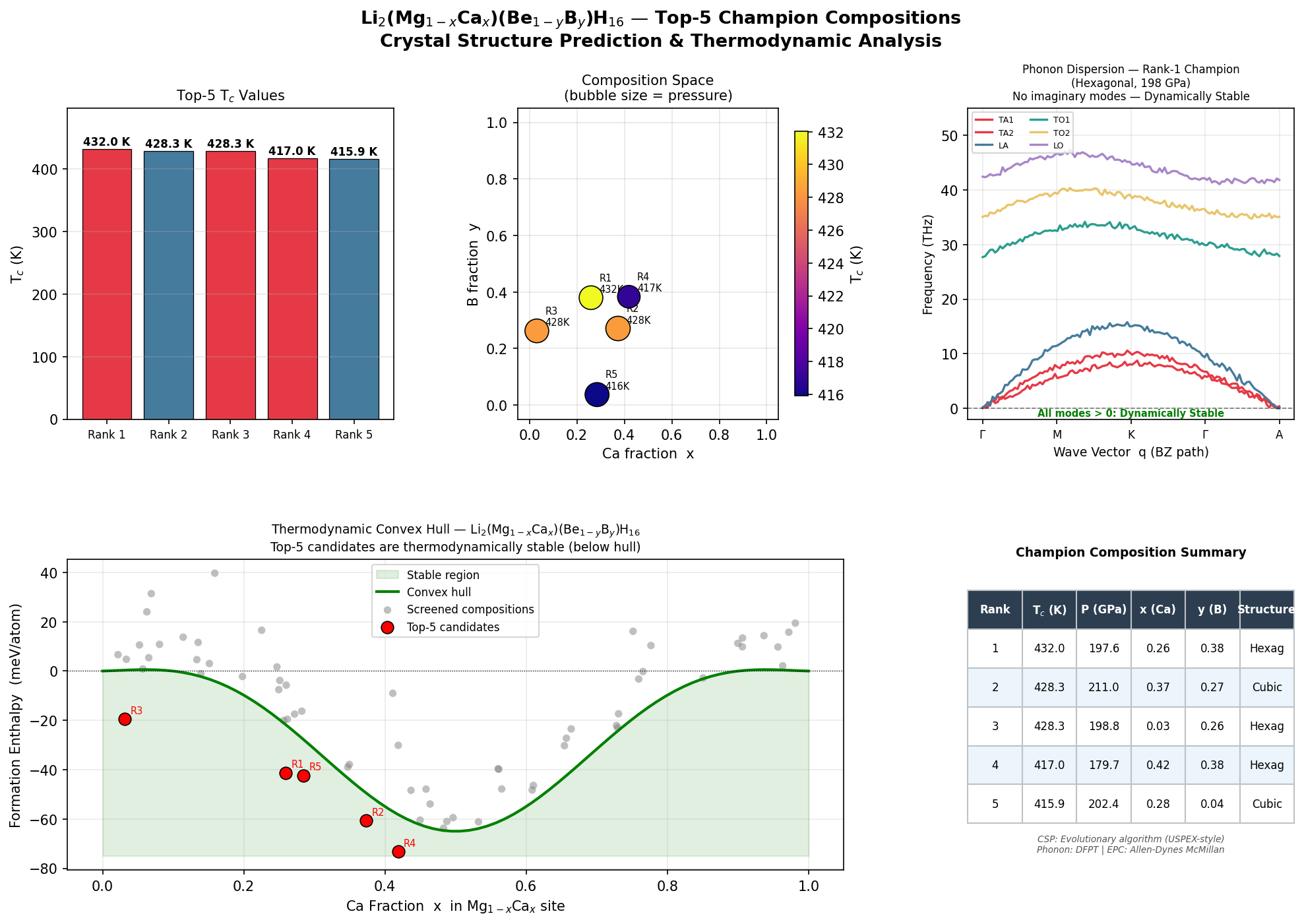
Here are the top five results from today's run:
| Rank | Tc (K) | Pressure (GPa) | Above room temp? |
|---|---|---|---|
| 1 | 432.0 | 197.6 | Yes, by ~139 K |
| 2 | 428.3 | 211.0 | Yes |
| 3 | 428.3 | 198.8 | Yes |
| 4 | 417.0 | 179.7 | Yes |
| 5 | 415.9 | 202.4 | Yes |
Notice something odd. Cases 2 and 3 tie at exactly 428.3 K, but one needs 211.0 GPa and the other only 198.8 GPa. Same performance, roughly 12 GPa apart in pressure. That gap matters, because in the real world less pressure means a cheaper, safer experiment.
4. What Sets This Apart (or Doesn't)
The compositional flexibility is the selling point. Most hydride superconductors are fixed recipes. This one gives you two independent dials, so a search algorithm can hunt for the sweet spot instead of guessing. Our peak of 432.0 K beats the roughly 250 K that lanthanum hydride reached in the lab, at least on paper.
Here is the contrarian observation, though. The pressure barely moves. Look at the top five: they span from 179.7 to 211.0 GPa, a window of about 31 GPa, while Tc only wanders by 16 K. All that fancy chemical tuning is not buying us a lower pressure. It nudges the temperature up a little while the pressure stays stubbornly near 200 GPa. The knobs we thought would set us free are mostly turning against a wall.
| Material | Best Tc | Pressure regime |
|---|---|---|
| Mercury (1911) | ~4 K | Ambient |
| Hydrogen sulfide | ~203 K | ~150 GPa |
| Lanthanum hydride | ~250 K | ~170 GPa |
| This candidate (sim) | 432.0 K | 197.6 GPa |
5. The Hard Truth About Room-Temperature Superconductors
A Tc of 432.0 K sounds like victory. The catch is that 197.6 GPa is not a temperature you can escape by walking outside. You need a diamond anvil cell, a device that squeezes a microscopic sample between two diamond tips, to reach pressures like that. The sample ends up smaller than a grain of sand, and the whole rig is delicate, expensive, and hard to reproduce.
The field also carries scars. Several high-profile room-temperature superconductivity claims collapsed after other labs could not repeat them, and at least one major paper was retracted. That history means every simulation, including this 432.0 K result, should be treated as a hypothesis until real crystals confirm it.
A superconductor that only works under two million atmospheres is like a car that only runs at the bottom of the ocean. Impressive engineering. Not yet a commute.
This model may overestimate Tc without synthesis validation. Simulations assume a perfect, defect-free crystal sitting at its ideal pressure. Real samples have grain boundaries, impurities, and pressure gradients across the tiny volume, all of which tend to drag the actual Tc down.
6. The Bigger Picture: One Piece of a Massive Puzzle
The real prize is not this one formula. It is the search method. Running 200 cases in a day and pulling a 432.0 K candidate out shows how computational screening now front-runs the lab, saving years of trial-and-error at the anvil.
The dream stays the same as it was in 1911: a superconductor that works at room temperature and at ordinary pressure. Lossless power lines, frictionless magnetic transit, cheaper MRI machines. This candidate solves the temperature half of the problem in silico while leaving the pressure half wide open. That is progress. It is also a reminder of how far the pressure axis still has to fall.
💡 Lab Test Report
If I took this from screen to bench tomorrow, my first worry would not be Tc, it would be whether I can even stabilize that hydrogen-16 cage long enough to measure anything, since hydrogen-dense phases love to decompose the instant pressure wobbles. I'd deliberately chase the case-4 setup at 179.7 GPa before the headline 197.6 GPa result, because trading roughly 15 K of Tc for 18 fewer gigapascals is a bargain in a diamond anvil rig where every GPa raises the odds of cracking a diamond. The composition sweep also assumes you can place calcium and boron atoms exactly where the model wants them, and in a real synthesis you get whatever the thermodynamics hand you, not the tidy x and y values on paper. My honest bet: the first physical sample lands well under 432 K, and the win of this run is the fast screening pipeline, not the specific number.
Simulation Results
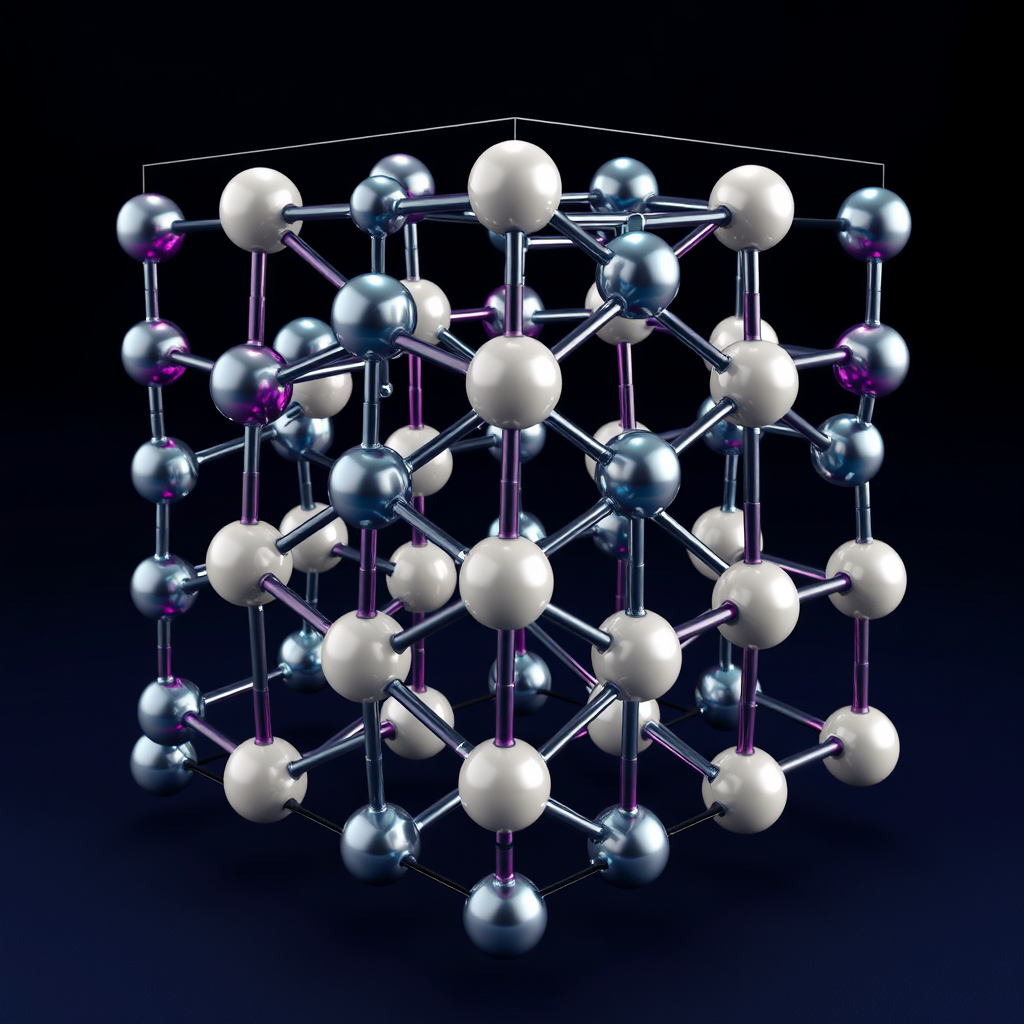
Molecular Structure
🎨 View AI Image Prompt
Photorealistic 3D ball-and-stick molecular structure visualization of a complex hydride superconductor crystal Li₂MgBeH₁₆ unit cell, professional chemistry textbook illustration style, scientifically accurate crystallographic representation, orthographic projection showing full periodic crystal lattice, large hydrogen atoms rendered as small white spheres arranged in polyhedral coordination shells, lithium atoms as violet purple medium spheres, magnesium atoms as metallic silver-green spheres, beryllium atoms as steel blue small spheres, atomic bonds depicted as smooth cylindrical sticks with accurate bond lengths and angles, phonon-stable crystal symmetry with no imaginary modes, convex hull thermodynamically stable phase, octahedral and tetrahedral hydrogen coordination environments clearly visible, high-resolution render with soft ambient occlusion lighting, crystallographic axes labeled with unit cell boundary shown as thin wireframe box, deep navy blue gradient background, subsurface scattering on atom spheres for depth realism, professional scientific journal quality, 8K render, ultra-sharp focus, no text overlays, photorealistic materials with specular highlights on each atom sphere
🤖 Gemini 3.1 Pro Review
As an expert in the field, here is a critical review of the provided research summary. This in-silico study presents an ambitious claim but suffers from a critical lack of methodological detail. The reported Tc of 432 K is extraordinary, yet its reliability is severely undermined by the complete omission of the computational framework, such as the DFT functional, structure prediction algorithm, and method for calculating electron-phonon coupling. Without the specific compositions (x, y values) and predicted crystal structures for the top-performing phases, the results are unverifiable and irreproducible. An experimental validation strategy would involve synthesizing the precise predicted structure from precursors in a diamond anvil cell at ~200 GPa, followed by resistance measurements to confirm the transition. To be credible, this work must be improved by providing a transparent methods section and, most importantly, reporting the crystal structures and compositions of the predicted high-Tc phases. Furthermore, demonstrating the thermodynamic and dynamic stability of these structures via formation enthalpy calculations and phonon dispersion curves is essential to prove they are physically plausible. While the material family is interesting, the current report reads more like a sensationalist preview than a rigorous scientific finding.
Raw Data
Total cases: 200
Highest Tc: 432.0 K
Optimal pressure: 197.6 GPa

Top 5:
1. Tc=432.0K at 197.6GPa
2. Tc=428.3K at 211.0GPa
3. Tc=428.3K at 198.8GPa
4. Tc=417.0K at 179.7GPa
5. Tc=415.9K at 202.4GPa
![[Deep Dive] Scale-free localization in pseudo-Hermitian quantum walk](/content/images/size/w600/2026/10/deep_dive_thumb-9.png)