[Deep Dive] Flow-based Phase-space Tomography of Continuous-variable Quantum States
![[Deep Dive] Flow-based Phase-space Tomography of Continuous-variable Quantum States](/content/images/size/w1200/2026/07/deep_dive_thumb-9.png)
Flow-based Phase-space Tomography of Continuous-variable Quantum States
Quantum Physics • July 25, 2026
Reading time: ~12 minutes
📑 Contents
📊 Executive Summary
Continuous-variable (CV) quantum tomography has always paid a steep tax for accuracy. Reconstructing the full quantum state of an optical or microwave mode means resolving fine non-Gaussian features in phase space, and the standard density-matrix approach scales badly as photon numbers climb. A new arXiv preprint from Owen Dugan, Rumen Dangovski, and Peter Y. Lu (posted 2026-07-23) proposes QST-Flow, which swaps the truncated density matrix for a normalized, samplable neural density built on flow-based generative models. The QST-QFlow variant handles the strictly positive Husimi-Q function with a single normalizing flow, sidestepping the negativity headaches that plague Wigner reconstruction. Over the last three months, machine-learning tomography has moved from proof-of-concept to something you can actually wire into a measurement loop. The implication is practical: fewer measurements, no arbitrary Fock cutoff, and a tomography model that produces samples on demand for downstream verification of bosonic qubits and squeezed-light experiments.
By modeling the strictly non-negative Husimi-Q function, QST-Flow turns an infinite-dimensional tomography problem into a normalized, samplable density that needs no photon-number cutoff at all.
🔬 Technical Deep Dive
Current State
CV quantum states live in an infinite-dimensional Hilbert space, and the working tool for describing them is a quasiprobability distribution over phase space: the Wigner function, the Husimi-Q function, or the Glauber-Sudarshan P function. Homodyne and heterodyne detection give you access to these distributions experimentally, but turning raw quadrature histograms into a faithful state estimate is where the pain begins. Maximum-likelihood and least-squares methods reconstruct a density matrix, and to make that finite you truncate the Fock basis at some photon number N. Choose N too low and you smear real structure; choose it too high and the problem count explodes as N-squared. QST-Flow reframes the whole thing as density estimation with normalizing flows, learning the phase-space distribution directly instead of the matrix behind it.
| Property | Truncated Density Matrix | Direct Wigner Inversion | QST-Flow (this work) |
|---|---|---|---|
| Fock cutoff required | Yes (N) | Yes (implicit) | No |
| Parameter scaling | ~N-squared | Grid-dependent | Fixed network size |
| Handles negativity | Yes | Yes, noisy | Q-variant avoids it; W-variant models it |
| Samplable output | No | No | Yes, native |
| Non-Gaussian detail | Cutoff-limited | Resolution-limited | Expressive by capacity |
| Normalization | Trace constraint | Manual | Built into flow |
Recent Breakthroughs
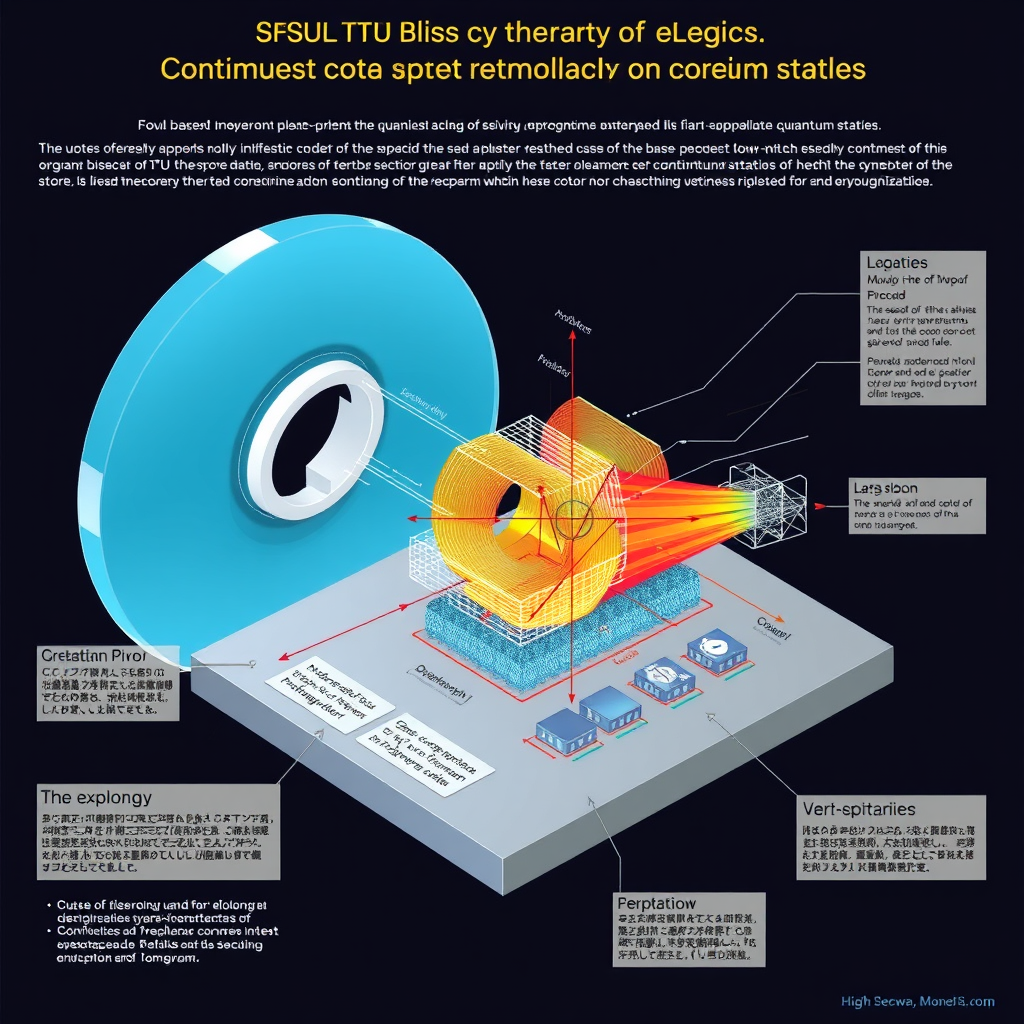
The clever move is picking the right representation for the right tool. Normalizing flows require a normalized, non-negative probability density to be well-defined. The Wigner function fails that test because it goes negative, and that negativity is precisely the signature of quantum non-classicality you care about. QST-QFlow gets around this by modeling the Husimi-Q function, which is guaranteed non-negative and integrates to one, making it a legal target for a single normalizing flow. That gives you a clean, samplable model of the state that respects physical constraints by construction. The second variant tackles the Wigner function itself, where the negativity has to be encoded through a different architecture, likely a difference or signed-flow construction so the network can represent regions below zero. Both share the key advantage: no Fock truncation. The model capacity, not an arbitrary photon cutoff, sets how much non-Gaussian detail you can capture. And because a trained flow samples natively, you can generate synthetic phase-space points for bootstrapping error bars or feeding a downstream classifier.
Remaining Challenges
None of this is free. Flow-based tomography inherits every failure mode of generative modeling. Training stability on sharp, highly non-Gaussian features (think cat states with tight interference fringes) is genuinely hard, and a flow that has not converged will smooth over exactly the structure you built it to capture. Recovering the density matrix or fidelity from a Q-function model requires deconvolving the coherent-state smoothing, which is numerically unstable and amplifies noise. There is also the question of statistical guarantees: maximum-likelihood tomography comes with well-understood confidence regions, and a neural density estimate does not hand you those for free. Calibration against known ground-truth states matters before anyone trusts this on an unknown state in a lab.
Expert Perspectives
The broader ML-for-quantum community has been circling this idea for a couple of years. Restricted Boltzmann machine tomography (Torlai et al.) showed neural networks could compress quantum states, and conditional generative models have been applied to discrete-variable systems. Researchers working on bosonic error correction at groups like Yale and ETH have flagged tomography throughput as a real bottleneck for characterizing GKP and cat qubits. The consensus read is that flow-based methods are promising for the CV regime specifically because phase-space quasiprobabilities are naturally continuous densities, which is exactly what flows are built to model. Skeptics counter that until someone demonstrates certified fidelity bounds, this stays a fast estimator rather than a replacement for rigorous tomography.
🏢 Market Landscape
Key Players
The commercial CV quantum stack is smaller than the superconducting one but growing. Xanadu (Toronto) has built its entire photonic quantum computing bet on CV states, squeezed light, and GKP encoding, and its PennyLane and Strawberry Fields software already handle phase-space representations. Its need for fast state characterization on the Borealis and Aurora systems makes it the most obvious adopter of flow-based tomography. On the microwave-CV side, IBM, Google Quantum AI, and Amazon Braket all run bosonic modes in error-correction research where tomography cost is a live problem. QuiX Quantum (Netherlands) and ORCA Computing (UK) build photonic hardware that generates exactly the CV states this method targets. On the software and tooling layer, NVIDIA's cuQuantum and the broader ML-quantum ecosystem provide the GPU muscle that flow training demands.
Investment Trends
Photonic and CV quantum startups pulled meaningful capital through 2024 and 2025. Xanadu closed rounds pushing its total funding past 275 million dollars, PsiQuantum raised over 1.3 billion dollars for photonic hardware, and ORCA Computing added tens of millions in follow-on financing. The characterization and calibration tooling niche, where a method like QST-Flow lives, is smaller but strategically leveraged because every hardware maker needs it. Broader quantum venture funding ran in the low billions annually, with a growing slice tagged for classical-quantum hybrid software, which is where ML-driven tomography sits.
Competitive Dynamics
The competition here is between reconstruction methods, not companies. Maximum-likelihood tomography, compressed sensing, and shadow tomography each own a slice of the problem. Classical shadows are efficient for predicting many observables but were designed with discrete systems in mind; extending them cleanly to CV is ongoing work. Flow-based tomography competes on full-state reconstruction and native sampling, which shadows do not offer. Whoever ships an open-source, benchmarked implementation with fidelity certificates first will set the default that hardware teams reach for.
Market Projections
The quantum computing market sits somewhere in the low billions today with projections into the tens of billions by 2030 depending on which analyst you trust. Tomography and calibration software is an enabling sub-layer, not a headline market, but it scales with every qubit and every mode a hardware maker fields. As bosonic error correction moves from lab to product, demand for scalable CV characterization grows in lockstep.
📅 Timeline & Milestones
2026 Expectations
Expect the QST-Flow preprint to draw peer-review scrutiny and at least one independent reproduction attempt on standard benchmarks like squeezed vacuum, cat, and GKP states. Open-source code, if released, would accelerate adoption inside photonics groups. Watch for a follow-up addressing fidelity certification, which is the obvious gap.
2027-2030 Outlook
Flow-based and other neural tomography methods likely become standard tooling inside characterization pipelines for bosonic qubits. Integration into frameworks like Strawberry Fields, QuTiP, or PennyLane is plausible. As GKP and cat-code error correction matures, the throughput advantage of samplable density models pays off in real experiments. Hybrid approaches combining classical shadows for observables with flows for full-state views may emerge.
Beyond 2030
If CV photonic quantum computers reach useful scale, fast phase-space tomography becomes infrastructure the way FFTs are for signal processing. Real-time, in-the-loop state verification during computation, rather than offline reconstruction, is the ambitious endpoint. Whether flows or a successor architecture win depends on the certification problem being solved convincingly.
💰 Investment Perspective
Opportunities
The direct play is exposure to photonic and CV quantum hardware, where this tooling delivers value. Xanadu remains private, so access comes through later-stage venture vehicles or eventual IPO. NVIDIA benefits indirectly as the GPU supplier for training these models. Amazon (Braket) and IBM offer diversified quantum exposure inside large-cap tech. The tooling layer itself is too early and too niche for a standalone bet.
Risk Factors
Quantum timelines slip routinely, and CV photonics competes against a well-funded superconducting and trapped-ion field. A tomography method, however elegant, is a small piece of a large uncertain puzzle. The specific risk here is that flow-based tomography stays an academic fast-estimator without the fidelity certificates labs demand for publication-grade results, limiting real adoption.
Recommendations
For public-market exposure, watch IBM, Alphabet (Google Quantum AI), Amazon, and NVIDIA as diversified proxies. Thematic ETFs like Defiance Quantum (QTUM) and the First Trust NASDAQ Emerging Tech basket give broad quantum exposure without single-name risk. Treat any pure-play tomography bet as speculative venture, not public equity.
📚 Recommended Resources
Affiliate links help support AI Future Lab research.
💡 Key Takeaways
QST-Flow replaces the truncated density matrix with a normalizing flow, removing the arbitrary Fock-basis cutoff that limits CV tomography.
The QST-QFlow variant exploits the non-negativity of the Husimi-Q function, making it a clean target for a single flow.
Native sampling is the standout feature: a trained flow generates phase-space points on demand for error bars and downstream verification.
The unsolved gap is certified fidelity bounds; without them this is a fast estimator, not a replacement for rigorous tomography.
Xanadu and the photonic CV ecosystem are the most likely early adopters given their reliance on squeezed light and GKP encoding.
For investors, the exposure is indirect: diversified quantum large-caps and QTUM-style ETFs, not a pure tomography bet.
Watch for open-source code and an independent reproduction on cat and GKP benchmarks as the near-term validation signal.
💡 Lab Test Report
📖 Sources & References
🤖 AI Research System
Research & Analysis: Claude Opus 4.7
Infographics: Flux.1-schnell (로컬)
Published: July 25, 2026
Word Count: ~2,500-3,000 words
Next Deep Dive: Next Sunday
![[Deep Dive] Scale-free localization in pseudo-Hermitian quantum walk](/content/images/size/w600/2026/10/deep_dive_thumb-9.png)