Are We Living Inside a Black Hole?
Episode 5: Black Holes Are Also Donuts
I like science that leaves room to imagine. When things that seemed unrelated turn out to share a hidden pattern — that moment feels like finding one of the world's secrets. Which opens a door I didn't know was there. Which leads somewhere unexpected. Which eventually leads back to me.
Have you ever woken up in a dark room you didn't recognize? A hotel. A friend's couch. For a second you have no idea where the walls are. You lie still. You listen. You try to work out the shape of the space around you without seeing any of it.
Most people solve this by turning on the light. Astronomers don't have a switch.
That's roughly the situation of everyone who has ever lived. We can see about 46 billion light-years*1 in every direction [1]. Beyond that, light simply hasn't had time to reach us. The universe is about 13..8 billion years old [2]. So how do we see 46 billion light-years away? Space kept stretching while the light was on its way to us [1]. The room got bigger while we were asleep.
So you live inside a bubble.Everything inside it, you can at least in principle know. Everything outside it is silent. Not hidden, exactly. Just out of reach, no matter how long you wait. The expansion of the universe is speeding up [3]. That means some galaxies we see today will slip past the edge and never send us another photon*2 [4]. Their old light keeps arriving anyway, like letters from someone who already moved away.
Here's the part that kept me up. There is another kind of place in nature with almost the same property. A boundary you can sit behind. A boundary that lets nothing out. Physicists have known about it for about a century [5], and they usually describe it from the outside, looking in.
But what would it look like from the inside, looking out?
Maybe something like a dark room. Walls you can't find. Light that only travels one way. And a lingering suspicion that the shape of the space around you is not what you assumed.
So lie still for a moment. Listen. If you woke up inside something enormous, how would you ever know?
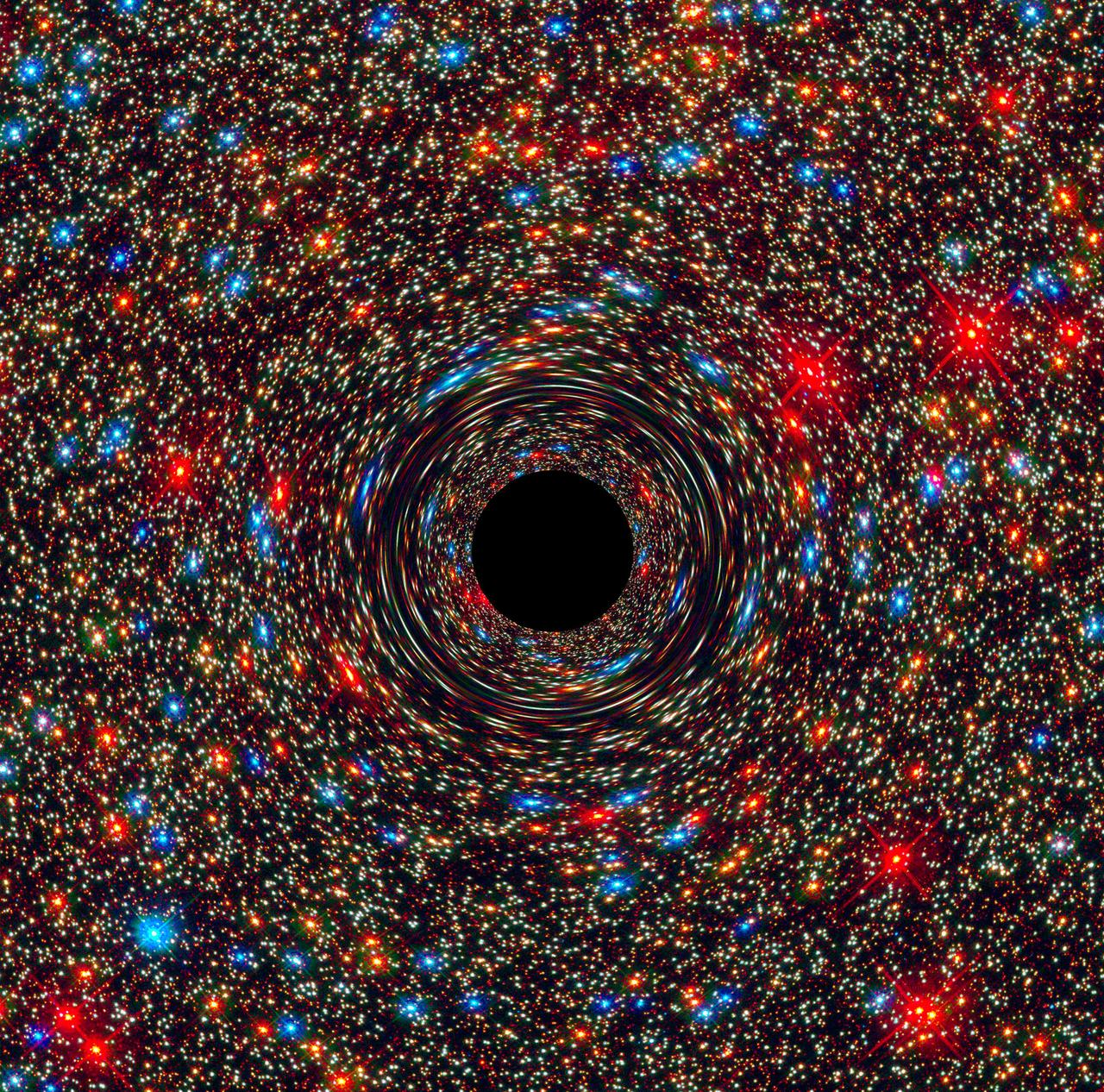
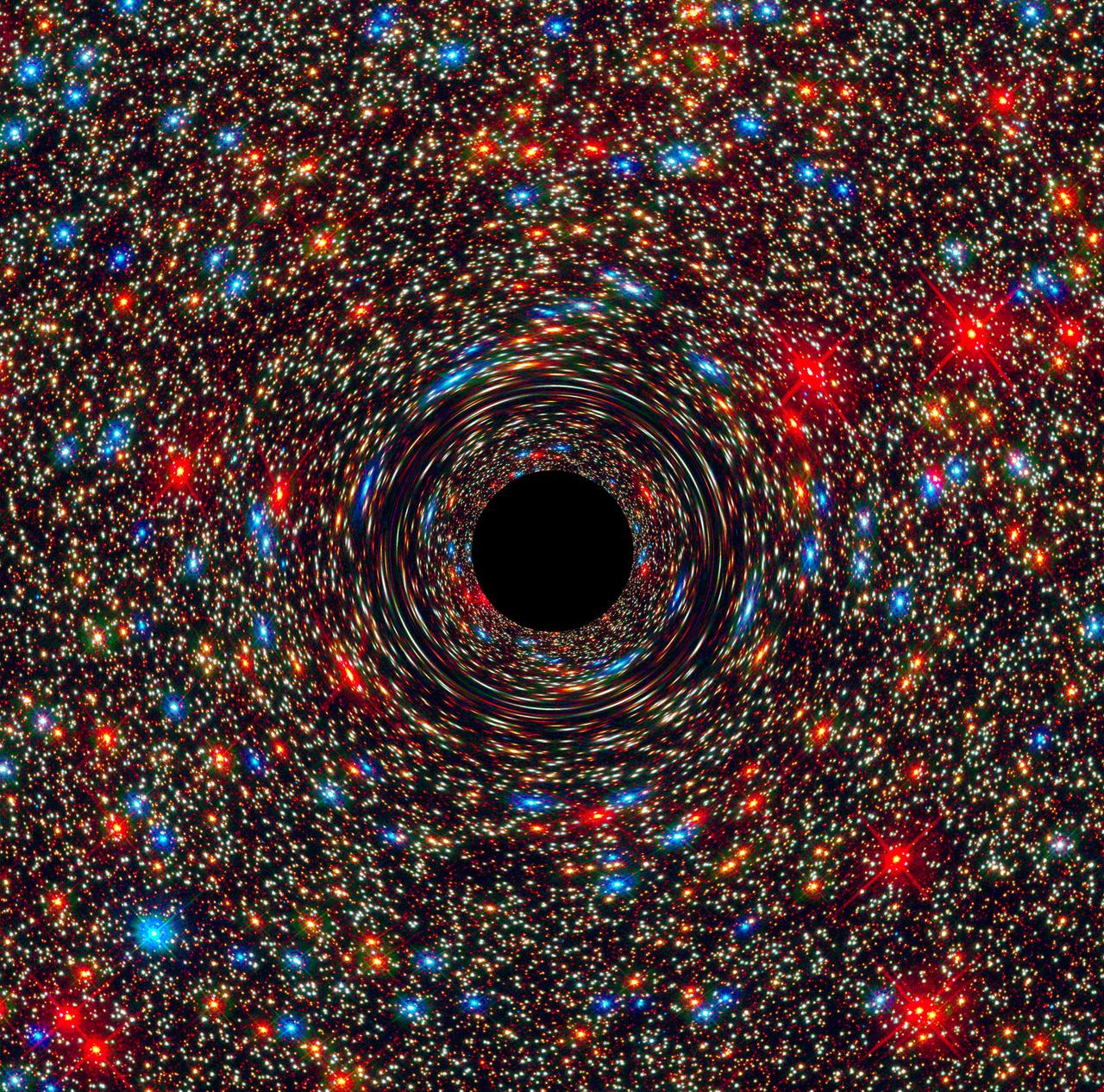
📷 Behemoth Black Hole Found in an Unlikely Place — GSFC (NASA Image and Video Library, Public Domain)
Pac-Man Lives on a Donut
Remember Pac-Man? He runs off the left edge of the screen and pops out on the right. Off the top, back in at the bottom. To him the maze has no edge. But it isn't infinite either. Roll that screen up, glue left to right and top to bottom, and you get a donut. Mathematicians call this shape a torus*2. Pac-Man spent his whole career on the surface of a pastry and never noticed.
That is one possible shape for our universe. Finite, but with no edge. Fly far enough in a straight line and you come home from behind. Astronomers have searched for this. They looked for repeating patterns in the cosmic microwave background*3, the oldest light there is. A donut universe would show the same patch of sky twice, in two different places. They haven't found it [3]. If we live on a donut, it's bigger than everything we can see.
Now the strange part. Black holes have donuts inside them too. Almost everything in space spins. In 1963 Roy Kerr worked out what happens when a black hole spins [2]. The center isn't a point anymore. It's a ring. The singularity*4, the place where our math gives up, gets stretched into a loop.
Why should you care? Because some physicists think our whole universe began inside a spinning black hole in someone else's universe. Nikodem Popławski tweaked Einstein's equations to account for the tiny spin of particles [5]. In his version, matter falling into a black hole doesn't crush down to nothing. It bounces. From the inside, that bounce could look exactly like a Big Bang. There's also an odd coincidence. Take all the mass in the observable universe and ask how big a black hole it would make. The answer is roughly the size of the observable universe [4]. It could be chance. Physicists trust coincidences about as much as they trust decaf.
One more crumb. In 2025, Lior Shamir studied 263 distant galaxies seen by the James Webb telescope. About two-thirds appeared to spin the same way [6]. A universe born from a spinning parent might inherit a preferred direction. Or the result might come from how we measure. Nobody knows yet.
Here's what stays with me. Pac-Man can't see the donut. He only notices that he keeeps running into the same ghosts. That's the clue. You can't see the shape you live in either. Maybe it's a donut. Maybe it's the inside of something spinning, somewhere else, in a place you'll never visit. The only way to know is to look for things that come back around.
So if you could fly far enough, past every galaxy and every edge of the light, what would you hope to find waiting for you?
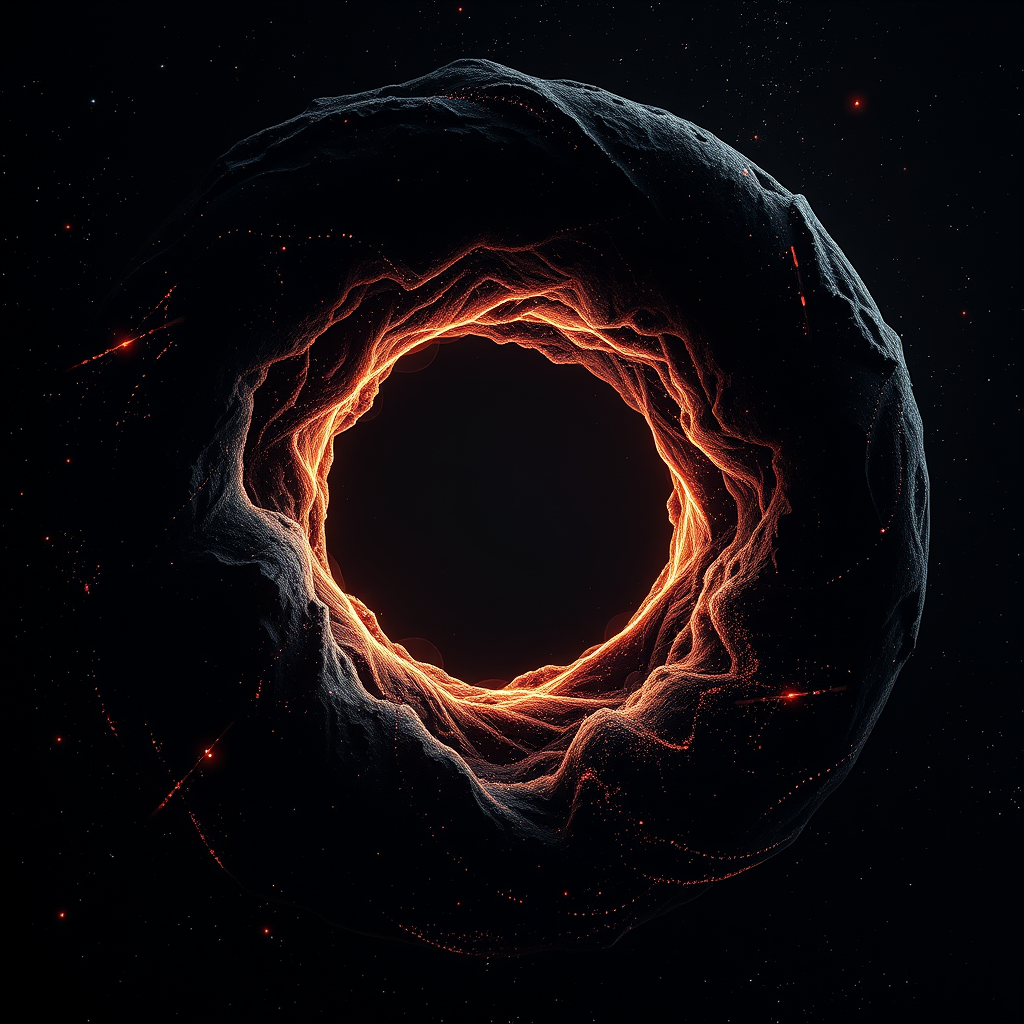
AI-generated image — a conceptual visualization
The Ring Hiding Inside Every Spinning Black Hole
Here's the number that made me put my coffee down.
Take all the matter in the observable universe. Every star, every gas cloud, every cat. Now ask: how small would you have to squeeze it before nothing could escape, not even light? That size has a name. The Schwarzschild radius*3 [2]. It's the line you cross when something becomes a black hole.
Do the math for a universe like ours and something strange happens. For a flat universe expanding at the rate we measure, the escape boundary for everything inside the Hubble radius*4 lands almost exactly on the Hubble radius itself [3]. The density and the size of our universe fit the black hole formula like a key in a lock.
People noticed. In 1972 an Indian physicist named Raj Kumar Pathria published a short paper in Nature with a blunt title: "The Universe as a Black Hole" [4]. His idea was simple. Maybe we aren't looking at a black hole from the outside. Maybe we're in one.
Now the honest part. Most cosmologists aren't convinced, and for good reasons. That neat match isn't a cosmic wink. It falls straight out of the equations that describe expansion [3]. And a normal black hole has a center and an outside. Our universe, as far as anyone can tell, has neither. Every direction looks roughly the same [10]. So it's the same equation telling two very different stories. A coincidence of arithmetic is not evidence. But it's the kind of coincidence that makes you keep checking under the bed.
Then, in 2010, Nikodem Popławski at the University of New Haven made the idea harder to dismiss [5]. He used a slightly modified version of Einstein's gravity, one that includes something called torsion*5. In his math, matter falling into a black hole doesn't crush down to an infinitely small point. It gets squeezed until it can't be squeezed anymore, and then it bounces. That bounce blooms into a brand new expanding universe, connected to ours through an Einstein-Rosen bridge*6 [5]. From inside, Popławski argued, that bounce would look a lot like a Big Bang.
Lee Smolin took this somewhere wilder. In his book The Life of the Cosmos he proposed that universes reproduce through black holes, each baby universe inheriting slightly tweaked laws of physics from its parent [6]. Universes that are good at making black holes have more children. Over many generations, the cosmos fills up with black-hole-making universes. Like ours. Which makes reality less a clockwork and more a rabbit farm.
AI-generated image — a conceptual visualization
Here is where the donut comes back.
In 1963 a New Zealand mathematician named Roy Kerr solved Einstein's equations for a black hole that spins [7]. Real black holes almost certainly spin, because the stars that collapse into them spin. And Kerr's solution has a shocking feature. The singularity*7 at the center isn't a point at all. It's a ring [7][9].
Think about that for a second. Squeeze a spinning star to nothing, and nothing turns out to have a shape. A loop. A circle of infinite density with a hole through the middle. In Kerr's math, you could in principle fall through the hole in that ring without touching it and come out somewhere the equations can't fully describe [9]. Physicists argue about whether that region could exist in a real black hole. Most suspect it gets torn apart. But on paper, the deepest point of a spinning black hole has the same basic layout as the thing in the bakery window.
So the two halves of this episode are quietly holding hands. A universe that might be a donut. A black hole that hides a ring. And a few people who suspect the second gave birth to the first.
Here's why that matters for testing it. If our universe was born inside a spinning black hole, it might have inherited a direction. A preferred axis. Popławski suggested exactly this [5]. A universe made from a spinning parent might carry a faint memory of that spin.
And in 2025, Lior Shamir at Kansas State University looked at 263 distant galaxies photographed by the James Webb Space Telescope [8]. About two-thirds of them appeared to rotate in the same direction. If galaxies spun randomly, you'd expect roughly half and half. Shamir offered two possible explanations. One is that the universe was born spinning, which fits the black hole idea. The other is far more boring. Our own galaxy's motion might be subtly skewing how we measure everything else [8].
I'd bet on boring. Most astronomers would too. Strange results usually turn out to be measurement problems wearing a disguise. But the question is now something telescopes can test, and that's a big step up from a coincidence in a formula.
AI-generated image — a conceptual visualization
Here's what gets me. Everything you have ever touched would be inside the horizon. Your hands. Your house. The light from every star you've wished on. If Popławski is right, there's an outside. A parent universe where our entire cosmos is a dark, spinning dot that someone could, in principle, point a telescope at.
If somebody out there is looking at us right now, what do they see?
A two-step analogy for Smolin's cosmological natural selection: the same cosmic web shown as an inner universe and as part of a larger parent black hole. An illustration, not a prediction of nested space.
The Coincidence That Might Be Nothing
Here's the uncomfortable part. That number might mean nothing at all.
The match between our universe's size and its black-hole boundary isn't a lucky break. It falls straight out of the equations for any flat universe*4 [3]. Flat means the density is just right, and "just right" automatically produces that coincidence. It's a bit like discovering your house is exactly the size of your house. True. Not a clue.
And a real black hole sits inside space. It has an outside. Things fall into it. Our universe, as far as we can tell, has no outside, and everything in it is flying apart, not falling together. Some physicists have built models where a new universe blooms inside a black hole, born from a bounce at its center [4][5]. These are serious ideas. Nobody has found a way to test them.
The donut has the same problem. If space wraps around, we should see repeats: the same pattern in the cosmic microwave background*5 printed twice, on opposite sides of the sky. People have looked hard [6][7]. They found nothing. That doesn't kill the donut. It only means that if we live on one, it's at least about as big as everything we can see [7]. Maybe far bigger. A donut too large to ever spot the hole.
So we're back in the dark hotel room. We touched something. We can't tell if it's a wall or a chair.
AI-generated image — a conceptual visualization
Here's what gets me. You will live your whole life inside a shape nobody has confirmed. So will your grandchildren. The light that would settle it may never reach us. And still you get up, make coffee, and move through a room whose walls you've never seen.
What would actually change for you if you knew?
The Dark Room We Never Leave
So the light stays off. We still don't know the shape of the room we woke up in.
But some physicists flip the question. Maybe every black hole holds a fresh universe, bouncing into being on the far side of its collapse [4]. Lee Smolin went further. Universes might reproduce this way, passing their physical laws to their children like eye color [5]. Nobody has tested it. Nobody knows how yet.
Here's what keeps me up at night. Much of the oxygen you just breathed was forged in massive stars that exploded [6]. Some of those explosions leave black holes behind [7]. If Smolin is right, the same kind of death that built your body might also be how universes are born.
Every one of these ideas points backward. They lead to a moment when everything you can see was squeezed into almost nothing, a point where our equations break. Physicists call it a singularity*5. We call it the beginning. Next time, I want to check whether it deserves the name. If our universe began as someone else's ending, then what is every ending around you quietly beginning?
TERMS EXPLAINED
- *1Light-year: The distance light travels in one year. About ten trillion kilometers. It measures distance, not time.
- *2Photon: A single particle of light. The smallest possible packet of it.
- *3Cosmic microwave background: The faint glow left over from when the universe first became see-through, about 380,000 years after the Big Bang. It is the oldest light we can detect.
- *4Singularity: The spot at the center of a black hole where our equations predict infinite density. It really means our physics stops working there.
- *5Torsion: A twist in the fabric of space, added to Einstein's gravity. Ordinary gravity bends space. Torsion also lets it wring a little, like a towel.
- *6Einstein-Rosen bridge: A tunnel through space connecting two places, allowed by Einstein's equations. The popular name is a wormhole.
- *7Singularity: The point where the math breaks and predicts infinite density. Less a place than a sign saying "our theory stops working here."
SOURCES & REFERENCES
- [1]Davis, T. M. & Lineweaver, C. H. (2004). "Expanding Confusion: Common Misconceptions of Cosmological Horizons and the Superluminal Expansion of the Universe." Publications of the Astronomical Society of Australia. — The observable universe extends about 46 billion light-years because space expanded while light traveled.
- [2]Planck Collaboration (2020). "Planck 2018 results. VI. Cosmological parameters." Astronomy & Astrophysics. — The universe is about 13.8 billion years old.
- [3]Riess, A. G. et al. (1998). "Observational Evidence from Supernovae for an Accelerating Universe and a Cosmological Constant." The Astronomical Journal. — The expansion of the universe is accelerating.
- [4]Krauss, L. M. & Scherrer, R. J. (2007). "The Return of a Static Universe and the End of Cosmology." General Relativity and Gravitation. — Accelerating expansion will carry distant galaxies beyond our ability to receive new signals from them.
- [5]Schwarzschild, K. (1916). "Über das Gravitationsfeld eines Massenpunktes nach der Einsteinschen Theorie." Sitzungsberichte der Königlich Preussischen Akademie der Wissenschaften. — The first solution of Einstein's equations describing a boundary from which nothing escapes.
- [6]Shamir, L. (2025). "The distribution of galaxy rotation in JWST Advanced Deep Extragalactic Survey." Monthly Notices of the Royal Astronomical Society. Reports that about two-thirds of 263 distant galaxies appear to rotate in the same direction.
- [7]Kerr, R. P. (1963). "Gravitational Field of a Spinning Mass as an Example of Algebraically Special Metrics." Physical Review Letters 11, 237–238. — Exact solution for a rotating black hole, with a ring-shaped singularity.
- [8]Shamir, L. (2025). "The distribution of galaxy rotation in JWST Advanced Deep Extragalactic Survey." Monthly Notices of the Royal Astronomical Society 538, 76–91. — About two-thirds of 263 JADES galaxies rotate in the same direction, with two candidate explanations.
- [9]Visser, M. (2007). "The Kerr spacetime: A brief introduction." arXiv:0706.0622. — The ring singularity and the debated regions beyond it in the Kerr solution.
- [10]Planck Collaboration (2020). "Planck 2018 results. VII. Isotropy and Statistics of the CMB." Astronomy & Astrophysics 641, A7. — The universe looks statistically the same in every direction.
Inline citations [N] correspond to numbered references above.
A weekly journey from the present universe back to the Big Bang — and to what it means for us.