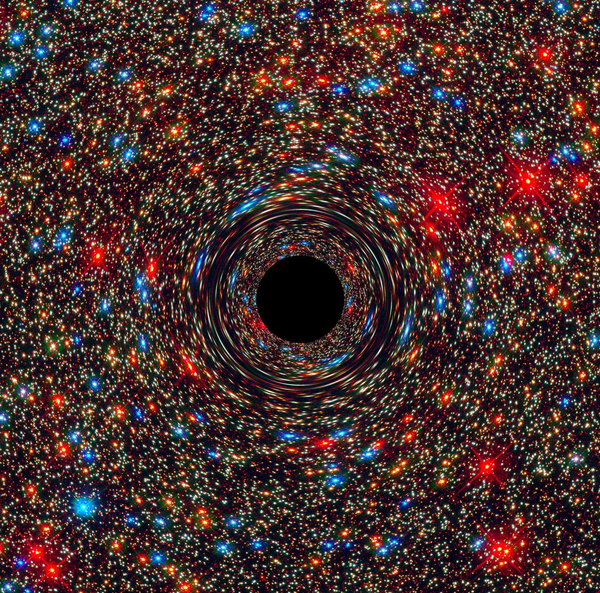
The Donut We Cannot Draw: The 3-Torus
Episode 1: The Universe Is Shaped Like a Donut. Probably.
I like science that leaves room to imagine. When things that seemed unrelated turn out to share a hidden pattern — that moment feels like finding one of the world's secrets. Which opens a door I didn't know was there. Which leads somewhere unexpected. Which eventually leads back to me.
You've played a video game like this. You walk off the right edge of the screen and reappear on the left. Walk off the top, come back at the bottom. The old arcade ones did it. Asteroids. Your little ship drifts past the boundary and pops out the other side, like nothing happened.
You never thought about it much. It was just a rule. The screen wraps.
But sit with it for a second. What is the actual shape of that world? Not the flat rectangle you're looking at. The thing your spaceship actually lives on.
Because here's the strange part. In that game, there is no edge. You think you see one — the side of your screen. But the ship doesn't think so. To the ship, the right edge and the left edge are the same place. They're glued together. The top and bottom too.
Try to build that shape with your hands. Take a sheet of paper. Roll it so the left edge meets the right edge — now you've got a tube. Fine. Now you need the top and bottom to meet too. So you bend the tube around until its two open ends touch.
And you get a donut [1].
That's the punchline of Asteroids. Your ship was crawling around the surface of a donut the whole time, and it had no idea, because from the inside a donut and a flat sheet feel exactly the same. The ship never feels itself curving. It just walks straight and comes home.
I want you to hold onto that feeling. The feeling of being inside something whose shape you can't see from where you're standing.
Because you're standing inside one right now.
Not a video game. The real thing. The space around you — the air in the room, the gap between you and the wall, the dark between Earth and the stars — that space has a shape. A global shape. And we don't actually know what it is.
That sentence should bother you more than it does. We've mapped the ocean floor. We've photographed a black hole. We landed a robot on a comet moving forty thousand miles an hour. And the shape of the thing we are all sitting inside of — the basic question of whether space goes on forever or quietly wraps back on itself like that arcade screen — that one is still open [2].
The reason is almost funny. To see the shape of something, you usually have to step outside it. You look at a globe from across the room. You can't see the shape of your own house while you're locked in the basement. And there is no "outside" the universe. There's no balcony. No place to stand and look back at the whole thing and say, ah, so that's what it looks like.
So we're the ship in Asteroids. We can walk in straight lines. We can send light out and watch what comes back. We can measure angles in giant triangles drawn across the sky [3]. And from those scraps — those clues from the inside — we have to guess the shape of a thing we can never step out of.
Most people assume space is just... infinite. Open. Going on and on with no edges and no wrapping. Maybe. That's one possibility, and a lot of physicists lean that way.
But there's another possibility that keeps coming back. One where space is finite — it has a size, you could in principle measure how much of it there is — and yet it still has no edge, no wall, nowhere it stops.
A shape where you could fly in a straight line forever and one day pass yourown house, coming at it from behind, having gone all the way around without ever turning [4].
You know what shape does that. You just built it out of paper.
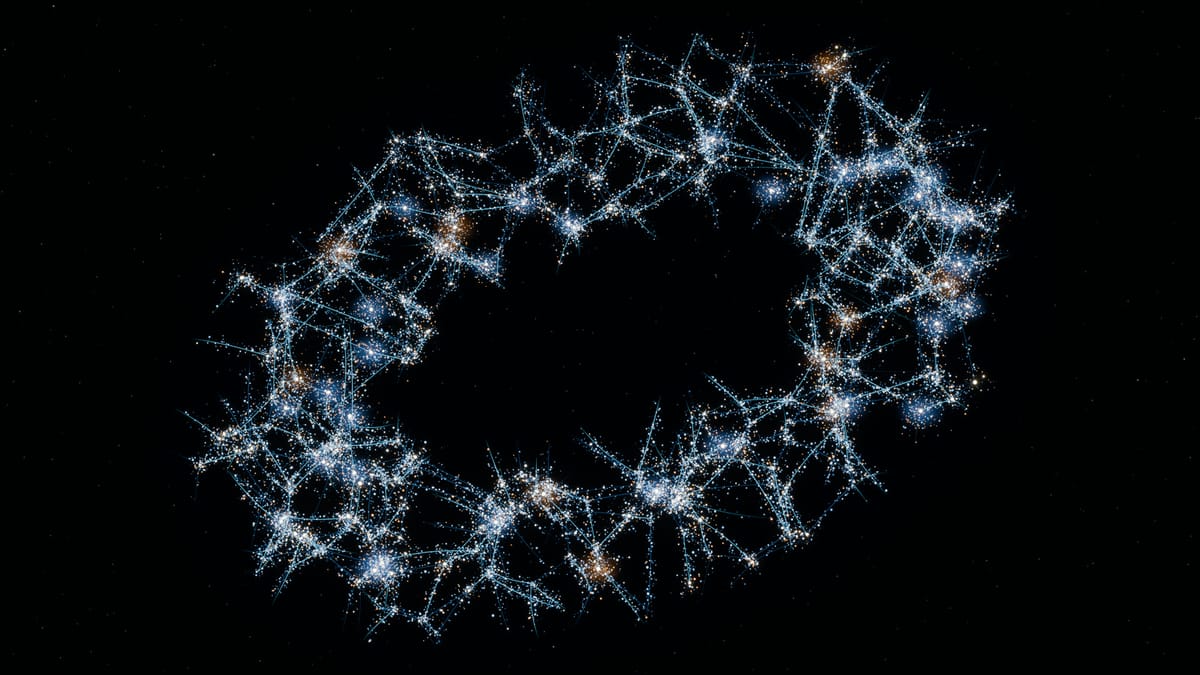
The 3-torus: a cube whose opposite faces are joined. Fly out one side, come back in the other.
A donut.
I'm not joking, and I'm not exaggerating for clicks. There is a serious, much-studied candidate for the shape of the entire universe, and the closest thing your brain has to it is the surface of a donut [4]. Mathematicians have a less delicious name for it, which we'll get to. For now, donut.
And here's what I can't stop thinking about. If it's true — if space really does wrap — then somewhere out there, light that left a galaxy billions of years ago could have circled all the way around and be arriving here from two directions at once [5]. The same object. Two places in the sky. Like seeing the back of your own head.
We've looked for exactly that. We have not, so far, found it [5]. Which doesn't prove the universe is infinite. It just means that if it wraps, it wraps on a scale bigger than the part we can see.
So we're left where we started. Inside something. Walking in straight lines. Sending out light and waiting.
If you could fire a beam of light off into the dark and wait long enough — longer than any waiting that has ever meant anything — would it ever come back and tap you on the shoulder?
Here's the thing about that Asteroids screen. The shape your spaceship actually lives on is not flat. It only looks flat to you, because you're outside it, watching from your couch.
Try to build the real shape. Take the rectangle. The right edge and the left edge are secretly the same edge — your ship proves it every time it crosses over. So glue them together. Roll the paper into a tube. Now the left and right are one seamless line, and your ship can loop around the tube forever.
Good. But you still have the top and bottom edges to deal with. In the game, the top wraps to the bottom too. So now you need to glue the two open ends of your tube together. Bend the tube around. Bring one end to meet the other.
And you get a donut.
The technical name is a torus *1. But it's a donut. A bagel. A pool floaty. The surface of that ring is the actual shape of the Asteroids universe — a place with no edges, no walls, where every direction eventually brings you home.
I want to stop here, because something sneaky just happened, and it took me a while to notice it.
When you played the game, the world was perfectly flat. Straight lines stayed straight. There were no hills, no curves, no weird stretching. A triangle drawn on that screen had angles that added up to exactly 180 degrees, the way your school teacher promised *2. The geometry was the boring, normal, flat kind.
But the donut you built is not flat. It's curved. It bulges on the outside and dips on the inside. So which is it? Flat, or curved?
This is the part that broke my brain a little. The flatness was real. The donut shape was a lie — or rather, a convenience. When you bent that tube around to glue the ends together, you had to stretch it. You forced curvature onto something that didn't actually have any. The bending was just so your eyes, stuck in three dimensions, could see how the gluing works.
The true shape — the flat one, where straight lines stay straight and the corners still wrap around — can't be drawn. Not really. Not in our space. You can describe it perfectly. You can do math on it all day. You just can't build a model of it on your kitchen table without cheating and adding curves that aren't supposed to be there. This is the donut we cannot draw.
Mathematicians have a name for this honest, flat, un-drawable version. They call it the flat torus *3. And it exists, just not anywhere you can point.
Now climb up one level, because this is where it gets personal.
Asteroids is a flat world with two directions. Left-right, up-down. Wrap both, and you get the donut.
You live in a world with three directions. Left-right. Up-down. And forward-back. Three ways to move.
So picture a room. An ordinary room, with six walls — four around you, one above, one below. Now wrap them the way the game wraps. Walk through the right wall, come out the left. Float up through the ceiling, drift back in through the floor. Walk forward through the far wall, arrive behind you through the near one. Every wall glued to the wall across from it.
That room has no edges. No outside. You could walk forever and never hit anything, but youwouldn't be in an infinite room. You'd just keep arriving back where you started, like the spaceship, like the bagel, except now in every direction at once.
This shape has a name. The 3-torus *4. Three because there are three directions, each one wrapping around. It's the donut idea, promoted one dimension up.
And here is the cruel joke. We couldn't draw the flat 2D donut without cheating, without bending it through a third dimension we happened to have lying around. To honestly bend a 3-torus into shape, you'd need a fourth dimension to fold it through. We don't have one. Not one we can move in, anyway.
So we are completely stuck. We can write the 3-torus down. We can calculate what it would feel like to live inside. We can simulate it on a computer, fly a virtual camera through that wrapping room and watch ourselves appear in the distance, smaller and smaller, copy after copy stretching off toward a horizon that isn't really there *5. But we cannot picture it the way we picture a ball or a box. The machinery in your head that turns shapes into pictures simply does not have the room.
I find that strangely comforting. Your imagination isn't broken. It's just three-dimensional, and so are you, and this thing is asking for one more.
Why does any of this matter? Because the room I just described isn't only a math game. Some physicists think it might be the actual shape of everything — the whole universe wrapped on itself in three directions, finite but with no edge, no wall, no outside *6. A cosmos shaped like a donut you can't draw.
Which raises a quiet, uncomfortable question. If you lived inside a wrapping room, and the light from your own back traveled all the way around and reached your eyes — would you even know you were looking at yourself?
So that donut shape has a name. The 3-torus. And here's the part that should bother you: nobody has ever drawn it correctly, and nobody ever will.
Let me explain why, and then let me explain why serious people think we might be living inside one.
Remember the paper trick. You rolled the rectangle into a tube to glue the left and right edges. Now you need to glue the top and bottom edges too. On a flat sheet, easy — bend the tube around and join the ends, and you get the donut you can hold in your hand. But that bending cheats. When you curve the tube to bring its ends together, you stretch the outer edge and squash the inner one. The shape gets distorted. The real surface — the one where every point is treated equally, no stretching, no squashing — can't be built in our three dimensions without lying about it [1]. Mathematicians call this a flat torus, and the word "flat" is the whole point. It has no curvature, even though it wraps around on itself. You cannot fit a genuinely flat donut into ordinary space. The donut on your plate is a fake.
That's the two-dimensional version. The shape an Asteroids ship lives on. Now stack one more dimension on top, so the wrapping happens in all three directions — left-right, up-down, and front-back. Walk forward far enough, come back behind yourself. That is the 3-torus. And that is the shape some cosmologists think the whole universe might have.
Here's where it gets strange. Most people assume the universe is infinite, going on forever in every direction. But "infinite" and "wraps around" can look exactly the same from the inside. If you're a tiny ship on the Asteroids screen, you have no way to tell whether you live on an endless flat plane or on a torus that just keeps bringing you home. You'd see the same thing either way: you go straight, you never hit a wall. The shape hides itself.
So how would you ever catch it?
You look for repeats. On a torus, light can wrap around the whole universe. That means a distant galaxy might also show up somewhere else in your sky — the same object, seen from two directions, because its light took two different paths around the loop [2]. Astronomers call these "ghost images" or "topological images." Find a matched pair, and you've found the wrapping.
The cleanest place to look is the oldest light there is. The cosmic microwave background — the faint afterglow left over from when the universe was about 380,000 years old, before there were any stars, when everything was a hot fog that suddenly cleared [3]. That light has been traveling ever since. It surrounds us like the inside of a sphere. And if the universe wraps around on a scale smaller than that sphere, the wrapping should leave a signature in it.
The signature is a circle. Picture the sphere of oldest light around you. If space wraps, that sphere intersects its own wrapped-around copy along a circle. The same pattern of hot and cold spots should appear on two different circles in the sky — like seeing the same coastline on two different maps. This is the "circles in the sky" test, proposed in 1998 by Neil Cornish, David Spergel, and Glenn Starkman[4]. Their idea was clean: scan the whole sky, compare every circle against every other circle, and if space is a torus, the matches will jump out.
"If we live in a small universe," Cornish and his colleagues wrote, the oldest light "will display a clear signature" — pairs of matched circles, written into the sky like a fingerprint [4].
So people went looking.
In 2003, a satellite called WMAP delivered the best map of that oldest light anyone had ever made [5]. Sharp enough to run the test. And right away, something odd turned up — not in the circles, but in the overall pattern. The largest ripples, the broadest hot-and-cold variations spread across the whole sky, were weaker than expected. Much weaker. As if the universe had run out of room for the biggest waves [6].
Think about a guitar string. A short string can't play a low note — the wavelength simply doesn't fit. Spergel and the WMAP team noticed the universe seemed to be missing its lowest notes [6]. One way to explain a missing low note is a string that's too short. One way to explain missing big ripples is a universe that wraps around before they have space to form.
That got attention. In 2003, a French team led by Jean-Pierre Luminet proposed a specific shape to explain it — not a torus, but a stranger thing called the Poincaré dodecahedral space, a universe made of curved pentagonal blocks that fold into each other [7]. "The presence of these patterns might be a sign of the finite size of the universe," Luminet's group argued in Nature [7]. The idea was beautiful. It also made a prediction: matched circles, about 35 degrees across, should be sitting in the sky waiting to be found.
So Cornish, Spergel, Starkman and others ran their circle hunt on the real data.
They found nothing.
No matched circles. Not the ones the dodecahedron predicted, not the ones a torus would make, not at any size big enough to test. In 2004 they reported that the data ruled out any wrapping smaller than about 24 gigaparsecs — a number so large it's roughly the size of the observable universe itself [8]. In plain terms: if the universe does wrap around, the loop is at least as big as everything we can see. The donut, if it's a donut, is bigger than our entire view of it.
That's a frustrating result, and an honest one. It doesn't say the universe is infinite. It says: if it's finite, it's too big for us to catch with this method. The wrapping might be just past the edge of what light has had time to reach us from. We'd be a ship on the Asteroids screen, but the screen is so wide we've never made it to the far side.
The story didn't end there. A better satellite, Planck, mapped the oldest light with even sharper eyes, and in 2013 and 2015 the Planck team ran the topology tests again [9]. Same answer. No matched circles. No sign of wrapping inside the part of the universe we can observe. They put the limit even tighter [9]. If you want a wrapped universe now, you have to put the seam beyond our horizon, where no light can ever reach us tocheck.
But — and this is the part I keep turning over — the weird thing that started all of this never fully went away. Those missing big ripples. Planck saw them too [9]. The largest patterns in the oldest light are still quieter than the simplest theory says they should be. Not by a huge amount. Not enough to be sure it isn't just luck — the universe only gives us one sky to measure, and with the biggest ripples there are only a handful to count, so the statistics are shaky [10]. Flip a coin three times, get three heads, and you can't tell if the coin is loaded. Same problem. We have one universe and a few big ripples, and they look slightly off, and we genuinely cannot tell whether that means something or nothing [10].
Starkman has spent years on exactly this discomfort. He and his collaborators kept poking at these large-scale oddities — not just the missing power, but a strange alignment, where some of the big ripples seem to line up with each other in a way randomness shouldn't produce [11]. They nicknamed one of these alignments "the axis of evil," partly as a joke, partly because it refused to go away [11]. "These anomalies," Starkman has said, "are a real feature of the microwave sky. The question is whether they are telling us something profound or are simply a statistical fluke" [11].
That sentence is the whole field in one breath. Something profound, or a fluke. Nobody knows which.
Here's where I have to be straight with you about what physicists actually believe today. The mainstream position is not "the universe is a donut." The mainstream position is "the universe looks flat and might be infinite, and we have no positive evidence of wrapping." The circle tests came up empty. The measurements of the universe's curvature, from Planck, say space is flat to within a fraction of a percent [9]. Flat is exactly what you'd get from an infinite universe — but it's also exactly what you'd get from a 3-torus. Flat doesn't decide it. A flat universe can wrap. Remember the flat donut you couldn't draw. Flat and finite live together just fine.
So we're stuck at a real edge of knowledge. Not a temporary gap that next year's data will fill. A possibly permanent one. If the universe wraps at a scale larger than the distance light has traveled since the beginning, then the seam is behind a curtain we can never pull back. The information simply isn't here yet, and the universe is expanding fast enough that it may never arrive [12]. We could be living inside a perfectly finite, wrapped-around space and have no way, ever, to prove it.
Janna Levin, a cosmologist who has written about this for years, put the strangeness plainly. A finite universe, she has argued, would be more natural in some ways than an infinite one — an infinite universe asks you to swallow infinitely many stars, infinitely many copies of everything, including infinitely many copies of you [13]. "I'm prejudiced," Levin once wrote, "I think the universe is finite" [13]. That's not a proof. She'd be the first to say so. It's a hunch, stated honestly, from someone who has stared at the math longer than
Here's what nobody can tell you yet: whether any of this is real.
We have a flat universe. That part we're fairly sure about. The light left over from the Big Bang *1 shows us a cosmos that is geometrically flat to within a fraction of a percent [1]. Flat is exactly what you need for the donut. A 3-torus is flat. It just wraps.
But flat doesn't prove wrapped. A normal infinite sheet of paper is also flat, and it doesn't loop back on itself. So flatness opens the door. It doesn't walk you through it.
To prove the wrapping, you'd need to catch the universe in the act. Like your spaceship in Asteroids — the proof that the screen wraps is that the ship comes out the other side. So we go looking for things that came out the other side.
The cleanest idea is this. If the universe is small enough and it wraps, then light from a distant galaxy could leave, travel all the way around, and come back. You'd see the same galaxy twice. Once nearby, young. Once far away, ancient — because that light took the long way around. The same object, two ages, two places in the sky.
Astronomers looked. They called it "cosmic crystallography" and "circles in the sky" [2]. The idea with the circles: the leftover Big Bang light should show matching patterns in opposite directions, like seeing the back of your own head. Teams searched the data for those matching circles.
They found nothing [3].
That's not a small thing to admit, so let me be honest about what it means. It doesn't mean the universe isn't a donut. It means that if it is, the donut is big. Bigger than the part we can see. Our whole observable universe could be one small room inside a much larger wrapped house, and we'd have no way to walk to the far wall. The light hasn't had time to make the loop. It never will. The universe is expanding faster than we can chase it.
So we're stuck. The shape might be a torus. It might be infinite and just flat. It might be one of several other wrapped shapes — there are more than one [4], and a donut is only the easiest to picture. We can rule out small versions. We cannot rule out large ones. And "large" might mean forever, as far as you're concerned.
There's a stranger problem underneath all this. Even if we proved the wrapping, we still couldn't picture it. I told you nobody can draw a 3-torus correctly. That's not a failure of effort. Your brain runs on a body that evolved to catch food and not fall off cliffs. It builds a model of three-dimensional space because three dimensions is where the food was. A shape that needs four dimensions to sit inside comfortably — your visual system simply has no slot for it. You can know it. You cannot see it. Those turn out to be different things, and we don't talk about that difference enough.
Which leaves the one question I keep circling. We assume the universe has a shape at all. A single, definite answer waiting to be measured. But the only tool we have for finding it is light, and light is too slow to bring us the news. Maybe the shape is real and forever out of reach. Maybe asking for the shape of everything is like asking for the edge
of a circle — a sensible-sounding question with no answer, because the question quietly assumes something the world doesn't owe us.
We treat "the universe has a shape" as obvious. It might be the wrongest obvious thing we believe.
So here's where I leave you. We can measure that space is flat. We can search for the place where it loops back. We've searched, and so far the universe has kept quiet. Maybe it's infinite. Maybe it's a donut so wide that the loop sits beyond every telescope we'll ever build, in this life or any other.
And if the answer is permanently out there, past the last star we can ever receive light from — does it still count as the shape of the universe? Or just the shape of the part that happened to let us watch?
So how would you ever know? You can't step outside the universe and look at its shape. You're the spaceship. You're stuck on the surface, drifting.
But there's a trick. If the universe wraps, then light wraps too. Look far enough in one direction and you might see the back of your own head — or rather, a galaxy you already saw somewhere else in the sky. The same galaxy, twice, from two angles. Like standing between two mirrors and watching yourself repeat.
People have looked for this. The leftover light from the Big Bang should carry the pattern. If space loops back, certain circles in that ancient light should match — the same temperature, the same ripples, showing up in two different patches of sky [2]. They searched. So far, nothing convincing [2]. No matched circles. No repeated galaxies.
Which means one of two things. Either the universe doesn't wrap. Or it wraps on a scale so big that the loop is longer than the part of it we can see [3]. The light hasn't had time to go all the way around since the Big Bang. The donut might be real, just too large to catch us looking.
I find that second option strangely lonely. Imagine living in a house with a hallway that loops back on itself, but the hallway is so long you die before you finish walking it. You'd never know the door at the end was your own front door. You'd think the hallway went on forever. From the inside, an enormous loop and an endless line look identical.
That's where we are. Not knowing if we're in a small closed thing or an endless open one. And the honest answer is we may never know, because the answer might be hiding just past the edge of everything we can ever see.
So here's what stays with me. You've spent your whole life assuming the world keeps going. The road keeps going. Space keeps going. But maybe it doesn't. Maybe it comes back. Maybe everything you've ever lost just went around the long way.
And if the universe really is a loop — where does the loop begin?
TERMS EXPLAINED
- *1Torus: The mathematician's word for a donut shape — more precisely, the surface of a donut, where opposite edges of a flat sheet are glued together.
- *2Topology: The study of a shape's basic connectedness — whether it wraps, loops, or has holes — ignoring how it's bent or stretched.
- *3Observable universe: The part of space close enough that light from it has had time to reach us since the Big Bang. Beyond it, there may be much more we simply can't see yet.
- *43-torus: The donut idea moved up one dimension. A three-dimensional space where all three directions — left-right, up-down, forward-back — wrap around on themselves. Walk far enough in any direction and you return to where you started. Finite, but with no walls and no edge.
- *5Cosmic topology: The study of the overall shape of the universe — not whether it's curved here or there, but how it connects to itself on the largest scale. Whether it goes on forever, or wraps back around like a giant room with no walls.
SOURCES & REFERENCES
- [1]Weeks, J. (2002). "The Shape of Space." Marcel Dekker. — That gluing a flat rectangle's opposite edges produces a torus (donut) surface.
- [2]Planck Collaboration (2020). "Planck 2018 results. VI. Cosmological parameters." Astronomy & Astrophysics. — That the global topology and curvature of the universe remain observationally unsettled.
- [3]de Bernardis, P. et al. (2000). "A flat Universe from high-resolution maps of the cosmic microwave background radiation." Nature. — That measuring angles in large cosmic triangles constrains the geometry of space.
- [4]Luminet, J.-P. et al. (2003). "Dodecahedral space topology as an explanation for weak wide-angle temperature correlations in the CMB." Nature. — That finite, edgeless wrap-around topologies are serious candidates for cosmic shape.
- [5]Cornish, N. et al. (2004). "Constraining the Topology of the Universe." Physical Review Letters. — That searches for repeated/matched images of the same region have not found evidence of wrapping within the observable universe.
- [6]Planck Collaboration (2014). "Planck 2013 results. XXVI. Background geometry and topology of the Universe." Astronomy & Astrophysics 571, A26. — Tests of whether the observable universe has a finite, wrapping topology such as the 3-torus.
Inline citations [N] correspond to numbered references above.
A weekly journey from the present universe back to the Big Bang — and to what it means for us.
![[Deep Dive] Scale-free localization in pseudo-Hermitian quantum walk](/content/images/size/w600/2026/10/deep_dive_thumb-9.png)