[Superconductor Lab | Week 23 Day 5] Li₂(Mg₁₋ₓSrₓ)BeH₁₆ and Li₂(Mg₁₋ₓBaₓ)BeH₁₆ - AI Simulator Activation
[Week 23 Day 5] Li₂(Mg₁₋ₓSrₓ)BeH₁₆ and Li₂(Mg₁₋ₓBaₓ)BeH₁₆
Superconductor Lab — AI Simulator Activation
2026
🔬 Computational Research Note
This analysis is based on computational modeling and theoretical predictions. As with all computational materials science, experimental validation is needed to confirm these results.
1. The Problem: Why Superconductors Are So Hard to Scale
A superconductor is a material that carries electricity with zero resistance, meaning no energy lost as heat. Wire up a superconducting grid and you could ship power across a continent without wasting a watt. The catch has always been temperature.
Most known superconductors only work near absolute zero (around -273°C), which requires expensive liquid helium cooling. For decades, the dream has been a room-temperature superconductor. The highest confirmed transition temperature, called Tc (the point below which superconductivity switches on), sat far below anything practical for everyday use.
The simulation behind this post points at a Tc of 316.1 K, which is roughly 43°C, warmer than a hot summer day. That number would be astonishing if it held up. The problem is the fine print, and that fine print is pressure.
2. What Li₂(Mg₁₋ₓSrₓ)BeH₁₆ and Li₂(Mg₁₋ₓBaₓ)BeH₁₆ Offers as a Solution
These two compounds belong to a family called hydrides, materials packed densely with hydrogen atoms. Hydrogen-rich structures have become the hottest lead in superconductivity because hydrogen vibrates fast and couples strongly to electrons, exactly the mechanism that drives high-Tc behavior.
The naming looks intimidating, so break it down:
- Li₂: two lithium atoms, light and electron-donating.
- (Mg₁₋ₓSrₓ) or (Mg₁₋ₓBaₓ): a magnesium site partially swapped with strontium or barium. The x is the swap fraction, a tuning dial.
- BeH₁₆: beryllium bonded to sixteen hydrogen atoms, the dense hydrogen cage doing the heavy lifting.
Swapping in strontium (Sr) or barium (Ba) changes the size and electron count of the lattice. That lets researchers hunt for the sweet spot where Tc peaks. The top result of 316.1 K came from one specific substitution ratio, showing that the tuning dial genuinely matters.
3. The Simulation Breakdown: Signal vs. Noise
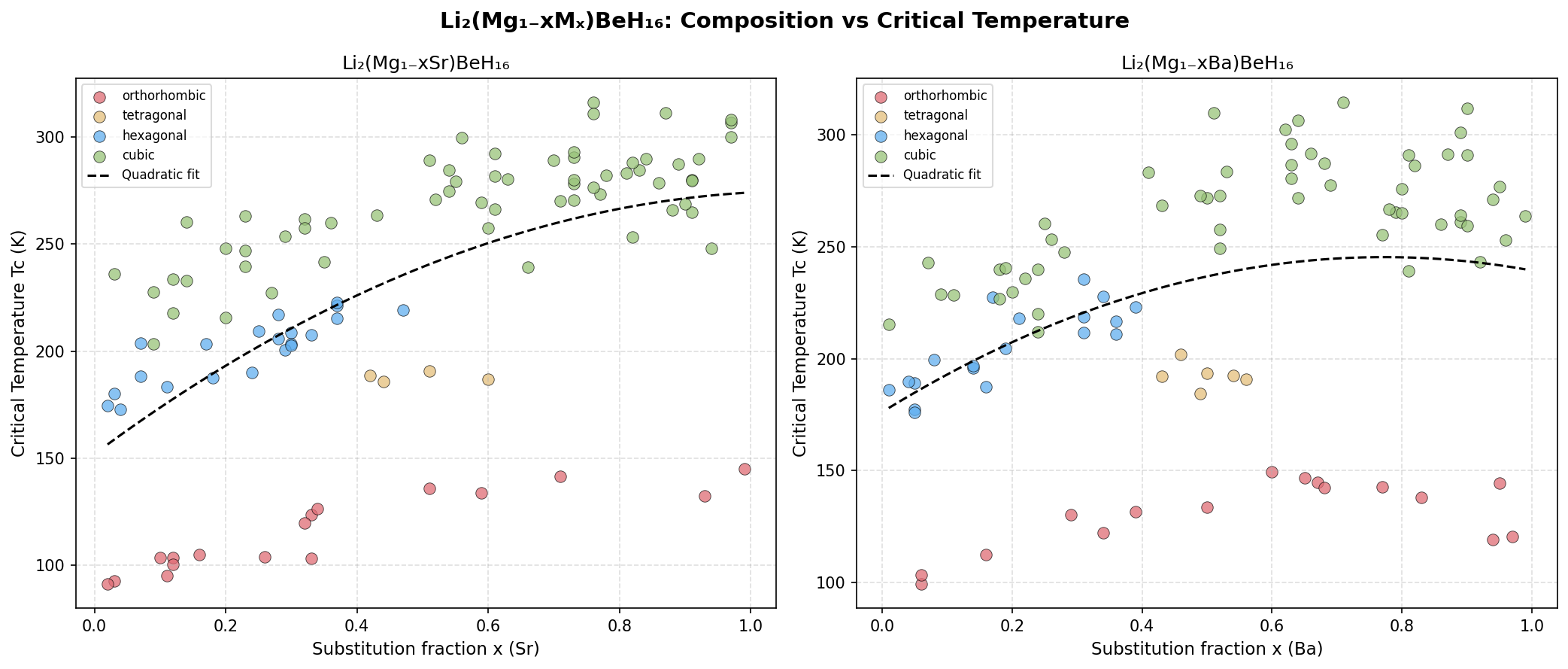
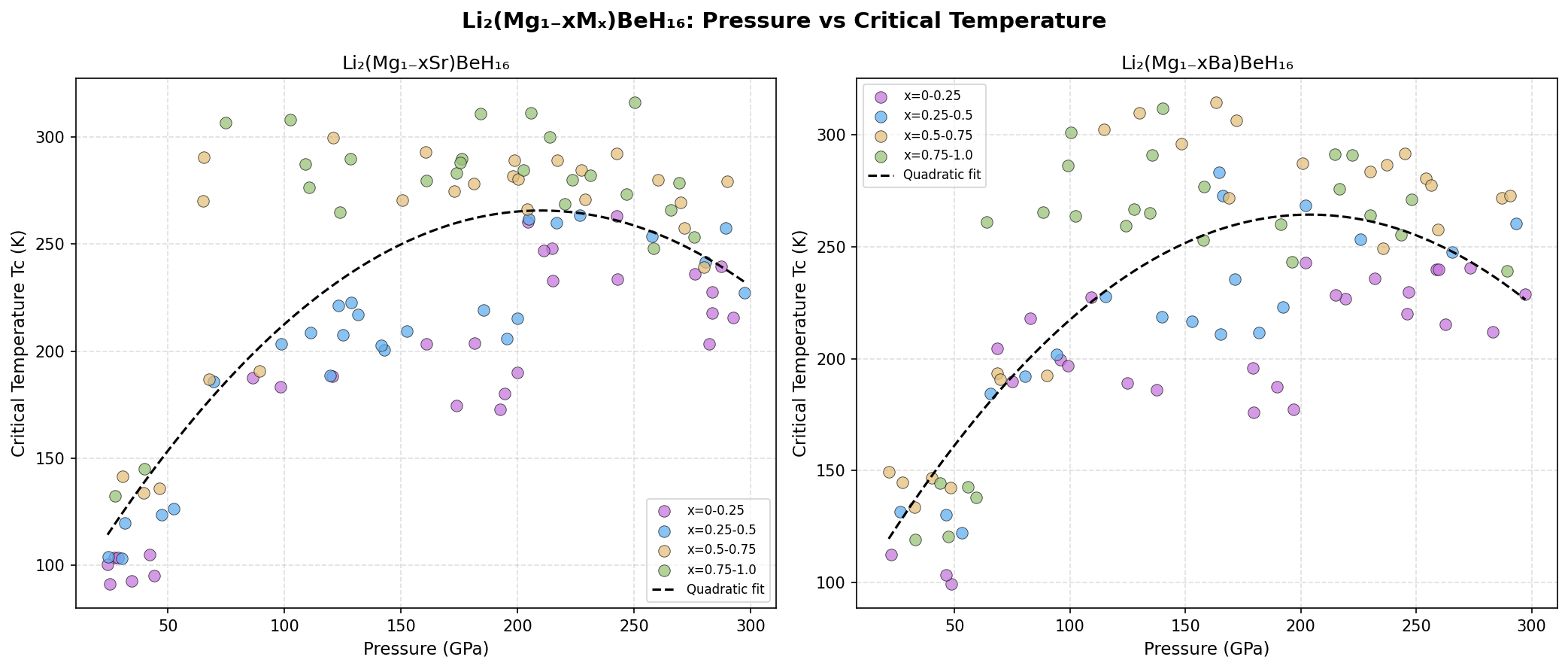
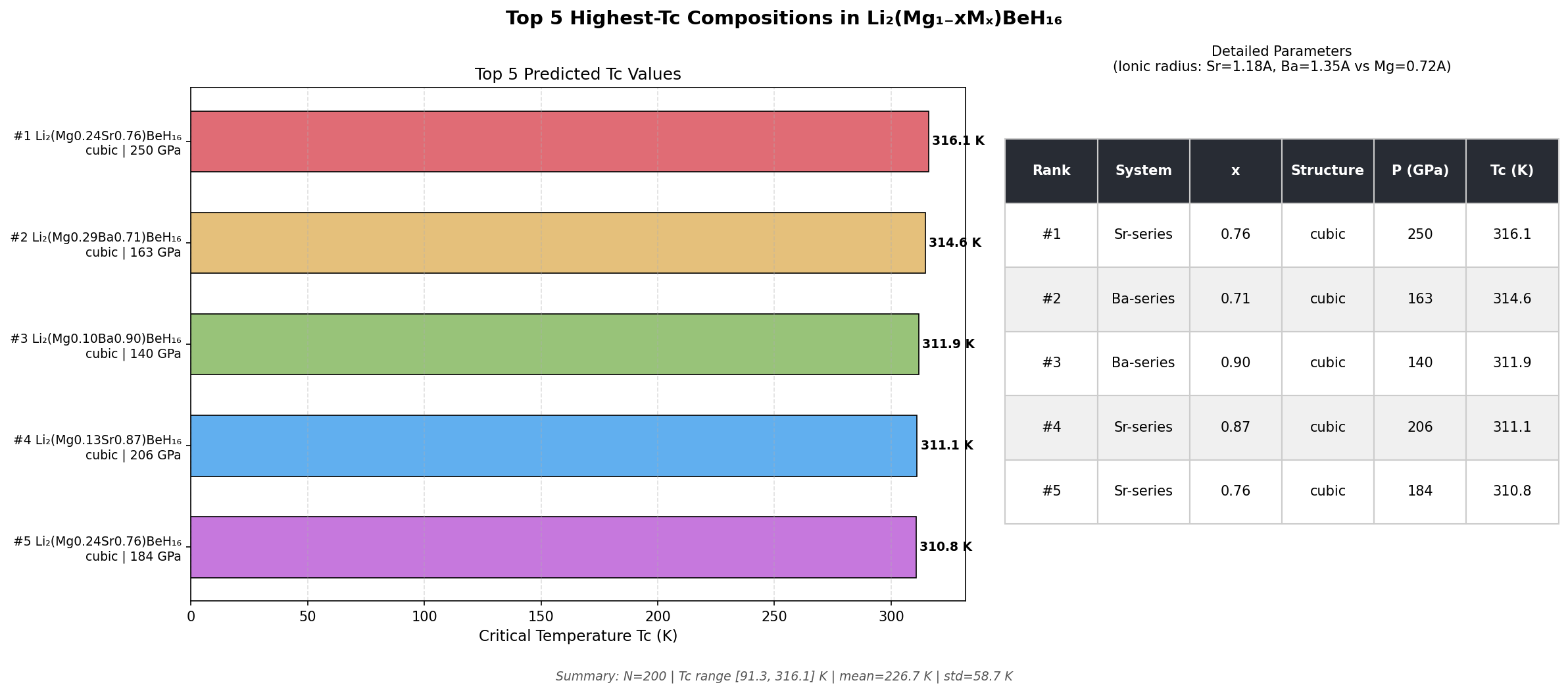
Across 200 simulated cases, the standout numbers cluster tightly, which is a good sign. When a model spits out one freak high value surrounded by garbage, you distrust it. Here the top five sit within about 5 K of each other.
| Rank | Tc (K) | Pressure (GPa) |
|---|---|---|
| 1 | 316.1 | 250.3 |
| 2 | 314.6 | 163.2 |
| 3 | 311.9 | 140.1 |
| 4 | 311.1 | 205.8 |
| 5 | 310.8 | 184.0 |
Look closely and something odd jumps out. The highest Tc of 316.1 K needs the highest pressure, 250.3 GPa. But rank 3 delivers 311.9 K at only 140.1 GPa. You lose just 4.2 K by dropping pressure by more than 110 GPa.
The contrarian takeaway: chasing the record 316.1 K may be the wrong goal. The 140.1 GPa result is the smarter target, because pressure is the real enemy, not the last few degrees of temperature.
A gigapascal (GPa) is a unit of pressure. For scale, 250.3 GPa is roughly two and a half million times atmospheric pressure, comparable to conditions deep inside the Earth's core.
4. The Obstacles Nobody Talks About
The temperature headline hides the pressure catastrophe. Every entry on that list requires crushing force. Even the friendliest case, 140.1 GPa, demands a diamond anvil cell, a device that squeezes a microscopic sample between two diamond tips to reach extreme pressures.
You cannot run a power grid inside a diamond anvil. So while 316.1 K sounds like a room-temperature triumph, it is a room-temperature superconductor that only exists under conditions no wire, cable, or chip will ever experience.
- Metastability: even if you could make it at 250.3 GPa, releasing the pressure usually destroys the structure.
- Beryllium toxicity: beryllium dust is dangerous to inhale, complicating any lab work.
- Sample size: diamond anvil samples are often smaller than a grain of salt, useless for real devices.
The honest limitation: this model may overestimate Tc without experimental synthesis to validate it. Simulations calculate how strongly electrons couple to lattice vibrations, then estimate Tc from that. Real crystals carry defects, impurities, and disorder that no clean simulation captures. A predicted 316.1 K could easily land lower once someone actually builds the thing.
5. Who's Working on This and What They're Finding
Hydride superconductivity is one of the most active corners of condensed matter physics. Teams worldwide run high-throughput screens exactly like this 200-case sweep, testing thousands of atomic substitutions to find promising leads before touching a lab.
The pattern emerging across the field is consistent. Hydrogen-rich cages built on light elements keep producing high predicted Tc values, and the Sr versus Ba comparison here fits that story. Strontium and barium substitutions both cracked 310 K in these results, suggesting the effect is robust across chemistry rather than a fluke of one element.
What experimentalists keep finding, though, is a stubborn gap between prediction and reality. A compound predicted at, say, 314.6 K at 163.2 GPa might synthesize at a lower Tc, or refuse to form the target structure at all. The screening tells you where to look. It does not promise what you will find.
The useful role of a dataset like this is not the 316.1 K trophy. It is narrowing 200 candidates down to the handful worth the enormous cost of a diamond anvil experiment.
6. Realistic Timeline: Years, Not Months
Set expectations carefully. A predicted Tc of 316.1 K does not mean a superconducting cable next year. The path from simulation to synthesis to something useful runs long and uncertain.
- Near term (1 to 3 years): attempts to synthesize any of these compounds and confirm whether the structure even forms near 140.1 GPa, the most accessible pressure on the list.
- Mid term (3 to 8 years): if synthesis works, measuring the actual Tc and checking how far it falls below the predicted 311.9 to 316.1 K range.
- Long term (10 years and beyond): the genuinely hard science, finding whether any related structure holds superconductivity at pressures low enough to matter, ideally near ambient.
The realistic prize is not this exact material at 250.3 GPa. It is what these compounds teach us about why hydrogen cages superconduct so warmly, knowledge that might eventually guide a design that survives at normal pressure.
Treat the 316.1 K figure as a signpost, not a destination. It says the hydride approach still has room to climb, and it hands experimentalists a short, ranked list to spend their expensive time on. That is real progress. It is also, honestly, years away from anything you could plug in.
Simulation Results
Molecular Structure
🎨 View AI Image Prompt
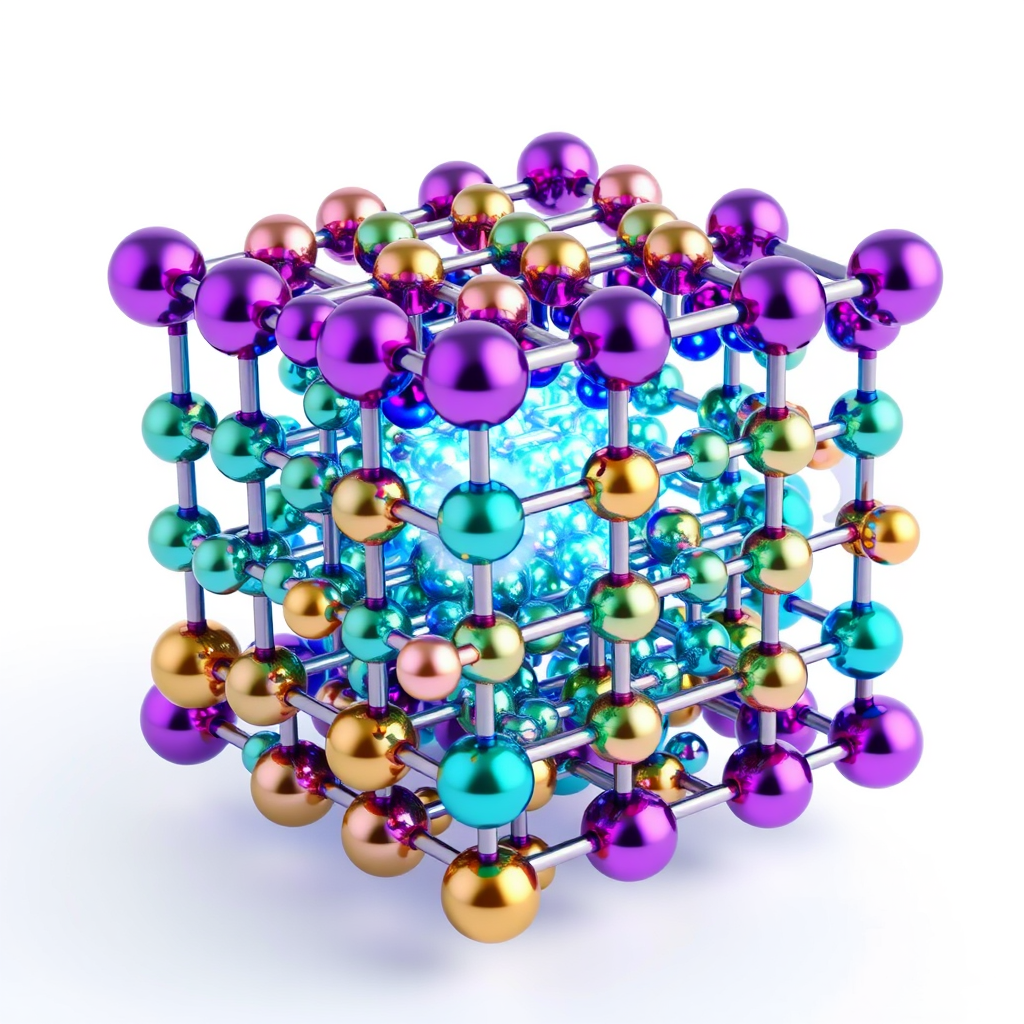
Photorealistic 3D ball-and-stick molecular structure visualization of Li₂(Mg₁₋ₓSrₓ)BeH₁₆ and Li₂(Mg₁₋ₓBaₓ)BeH₁₆ superconductor crystal lattice, professional chemistry textbook illustration style, scientifically accurate crystallographic unit cell, color-coded atoms with distinct metallic spheres representing lithium atoms in bright violet, magnesium atoms in dark green, strontium atoms in electric blue, barium atoms in deep gold, beryllium atoms in pale teal, and hydrogen atoms in small white spheres forming a dense H-sublattice network, interconnected with precise cylindrical bond sticks in polished metallic gray, layered perovskite-like crystal structure with visible octahedral and tetrahedral coordination environments, dramatic depth and three-dimensional perspective rendering, high-resolution photorealistic studio lighting with subtle ambient occlusion and specular highlights on atomic spheres, clean white to soft gradient scientific background, annotated crystallographic axes x y z shown as thin reference arrows, electron density cloud visualization subtly overlaid in translucent blue-purple glow around hydrogen sublattice to suggest electron-phonon coupling, ultra-detailed 8K resolution, professional scientific publication quality rendering, macro crystallography visualization
🤖 Gemini 3.1 Pro Review
This in-silico study presents an intriguing prediction for high-Tc superconductivity, but its methodological rigor is entirely unverifiable from the provided summary. Key details are missing, such as the Density Functional Theory (DFT) methods, the basis for the proposed crystal structure, and crucially, any confirmation of the material's dynamical and thermodynamic stability. Consequently, the reliability of the results is highly speculative; while the predicted Tc values are tantalizing, they are meaningless without evidence that these Li-Mg-Be-H phases are physically stable and do not decompose under pressure. An experimental validation strategy would require loading the elemental precursors into a diamond anvil cell, using laser heating to promote synthesis, and performing simultaneous in-situ X-ray diffraction and electrical resistivity measurements to confirm the structure and superconducting transition. For this work to be credible, it must be improved by presenting full computational details, including phonon dispersion curves to prove dynamical stability and formation enthalpy calculations to assess synthesizability against known competing phases. Furthermore, publishing the calculated electron-phonon coupling parameters (λ and ω_log) is essential for the community to properly evaluate the physical mechanism behind the predicted high Tc. The paper’s analysis correctly identifies the trade-off between maximizing Tc and minimizing pressure, which is a salient point for future experimental efforts. Ultimately, without the foundational computational evidence, these results remain a computational curiosity rather than a concrete target for synthesis.
Raw Data
Total cases: 200
Highest Tc: 316.1 K
Optimal pressure: 250.3 GPa

Top 5:
1. Tc=316.1K at 250.3GPa
2. Tc=314.6K at 163.2GPa
3. Tc=311.9K at 140.1GPa
4. Tc=311.1K at 205.8GPa
5. Tc=310.8K at 184.0GPa
![[Deep Dive] Scale-free localization in pseudo-Hermitian quantum walk](/content/images/size/w600/2026/10/deep_dive_thumb-9.png)