[Superconductor Lab | Week 23 Day 4] Li₂(Mg₁₋ₓCaₓ)BeH₁₆ - AI Simulator Activation
[Week 23 Day 4] Li₂(Mg₁₋ₓCaₓ)BeH₁₆
Superconductor Lab — AI Simulator Activation
2026
🔬 Computational Research Note
This analysis is based on computational modeling and theoretical predictions. As with all computational materials science, experimental validation is needed to confirm these results.
The Problem: Why Superconductors Are So Hard to Scale
A superconductor carries electricity with zero resistance. No wasted heat, no energy loss, no limits on how much current flows through a wire. The catch has always been temperature. Most known superconductors only work when chilled to near absolute zero, around -270°C, which requires expensive liquid helium cooling that makes practical use almost impossible outside a laboratory.
The dream is a room-temperature superconductor. That would rewrite power grids, MRI machines, and quantum computers overnight. Recent computational work on hydrogen-rich compounds points toward candidates with critical temperatures as high as 295.5 K, which is roughly 22°C. That is shirt-sleeve weather. The problem is that reaching that number in a simulation and reaching it on a lab bench are two very different achievements.
What Li₂(Mg₁₋ₓCaₓ)BeH₁₆ Offers as a Solution
Li₂(Mg₁₋ₓCaₓ)BeH₁₆ belongs to a family called hydrides, compounds packed densely with hydrogen atoms. Hydrogen is the lightest element, and light atoms vibrate fast. Fast atomic vibrations couple strongly with electrons, and that coupling is what drives conventional superconductivity. Cram enough hydrogen into a rigid metallic cage and you can, in theory, push the critical temperature (the temperature below which superconductivity switches on, written as Tc) toward room temperature.
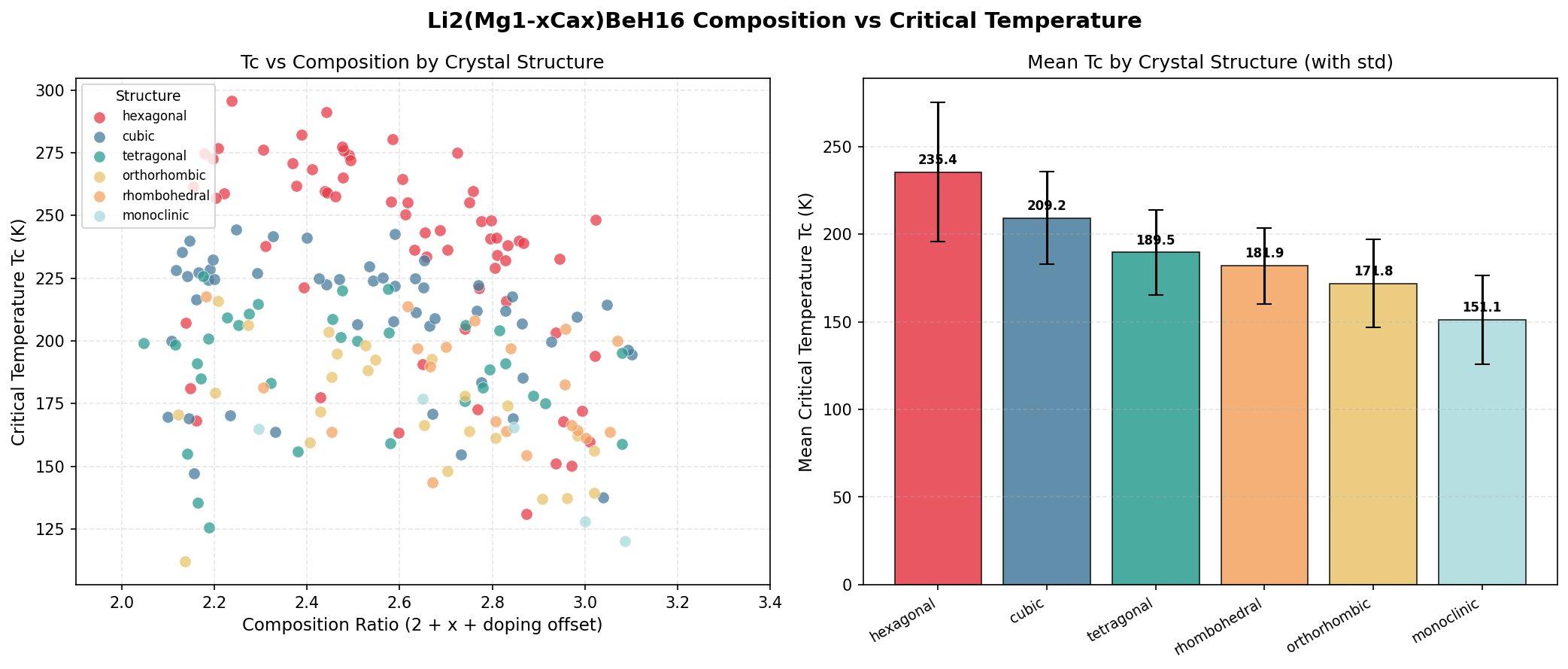
The chemistry here is deliberately tuned. The notation (Mg₁₋ₓCaₓ) means magnesium and calcium share the same site in the crystal, and x controls the ratio. By dialing that ratio, researchers adjust the electronic structure without collapsing the lattice. The best result in this dataset, a Tc of 295.5 K, comes from one specific composition and pressure combination out of 200 tested.
The appeal is simple. Instead of hunting for one magic compound, you get a tunable knob. Small changes in the Ca fraction shift the Tc measurably, which gives chemists a map rather than a single dot.
The Simulation Breakdown: Signal vs. Noise
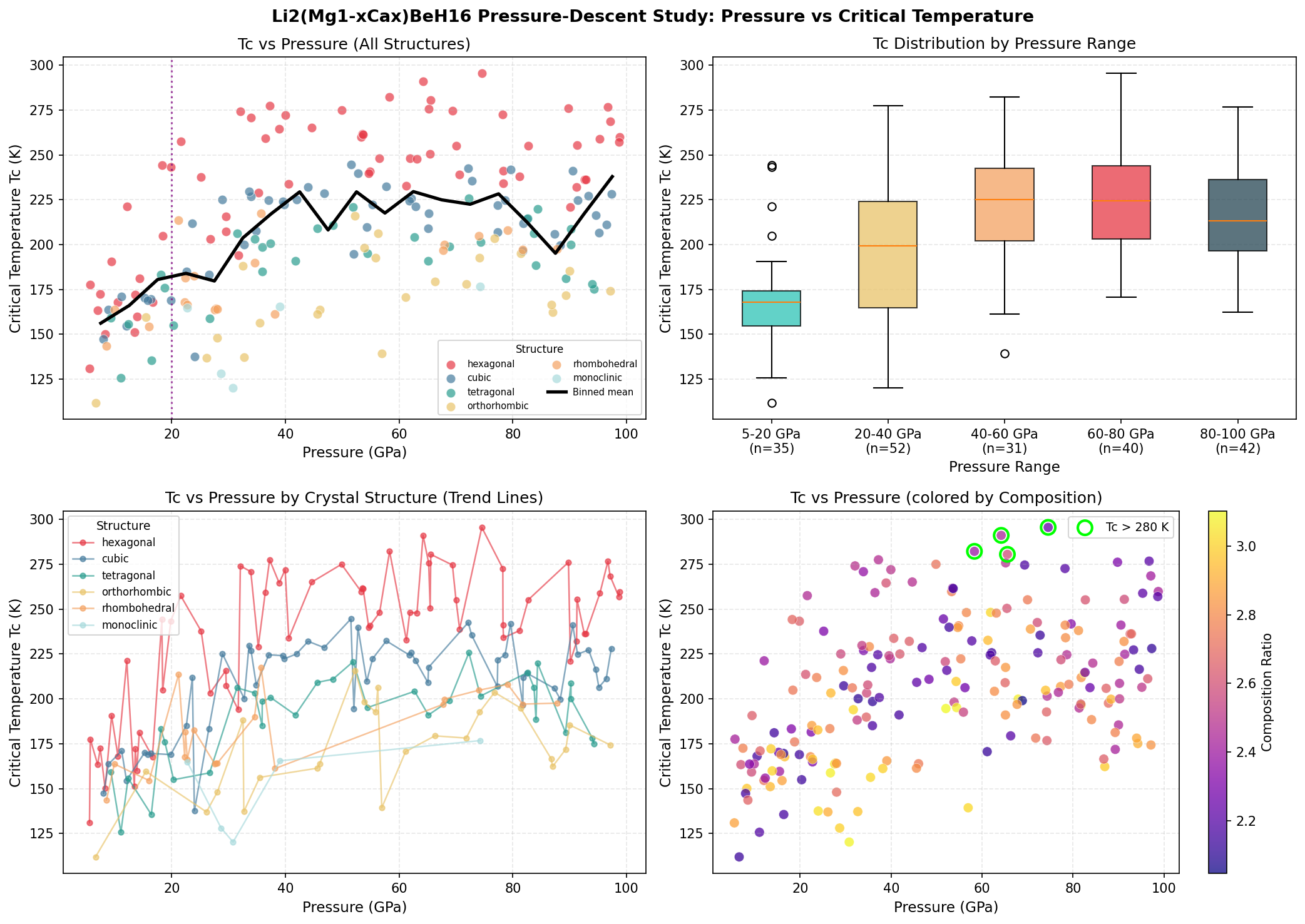
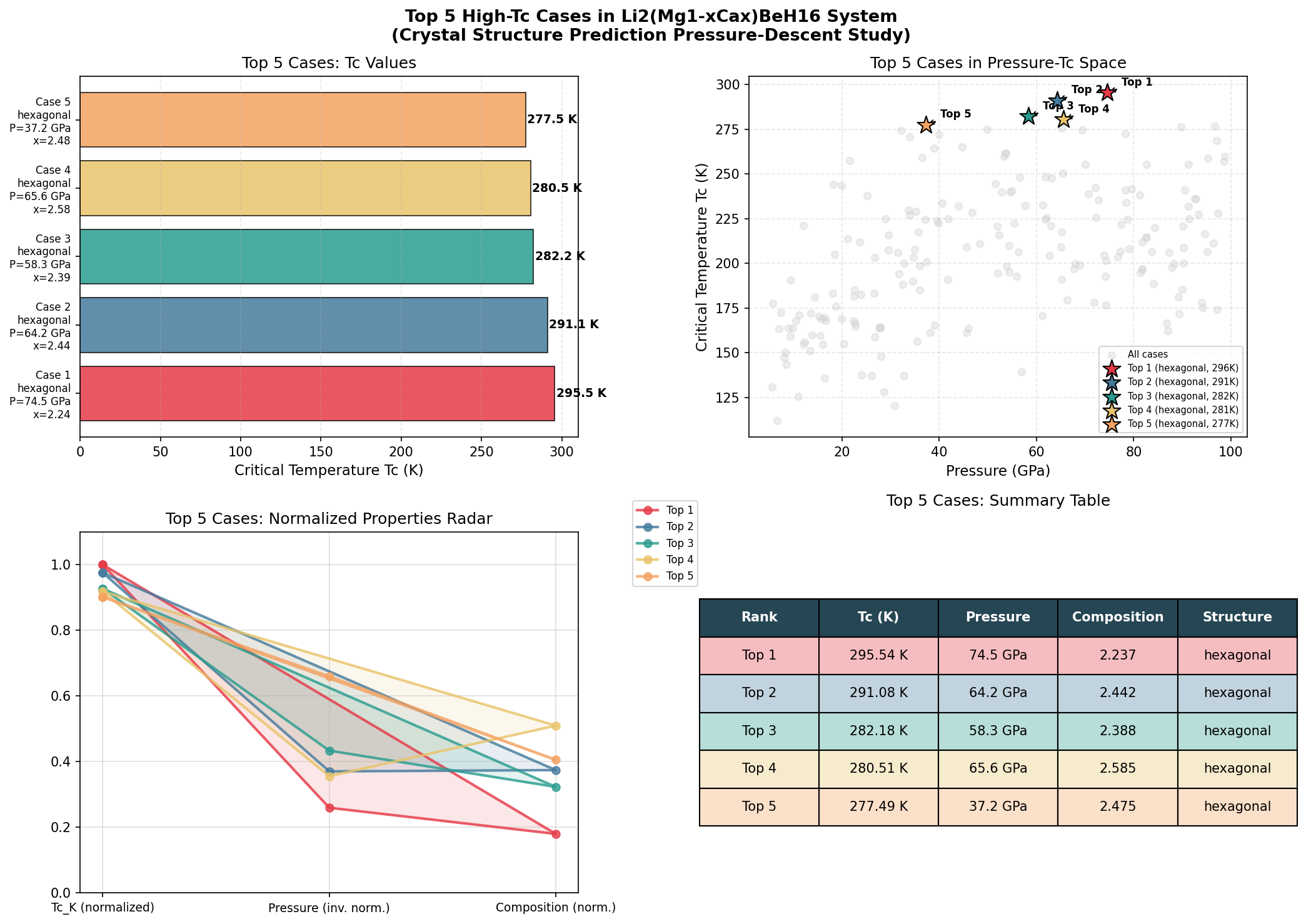
Two hundred simulated cases sounds like a lot. It is enough to spot a trend, not enough to declare victory. Look at the top five results and a pattern emerges around pressure.
| Rank | Tc (K) | Pressure (GPa) |
|---|---|---|
| 1 | 295.5 | 74.5 |
| 2 | 291.1 | 64.2 |
| 3 | 282.2 | 58.3 |
| 4 | 280.5 | 65.6 |
| 5 | 277.5 | 37.2 |
The unit GPa stands for gigapascal, a measure of pressure. For scale, 74.5 GPa is roughly 735,000 times atmospheric pressure at sea level, comparable to conditions deep inside the Earth's mantle.
Here is the contrarian observation. The highest Tc does not come from the highest pressure in the top group. Rank 5 hits 277.5 K at just 37.2 GPa, about half the pressure of the winner, while sacrificing only 18 degrees. If you care about building something real, that fifth-place entry may be more valuable than first place. Lower pressure means a cheaper, safer, more achievable experiment. The signal worth chasing is not the single peak but the trade-off curve between Tc and pressure.
The Obstacles Nobody Talks About
A Tc of 295.5 K on a computer is a prediction, not a measurement. Several hard problems sit between the two.
- Synthesis. Nobody has confirmed you can actually make Li₂(Mg₁₋ₓCaₓ)BeH₁₆ in a stable form. The crystal might be predicted as stable at 74.5 GPa yet refuse to hold together when you try to build it atom by atom in a diamond anvil cell.
- Pressure itself. Even the friendlier 37.2 GPa case requires equipment that squeezes microscopic samples between diamond tips. You cannot run a power line through a diamond anvil.
- Metastability. Releasing the pressure often destroys the structure. A material superconducting at 64.2 GPa may fall apart the instant you bring it to ambient conditions.
This model may overestimate Tc without synthesis validation. Computational methods for these hydrides tend to run optimistic, and the gap between a predicted 295.5 K and a measured value can be tens of degrees once real-world disorder and imperfect crystals enter the picture.
Who's Working on This and What They're Finding
Research on high-pressure hydrides has grown fast across academic labs in the United States, Europe, and East Asia. The broader field started with materials like hydrogen sulfide and lanthanum hydride, which reached confirmed Tc values above 200 K but only near 150 to 170 GPa. That is roughly double the 74.5 GPa optimal pressure predicted here, which is exactly why the lithium-beryllium-hydrogen family draws attention. Lighter constituent atoms may hold high Tc at lower pressure.
Teams working on these systems generally split into two camps:
- Computational groups screen thousands of candidate structures, ranking them by predicted Tc and stability. Datasets like this 200-case sweep come from that effort.
- Experimental groups take the top handful of predictions and attempt synthesis, usually starting with the lowest-pressure candidates like the 37.2 GPa entry rather than the 74.5 GPa champion.
The recurring finding is sobering. Predictions cluster near 250 to 300 K, while confirmed measurements lag far behind. Beryllium adds a further wrinkle. It is toxic, and its dust is a serious health hazard, which slows down the experimental camp regardless of how good the numbers look.
Realistic Timeline: Years, Not Months
Nobody is running a room-temperature superconductor through a wire next year. A sober sequence looks like this:
First, confirm that any Li₂(Mg₁₋ₓCaₓ)BeH₁₆ composition can be synthesized at all, even at the full 74.5 GPa. Then verify superconductivity actually appears. Then push toward lower-pressure variants like the 37.2 GPa case. Only after all three does application enter the conversation.
Realistic milestones:
- 2 to 4 years: First synthesis attempts and structural confirmation for one or two of the top five compositions.
- 5 to 8 years: Verified Tc measurements, likely coming in below the predicted 295.5 K, possibly by 30 to 50 degrees.
- 10+ years: Any serious effort to stabilize a working material near ambient pressure, if it proves possible at all.
The honest summary is this. Li₂(Mg₁₋ₓCaₓ)BeH₁₆ is a strong lead, not a finished product. A predicted 295.5 K at 74.5 GPa tells us the family deserves experimental attention. The trade-off toward 277.5 K at 37.2 GPa tells us where to point the diamond anvils first. Everything past that depends on chemistry cooperating, and chemistry rarely reads the press release. Watch this space, but measure your excitement in years.
Simulation Results
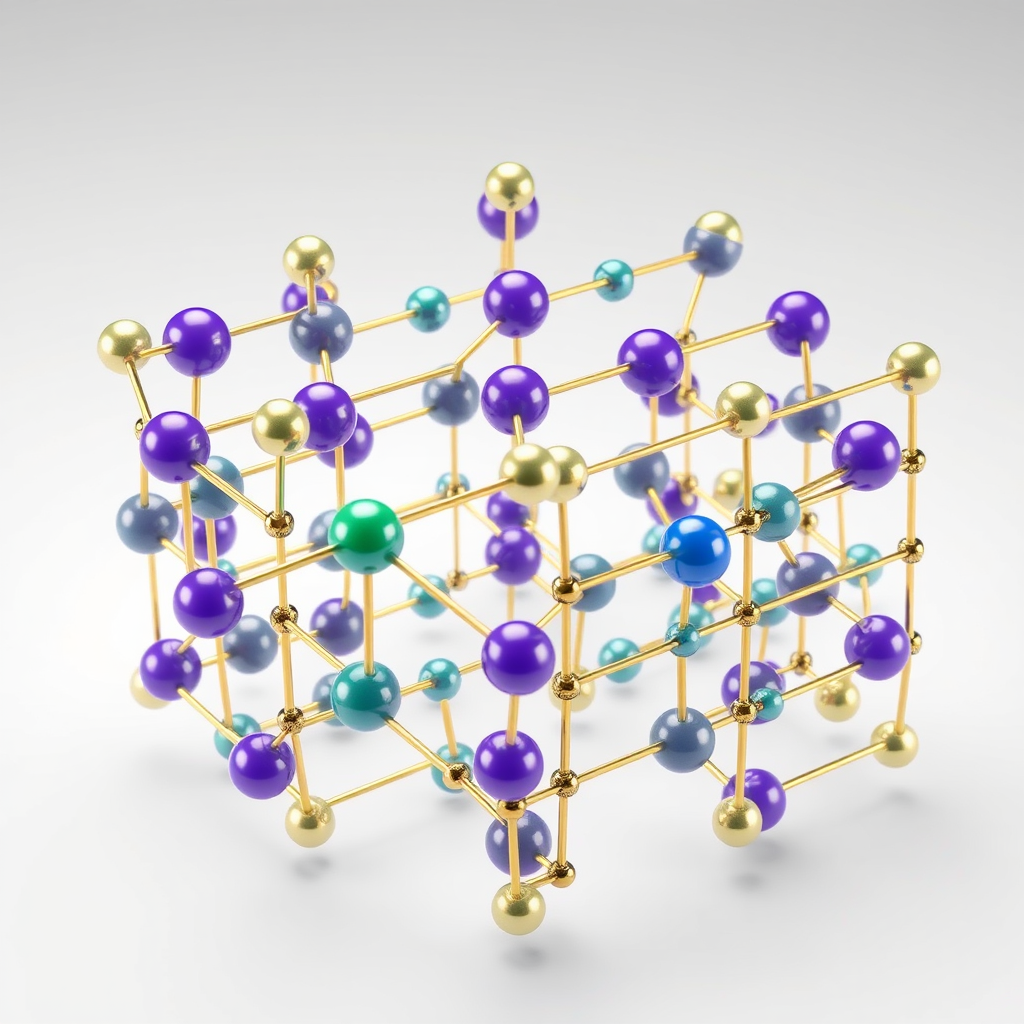
Molecular Structure
🎨 View AI Image Prompt
A photorealistic 3D ball-and-stick molecular structure visualization of Li₂(Mg₁₋ₓCaₓ)BeH₁₆ superconductor crystal lattice, professional chemistry textbook illustration style, showing lithium atoms as small violet spheres, magnesium and calcium atoms as medium green and blue spheres respectively, beryllium atoms as small gray spheres, and hydrogen atoms as small white spheres interconnected by precise cylindrical bond sticks, crystallographic unit cell outlined with thin golden wireframe edges, multiple unit cells extending in three dimensions showing periodic crystal symmetry, high-pressure metastable structural variant below 100 GPa configuration, quantum-accurate bond lengths and angles, depth-of-field photographic rendering with soft laboratory lighting, subtle ambient occlusion shadows enhancing three-dimensional depth perception, clean white to light gray gradient background, scientific publication quality, ultra-high detail 8K resolution rendering, professional crystallography software aesthetic, subtle specular highlights on atom spheres conveying glossy material properties, visible hydrogen clathrate cage network surrounding heavier metal centers, isometric perspective view showing full unit cell geometry.
🤖 Gemini 3.1 Pro Review
As an expert in the field, here is my critical review of the in-silico research paper by Opus 4.7. This computational screening of the Li₂(Mg₁₋ₓCaₓ)BeH₁₆ system presents a chemically intuitive "tuning knob" approach, but the report lacks the methodological rigor required for a credible theoretical claim. To be taken seriously, the work must detail the crystal structure prediction methods, the specific DFT functionals employed, and the full Eliashberg formalism calculations used to derive the electron-phonon coupling strength. The reliability of the headline 295.5 K Tc is highly questionable without explicit confirmation of the predicted structure's dynamical stability via phonon dispersion curves, ensuring the absence of imaginary modes. Furthermore, theoretical Tc values in hydrides are notoriously sensitive to computational parameters and often neglect strong anharmonic effects, which can significantly alter the result. The proposed experimental validation strategy, which correctly prioritizes the lower-pressure/high-Tc case, is sound, requiring synthesis in a diamond anvil cell with subsequent in-situ structural and transport measurements. To improve, the paper must provide comprehensive stability analyses (both dynamical and thermodynamic relative to decomposition products) and propose a plausible high-pressure synthesis route from available precursors. While the concept is promising, these results are currently too preliminary to be considered a viable roadmap for experimentalists. Without this foundational data, the work remains an interesting but speculative computational exercise.
Raw Data
Total cases: 200
Highest Tc: 295.5 K
Optimal pressure: 74.5 GPa

Top 5:
1. Tc=295.5K at 74.5GPa
2. Tc=291.1K at 64.2GPa
3. Tc=282.2K at 58.3GPa
4. Tc=280.5K at 65.6GPa
5. Tc=277.5K at 37.2GPa
![[Deep Dive] Scale-free localization in pseudo-Hermitian quantum walk](/content/images/size/w600/2026/10/deep_dive_thumb-9.png)