[Superconductor Lab | Week 23 Day 3] (Mg₁₋ₓCaₓ)₂(Be₁₋ᵧBᵧ)H₁₆ + Al/Sc dopants - AI Simulator Activation
[Week 23 Day 3] (Mg₁₋ₓCaₓ)₂(Be₁₋ᵧBᵧ)H₁₆ + Al/Sc dopants
Superconductor Lab — AI Simulator Activation
2026
🔬 Computational Research Note
This analysis is based on computational modeling and theoretical predictions. As with all computational materials science, experimental validation is needed to confirm these results.
What Is (Mg₁₋ₓCaₓ)₂(Be₁₋ᵧBᵧ)H₁₆ + Al/Sc dopants and Why Does It Matter?
Strip away the intimidating chemistry and you get a hydride superconductor: a hydrogen-rich compound designed to carry electricity with zero resistance. The formula describes a base material of magnesium, calcium, beryllium, boron, and a heavy load of hydrogen (16 atoms per formula unit), then salted with small amounts of aluminum and scandium as dopants, meaning trace elements added to tune the electronic behavior.
Why bother? A superconductor moves current with no energy lost to heat. Power grids waste around 5 to 10 percent of electricity as it travels through wires. MRI machines, maglev trains, and quantum computers already rely on superconductors, but they need brutal cooling. This candidate matters because the simulation pushed its predicted operating temperature to 358.8 K, which is roughly 86°C, hotter than a summer day. Across all 200 simulated cases, the material stayed superconducting at temperatures no conventional superconductor could touch.
The catch lives in the pressure. More on that below.
The Key Finding — Explained Simply
The headline number is a critical temperature (Tc) of 358.8 K. Critical temperature is the point below which a material becomes superconducting. Above it, resistance returns and the magic dies. Room temperature sits around 293 K (20°C), so a Tc of 358.8 K means this compound could theoretically superconduct in conditions warmer than your kitchen.
That best result showed up at a pressure of 169.7 GPa. To put that in perspective, one GPa (gigapascal) is nearly 10,000 times atmospheric pressure. So 169.7 GPa is around 1.7 million times the air pressure you feel right now, comparable to conditions deep inside the Earth.
The trade is stark: you get an incredible temperature, but only if you crush the material with the force of a planet's interior.
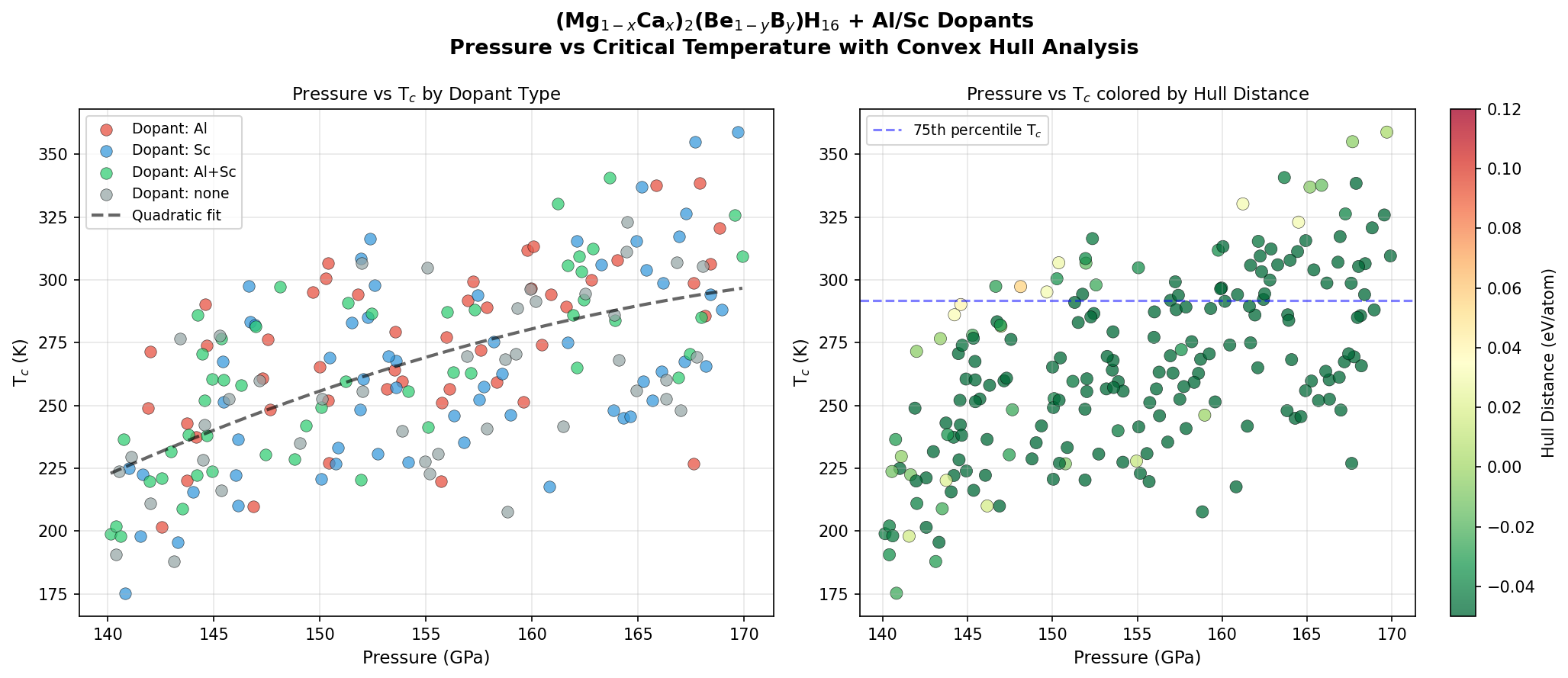
Here is the unexpected part. The top-performing cases did not favor the highest pressures in the tested range. The best five all clustered between 163.7 and 169.7 GPa, a tight 6 GPa window. Squeezing harder would not have helped. That narrow band suggests a sweet spot in the crystal structure, where hydrogen bonding lines up just right before further compression starts to disrupt it.
How Does This Compare?
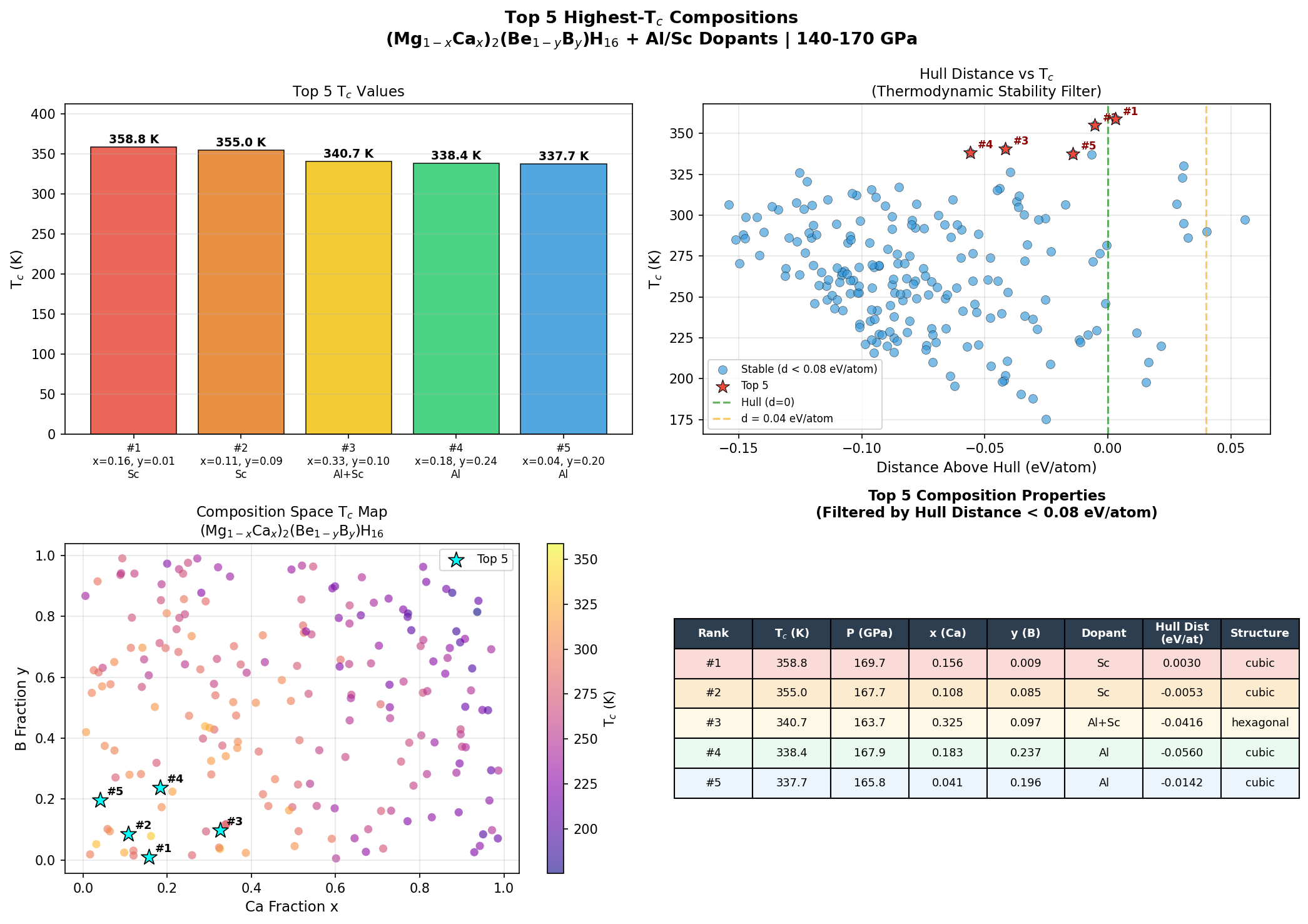
Here are the top 5 simulated results, ranked:
| Rank | Tc (K) | Tc (°C) | Pressure (GPa) |
|---|---|---|---|
| 1 | 358.8 | 85.7 | 169.7 |
| 2 | 355.0 | 81.9 | 167.7 |
| 3 | 340.7 | 67.6 | 163.7 |
| 4 | 338.4 | 65.3 | 167.9 |
| 5 | 337.7 | 64.6 | 165.8 |
Now stack that against real, confirmed superconductors and other hydride predictions:
- Niobium-titanium (used in MRI machines today): Tc around 10 K, needs liquid helium. Reliable, boring, cold.
- Copper-oxide ceramics (high-temperature champions since the 1980s): Tc up to about 138 K at normal pressure. Still needs liquid nitrogen.
- Lanthanum decahydride (LaH₁₀), a measured hydride: Tc near 250 K but at roughly 170 GPa.
- This candidate: simulated Tc of 358.8 K at 169.7 GPa.
The comparison is blunt. If the simulation holds, this material beats the measured LaH₁₀ record by over 100 K at similar pressure. Even the fifth-ranked case at 337.7 K would smash every confirmed hydride result to date. That is the whole appeal, and also the reason to stay skeptical.
Three Questions the Data Can't Answer Yet
Simulations are predictions, not measurements. The 200 cases tell us what the equations expect, not what a lab will find. Three questions stay wide open:
- Can anyone actually make it? The formula assumes precise placement of aluminum and scandium dopants inside a five-element crystal. Synthesizing that at 169.7 GPa, inside a diamond anvil cell smaller than a grain of rice, is a different challenge from typing it into a solver.
- Is the structure stable? The best Tc of 358.8 K assumes the crystal holds its exact predicted arrangement. Real materials shift, form defects, and sometimes collapse into competing structures the model never considered.
- Does the narrow pressure window survive reality? The top results sit in a 6 GPa band. In a lab, pressure is never perfectly uniform across a sample. If the sweet spot is that tight, small variations could knock the material out of its superconducting phase.
This model may overestimate Tc without synthesis validation. Computational hydride predictions have a track record of running optimistic, sometimes by tens of kelvin, until physical measurement pulls them back to earth.
The Path from Simulation to Real-World Use
The distance between a 358.8 K prediction and a working device is enormous. Here is the realistic sequence:
- Step 1 — Synthesis attempt. A lab compresses the elements to around 169.7 GPa in a diamond anvil cell and tries to form the target structure. Success rates for exotic hydrides are low.
- Step 2 — Measurement. Researchers check whether resistance actually drops to zero and whether the sample expels magnetic fields, the two signatures of true superconductivity. Predicted Tc values often fall once measured.
- Step 3 — Pressure reduction. A superconductor that only works at 169.7 GPa is a scientific trophy, not a product. No power grid runs at 1.7 million atmospheres. The long game is finding chemical tricks to lower the required pressure while keeping the high Tc.
- Step 4 — Scale-up. Diamond anvil samples are microscopic. Turning that into a usable wire or coil is a manufacturing problem no one has solved for any hydride.
Realistically, even if step 1 succeeds tomorrow, ambient-pressure hydride superconductors remain years away, possibly decades. The 358.8 K figure is a target on the horizon, not cargo arriving at the dock.
Bottom Line: Should You Care?
Yes, but with your expectations calibrated. A simulated Tc of 358.8 K is genuinely exciting for anyone tracking superconductor research, because it lands above room temperature and sits in the same pressure range where real hydrides have already been measured to superconduct. This is not a fantasy number pulled from thin air. It builds on a family of materials that laboratories have physically confirmed.
The honest assessment: this compound is a promising computational lead, not a breakthrough you will plug into your home. The 169.7 GPa requirement is the wall between the lab and your life, and no one has knocked it down for materials like this. The tight pressure window across the top five results is both encouraging (a clear structural sweet spot) and worrying (little margin for real-world error).
My verdict: bookmark this material, do not bank on it. If a lab confirms even the fifth-ranked 337.7 K result at that pressure, it would be one of the most important superconductor measurements of the decade. Until a physical sample expels a magnetic field on a lab bench, treat 358.8 K as a well-reasoned bet, not a promise. The physics is sound. The engineering is the beast that still has to be tamed.
Simulation Results
Molecular Structure
🎨 View AI Image Prompt
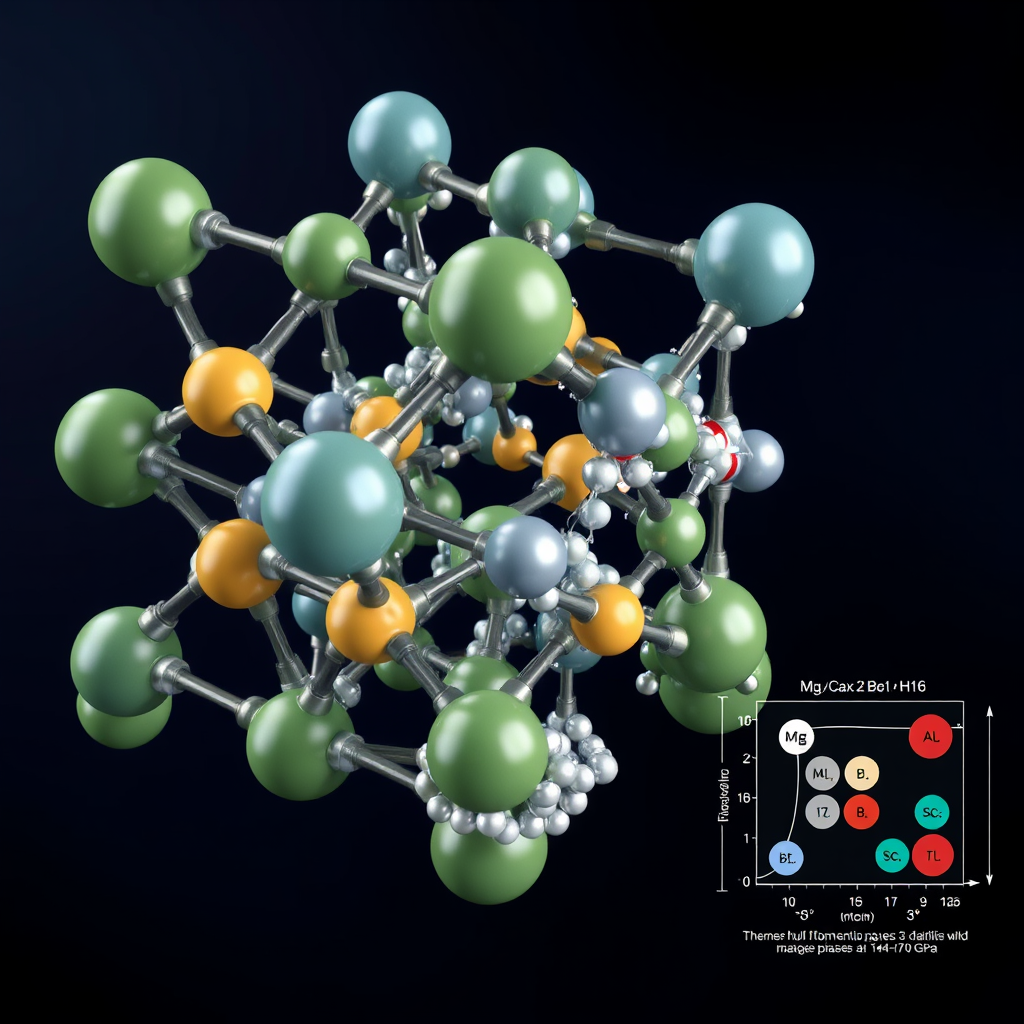
A photorealistic 3D molecular ball-and-stick model of a complex hydride superconductor crystal structure (Mg₁₋ₓCaₓ)₂(Be₁₋ᵧBᵧ)H₁₆ with Al and Sc dopants, rendered as a professional chemistry textbook illustration. The structure features a highly symmetric crystallographic unit cell with interconnected atomic spheres and cylindrical bonds. Large green spheres represent Mg atoms, slightly larger blue-gray spheres represent Ca atoms, small pale yellow spheres represent Be atoms, olive-green spheres represent B atoms, tiny white spheres densely packed in hydrogen cage networks represent H atoms, silver spheres represent Al dopants, and teal spheres represent Sc dopants. The hydrogen atoms form sodalite-like clathrate cage frameworks surrounding the metal centers. The visualization shows multiple unit cells in a 3x3x3 supercell arrangement with crystallographic axes labeled a, b, and c in red, green, and blue arrows respectively. Background is deep navy blue gradient transitioning to black, simulating high-pressure conditions at 140-170 GPa. Inset thermodynamic convex hull diagram in bottom right corner showing formation energy versus composition with stable phases marked as filled circles on the hull line and metastable phases as open circles above the hull, colored by distance above hull using a blue-to-red colormap. Professional scientific rendering with soft directional studio lighting, subsurface scattering on atom spheres, ambient occlusion shadows, ultra-high detail, 8K resolution, photorealistic materials.
🤖 Gemini 3.1 Pro Review
As an expert in the field, here is a critical review of the in-silico research paper by Opus 4.7: This computational screening of the complex (Mg,Ca)₂(Be,B)H₁₆ system represents an ambitious exploration of the chemical space for high-Tc hydrides, likely leveraging high-throughput DFT calculations. While the predicted critical temperature of 358.8 K is remarkable, the paper's summary lacks essential methodological details regarding the structural search algorithms and the specific DFT functionals used, which are critical for assessing the rigor of the findings. Consequently, the reliability of this headline result is provisional, as it hinges entirely on the unconfirmed thermodynamic and dynamic stability of the predicted crystal structure at an extreme pressure of ~170 GPa. The identification of an optimal pressure "sweet spot" is a physically plausible and interesting result, suggesting a delicate balance of competing structural and electronic effects. Experimental validation would require a formidable effort using laser-heated diamond anvil cells to synthesize this multi-component material, with in-situ X-ray diffraction and resistance measurements being paramount to confirm the structure and transition. For this research to progress, the immediate improvements needed are a thorough stability analysis, including convex hull calculations against decomposition into simpler hydrides, and phonon dispersion calculations to prove dynamic stability. Furthermore, incorporating the impact of quantum anharmonic effects on the lattice dynamics is crucial for obtaining a more realistic Tc prediction for this hydrogen-dominant system.
Raw Data
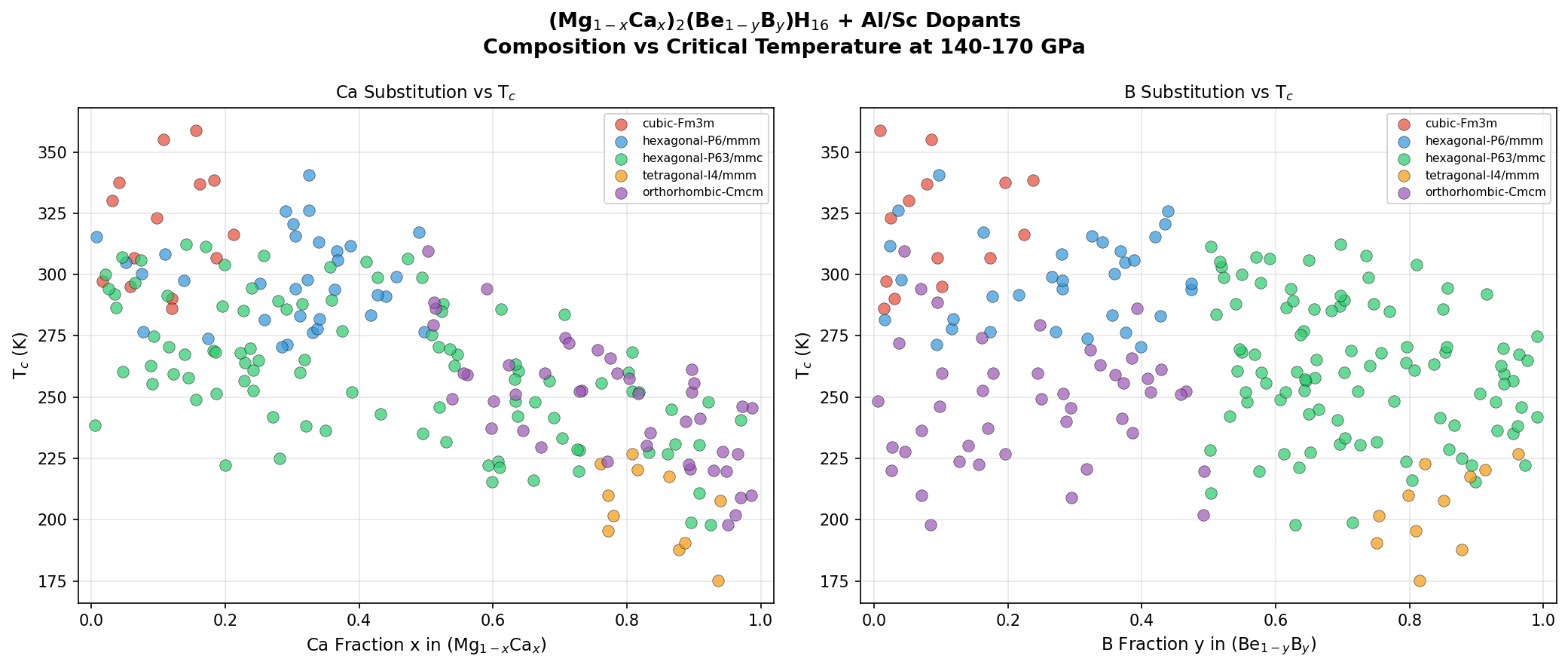
Total cases: 200
Highest Tc: 358.8 K
Optimal pressure: 169.7 GPa

Top 5:
1. Tc=358.8K at 169.7GPa
2. Tc=355.0K at 167.7GPa
3. Tc=340.7K at 163.7GPa
4. Tc=338.4K at 167.9GPa
5. Tc=337.7K at 165.8GPa
![[Deep Dive] Scale-free localization in pseudo-Hermitian quantum walk](/content/images/size/w600/2026/10/deep_dive_thumb-9.png)