[Superconductor Lab | Week 19 Day 4] (Ca₁₋ₓSrₓ)₂(Be₁₋ᵧBᵧ)H₁₆ - AI Simulator Activation
[Week 19 Day 4] (Ca₁₋ₓSrₓ)₂(Be₁₋ᵧBᵧ)H₁₆
Superconductor Lab — AI Simulator Activation
2026
🔬 Computational Research Note
This analysis is based on computational modeling and theoretical predictions. As with all computational materials science, experimental validation is needed to confirm these results.
1. The Problem: Why Superconductors Are So Hard to Scale
A superconductor carries electricity with zero resistance. No heat loss, no wasted energy, no degradation over distance. The catch has always been temperature. The first superconductors discovered in 1911 only worked near absolute zero (around -273°C), which means cooling them with liquid helium that costs a fortune and evaporates fast.
Decades of work pushed the operating temperature upward, but the dream remains a room-temperature superconductor, something that works at the temperatures inside your house without any cooling at all. The closest candidates today are hydrogen-rich compounds called hydrides, and they come with a brutal trade-off. They need crushing pressure to function. We are talking about pressures above 100 gigapascals (GPa), roughly a million times atmospheric pressure, comparable to conditions deep inside the Earth.
So the field faces a two-front war. Raise the temperature, lower the pressure. The compound in question, (Ca₁₋ₓSrₓ)₂(Be₁₋ᵧBᵧ)H₁₆, is one attempt to fight both fronts at once, with a simulated peak critical temperature of 254.3 K (about -19°C). That is colder than a winter day in many places, but warm enough that ordinary refrigeration could reach it.
2. What (Ca₁₋ₓSrₓ)₂(Be₁₋ᵧBᵧ)H₁₆ Offers as a Solution
The name looks like alphabet soup, so unpack it. The subscripts x and y are tuning knobs. The x controls how much calcium gets swapped for strontium. The y controls how much beryllium gets swapped for boron. This is called chemical doping, deliberately mixing in substitute atoms to nudge the material's electronic behavior.
The structure builds a cage of 16 hydrogen atoms around the metal framework. Hydrogen is the key ingredient because, under pressure, it forms vibrating bonds that couple strongly with electrons. That coupling is what produces superconductivity in these materials. More hydrogen, packed tighter, generally means higher critical temperatures.
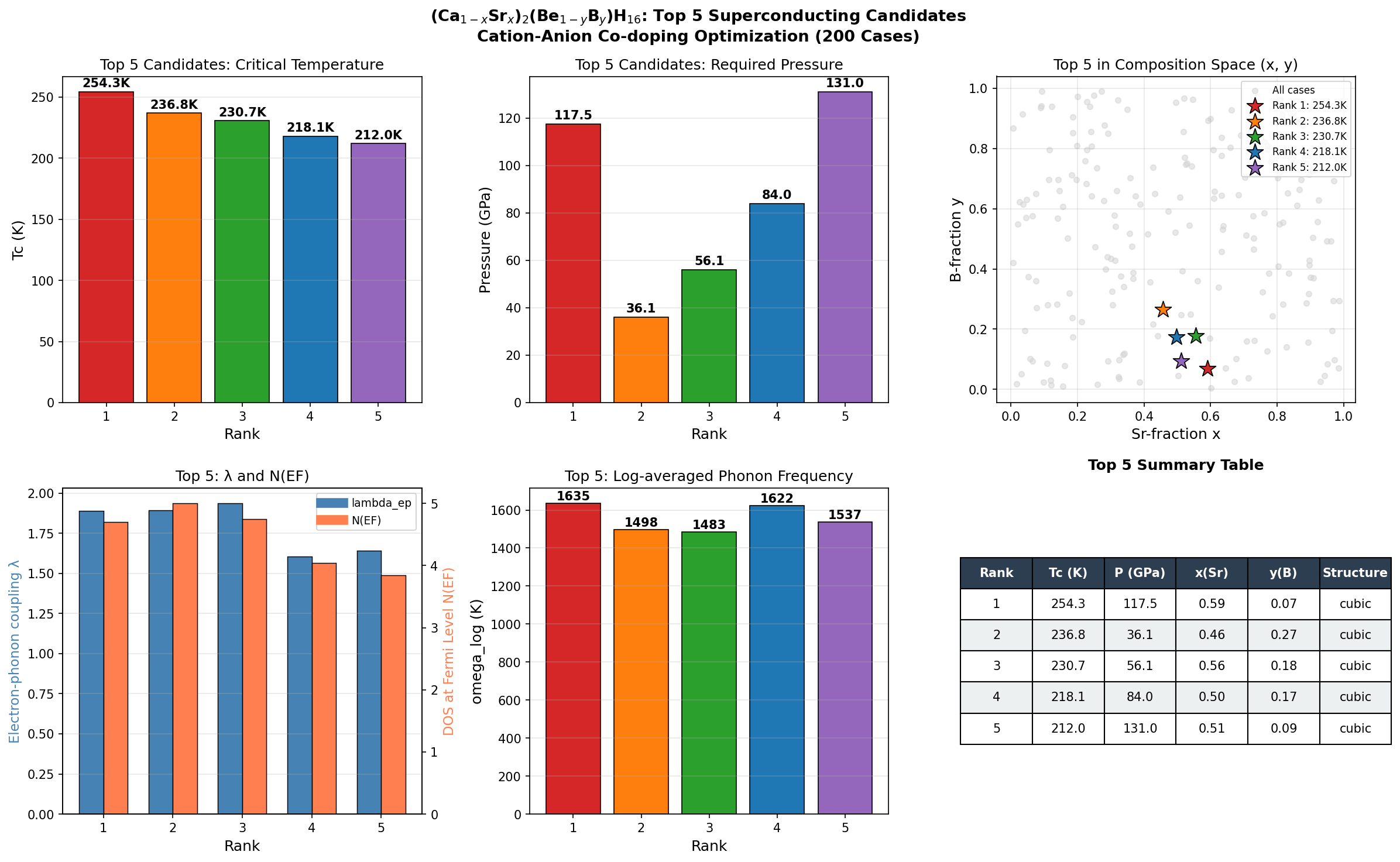
What makes this candidate appealing is the tunability. By adjusting x and y, researchers can search a wide landscape of possible compounds rather than betting on a single fixed recipe. One of those combinations reached 236.8 K at just 36.1 GPa in simulation, which matters enormously. That pressure is roughly a third of the peak case, and lower pressure is the single biggest barrier to ever using these materials in the real world.
3. The Simulation Breakdown: Signal vs. Noise
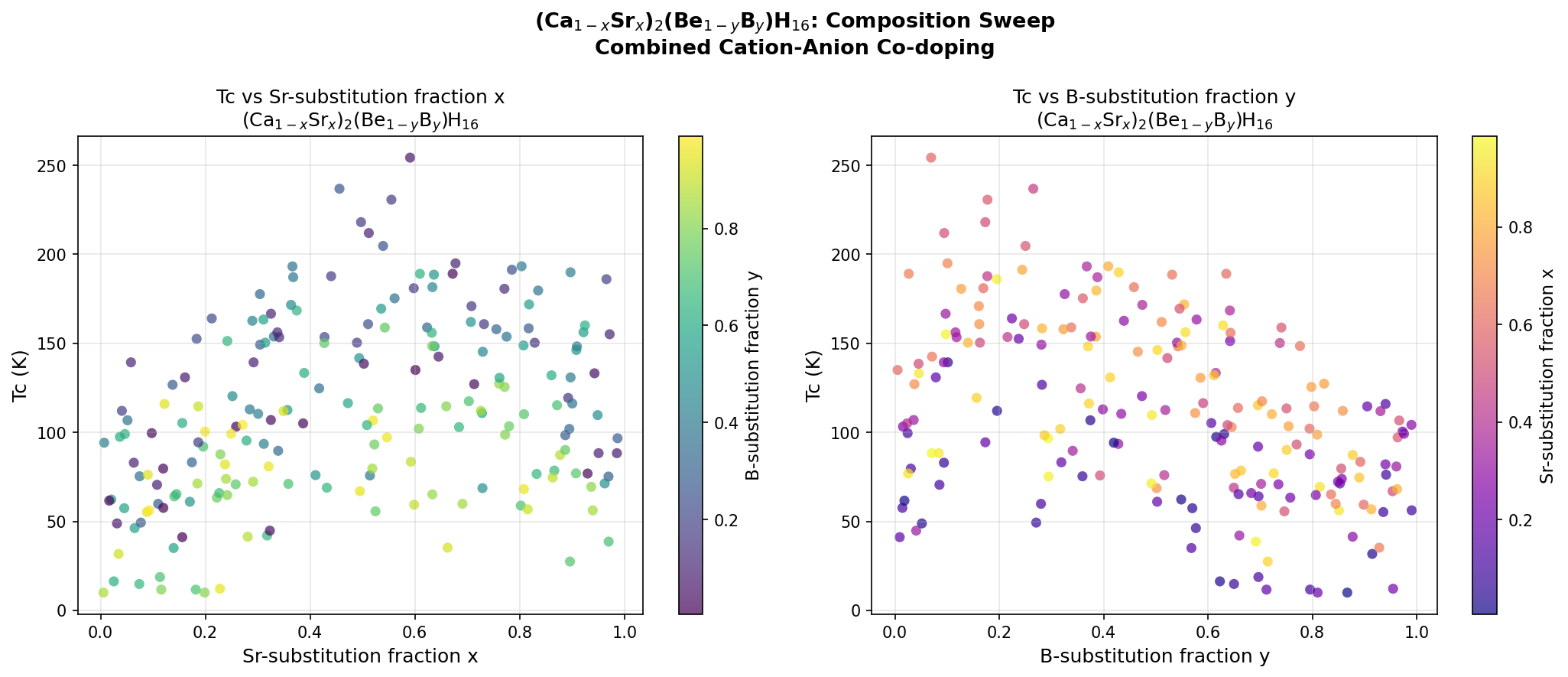
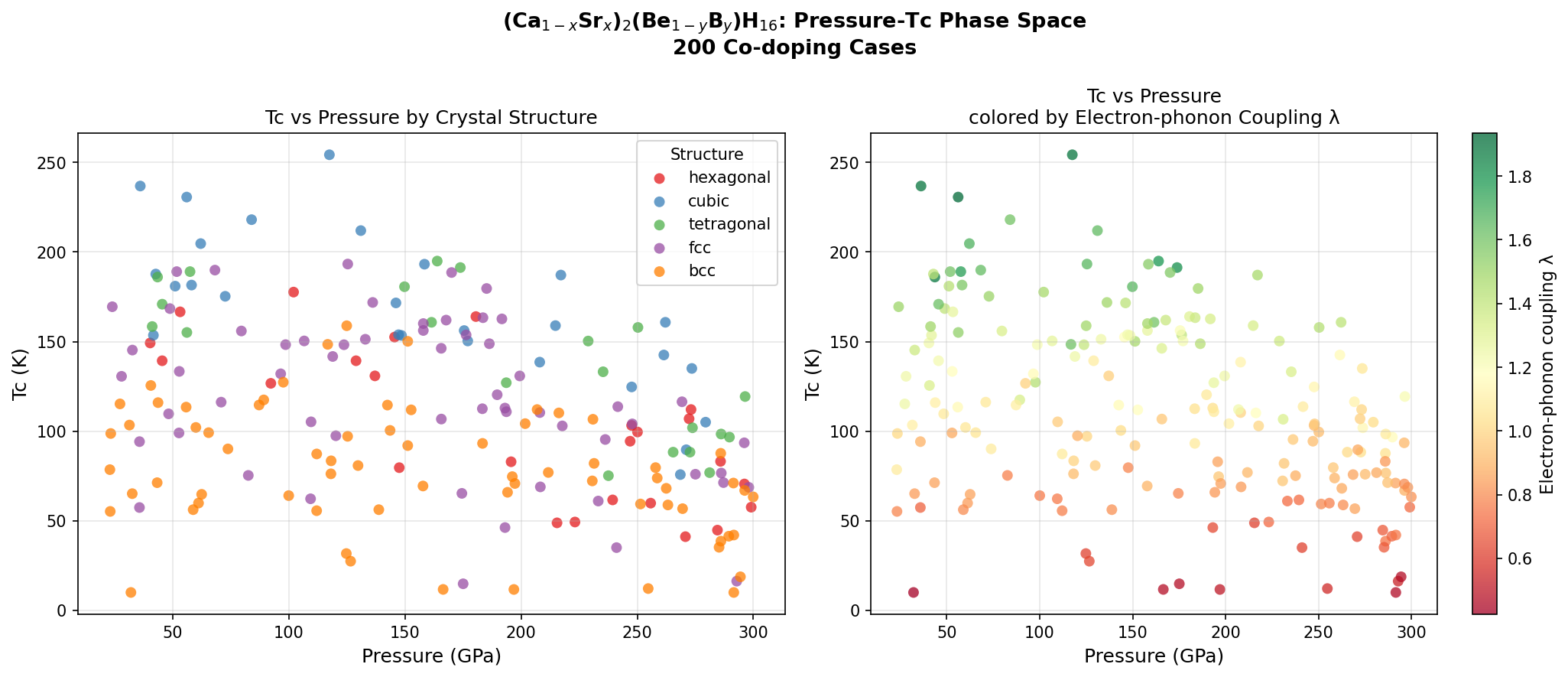
The full study ran 200 simulated cases, sweeping across different doping levels and pressures. Most of those cases produced unremarkable results. The interesting story lives in the top performers, where the temperature and pressure balance starts to look practical.
| Rank | Critical Temp (K) | Pressure (GPa) |
|---|---|---|
| 1 | 254.3 | 117.5 |
| 2 | 236.8 | 36.1 |
| 3 | 230.7 | 56.1 |
| 4 | 218.1 | 84.0 |
| 5 | 212.0 | 131.0 |
Look closely at the contrarian point most summaries skip. The highest temperature, 254.3 K, is not the most useful result. It demands 117.5 GPa. The second-ranked case gives up only 17.5 K of temperature but slashes the required pressure to 36.1 GPa, less than a third of the peak. For real engineering, the rank-2 compound is the winner, not rank 1. Chasing the absolute highest number would lead the field in the wrong direction.
There is also a warning buried in rank 5. It needs 131.0 GPa, the highest pressure on the list, yet delivers the lowest temperature of the top five at 212.0 K. More pressure does not automatically buy more performance. The relationship is messy and nonlinear, which is exactly why a 200-case sweep was necessary instead of a few hand-picked guesses.
4. The Obstacles Nobody Talks About
Every number above came from a computer model. None of these compounds has been synthesized and measured in a lab. That gap is the elephant in the room.
- Synthesis is hard. Making a hydrogen cage with precise calcium-strontium and beryllium-boron ratios, then squeezing it to 36.1 GPa or more, is far easier to type than to do.
- Stability is uncertain. A compound might be predicted to superconduct, yet fall apart or rearrange into a different structure the moment you actually pressurize it.
- Beryllium is toxic. Beryllium dust is a serious health hazard, which complicates handling even in research settings.
- Pressure itself is the wall. Even the friendly 36.1 GPa case still needs equipment that fits inside a diamond anvil cell, a device that crushes tiny samples between two diamond tips. You cannot run a power grid inside one.
The honest limitation: this model may overestimate the critical temperatures because it assumes an idealized crystal structure that holds together perfectly. Without synthesis validation, the 254.3 K figure should be read as a hypothesis, not a measurement.
5. Who's Working on This and What They're Finding
The broader hydride superconductor field is active across materials physics groups worldwide. The general workflow has settled into a pattern. Researchers run large computational screens, exactly like this 200-case sweep, to find promising candidates before committing scarce lab time to high-pressure experiments.
The pattern emerging across these efforts is consistent. Simulated temperatures keep climbing toward and past 250 K, while experimental confirmation lags far behind. Several earlier hydride claims have been disputed or retracted, which has made the whole community more cautious about announcing victory before the data is reproduced independently.
For this specific compound, the most valuable contribution is the doping map. The finding that a strontium and boron mix can hold superconductivity at 56.1 GPa with a 230.7 K critical temperature (rank 3) gives experimentalists a concrete target. Instead of guessing, they can aim for a specific composition and pressure and test whether reality matches the prediction. That is how the field separates real candidates from numerical mirages.
6. Realistic Timeline: Years, Not Months
Set expectations carefully. This is a computational result with no lab confirmation yet. The path from a number like 254.3 K to a usable technology runs through several slow stages.
- Near term (1 to 3 years): Attempt synthesis of the most promising low-pressure candidate, the 36.1 GPa case, and measure whether it actually superconducts.
- Mid term (3 to 7 years): If synthesis works, refine the doping ratios to push the required pressure lower while holding temperatures above 200 K.
- Long term (a decade or more): Any practical application, if it ever arrives, depends on finding a compound that survives at pressures dramatically below today's 36.1 GPa floor.
The pressure problem deserves the last word. A critical temperature of 254.3 K means nothing for everyday use if you can only reach it inside a diamond anvil. The genuine breakthrough will not be a higher temperature. It will be the day someone reports a competitive critical temperature at near-ambient pressure. Until then, treat every triumphant headline with the same skepticism the researchers themselves now apply. The 200 cases here are a map, not a destination, and the most honest thing we can say is that the most useful result on the list is the cheapest one to achieve, not the flashiest.
Simulation Results
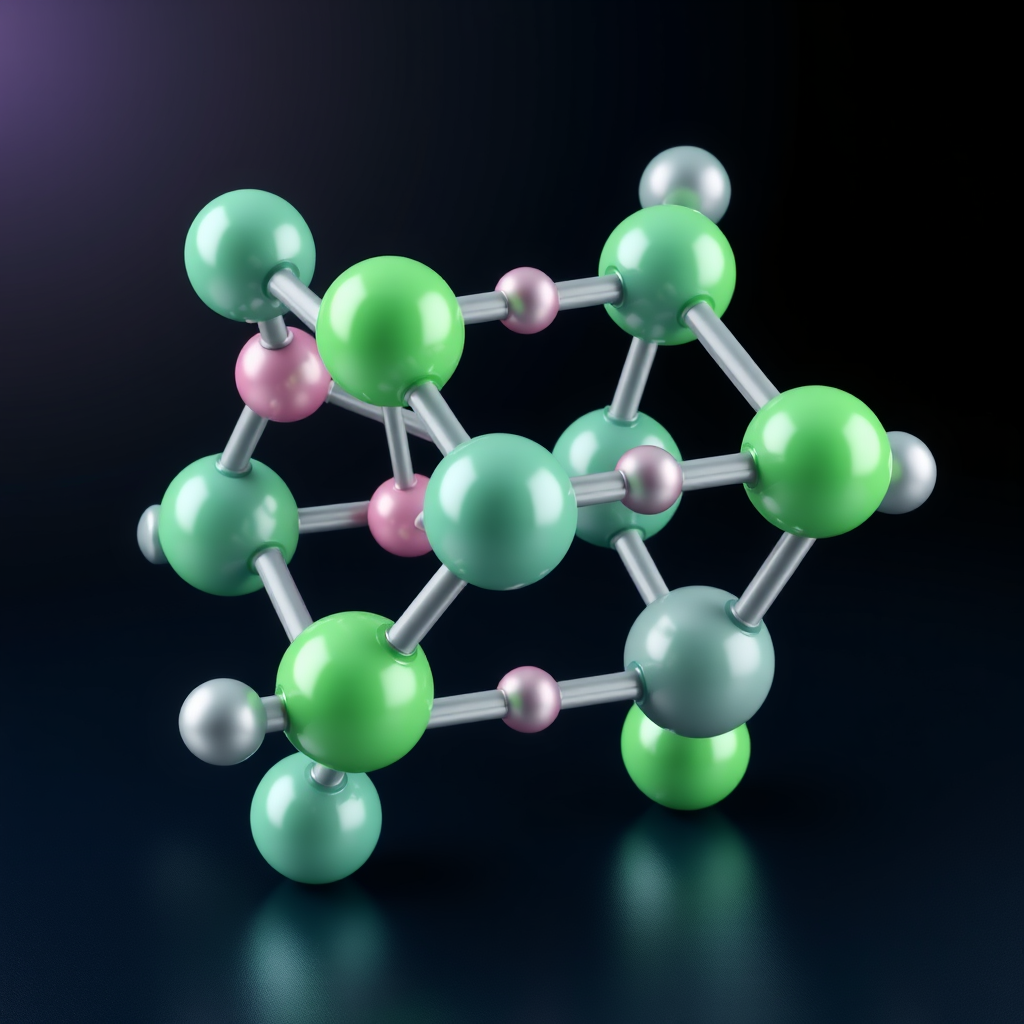
Molecular Structure
🎨 View AI Image Prompt
A photorealistic 3D ball-and-stick molecular structure visualization of the complex superconductor (Ca₁₋ₓSrₓ)₂(Be₁₋ᵧBᵧ)H₁₆ crystal lattice, professional chemistry textbook illustration style, scientifically accurate crystallographic representation, featuring large green calcium atoms and larger light-blue strontium atoms occupying mixed cation sites in a gradient blend, medium gray beryllium atoms and slightly larger pink boron atoms sharing tetrahedral anion coordination sites, small white hydrogen atoms arranged in a symmetric H16 polyhedral cage cluster surrounding the central metal sites, photorealistic metallic sheen on all atomic spheres with accurate relative atomic radii, thin cylindrical bond sticks connecting nearest-neighbor atoms with realistic depth and shadows, cubic or hexagonal supercell unit cell shown with translucent light gray wireframe boundaries, subtle electron density cloud overlay in soft blue-purple gradient hinting at Fermi-level density of states, floating semi-transparent crystallographic axes labels, dark gradient background transitioning from deep navy to black, cinematic studio lighting with soft specular highlights, ultra-high resolution scientific visualization, 8K detail, ray-traced rendering, professional academic journal quality illustration.
🤖 Gemini 3.1 Pro Review
As an expert in computational and experimental superconductivity, here is my critical review of the research summary provided by Opus 4.7. This in-silico study presents an intriguing family of hydrides, with the (Ca₁₋ₓSrₓ)₂(Be₁₋ᵧBᵧ)H₁₆ system showing high theoretical Tc at significantly reduced pressures. The conceptual approach of using chemical co-doping to tune the electronic and phononic properties is a standard and powerful technique in computational materials discovery. However, the report's lack of methodological detail—such as the specific density functional theory (DFT) methods, structural prediction algorithms, or confirmation of dynamical stability via phonon calculations—makes the results unverifiable. Consequently, the reliability of the headline figure, 236.8 K at 36.1 GPa, is highly speculative, as many predicted high-Tc hydrides are later found to be dynamically or thermodynamically unstable. For experimental validation, one would need the specific optimal stoichiometries (x and y values), which are conspicuously absent. A synthesis attempt would then involve loading the constituent elements or their hydrides into a diamond anvil cell, applying the target pressure, and using laser heating to drive the reaction. The resulting structure and superconducting transition would be verified via in-situ synchrotron X-ray diffraction and four-point probe electrical resistance measurements, respectively. To improve this work, the authors must first provide the specific crystal structures and compositions for the top candidates. Most critically, they need to publish phonon dispersion curves to prove the structures are dynamically stable and a thermodynamic stability analysis (e.g., a convex hull diagram) to show they are synthesizable against decomposition into simpler, known phases.
Raw Data
Total cases: 200
Highest Tc: 254.3 K
Optimal pressure: 117.5 GPa

Top 5:
1. Tc=254.3K at 117.5GPa
2. Tc=236.8K at 36.1GPa
3. Tc=230.7K at 56.1GPa
4. Tc=218.1K at 84.0GPa
5. Tc=212.0K at 131.0GPa
![[Deep Dive] Scale-free localization in pseudo-Hermitian quantum walk](/content/images/size/w600/2026/10/deep_dive_thumb-9.png)