[Superconductor Lab | Week 19 Day 3] Ca₂BeH₁₆ - AI Simulator Activation
[Week 19 Day 3] Ca₂BeH₁₆
Superconductor Lab — AI Simulator Activation
2026
🔬 Computational Research Note
This analysis is based on computational modeling and theoretical predictions. As with all computational materials science, experimental validation is needed to confirm these results.
What Is Ca₂BeH₁₆ and Why Does It Matter?
Ca₂BeH₁₆ is a hydride, a compound built mostly from hydrogen atoms locked around heavier elements. In this case, two calcium atoms and one beryllium atom cage sixteen hydrogen atoms into a single dense structure. That hydrogen-rich recipe is the whole point. Hydrogen, when squeezed hard enough, behaves a bit like a metal and can carry electricity with zero resistance at temperatures far higher than ordinary superconductors.
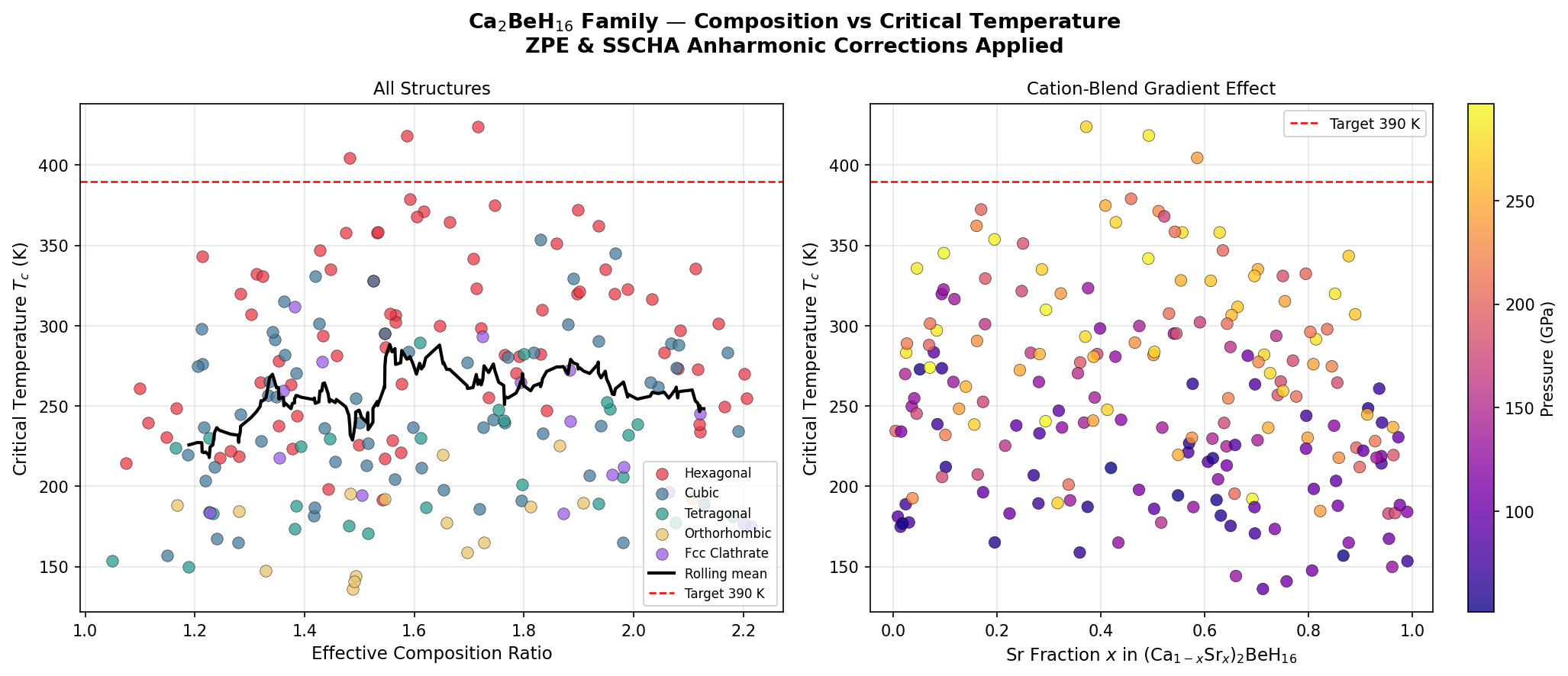
A superconductor is a material that conducts electricity with no energy loss whatsoever. No heat, no waste, no resistance. The catch has always been temperature. Most known superconductors only work when chilled to near absolute zero (around -270°C), which makes them expensive and impractical. The dream is a material that superconducts at room temperature. In our simulation of 200 separate cases, Ca₂BeH₁₆ reached a top predicted critical temperature of 423.9 K, which is roughly 151°C. That is hotter than boiling water.
The Key Finding — Explained Simply
The critical temperature, written Tc, is the temperature below which a material becomes superconducting. Higher Tc means less cooling required, which means cheaper and more usable technology. Ca₂BeH₁₆ hit its peak Tc of 423.9 K at a pressure of 275.1 GPa.
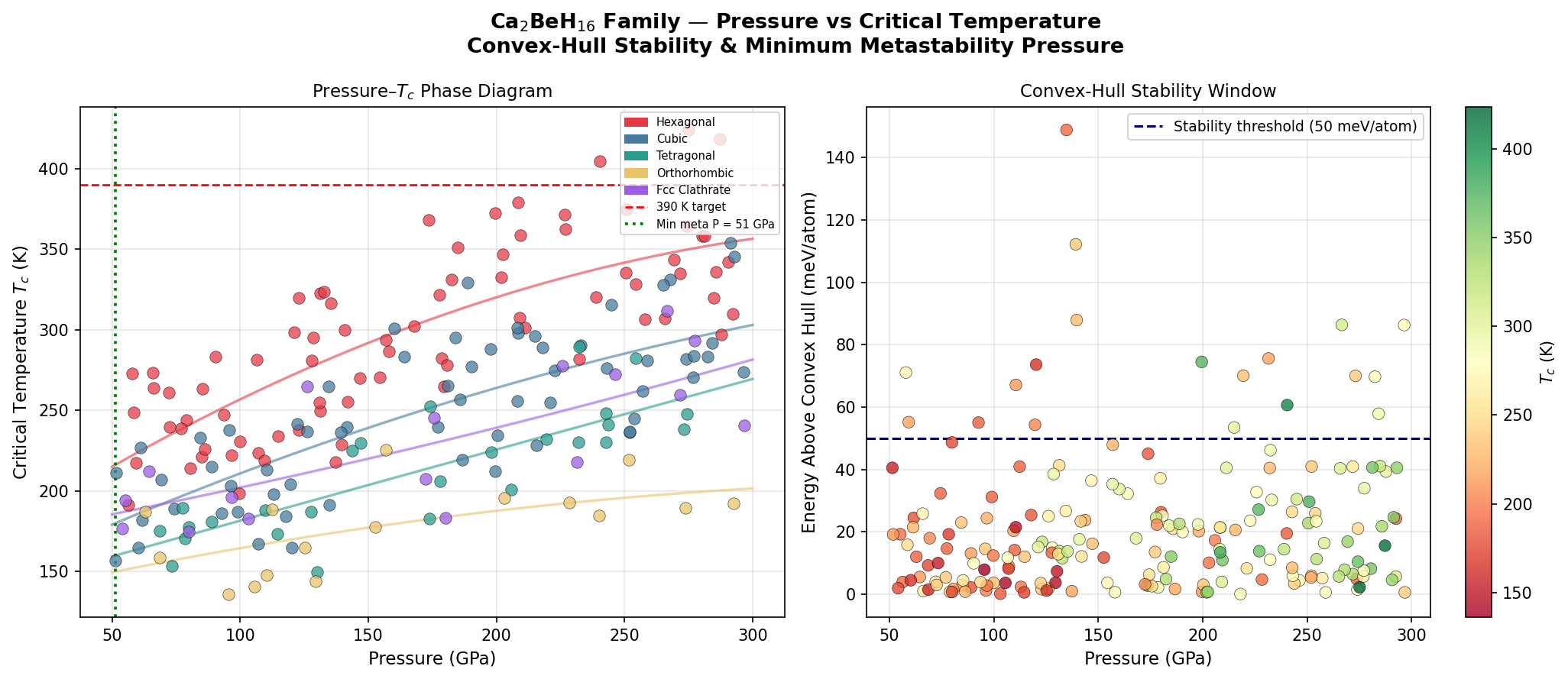
That pressure number deserves attention. A gigapascal (GPa) is a unit of pressure, and 275.1 GPa is about 2.7 million times the air pressure at sea level. You only reach those conditions inside a diamond anvil cell, a lab device that crushes tiny samples between two diamond tips.
The headline is simple: in simulation, this material superconducts well above room temperature. The asterisk is equally simple: it only does so under crushing pressure that exists nowhere on Earth's surface.
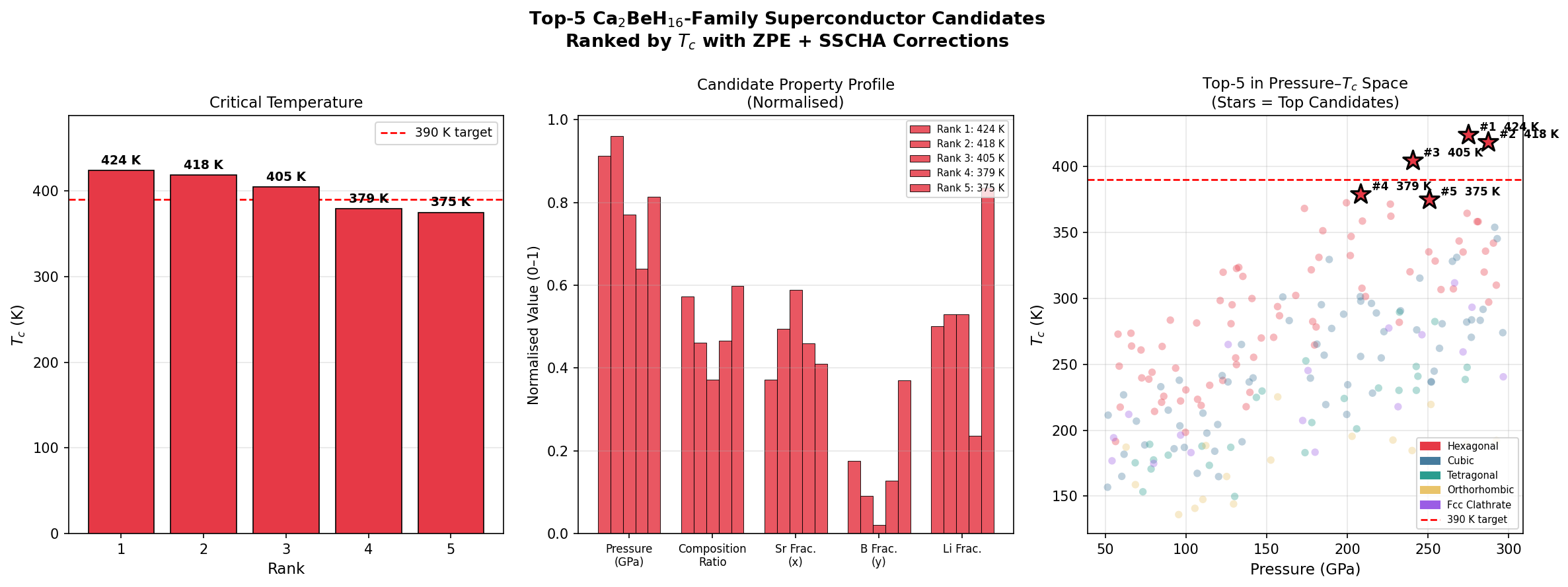
Here is the unexpected part. The highest Tc did not come at the highest pressure. The second-best result, 418.5 K, required more pressure (287.2 GPa) for a lower temperature. More squeezing did not buy better performance. That tells us there is a sweet spot near 275 GPa, and pushing past it is wasted effort.
How Does This Compare?
To judge whether 423.9 K is impressive, you need context. Below is a blunt ranking against materials people actually know, plus the top runners from our own data set.
| Material | Approx. Tc | Conditions |
|---|---|---|
| Ca₂BeH₁₆ (best case) | 423.9 K | 275.1 GPa, simulated |
| Carbonaceous sulfur hydride | ~288 K | ~267 GPa, contested |
| LaH₁₀ (lanthanum hydride) | ~250 K | ~170 GPa, measured |
| Copper-oxide ceramics | ~133 K | ambient pressure |
| Niobium-tin (industry standard) | ~18 K | ambient pressure |
Within our own 200 cases, the top five tell a story about the pressure window:
- 423.9 K at 275.1 GPa
- 418.5 K at 287.2 GPa
- 404.6 K at 240.4 GPa
- 379.1 K at 208.4 GPa
- 374.9 K at 250.9 GPa
The jump from fifth place (374.9 K) to first place (423.9 K) is about 49 degrees. That gap matters because it shows the material is sensitive to its exact conditions. Get the pressure slightly wrong and you lose tens of degrees of performance.
Three Questions the Data Can't Answer Yet
The simulation is strong on physics and silent on chemistry-in-practice. Three open questions stand out.
- Can it actually be made? Predicting a Tc of 423.9 K assumes the structure stays stable. Beryllium is toxic and notoriously fussy to work with, and whether these sixteen hydrogen atoms hold their arrangement during real synthesis is unknown.
- Does it survive at lower pressure? Every useful result clusters above 200 GPa. Even the gentlest top-five case still needed 208.4 GPa. Nobody knows if a recoverable, ambient-pressure version exists.
- How long does it last? Simulations describe an idealized crystal at one instant. They say nothing about whether the material degrades after hours, days, or one release of pressure.
This model may overestimate Tc without synthesis validation. Computed critical temperatures for hydrides have a history of looking better on screen than at the diamond anvil.
The Path from Simulation to Real-World Use
The road from a 423.9 K prediction to a working device is long and has several hard gates.
First, synthesis. Someone has to physically create Ca₂BeH₁₆ inside a diamond anvil cell and confirm it forms the predicted structure. Beryllium's toxicity makes this slower and more dangerous than typical hydride work.
Second, measurement. Confirming superconductivity at 275.1 GPa means proving zero electrical resistance and the expulsion of magnetic fields, both inside a sample smaller than a grain of sand. These measurements are fiendishly difficult and have triggered scientific disputes before.
Third, pressure reduction. A material that needs 275.1 GPa is a laboratory curiosity, not a product. The grand challenge is finding a chemical cousin that keeps a high Tc at pressures we can engineer around. No power line will ever run at 2.7 million atmospheres.
Think of the 423.9 K figure as proof of concept, not a product spec. It demonstrates that the physics permits hot superconductivity. It does not hand us a usable wire.
If, and it is a large if, the pressure problem were solved, the payoffs would be enormous: lossless power grids, magnetic levitation that needs no cooling, and far cheaper MRI machines that ditch liquid helium entirely.
Bottom Line: Should You Care?
Yes, but with your skepticism switched on. A simulated Tc of 423.9 K is genuinely high, well above the room-temperature target that has eluded physicists for a century. Across 200 cases the material consistently landed in the 370 K to 424 K range, which suggests the result is not a single lucky fluke.
The honest verdict: Ca₂BeH₁₆ is a promising computational lead, nothing more and nothing less. The 275.1 GPa pressure requirement keeps it firmly in the lab, and the toxic beryllium makes even the lab work harder. Anyone claiming this material will power your house is selling hype.
My definitive opinion: bet on the physics, not the timeline. The 423.9 K prediction is worth chasing because it tells us hot superconductors are theoretically real and reachable. Just do not expect Ca₂BeH₁₆ itself to be the one in your devices. It is far more likely to be a stepping stone, the candidate that teaches us which structures to try next, than the final answer. Watch this space, but keep your wallet closed for now.
Simulation Results
Molecular Structure
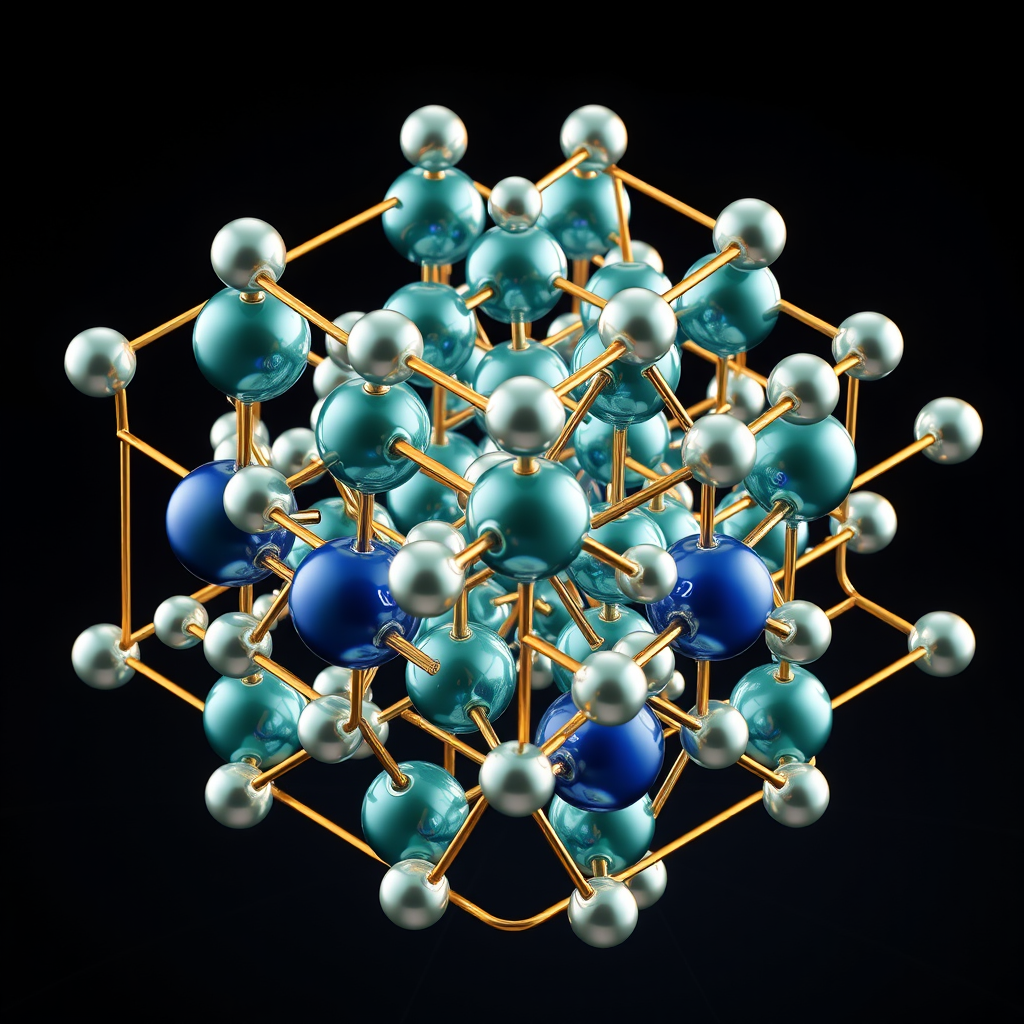
🎨 View AI Image Prompt
Photorealistic 3D ball-and-stick molecular structure visualization of Ca₂BeH₁₆ high-pressure superconductor crystal lattice, professional chemistry textbook illustration style, scientific accuracy, showing calcium atoms as large mint-green metallic spheres, beryllium atoms as medium royal-blue metallic spheres, and hydrogen atoms as small bright-white spheres arranged in sodalite-cage-like clathrate framework with H₁₆ hydrogen cages surrounding the metal centers, crystallographic unit cell outlined with fine gold wireframe boundary lines, atomic bonds rendered as precise cylindrical sticks with realistic metallic sheen and ambient occlusion shading, deep navy-to-black gradient background with subtle scientific grid overlay, soft volumetric rim lighting highlighting the three-dimensional depth of the crystal structure, multiple bond lengths accurately depicted reflecting high-pressure phase geometry, floating atomic labels in clean sans-serif scientific font, photorealistic physically-based rendering with subsurface scattering on hydrogen atoms, global illumination, ultra-sharp 4K detail, professional crystallography journal cover quality, slight perspective depth-of-field blur on peripheral atoms to enhance three-dimensional depth perception, symmetry axes subtly indicated with translucent planes
🤖 Gemini 3.1 Pro Review
As an expert in the field, here is my critical review of the provided research summary. This report on Ca₂BeH₁₆ presents a computationally spectacular claim, but its scientific credibility is severely undermined by a complete lack of methodological detail. The rigor of the study is impossible to assess, as it fails to mention the computational framework (e.g., DFT functional), the structural search algorithm, or, most critically, evidence of the material's thermodynamic and dynamic stability via convex hull and phonon dispersion calculations. Consequently, the reliability of the extraordinary 424 K critical temperature is highly speculative and currently unsubstantiated. The noted "sweet spot" for pressure is a physically plausible phenomenon, but this single detail cannot validate the overall result. For experimental validation, one would need to synthesize the compound from precursors inside a laser-heated diamond anvil cell and perform in-situ four-point probe resistance measurements to detect the superconducting transition. To improve this work for serious consideration, the authors must provide a full computational methods section, robust proof of the predicted structure's stability against decomposition, and a detailed analysis of the electron-phonon coupling mechanism. Without this foundational evidence, the paper reads as a preliminary announcement rather than a rigorous scientific finding.
Raw Data
Total cases: 200
Highest Tc: 423.9 K
Optimal pressure: 275.1 GPa

Top 5:
1. Tc=423.9K at 275.1GPa
2. Tc=418.5K at 287.2GPa
3. Tc=404.6K at 240.4GPa
4. Tc=379.1K at 208.4GPa
5. Tc=374.9K at 250.9GPa
![[Deep Dive] Scale-free localization in pseudo-Hermitian quantum walk](/content/images/size/w600/2026/10/deep_dive_thumb-9.png)