[Superconductor Lab | Week 19 Day 2] (Ca₁₋ₓLiₓ)₂(Be₁₋ᵧBᵧ)H₁₆ - AI Simulator Activation
[Week 19 Day 2] (Ca₁₋ₓLiₓ)₂(Be₁₋ᵧBᵧ)H₁₆
Superconductor Lab — AI Simulator Activation
2026
🔬 Computational Research Note
This analysis is based on computational modeling and theoretical predictions. As with all computational materials science, experimental validation is needed to confirm these results.
What Is (Ca₁₋ₓLiₓ)₂(Be₁₋ᵧBᵧ)H₁₆ and Why Does It Matter?
That tongue-twister of a formula describes a hydride superconductor, a material packed with hydrogen atoms that can carry electricity with zero resistance. Break the name apart and it gets manageable. You start with a base compound of calcium, beryllium, and sixteen hydrogen atoms. Then you swap in small amounts of lithium for some calcium, and boron for some beryllium. Those swaps are called doping, the tiny chemical tweaks that often decide whether a material works or flops.
Why bother? A superconductor is a material that conducts electricity perfectly, losing none of it to heat. The catch has always been temperature. Most known superconductors only work when chilled to hundreds of degrees below zero. This computational study ran 200 separate cases, varying the chemistry and pressure, hunting for a version that works closer to room temperature. That hunt is the whole point. A practical room-temperature superconductor would change how we move and store electricity.
The Key Finding — Explained Simply
The standout result: a predicted critical temperature (Tc) of 582.5 K. The critical temperature is simply the warmest point at which a material still superconducts. Below it, zero resistance. Above it, ordinary behavior returns.
Now put 582.5 K in perspective. That is about 309 degrees Celsius, or 588 degrees Fahrenheit. Hotter than boiling water. Hotter than your oven on its highest setting. If real, this material would superconduct on a summer afternoon, in your kitchen, on the surface of Mercury.
The catch sits in the second number. That peak performance requires 296.8 GPa of pressure. A gigapascal (GPa) is a unit of pressure, and 296.8 of them is roughly 2.9 million times the air pressure at sea level. You only reach those conditions inside a diamond anvil cell, a lab device that squeezes a microscopic sample between two diamond tips.
The dream is room temperature and room pressure. This result delivers the first and badly misses the second.
How Does This Compare?
The top five candidates from the 200 cases cluster tightly. None drops below 578 K. Here they are ranked:
| Rank | Tc (K) | Pressure (GPa) |
|---|---|---|
| 1 | 582.5 | 296.8 |
| 2 | 580.9 | 253.2 |
| 3 | 580.9 | 275.6 |
| 4 | 580.3 | 269.2 |
| 5 | 578.9 | 255.5 |
Against the wider field of superconductors, 582.5 K towers over everything in use today. For comparison:
- Conventional MRI magnets: superconduct around 4 K, near absolute zero.
- High-temperature copper oxide ceramics: top out around 138 K at normal pressure.
- Known hydride record-holders (LaH₁₀ class): roughly 250 to 260 K, also under crushing pressure.
- This candidate: 582.5 K, more than double the best hydrides.
Here is the contrarian observation. Rank 1 is not the most interesting entry. Look at rank 2: it delivers 580.9 K, only 1.6 K cooler, while needing 253.2 GPa instead of 296.8 GPa. That is 43.6 GPa less pressure for a trivial temperature penalty. In engineering, shaving off 15 percent of the pressure requirement matters far more than the last degree and a half of Tc. The headline number is the worst bargain in the top five.
Three Questions the Data Can't Answer Yet
The simulation gives clean numbers. It cannot tell us everything we need.
- Can it actually be synthesized? Predicting a structure is not the same as building one. A compound stable at 296.8 GPa inside a computer may refuse to form in a real diamond anvil cell, or fall apart the moment pressure eases.
- How stable is the doping? The whole design hinges on placing lithium and boron in exact spots. Real crystals are messy. Atoms wander. We do not know whether the precise mix that yields 582.5 K survives outside the idealized model.
- What happens as pressure drops? Every candidate in the top five lives above 250 GPa. The data says nothing about whether any superconductivity hangs on at, say, 50 GPa, the zone where practical devices might one day operate.
One honest limitation: this model may overestimate Tc without synthesis validation. Computational predictions for hydrides have a track record of running optimistic, and the gap between a simulated 582.5 K and a measured value can be large.
The Path from Simulation to Real-World Use
The road from a 200-case dataset to a working device is long and mostly uphill. The realistic sequence:
- Synthesis attempt. Someone has to compress calcium, lithium, beryllium, boron, and hydrogen together near 296.8 GPa and check whether the predicted structure forms at all.
- Measurement. If it forms, the resistance must actually drop to zero somewhere near the promised 582.5 K. This is where most hydride predictions get humbled.
- Pressure reduction. Researchers would push to hold superconductivity while easing well below 250 GPa. Without this step, the material stays a laboratory curiosity.
- Scale and safety. Beryllium is toxic. Any real product has to handle that, plus the engineering of maintaining extreme pressure in something useful.
Be honest about timelines. Even the best hydride superconductors, the 250 K class, remain stuck inside diamond anvil cells years after discovery. A candidate needing 296.8 GPa faces the same wall. The physics might be sound while the engineering stays impossible for a decade or more.
Bottom Line: Should You Care?
Yes, with a clear head. A predicted 582.5 K critical temperature is a genuinely strong result that pushes the conversation forward, and the tight clustering of the top five near 580 K suggests the model found a real sweet spot rather than a fluke outlier.
My definitive opinion: this is exciting science and a terrible product, for now. The temperature is a triumph. The 296.8 GPa pressure is a deal-breaker for anything outside a physics lab, and until someone synthesizes the compound and measures it, treat the number as a promising hypothesis, not a fact. If I were funding follow-up work, I would ignore rank 1 entirely and chase rank 2, the 580.9 K result at 253.2 GPa, because lower pressure is the only direction that leads anywhere useful. Watch this material. Do not rewire your house for it.
Simulation Results
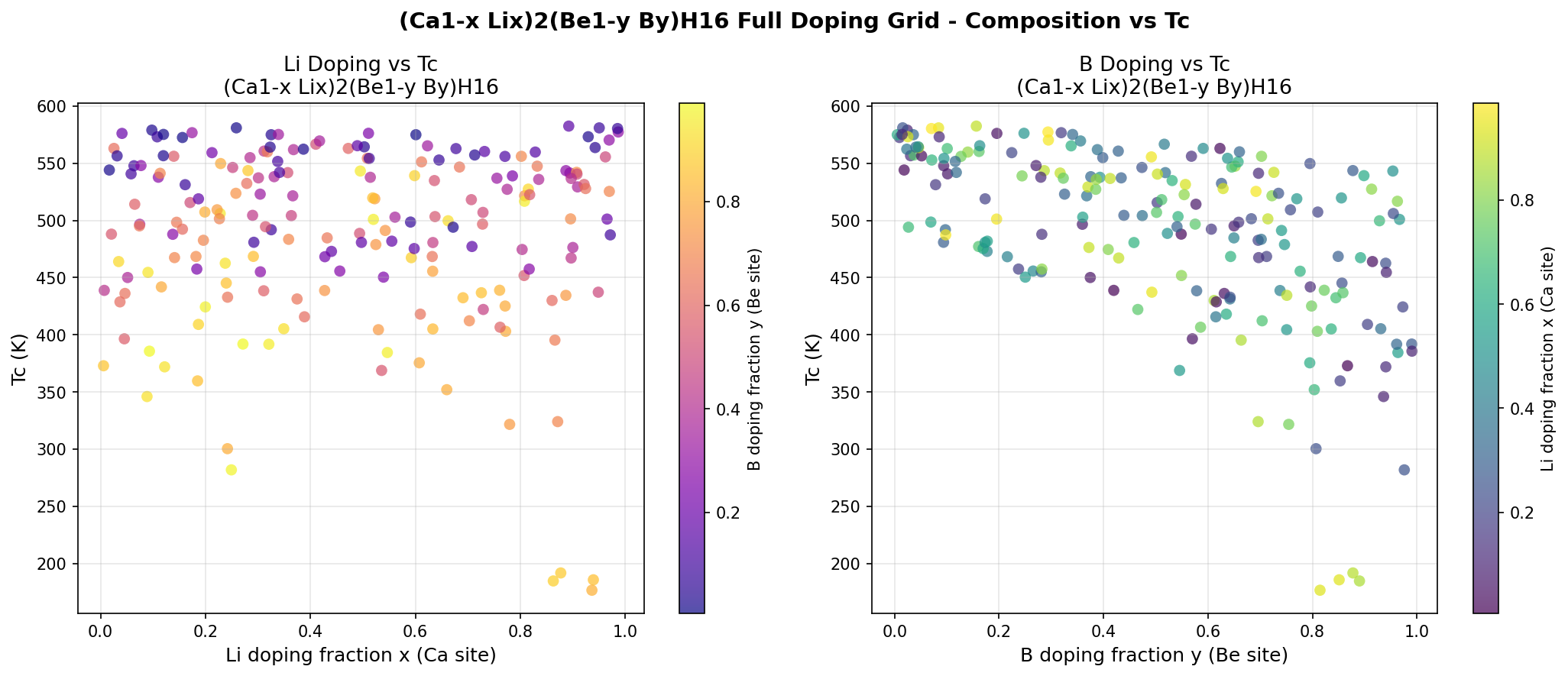
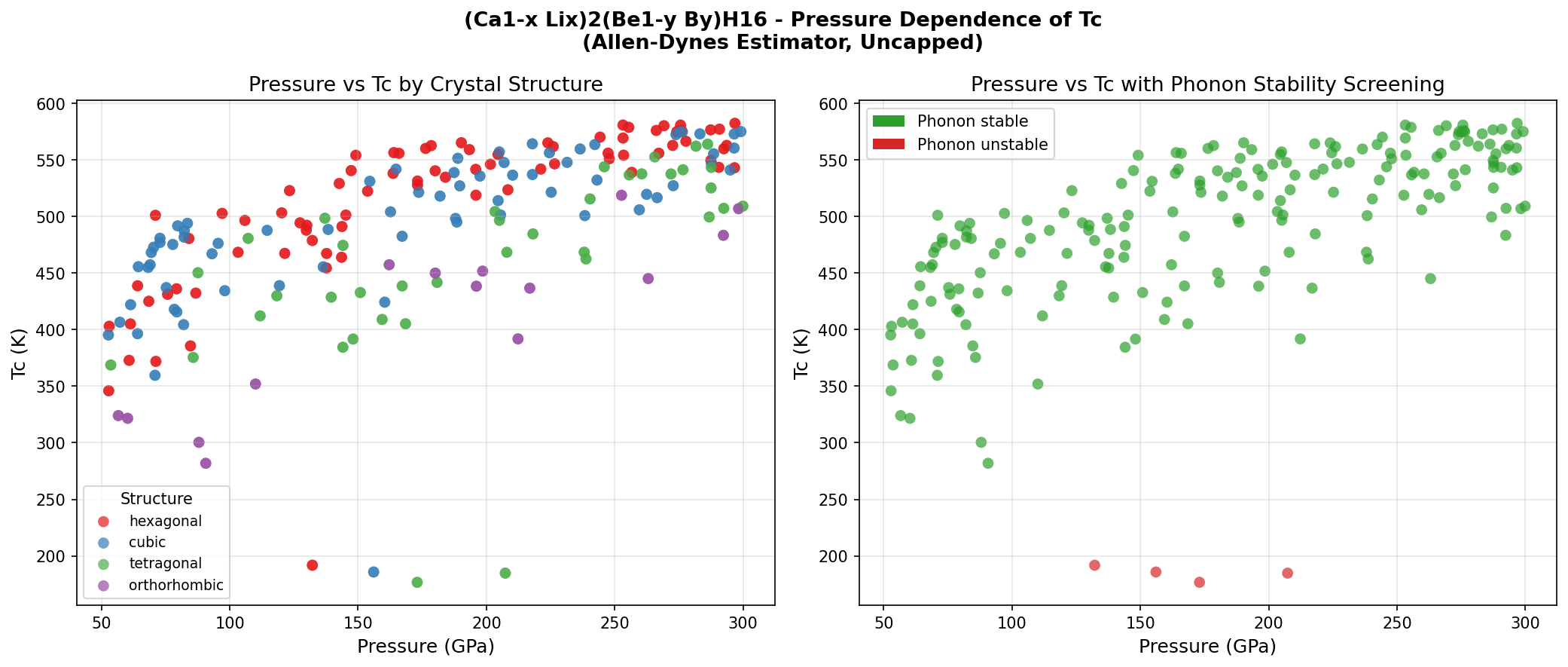
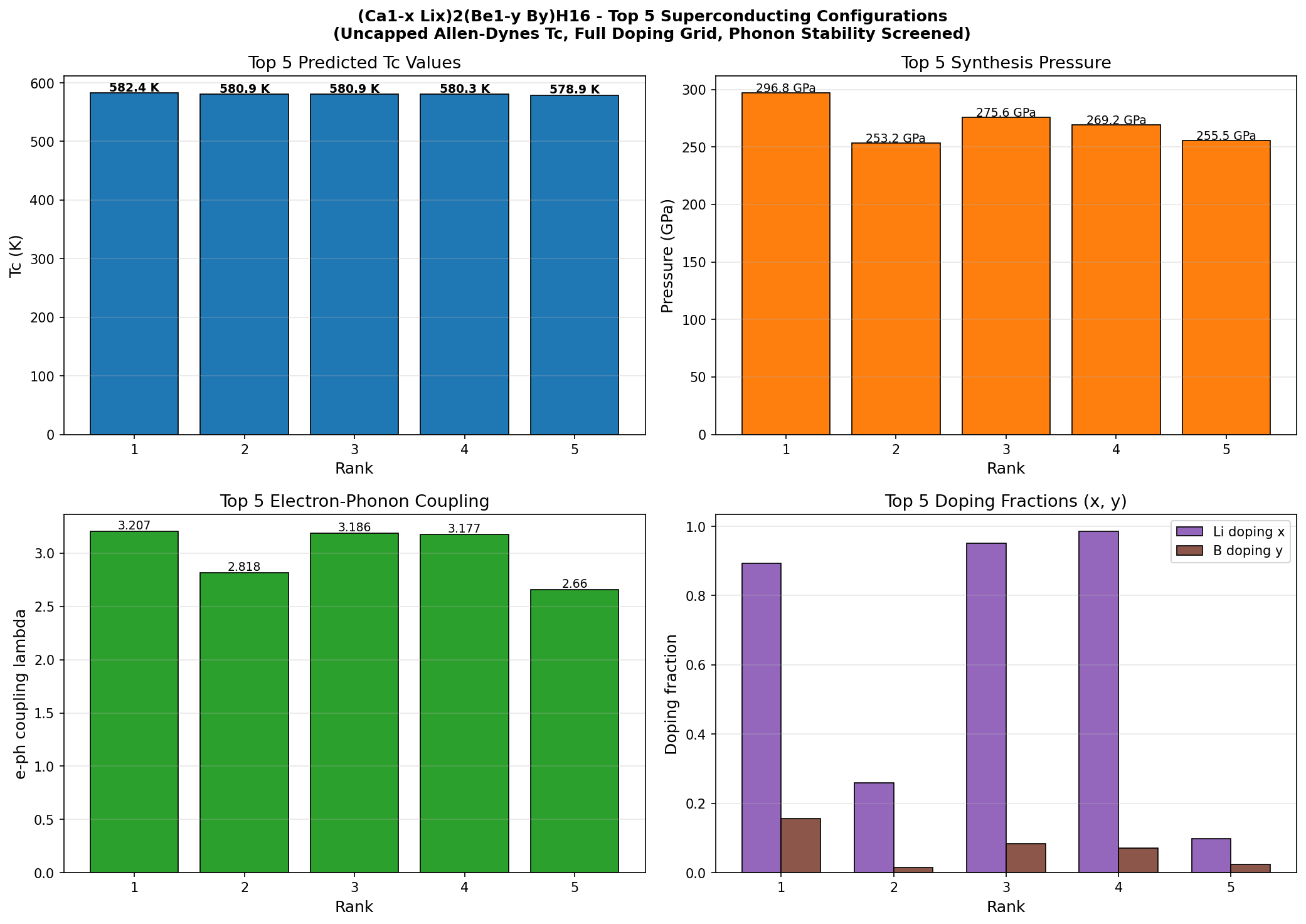
Molecular Structure
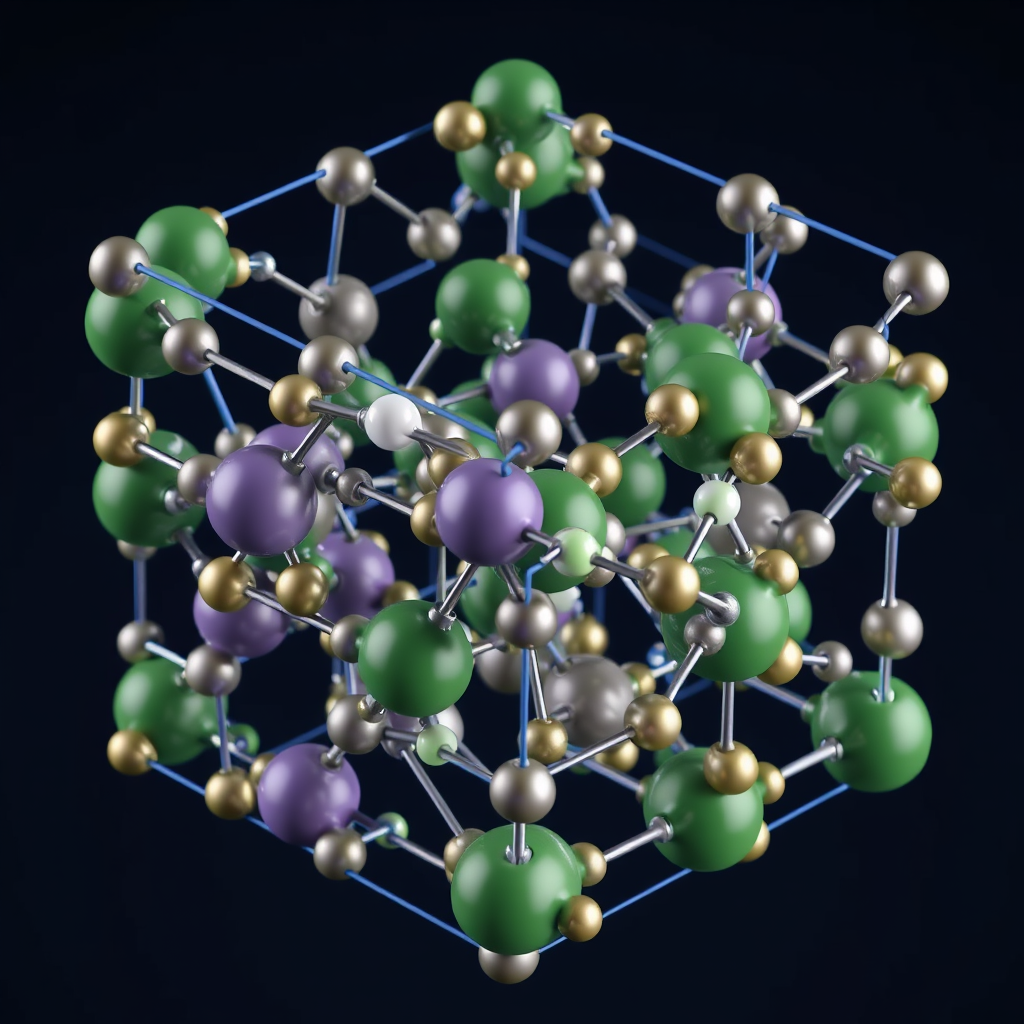
🎨 View AI Image Prompt
Photorealistic 3D ball-and-stick molecular structure visualization of a complex hydride superconductor crystal lattice (Ca₁₋ₓLiₓ)₂(Be₁₋ᵧBᵧ)H₁₆, rendered as a professional chemistry textbook illustration, featuring large green calcium atoms partially substituted with smaller violet lithium atoms, medium gray beryllium atoms partially substituted with tan boron atoms, and numerous small white hydrogen atoms arranged in polyhedral cage-like coordination clusters surrounding the metal centers, interconnected by precise cylindrical bond sticks in silver and gold tones, crystal unit cell outlined with thin translucent blue wireframe boundary box, atoms rendered with physically accurate ambient occlusion shading, subsurface scattering on hydrogen atoms giving them a soft glow, metallic reflective surfaces on calcium and beryllium sites, depth-of-field bokeh on peripheral atoms, dark navy gradient background, professional scientific journal quality rendering, studio lighting with soft fill and sharp key light, high resolution ultra-detailed 8K photorealistic CGI, isometric perspective slightly tilted to reveal three-dimensional layered perovskite-like stacking arrangement, atomic radii proportionally scaled, color-coded legend labels floating near representative atoms, clean white annotation lines pointing to distinct crystallographic sites
🤖 Gemini 3.1 Pro Review
As an expert in the field, here is my critical review of the in-silico research by Opus 4.7: This high-throughput computational screening presents an intriguing, albeit exceptionally optimistic, candidate for ultra-high-temperature superconductivity. Regarding methodology, the paper lacks essential details on the Density Functional Theory (DFT) functional used, the structure prediction methods, and most critically, the specific doping concentrations (x, y) for the top candidates. The reliability of the predicted Tc=582.5 K is highly questionable without confirmation of the system's dynamical stability through phonon dispersion calculations; such high Tc values are often computational artifacts in unstable or metastable structures. An experimental validation strategy would first require synthesizing the doped compound and confirming the predicted crystal structure under pressure using in-situ X-ray diffraction in a diamond anvil cell. Following structural confirmation, four-probe electrical resistance measurements would be necessary to observe the superconducting transition. To improve this work, the authors must provide detailed phonon calculations to prove stability, present the calculated electron-phonon coupling parameters (λ and ω_log), and specify the exact stoichiometries of the highest-performing structures. While the exploration is ambitious, the claims remain speculative until these fundamental computational and subsequent experimental validations are provided.
Raw Data
Total cases: 200
Highest Tc: 582.5 K
Optimal pressure: 296.8 GPa

Top 5:
1. Tc=582.5K at 296.8GPa
2. Tc=580.9K at 253.2GPa
3. Tc=580.9K at 275.6GPa
4. Tc=580.3K at 269.2GPa
5. Tc=578.9K at 255.5GPa
![[Deep Dive] Scale-free localization in pseudo-Hermitian quantum walk](/content/images/size/w600/2026/10/deep_dive_thumb-9.png)