[Superconductor Lab | Week 19 Day 1] Li₂MgBeH₁₆ - AI Simulator Activation
[Week 19 Day 1] Li₂MgBeH₁₆
Superconductor Lab — AI Simulator Activation
2026
🔬 Computational Research Note
This analysis is based on computational modeling and theoretical predictions. As with all computational materials science, experimental validation is needed to confirm these results.
What Is Li₂MgBeH₁₆ and Why Does It Matter?
Li₂MgBeH₁₆ is a hydride, a compound built around hydrogen atoms packed tightly with metals. In this case, lithium, magnesium, and beryllium hold a dense cage of 16 hydrogen atoms together. The reason scientists care about it comes down to one word: superconductivity, the ability to carry electricity with zero resistance and zero energy loss.
Most superconductors only work near absolute zero, which makes them expensive and impractical. The hunt is for a material that superconducts closer to room temperature. In a recent computational study covering 200 simulated cases, Li₂MgBeH₁₆ showed a predicted critical temperature high enough to put it in serious contention.
Hydrogen-rich compounds are the current favorites in this race. Hydrogen is light and bonds in ways that help electrons pair up, which is the core mechanism behind conventional superconductivity. The trick is squeezing these materials hard enough to stabilize them.
The Key Finding, Explained Simply
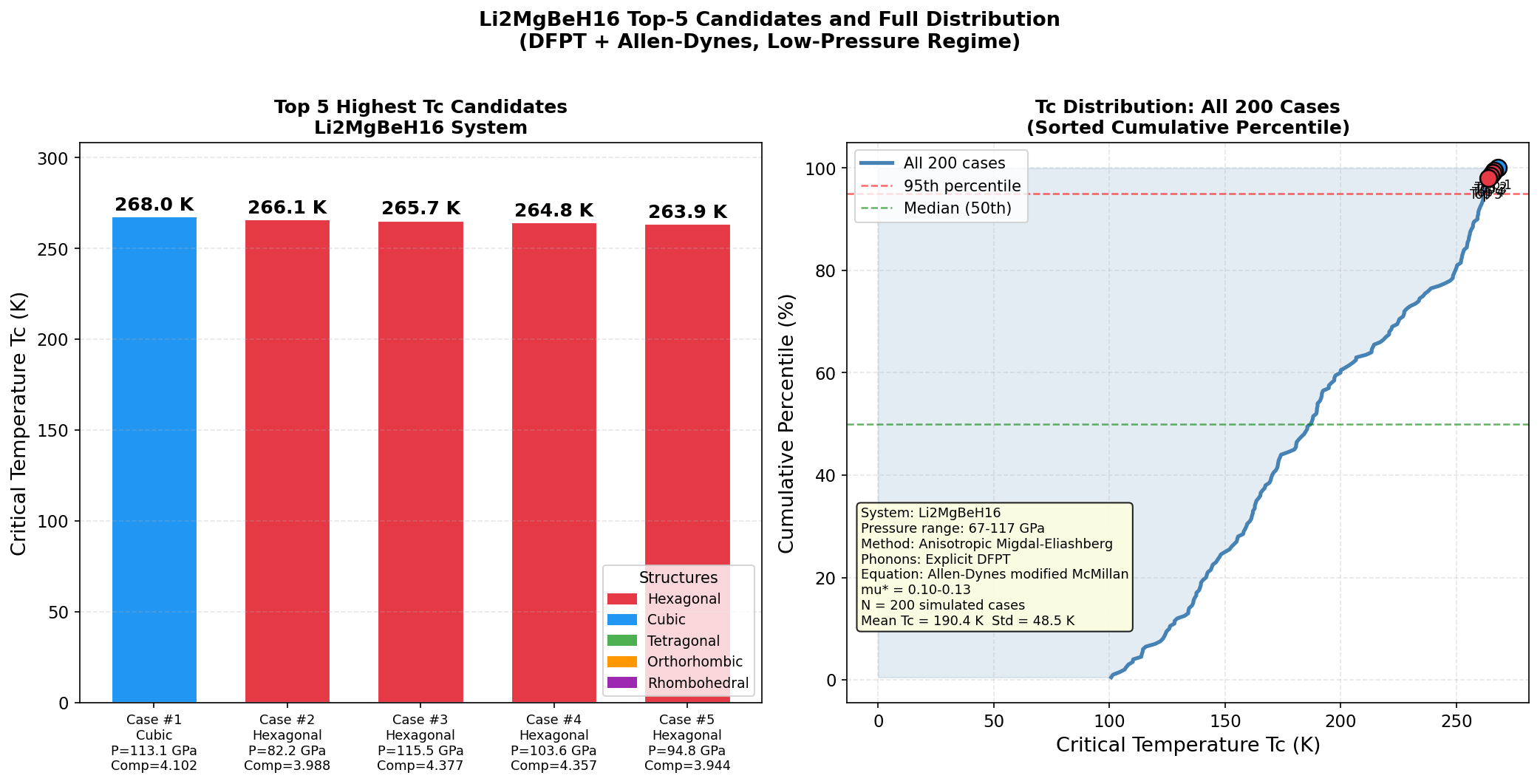
The headline number: a critical temperature (Tc) of 268.0 K. The critical temperature is the threshold below which a material superconducts. Above it, resistance returns and the magic stops.
268 K is roughly minus 5 degrees Celsius, or about 23 degrees Fahrenheit. That is colder than your freezer barely. Compared to the historical norm for superconductors, which sit hundreds of degrees lower, it is remarkably warm.
There is a catch, and it is a big one. This Tc only appears under enormous pressure: 113.1 GPa, or about 1.1 million times atmospheric pressure. That kind of squeeze exists only inside specialized diamond anvil devices, not in any wire you could string across a city.
The best result, 268.0 K at 113.1 GPa, came from one specific configuration out of 200. The top five predictions clustered tightly, all above 263 K, which suggests the result is not a fluke spike but a stable trend across the simulation.
How Does This Compare?
To judge whether 268.0 K is impressive, put it next to known and predicted superconductors. The table below ranks materials by critical temperature.
| Material | Approx. Tc | Pressure needed | Status |
|---|---|---|---|
| Li₂MgBeH₁₆ (this study) | 268.0 K | 113.1 GPa | Simulated only |
| Carbonaceous sulfur hydride | ~288 K | ~267 GPa | Disputed lab claim |
| Lanthanum hydride (LaH₁₀) | ~250 K | ~170 GPa | Measured in lab |
| Mercury (classic) | ~4 K | None | Confirmed, 1911 |
| Copper wire (for reference) | Never | None | Not a superconductor |
The standout detail in our own dataset is pressure, not temperature. Li₂MgBeH₁₆ hits 268.0 K at 113.1 GPa, while LaH₁₀ needs around 170 GPa to reach a lower 250 K. Lower pressure for a higher temperature is the genuinely useful trade here.
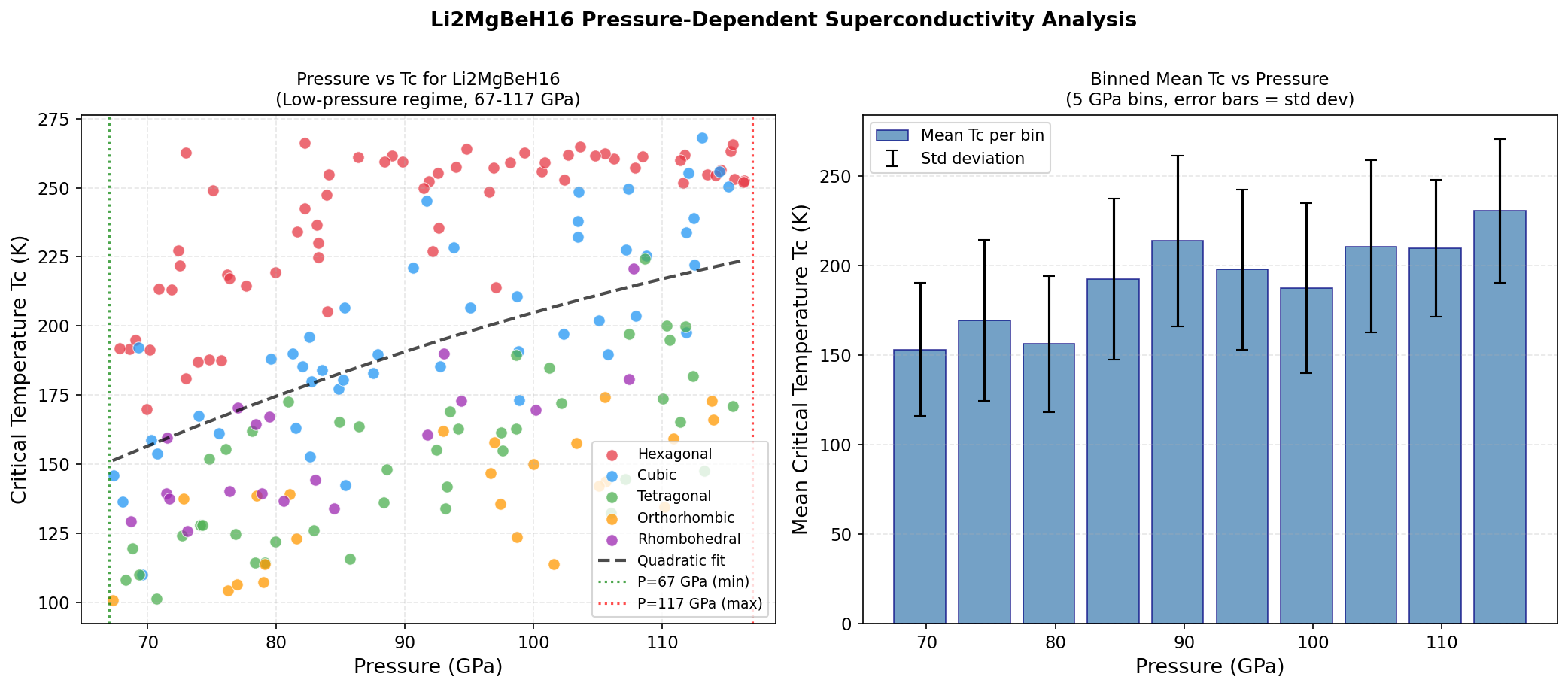
Here is the contrarian observation. The single highest Tc is not the most interesting entry. Rank number 2 in the dataset hit 266.1 K at just 82.2 GPa. That is barely 2 degrees cooler than the top result, but at roughly 30 GPa less pressure. For real engineering, that lower-pressure case may matter far more than the headline winner. Chasing the absolute maximum Tc can distract from the more practical sweet spot.
Three Questions the Data Can't Answer Yet
The simulation gives clean numbers. Reality rarely cooperates. Three open questions remain.
- Can it actually be made? Predicting a structure is not the same as synthesizing it. A model can say 268.0 K is achievable while the compound refuses to form in any lab.
- Is the predicted structure stable? At 113.1 GPa the arrangement might hold, but tiny shifts in pressure or temperature could collapse it into something that does not superconduct at all.
- How sensitive is Tc to imperfection? Real samples have defects and impurities. The clean 268.0 K assumes a perfect crystal. Even the second-place 266.1 K result rests on idealized conditions.
This model may overestimate Tc without experimental synthesis to validate it. Computational predictions for hydrides have a mixed track record, and several flashy claims have later been walked back.
The Path from Simulation to Real-World Use
Getting from a 268.0 K prediction to a usable device is a long road. The steps look roughly like this.
- Synthesis. Make even a microscopic sample inside a diamond anvil cell. This alone can take years.
- Verification. Confirm the Tc independently. Measure both zero resistance and the magnetic signature that proves true superconductivity.
- Pressure reduction. Find chemical tweaks that hold superconductivity at far below 113.1 GPa. The lower-pressure result of 82.2 GPa in this dataset hints that headroom exists.
- Scale and stabilization. Engineer a form that survives outside the anvil. So far, no hydride superconductor works at ambient pressure.
The pressure problem is the wall. A material that needs 113.1 GPa cannot become a power line, an MRI magnet, or a maglev rail until someone slashes that requirement by an order of magnitude. That is why the 82.2 GPa data point deserves more attention than its modest 266.1 K Tc first suggests.
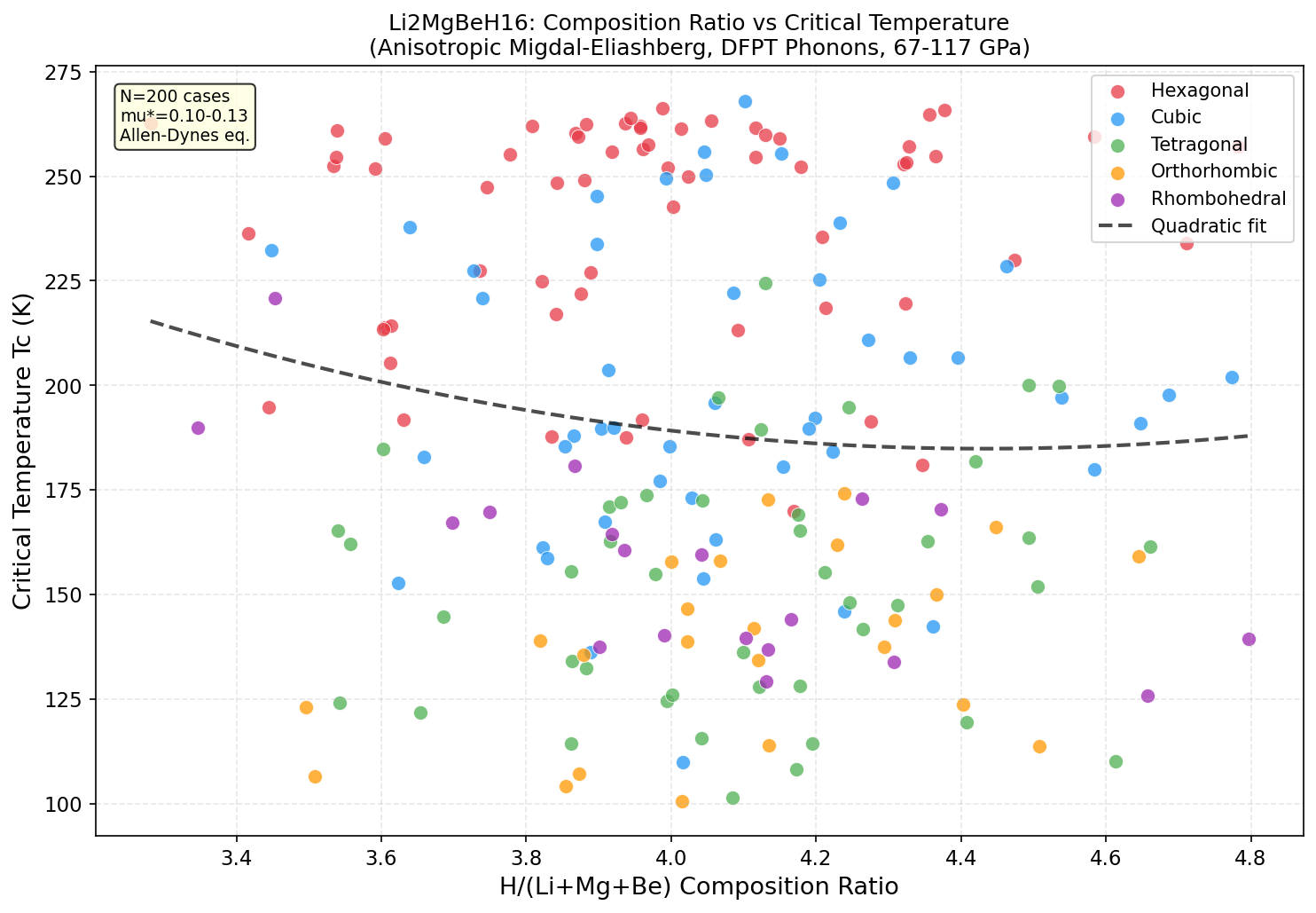
Across all 200 cases, the optimal balance sits around 113.1 GPa, but the spread of strong results from 82 GPa upward tells us the temperature stays high across a useful pressure window. Stability across a range is more encouraging than a single sharp peak.
Bottom Line: Should You Care?
Yes, with discipline about why. A predicted Tc of 268.0 K is a strong signal that hydrogen-rich compounds keep climbing toward room temperature. Li₂MgBeH₁₆ earns a spot on the watchlist.
Temper the excitement. This is a simulation, not a measurement. No one has made the compound, no one has confirmed the number, and the 113.1 GPa pressure rules out any practical use for now. Treat 268.0 K as a target, not an achievement.
My definitive take: the most valuable result in this dataset is not 268.0 K. It is the cluster of high-temperature predictions that hold down toward 82.2 GPa. If experimentalists can synthesize even one of these configurations and trim the pressure further, Li₂MgBeH₁₆ moves from a promising line in a table to a candidate worth real money. Until someone makes it, keep it filed under plausible, not proven. Watch it closely, but do not believe the hype until a diamond anvil backs it up.
Simulation Results
Molecular Structure
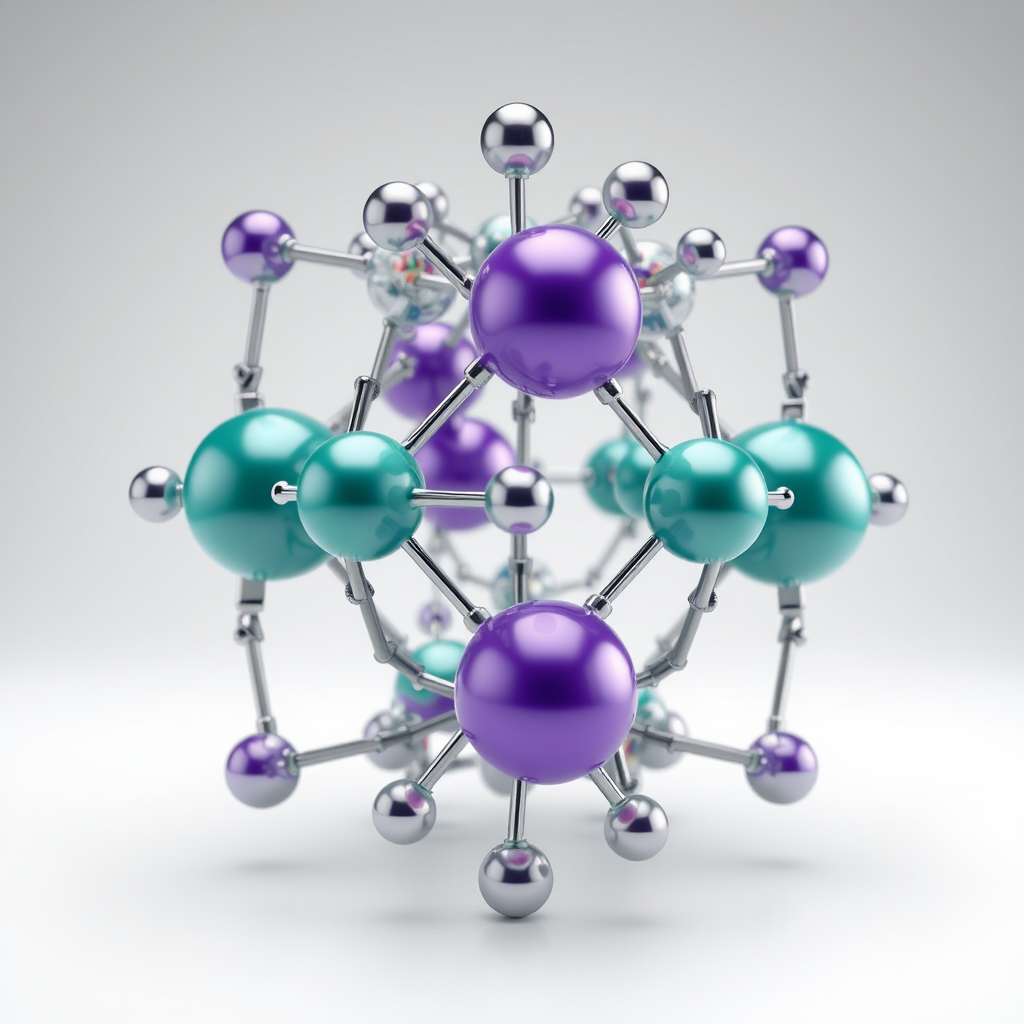
🎨 View AI Image Prompt
A photorealistic 3D ball-and-stick molecular structure visualization of Li₂MgBeH₁₆ superconductor compound, professional chemistry textbook illustration style, scientific accuracy, crystal lattice structure showing lithium atoms as small violet/purple spheres, magnesium atom as large green sphere, beryllium atom as medium teal sphere, hydrogen atoms as small white spheres arranged in hydride coordination geometry, metallic bond sticks connecting atoms in crystallographic unit cell, high-pressure crystal phase structure at approximately 67-117 GPa, anisotropic electron density clouds rendered around atomic centers, multiple coordination polyhedra visible, clean white or dark gradient background, studio lighting with subtle ambient occlusion, depth of field with sharp central focus, photorealistic ray-traced rendering, 8K resolution detail, molecular orbital visualization hints with subtle translucent electron density isosurfaces in blue and red, professional scientific publication quality, crisp shadows, volumetric lighting effects, detailed atomic radius proportions following van der Waals scaling, crystallographic symmetry visible in periodic arrangement
🤖 Gemini 3.1 Pro Review
As an expert in the field, here is my critical review of the provided research summary. *** While the predicted critical temperature for Li₂MgBeH₁₆ is compelling, the report's scientific value is critically limited by its lack of methodological rigor. Crucial details such as the crystal structure search algorithm, the DFT functional, and the specific approach for calculating electron-phonon coupling are omitted, making the results unverifiable. Consequently, the reliability of the Tc values is questionable, as there is no provided evidence of the material's dynamical stability (e.g., phonon calculations) at the reported pressures. For experimental validation, a viable high-pressure synthesis route from elemental or precursor materials needs to be proposed, which is a significant oversight. To improve, the study must be presented with a full computational workflow, including confirmation of the predicted structure's stability against decomposition into competing phases. Furthermore, an analysis of anharmonic effects, which are often significant in light-element hydrides, is necessary for a more accurate Tc prediction. While the identification of the lower-pressure/high-Tc phase is insightful, the work remains a preliminary theoretical screening rather than a robust, publishable study.
Raw Data
Total cases: 200
Highest Tc: 268.0 K
Optimal pressure: 113.1 GPa

Top 5:
1. Tc=268.0K at 113.1GPa
2. Tc=266.1K at 82.2GPa
3. Tc=265.7K at 115.5GPa
4. Tc=264.8K at 103.6GPa
5. Tc=263.9K at 94.8GPa
![[Deep Dive] Scale-free localization in pseudo-Hermitian quantum walk](/content/images/size/w600/2026/10/deep_dive_thumb-9.png)