Like Pac-Man: Topology Without a PhD
Episode 1: The Universe Is Shaped Like a Donut. Probably.
I like science that leaves room to imagine. When things that seemed unrelated turn out to share a hidden pattern — that moment feels like finding one of the world's secrets. Which opens a door I didn't know was there. Which leads somewhere unexpected. Which eventually leads back to me.
You played it. Or you watched someone play it. The little yellow circle, mouth opening and closing, running through a maze, eating dots.
You remember the thing it did. The trick. Pac-Man runs off the left edge of the screen and reappears on the right. Walks off the top, comes back at the bottom. The maze has no walls there. Just openings that connect to the opposite side.
You never thought about it. Nobody thinks about it. It's just how the game works. You move left long enough, you end up back where you started.
But sit with that for a second. Because something strange is happening on that screen, and it's stranger than a ghost named Blinky.
That little maze has no edges. There is no wall at the side of Pac-Man's world. There is no "off the map." He can run left forever and never hit anything, never fall off, never find a border. His world is finite — it fits on a screen the size of your hand — and yet it has no edge anywhere. You can't point to the boundary because there isn't one.
How can something be finite and have no edge?
Try to imagine it for yourself. Picture a room with no walls but also no exit. Walk in any direction and you come back to where you started, but you never passed through a door. There's no corner, no end, no place where the room "stops." Your brain refuses. It keeps wanting to put a wall somewhere. A finite thing should have an edge. That's what finite means. Right?
Pac-Man would disagree. If Pac-Man could think — and let's be honest, the bar for thinking has been lowered before — he might believe his world goes on forever. He runs left, sees more maze. Runs more, more maze. He never finds the end. He'd have no reason to think his world was small. From the inside, "endless" and "loops back on itself" look exactly the same.
That should bother you a little. Because you are also on the inside of something.
You walk out your front door. You look up. The sky goes on. Stars, and behind them more stars, and behind those a darkness that seems to have no bottom. Everything you've ever been told says space is huge, maybe infinite, going out and out with no wall at the end. And maybe it is.
But you've never been to the edge. Nobody has. We have never found a wall at the side of the universe. We have never found the place where it stops. We assume it keeps going because that's what it looks like from in here.
Just like Pac-Man.
Here's the part I can't stop thinking about. We have absolutely no way, from where we're standing, to tell the difference between a universe that goes on forever and a universe that quietly loops back on itself. From the inside, they look the same. An endless field of stars. A darkness with no visible end.
So the question isn't silly. It's not a cartoon question. It's one of the realest questions you can ask about the place you actually live.
What if you flew a spaceship in a perfectly straight line, never turning, for long enough? Most people assume you'd just keep going. More space, more emptiness, forever. But there's another answer nobody wants to take seriously until they've thought about the maze.
You might come home.
Not in a circle. You wouldn't turn. You'd go dead straight the whole way, your hands never touching the wheel. And one day, off in the distance, you'd see a galaxy that looked oddly familiar. Then a closer one. Then your own. Then Earth. You'd arrive back at your front door from the opposite direction, having never turned around, having never hit a wall, having never found an edge.
Because there wasn't one to find.
This is not science fiction. This is a thing physicists actually check for. They go looking in the oldest light in the sky for the fingerprint a looped-around universe would leave behind [1]. So far the results are murky — we haven't proven it loops, and we haven't proven it doesn't [2]. The honest answer is that we don't know the shape of the thing we live inside. We're Pac-Man, halfway across the maze, wondering if the left edge is a wall or a doorway.
And if it does loop — if space connects back to itself like that screen — there's a shape that does it in the simplest, most stubborn way. A shape you've eaten for breakfast.
But that's the next part. For now, just hold the strange thing in your head. You have never seen the edge of the universe. Not because it's too far away.
What if it's because there isn't one?
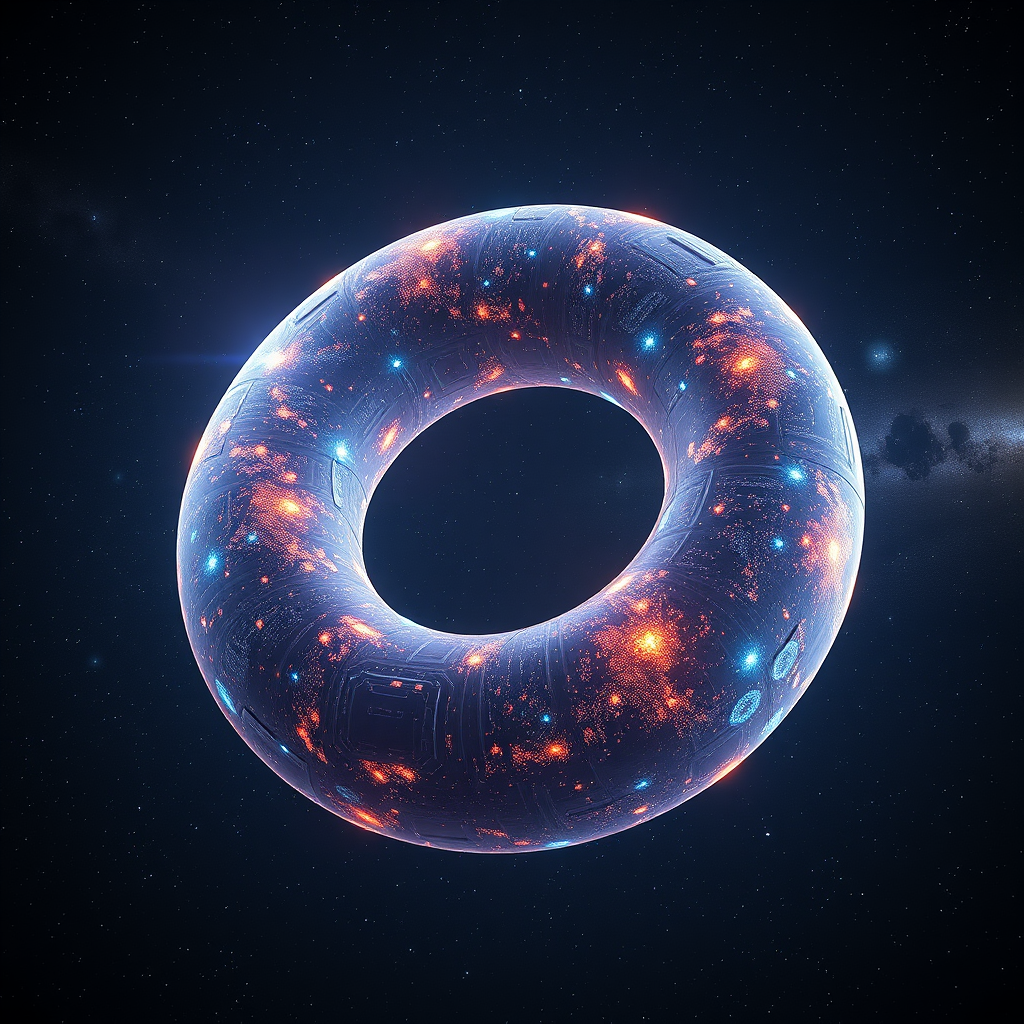
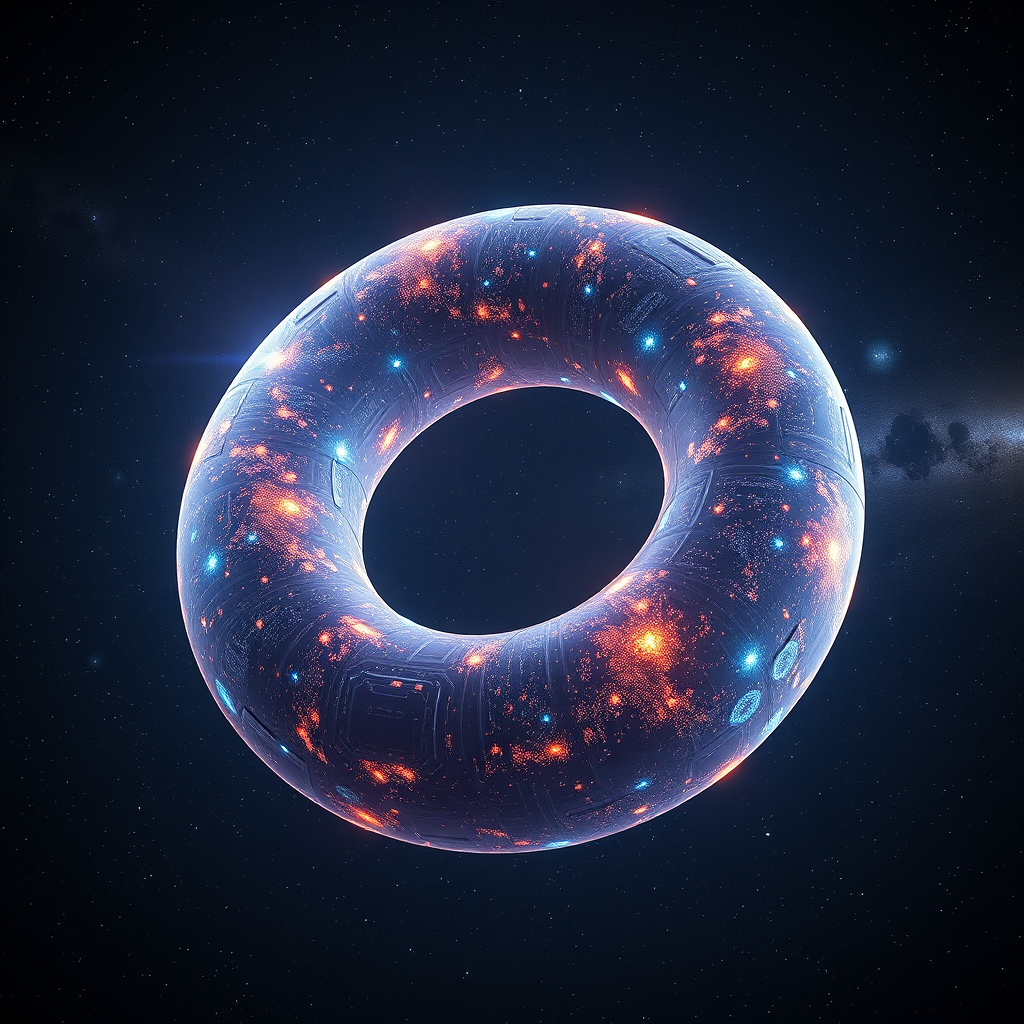
AI-generated image — a conceptual visualization
Here is the thing nobody tells you about Pac-Man. That little screen is not flat.
I mean it is flat. It is a screen. But the space inside it — the space Pac-Man lives in — is not flat at all. It is bent. Folded. Glued to itself in a way you cannot draw on paper without cheating.
Let me show you the cheat.
Take the Pac-Man screen. A rectangle. Now look at what the game does with the edges. The left edge and the right edge are the same edge. Pac-Man runs off one, comes back on the other. So they are not really two edges. They are one edge, pretending to be two.
So fold the rectangle. Bring the left side around to touch the right side. Now you have a tube. A cylinder. The two side edges are joined into a single seam.
But you are not done. Pac-Man also runs off the top and comes back at the bottom. So the top edge and the bottom edge are also the same edge. On your tube, the top is one circular rim, the bottom is another. You need to glue those rims together too.
Try it. Take a paper tube and bend it around until one open end meets the other. You get a donut. *1
That is the shape of the Pac-Man universe. A donut. A torus, if you want the word the mathematicians use, but donut is the same thing and tastes better. [1]
A computed fold, not a drawing: plane → cylinder → donut. The yellow dot never once changes direction.
Now here is where it gets strange, and I want you to sit with this part.
Pac-Man does not know he lives on a donut. From the inside, his world looks perfectly flat. There is no hill he climbs over. No curve he feels under his feet. The maze looks like an ordinary grid, all right angles, nothing bending. He could measure every triangle in his world and the angles would add up the way they do on a flat table. *2
The donut shape is invisible to him. He cannot see it. The only way he could ever discover it is by doing the one thing the game makes him do — running in a straight line and ending up back where he started. [2]
That is the whole trick of topology. Topology is the study of shape, but a sneaky kind of shape — the kind that does not care about distance or curve, only about how things are connected. *3 How they are glued. A coffee cup and a donut are the same shape to a topologist, because each has exactly one hole, and you could squish one into the other without tearing anything. This is the most famous joke in mathematics, which tells you something about mathematicians.
The point is this. A space can be finite — it has an end, an edge, a total size — and yet have no walls. No boundary.Stop and feel how odd that is. We usually think those two things go together. A box is finite, so a box has walls. A field is endless, so a field has no edge. Big means open, small means fenced in. That is how it works in the kitchen, in the parking lot, in every room you have ever stood in.
The donut breaks the rule. It is finite. You could measure it. You could, in principle, paint every square inch of it and run out of paint. And yet you could walk it forever and never hit a wall, never reach an edge, never find the place where the world stops. Because there is no such place. You just loop. [3]
This is hard to picture because you keep trying to picture the donut from outside. Floating above it, like a god looking down at a pastry. But that is not where Pac-Man is. He is in the dough. He cannot step back and see the hole. There is no "above" for him to float to.
And that, finally, is the part that should make the back of your neck go cold.
Because we are Pac-Man.
We live inside our space. We cannot step outside the universe and look back at it to see its shape. There is no balcony. No god's-eye view we can buy a ticket to. We are stuck on the inside, and from the inside, our universe also looks flat. We have measured it. The triangles add up the way they should, as far as we can tell, to within a tiny margin. [4]
So here is the question that keeps me up. A flat measurement does not mean an endless universe. Pac-Man's world measured flat too, and his world was a donut you could circle in an afternoon.
Flat tells you about the curve right here, in your neighborhood, where you happen to be standing. It tells you nothing about the glue. Nothing about whether the far left edge of everything is secretly stitched to the far right. Whether a beam of light, sent straight out and given enough patience, would come curving back around and hit you in the back of the head. [5]
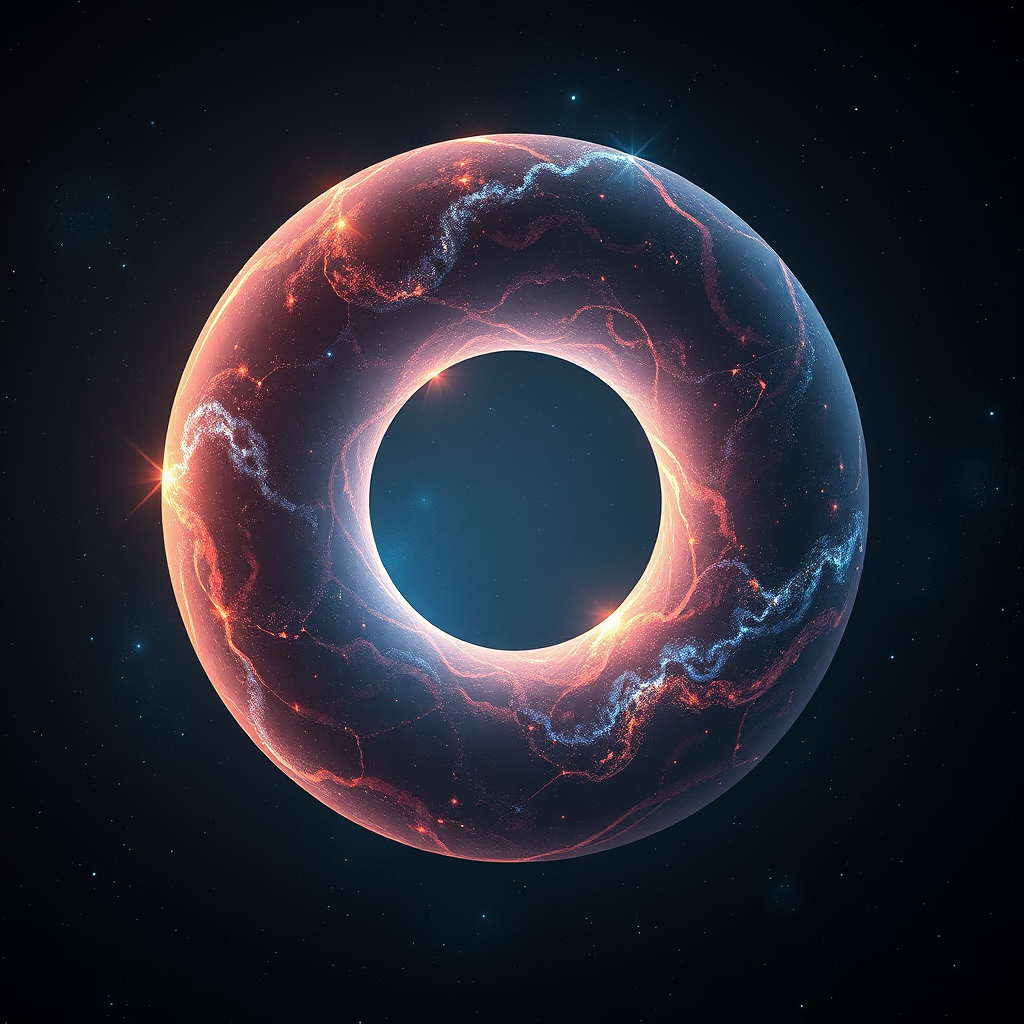
We do not know if it does. That is not me being coy. That is genuinely the state of the thing. The universe could be infinite, going on without end in every direction. Or it could be finite and glued, a donut so enormous that we have never once run off the edge and seen ourselves reappear. Both of these are allowed. Both fit what we see. [5]
AI-generated image — a conceptual visualization
The maze looks the same either way. That is the cruelty of it. From inside, you cannot tell the difference between a thing that goes on forever and a thing that loops back so far away you have never made the trip.
Pac-Man never wondered. He just ate the dots. But you are not Pac-Man, not quite, becauseyou can wonder. That is the one move he never had. You can stand in your flat little patch of maze and ask the thing he never asked: how is this glued?
And you can go looking. People have. The way you hunt for the seam of a universe is not by traveling to the edge — there may be no edge, and even if there is, you will not reach it in a billion lifetimes. You look for the echo instead.
Think about Pac-Man again. If his donut were small enough, he might glance across the screen and see his own back. Look left, and there he is in the distance, the same yellow circle, viewed from behind. Because the light bouncing off him runs off the edge and comes around. He would see copies of himself. A whole row of them, marching off into the distance, each one farther away and each one him. [6]
So astronomers went looking for copies. Not of us — of patterns. The oldest light in the sky, the faint leftover glow from when the universe was young, is spread across everything in a kind of speckled texture. *4 If space loops, that texture should repeat. The same speckle should show up in two different patches of sky, like the same face appearing twice in a crowded photo. Matching circles, stamped on opposite sides of the heavens. [6]
They searched. Carefully. For years.
They did not find them. [6]
Which does not prove the universe is infinite. It only means that if it is a donut, the donut is bigger than the part of it we can see. The loop is longer than our entire field of view. We are an ant on a beach ball, and we have only ever crawled across a coin-sized patch, and that patch looks flat, and we cannot honestly say what the rest of the ball does. [6]
I find this strangely calming. I do not know why. Maybe because most mysteries shrink when you look at them, and this one does the opposite. The more carefully we measure, the more the question stays open, polite, unbothered, waiting.
You are sitting somewhere right now. A chair. A train. A bed at the wrong hour. And the space around you, the ordinary empty air you have never once suspected of anything, might be folded. Stitched to itself somewhere out past every star you can name. You will never feel the fold. You will never reach the seam. You live your whole life in one flat patch of a maze and call it the world, the same way Pac-Man did, eating his dots, certain the screen was all there was.
So I will leave you with the thing I cannot answer.
If you walked in a perfectly straight line, forever, never turning — would you be walking away from home, or slowly, secretly
So here is what physicists actually do with that Pac-Man trick. They take it seriously. They ask: what if our universe does the same thing?
Run a spaceship in a straight line, far enough, fast enough, forever. Most people assume you'd just keep going. New stars, new galaxies, no end. But maybe not. Maybe you'd come back to where you started. Off one edge of the cosmos, in through the other. Pac-Man, but you're the yellow circle and the maze is everything.
This is the science of cosmic topology *1. Not the shape of space in the sense of curves and bends — that's geometry, and it's a different question. Topology is about connections. About what's glued to what. A flat sheet of paper and a flat sheet of paper rolled into a tube have the same geometry. They're both flat. But they're connected differently. One has edges. One doesn't. Roll it the way Pac-Man rolls his screen, and you get something with no edges and no center, where every straight line eventually loops back home.
Let me tell you about the people who actually went looking.
Start with the geometry, because you need it first. In the 1920s, Alexander Friedmann worked out the equations for an expanding universe from Einstein's general relativity [1]. He found three basic options for the overall curve of space. It could be positively curved — like the surface of a sphere, where parallel lines eventually meet. It could be negatively curved — saddle-shaped, where parallel lines spread apart. Or it could be flat — where parallel lines stay parallel forever, the geometry you learned in school.
For decades the assumption was simple: if space is flat or saddle-shaped, it must be infinite. Goes on forever. Only the sphere closes up on itself.
That assumption is wrong. And this is where it gets good.
You can have a flat universe that is also finite. A universe with no edge, no boundary, no center — but only so much of it. The Pac-Man screen is flat. Pac-Man never hits a wall. But there isn't infinite screen. There's one screen, glued to itself. Mathematicians knew this for a century. The flat, finite shapes are called Euclidean three-manifolds, and there are exactly eighteen of them [2]. Eighteen ways to glue up a flat universe so it has no edges. One of them — the simplest — is the three-dimensional version of the donut. The three-torus *2. Take a cube. Glue the left face to the right face. The top to the bottom. The front to the back.You can't actually build that cube in your kitchen. You'd run out of hands and dimensions. But Pac-Man's screen is two of those gluings done in two dimensions, and it works fine on the screen, so trust me — the three-dimensional version is real math, even if your brain refuses to hold the picture.
So if a finite universe doesn't have to be a sphere — if it can be flat and still wrap around — then how would we ever know which one we're in?
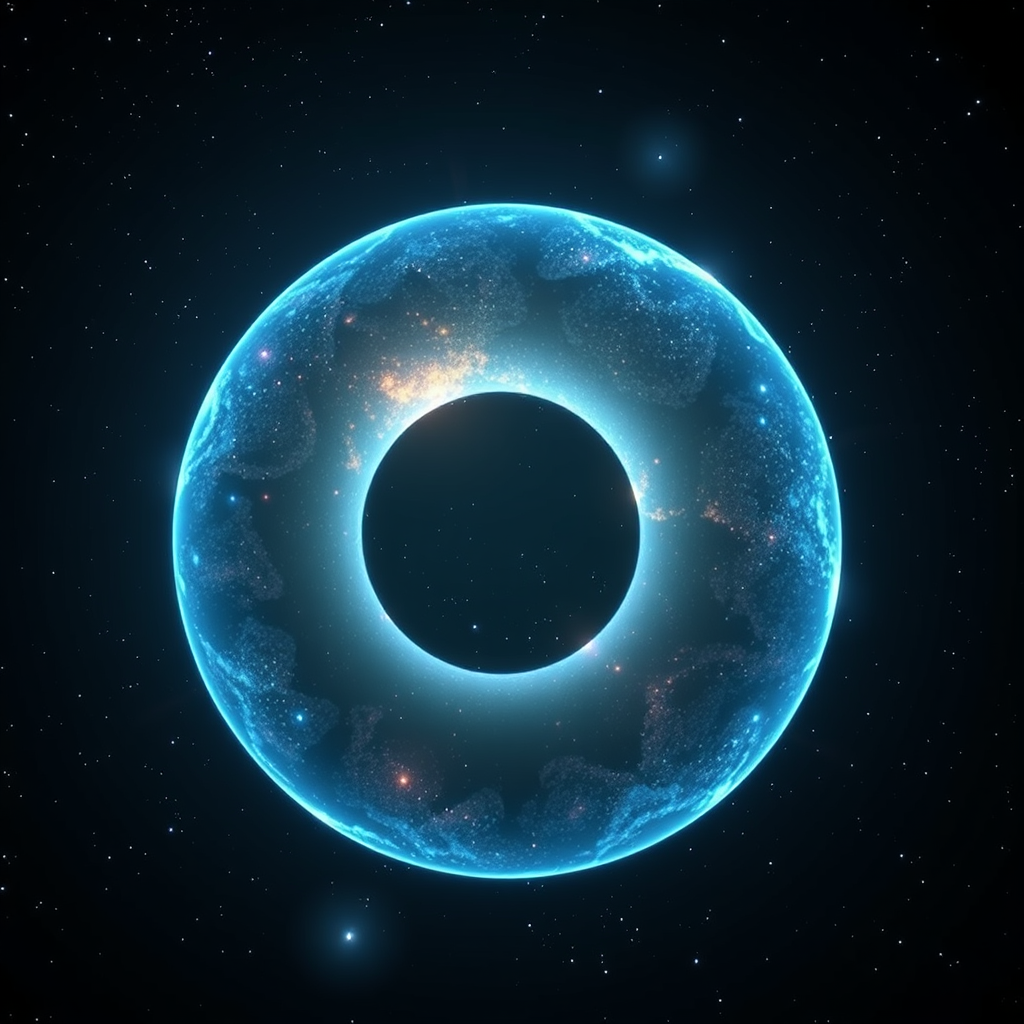
AI-generated image — a conceptual visualization
Here is the clever part. If space wraps around, light wraps around with it. And that means you could see the same thing twice.
Think about it. If the universe is small enough — smaller than the distance light has traveled since the beginning — then light from a single galaxy could reach you by two different routes. One straight ahead. One the long way around, off the edge and back. You'd see the same galaxy in two places in the sky. Like standing in a room of mirrors and seeing copies of yourself going off into the distance. Except these aren't reflections. They're the real thing, the actual light, having gone around the loop.
In the late 1990s, a group of cosmologists realized this gave us a way to test it. The key person here is Jeffrey Weeks, a mathematician who works on this for a living and writes about it better than almost anyone. Along with Neil Cornish and David Spergel and Glenn Starkman, he worked out a method called "circles in the sky" [3].
The idea is beautiful. We can't see individual repeated galaxies easily — too faint, too far. But we can see the oldest light in the universe. It's called the cosmic microwave background *3. It's the afterglow of the hot early universe, radiation that's been traveling for over thirteen billion years, and it fills the entire sky. It's the furthest thing we can see. A wall of light at the edge of the observable.
Now picture that wall as a giant sphere around you, with Earth at the center. If space wraps around, that sphere is big enough to intersect itself. And where two copies of the sphere overlap, they meet in a circle. So the same pattern of hot and cold spots — the same little ripples in that ancient light — should show up twice. Once on one circle in the sky, once on a matching circle somewhere else.
Find two matching circles, and you've found the wraparound. You've proven the universe is a donut, or one of its seventeen cousins. Cornish, Spergel, Starkman, and Eiichiro Komatsu searched the data from NASA's WMAP satellite for exactly these matching circlesin 2004 [4]. They combed the whole sky. They looked for back-to-back circles, the cleanest signature of the simplest wraparound shapes.
They found nothing.
No matching circles down to a certain size. Which means: if the universe wraps around, it doesn't wrap around small. The loop, if there is one, is at least as big as the part we can see [4]. So the donut isn't ruled out. It's just pushed out past the horizon. The screen, if it's a screen, is bigger than everything we've ever looked at.
That should have ended the story. It didn't. Because there was a clue in a completely different place.
When the Planck satellite and WMAP before it mapped that ancient light in detail, they noticed something odd. The big, sweeping patterns — the large-scale ripples — were weaker than expected [5]. Less than the standard infinite-universe model predicted. Not by a catastrophic amount. Just enough to make you squint.
And here is the connection nobody planned. A finite universe explains exactly that.
Think about Pac-Man again. The screen is only so wide. Pac-Man cannot make a wave longer than the screen. There's no room for it. The wraparound caps the size of the biggest thing that can fit. A finite universe does the same to those primordial ripples. It can't hold a wave bigger than itself. So the largest patterns get cut off. They go missing.
The missing large-scale power in the real sky and the cut-off waves in a finite universe — those might be the same fact wearing two costumes. Might be. A 2021 team led by Ralf Aurich and colleagues showed that certain three-torus models — the donut universes — fit that suppression of large-scale ripples better than the standard infinite model [6]. Better. Not proven. Better.
I want to be honest with you about where this stands, because honesty is more interesting than a clean answer. Most cosmologists are not betting their careers on a donut. The missing ripples could be a fluke. When you only have one universe to look at, you only get one roll of the dice, and sometimes the dice are just weird. Statisticians call this cosmic variance, and it's the polite scientific way of saying "maybe it's nothing, we can't run the experiment again." We have one sky. We cannot order a second.
So we sit in a strange spot. We have a test — circles in the sky — that came back empty for small universes. We have a hint — the missing ripples — that whispers finite. And we have eighteen possible shapes and no way, y
Here is the honest part. We don't know the shape of the universe. Not really.
You'd think we would. We have telescopes the size of buildings. We have a map of the oldest light in existence — the cosmic microwave background, the faint glow left over from when the universe was a baby, just 380,000 years old [1]. That light is everywhere. It's the static between channels on an old TV, a little piece of it [2]. We've measured it down to almost nothing.
And still. We don't know if you can run off one edge and come back.
So how would we check? Here's the clever idea. If the universe is small enough and folded like Pac-Man, then light could wrap around it. You'd see the same galaxy twice — once nearby, once far away, because its light went the long way around [3]. The far image would be younger, dimmer, looking the wrong direction. A cosmic hall of mirrors.
People went looking. They searched that ancient light for matching patterns — circles in the sky that should appear in pairs if space loops back on itself [4]. Two views of the same thing from two directions.
They found nothing. No matching circles. At least not in the data they checked [4].
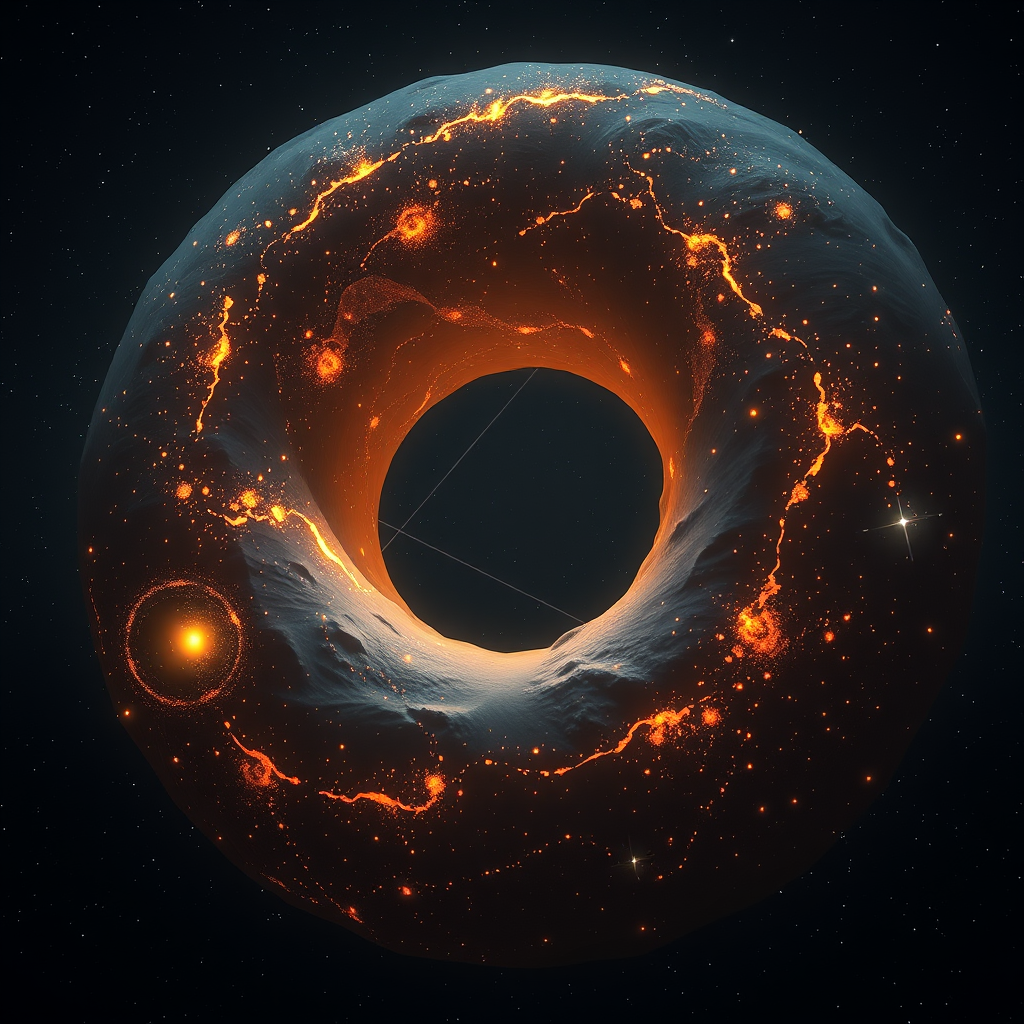
AI-generated image — a conceptual visualization
Now here's where you have to be careful, because "we found nothing" does not mean "the universe is flat and infinite." It means one of two things. Either space doesn't loop. Or it loops on a scale so enormous that the light hasn't had time to go around even once. The universe might be a donut a thousand times bigger than everything we can see [5]. In that case the wrapping is real but useless to us. The tunnel exists. It's just too long to walk.
That's the frustrating thing about this question. A "no" answer is never final. It only ever pushes the donut further out of reach.
What about the geometry itself — is space curved or flat? We've measured that too. The answer comes back flat, almost perfectly flat, as flat as we can detect [6]. But "almost" is doing heavy lifting. Our measurements have error bars. The universe could be very slightly curved in a way we simply can't see yet [6]. Flat-looking and actually flat are not the same claim. The ground under your feet looks flat too.
And here's a thing that genuinely bothers cosmologists, not just bloggers. There's an oddity in that ancient light — large-scale patterns that seem weaker than they should be, almost like something is missing at the biggest sizes [7]. Some people think this is just chance. Some people think it's a hint. A hint of what? Possibly a universe that's finite. Possibly a fold we haven't named yet [7]. Possibly nothing at all. We argue about it. Honestly, we argue about it a lot.
So put it all together. The shape of the universe could be a donut. It could be flat and endless. It could be a stranger thing — there are other ways to glue the edges, not just the donut, and some of them are hard to even picture [8]. We have a handful of clues, a couple of dead ends, and one suspicious smudge in the data that won't go away.
I find this comforting, which probably says something about me. We built machines to read the first light in existence. We learned the temperature of the whole sky to a fraction of a degree. And the most basic question — is it big or is it small, does it end or does it come back — we still can't answer.
There's a reason it's so hard, and it's not about telescopes. It's about you. You are inside the thing you're trying to measure. You cannot step outside the universe and look at its shape from the outside the way you look at a donut on a plate. Pac-Man can't see his own screen. He can only run, and notice when he comes back.
That's all we can do too. Run the light. Watch for it to return.
It hasn't yet. So either the loop is too long, or there is no loop.
Which would you rather it be — a universe small enough to circle, or one too big to ever come home from?
So we don't know the shape. Fine. But sit with what that actually means for a second.
If the universe is a donut *1 — if you really could fly off one edge and come back through the other — then somewhere out there, the same light has traveled past us more than once. The same galaxy could show up in two different parts of the sky [1]. Twins. Not similar galaxies. The same one, photographed from two angles, like catching your own reflection in a hall of mirrors and not realizing it's you.
People have looked for those twins. They searched the oldest light for matching patterns, circles in the sky that should appear in pairs if space wraps around [2]. They didn't find them. Which doesn't mean the universe is infinite. It might just mean the donut is bigger than the part we can see [3].
That's the part that gets me. The universe could loop back on itself, and we'd never know, simply because we can't see far enough around the bend. The edge of what we can observe is not the edge of what exists [3]. We are Pac-Man, halfway across the maze, with no idea there's an opening on the far side.
And here's where it stops being about geometry and starts being about you.
You go through your whole life assuming the straight line is the obvious one. Keep walking, keep going, you'll reach somewhere new. More road. More dots. That's the story we tell about everything — careers, ambitions, the future. Forward is forward.
But what if forward is a circle? What if the thing you're running toward is the thing behind you, and you just haven't gone far enough to notice? The universe might be built that way. Quietly. Without telling anyone.
We started this series by looking at what we can see today. A donut universe is a thing we cannot see — not because it's too small, but because it might be too big, folded in a way that hides the seam.
Next time we go further back. Closer to the beginning. To a moment when the whole universe was smaller than this sentence.
If space can loop, what happens when you run it backwards to the start?
TERMS EXPLAINED
- *1Topology: The study of a shape's connections — what links to what — ignoring size and distance. To topology, a coffee cup and a donut are the same thing, because each has exactly one hole. It cares whether your world loops back on itself, not how big it is.
- *2Finite but unbounded: Something that has a limited size but no edge anywhere. Pac-Man's maze is the easy example — small enough to fit on a screen, yet you can run forever without hitting a wall. The surface of the Earth is another: you can walk in one direction as long as you like and never fall off, but the planet isn't infinite.
- *3Cosmic microwave background: The oldest light in the universe, left over from when everything was hot and glowing, now spread faintly across the whole sky. It's the closest thing we have to a baby photo of the cosmos, and physicists hunt through it for clues about the shape of space.
- *4Error bars: The range of uncertainty around a measurement. They tell you how sure, or unsure, the number really is.
- *5Observable horizon: The edge of how far we can see, set by how long light has had to travel to us since the Big Bang. Anything beyond it is invisible, for now.
SOURCES & REFERENCES
- [1]Cornish, N. J., Spergel, D. N., Starkman, G. D., Komatsu, E. (2004). "Constraining the Topology of the Universe." Physical Review Letters. — Physicists search the cosmic microwave background for patterns a finite, looped-around universe would leave.
- [2]Planck Collaboration (2014). "Planck 2013 results. XXVI. Background geometry and topology of the Universe." Astronomy & Astrophysics. — Current data neither confirms nor rules out a universe that connects back on itself.
- [3]Levin, J. (2002). "Topology and the Cosmic Microwave Background." Physics Reports. — In a finite universe, light can wrap around and produce repeated images of the same object.
- [4]Cornish, N., Spergel, D., Starkman, G. & Komatsu, E. (2004). "Constraining the Topology of the Universe." Physical Review Letters. — Searches for matching circle pairs in the CMB found no evidence of a small finite topology.
- [5]Planck Collaboration (2014). "Planck 2013 results. XXVI. Background geometry and topology of the Universe." Astronomy & Astrophysics. — Limits push any topological scale to beyond the observable horizon.[6] Planck Collaboration (2020). "Planck 2018 results. VI. Cosmological parameters." Astronomy & Astrophysics. — Measurements show the universe is spatially flat to within small measurement uncertainties.
- [6]Schwarz, D., Copi, C., Huterer, D. & Starkman, G. (2016). "CMB Anomalies after Planck." Classical and Quantum Gravity. — A lack of large-scale correlations in the CMB remains an unexplained anomaly some link to finite topology.
- [7]Luminet, J.-P., Weeks, J., Riazuelo, A., Lehoucq, R. & Uzan, J.-P. (2003). "Dodecahedral space topology as an explanation for weak wide-angle temperature correlations in the cosmic microwave background." Nature. — There are multiple ways to close a finite universe besides the donut, including more complex shapes.
Inline citations [N] correspond to numbered references above.
A weekly journey from the present universe back to the Big Bang — and to what it means for us.
![[Deep Dive] Scale-free localization in pseudo-Hermitian quantum walk](/content/images/size/w600/2026/10/deep_dive_thumb-9.png)