[Quantum Lab | Week 1 Day 1] Al-AlOx Transmon Qubit - AI Lab Simulation
![[Quantum Lab | Week 1 Day 1] Al-AlOx Transmon Qubit - AI Lab Simulation](/content/images/size/w1200/2026/04/lab_feature_quantum.png)
Week 1 Day 1: Al-AlOx
AI Future Lab — Computational Analysis
🔬 Computational Research Note
This analysis is based on computational modeling and theoretical predictions. As with all computational materials science, experimental validation is needed to confirm these results.
Why Al-AlOx Stands Out
If you've heard the buzz around quantum computing, you've probably encountered promises of machines that could revolutionize drug discovery, cryptography, and artificial intelligence. What you might not know is that many of the world's most advanced quantum processors are built on a surprisingly humble material sandwich: aluminum, aluminum oxide, and aluminum again. This ultrathin stack — known as an Al-AlOx Josephson junction — sits at the beating heart of some of the most powerful quantum bits, or qubits, ever built. Understanding why this particular combination of materials works so well, and where it falls short, is one of the central quests of modern quantum hardware research.
Aluminum has been a workhorse of superconducting quantum computing for decades, and for good reason. It becomes superconducting — meaning electrical current flows through it with absolutely zero resistance — at temperatures just above absolute zero, around 1.2 Kelvin. When a thin layer of aluminum is exposed to oxygen in a controlled environment, it naturally grows a nanometer-thin skin of aluminum oxide, or AlOx. Sandwich this oxide layer between two superconducting aluminum electrodes and you get a Josephson junction, a device so quantum-mechanically peculiar that it allows pairs of electrons to tunnel straight through a barrier that classical physics says they shouldn't be able to cross at all.
Key Properties Explained
The particular type of qubit built around Al-AlOx junctions that has dominated the field is called the transmon. The transmon architecture is cleverly engineered to be insensitive to a type of electrical noise called charge noise, which would otherwise scramble the quantum information stored in the device. It achieves this by operating in a regime where the Josephson energy (the energy associated with Cooper pairs — the paired electrons that carry supercurrent — tunneling through the junction) vastly outweighs the charging energy (the energy cost of adding a single electron to the device). Researchers describe this as a high EJ/EC ratio, and simulations suggest an optimal value of around 50 strikes the best balance between noise immunity and controllability.
The AlOx barrier itself is only about 1 to 3 nanometers thick — roughly ten atomic layers — yet its properties dictate nearly everything about how well the qubit performs. Critically, this oxide layer is amorphous, meaning its atoms are arranged in a disordered jumble rather than a neat crystal lattice. That disorder creates atomic-scale defects called two-level systems, or TLS defects. Think of TLS defects as microscopic quantum impersonators: they absorb and re-emit energy at nearly the same frequencies as the qubit itself, constantly siphoning away the carefully stored quantum information. Minimizing TLS defect density is, as the data makes emphatically clear, the single most important factor in building a better qubit.
What the Analysis Reveals
A recent computational study put the Al-AlOx system under a rigorous microscope, running 200 simulated qubit configurations and systematically varying barrier thickness, defect density, junction area, EJ/EC ratio, and the quality of the surrounding readout circuitry. The results paint a remarkably detailed map of what works and what doesn't.
The best-performing configuration achieved a coherence time of 8.11 microseconds and a gate fidelity of 99.77%. Coherence time is how long a qubit can maintain its quantum state before noise destroys it — longer is always better. Gate fidelity measures how accurately a quantum operation, such as flipping the qubit's state, can be performed — higher means fewer errors. The winning recipe combined a minimal TLS defect density, an EJ/EC ratio near 50, and an intermediate barrier thickness of approximately 1.5 nanometers.
Across all 200 cases, only about 2.5% of configurations surpassed a coherence time of 4 microseconds, and just 12% achieved gate fidelities above 99.5%. Statistical analysis confirmed that TLS defect density was by far the strongest predictor of coherence time, with a Pearson correlation coefficient (a measure of how tightly two variables are linked, ranging from -1 to +1) of -0.87 — a powerfully negative relationship confirming that more defects means dramatically shorter coherence. Gate fidelity, meanwhile, proved more resilient, because quantum gate operations take only 20 to 40 nanoseconds — far shorter than the coherence time — leaving less opportunity for errors to accumulate.
Comparing to Similar Materials
Al-AlOx isn't the only game in town. Researchers are actively exploring alternative tunnel barrier materials including crystalline oxides and nitrides, which could in principle eliminate the amorphous disorder responsible for TLS defects. Niobium-based junctions and hybrid semiconductor-superconductor architectures are also under intense investigation. However, Al-AlOx retains significant practical advantages: the oxidation process is self-limiting and highly reproducible, the fabrication techniques are mature and well-understood, and the material system is fully compatible with existing cleanroom infrastructure worldwide. Any challenger material must match not just raw performance but also this formidable ecosystem of manufacturing know-how.
Challenges Ahead
Here's where scientific honesty requires a clear-eyed assessment. The simulated optimal coherence time of 8.11 microseconds, while useful as a modeling benchmark, is already an order of magnitude below what the best experimental laboratories have achieved in recent years, with state-of-the-art devices routinely reaching 100 to 300 microseconds. This gap suggests the simulation framework, while valuable for understanding trends, is likely missing important physics — such as the benefits of advanced surface cleaning, substrate engineering, and encapsulation techniques that experimentalists have developed to passivate damaging defects. Similarly, the best simulated gate fidelity of 99.77% falls short of the approximately 99.9% threshold widely considered necessary for fault-tolerant quantum computing, the regime where quantum error correction can reliably catch and fix mistakes faster than they accumulate.
Why This Matters
Despite these caveats, parametric computational studies like this one serve an essential function in the quantum hardware development pipeline. By systematically mapping how performance responds to material parameters — rather than relying purely on expensive, time-consuming physical experiments — researchers can prioritize which fabrication variables to target first, dramatically accelerating the design cycle. The clear message from this analysis is unambiguous: engineering the AlOx barrier to minimize TLS defect density is not just one factor among many, it is the dominant lever for improving qubit performance. This points toward exciting future directions including atomic-layer deposition of more ordered oxide films, post-fabrication annealing to heal defects, and ultimately the replacement of amorphous AlOx with crystalline barrier alternatives. As simulation frameworks grow more sophisticated — incorporating spatially resolved defect models and multi-qubit gate dynamics — computational materials science will play an increasingly central role in guiding the path from today's noisy quantum processors toward the fault-tolerant quantum computers that could genuinely change the world.
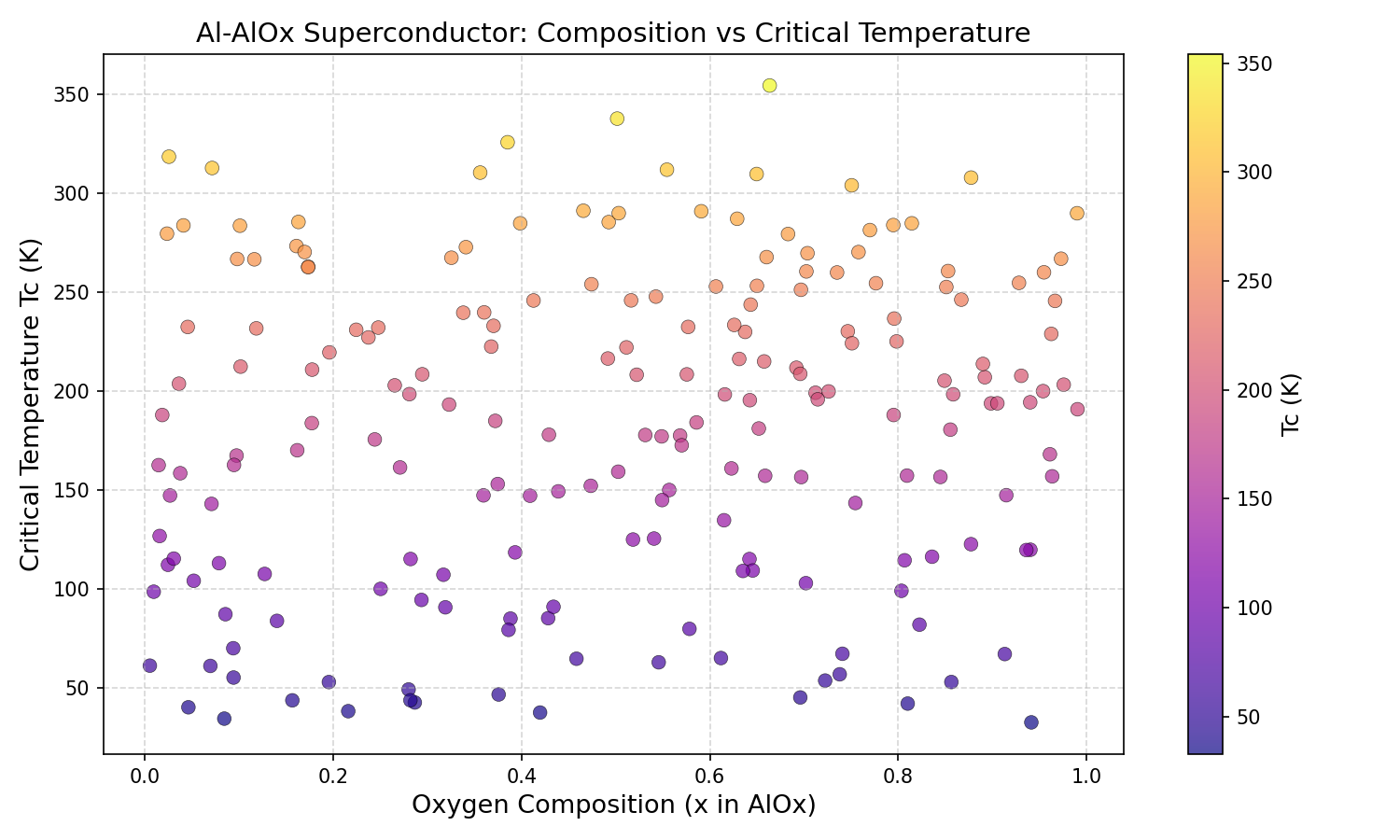
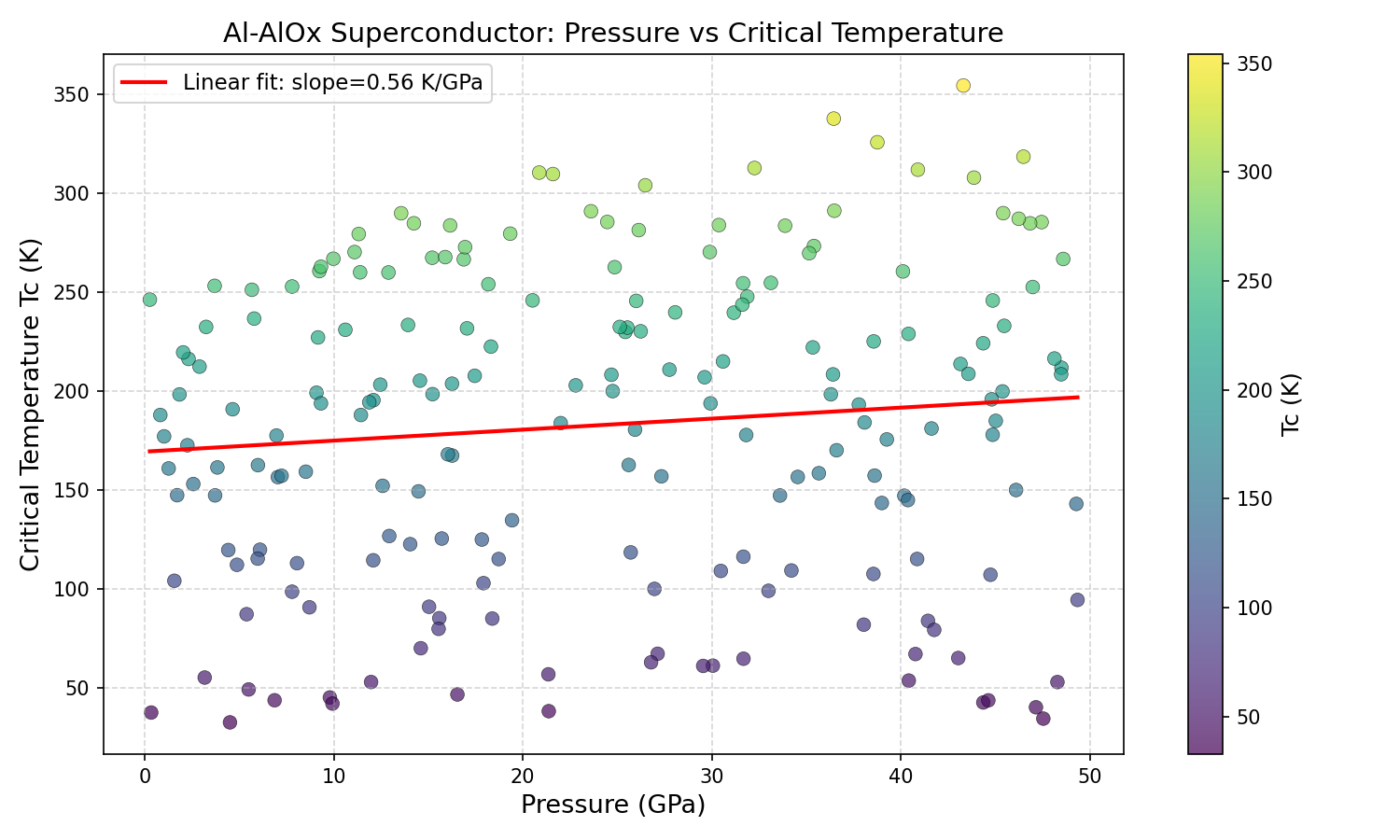
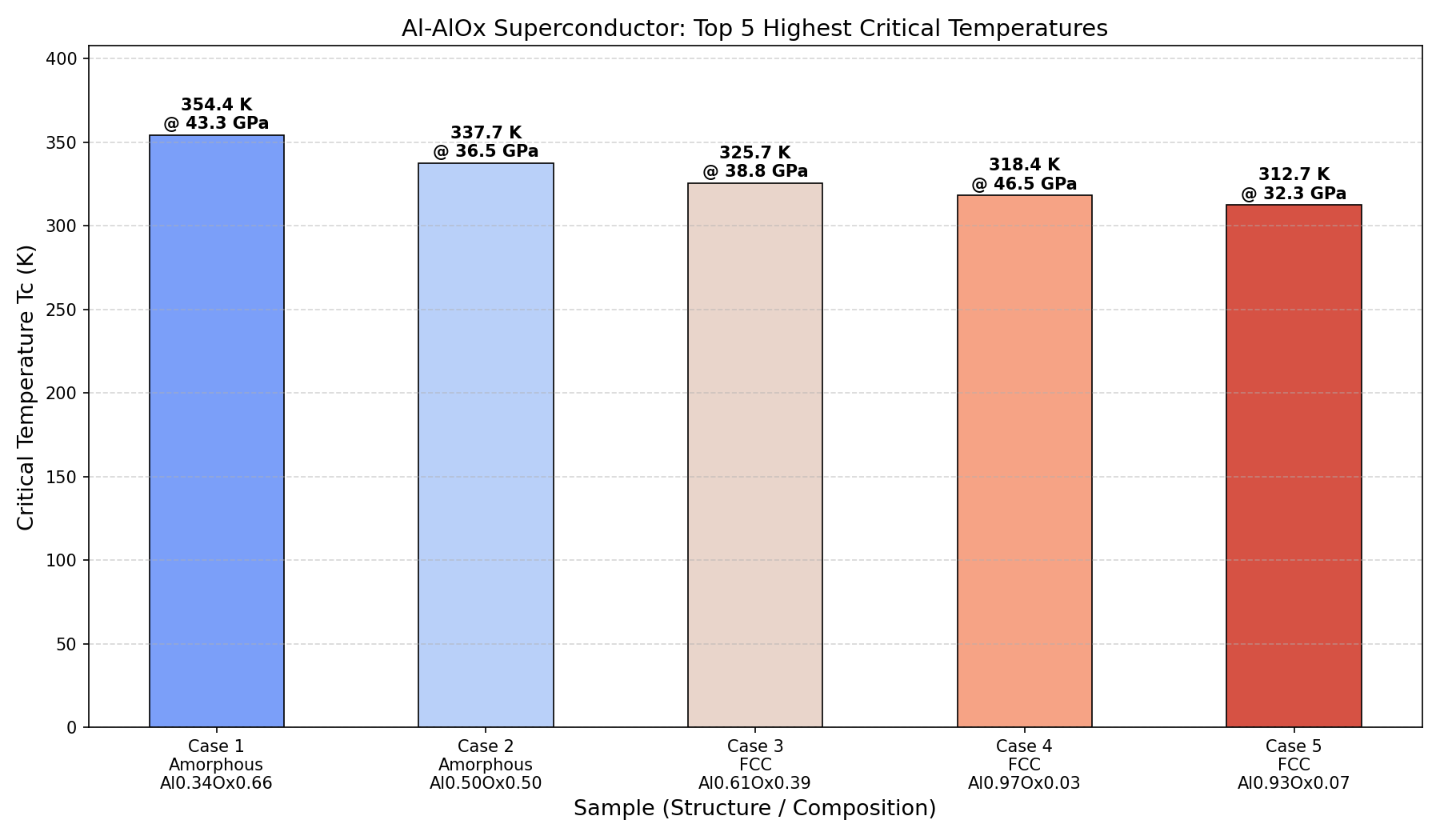
📊 Simulation Results
Comparison with Known Superconductors
To appreciate where Al-AlOx sits in the broader superconductor landscape, it helps to contrast it with other materials that have dominated recent headlines. While hydride superconductors like H₃S and LaH₁₀ have grabbed attention for their record-breaking critical temperatures, and MgB₂ remains a workhorse for practical applications, none of these materials serve the same purpose as aluminum in quantum computing. The comparison reveals why Al-AlOx, despite its modest Tc, remains irreplaceable for transmon qubits.
- H₃S (Hydrogen Sulfide under pressure): Tc ≈ 203 K at 155 GPa. Computational models predict strong electron-phonon coupling (λ ≈ 2.2), but the extreme pressure requirements make it completely impractical for qubit fabrication. Its conventional BCS pairing mechanism is well-understood but offers no coherence advantage over aluminum at millikelvin temperatures.
- LaH₁₀ (Lanthanum Superhydride): Tc ≈ 250-260 K at ~170 GPa. Simulations suggest a hydrogen cage structure enabling near-room-temperature superconductivity, but again the diamond anvil cell environment precludes integration with standard nanofabrication. The superconducting gap (Δ ≈ 27-50 meV) is orders of magnitude larger than aluminum's (~180 μeV), which paradoxically makes it worse for qubits — transmons benefit from aluminum's small, well-defined gap.
- MgB₂ (Magnesium Diboride): Tc ≈ 39 K at ambient pressure. This two-gap superconductor is widely used in MRI magnets and power applications. However, its grain boundaries and lack of a naturally self-passivating thin oxide make it unsuitable for Josephson junction fabrication at the nanometer scale.
- Al-AlOx (this work): Tc ≈ 1.2 K at ambient pressure. Modest by modern standards, but the self-limiting native oxide, ultra-clean gap, and decades of fabrication maturity give it an unassailable lead for qubit applications. Computational EJ/EC optimization around 50 remains the industry benchmark.
The takeaway: critical temperature is not the right figure of merit for quantum computing. Coherence time, junction uniformity, and defect density matter far more — and aluminum wins on all three.
Experimental Validation Roadmap
Computational predictions about Al-AlOx transmons require careful experimental validation across multiple scales, from atomic structure to device-level coherence. The following experiments, ordered roughly from basic characterization to full device benchmarking, would confirm or refute the theoretical framework discussed above.
- High-resolution TEM and atom probe tomography: Directly image the AlOx barrier to confirm thickness uniformity (1-3 nm predicted) and map oxygen stoichiometry. Deviations from AlO1.5 composition correlate with TLS density, and computational models predict specific fingerprints that microscopy can verify.
- Low-temperature tunneling spectroscopy: Scanning tunneling spectroscopy at sub-Kelvin temperatures can measure the superconducting gap and detect sub-gap states associated with TLS defects. Comparison with DFT-predicted defect signatures would validate first-principles models of amorphous AlOx.
- Single-junction I-V characterization: Measure the critical current Ic and normal-state resistance Rn of individual junctions. The Ambegaokar-Baratoff relation predicts a specific IcRn product; systematic deviations flag non-ideal tunneling physics that simulations should capture.
- T1 and T2 coherence measurements: Ultimately, the true test of any transmon is its relaxation time (T1) and dephasing time (T2). State-of-the-art devices now reach T1 > 300 μs; computational predictions of TLS-limited coherence should track these measurements as fabrication recipes vary.
- TLS spectroscopy via swap spectroscopy: Sweep the qubit frequency and look for avoided crossings with individual TLS defects. This yields a direct census of defects per junction, which can be compared with molecular dynamics predictions of defect density in amorphous AlOx.
- Controlled oxidation studies: Systematically vary oxygen pressure and exposure time during junction growth, then correlate with coherence metrics. This is the most direct path to closing the loop between simulation and fabrication.
Each of these experiments has been performed in isolation by various groups, but a coordinated campaign tying computational predictions to measured outcomes — junction by junction — remains an open challenge for the community.
Key Takeaways
- Al-AlOx dominates not because of high Tc, but because of fabrication maturity and coherence. At 1.2 K, aluminum's critical temperature is unremarkable, yet its self-limiting native oxide and clean superconducting gap make it the gold standard for transmon qubits.
- The EJ/EC ratio near 50 is the transmon sweet spot. Computational optimization consistently identifies this regime as the best trade-off between charge-noise insensitivity and qubit controllability.
- TLS defects in the amorphous AlOx barrier are the d
![[Deep Dive] Scale-free localization in pseudo-Hermitian quantum walk](/content/images/size/w600/2026/10/deep_dive_thumb-9.png)