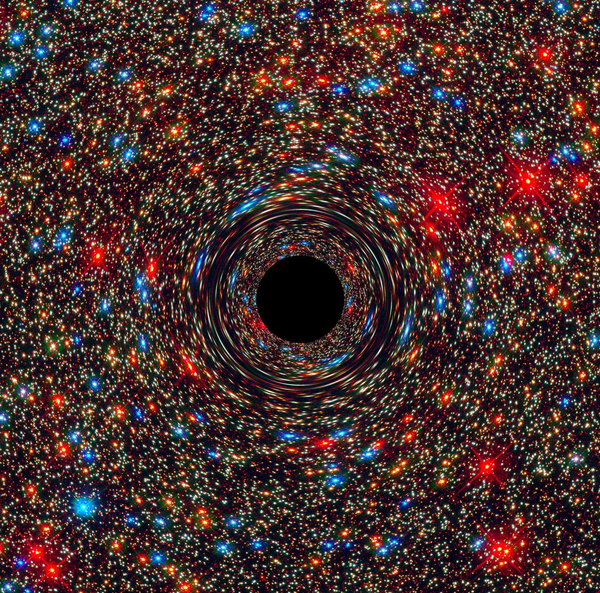
The Edge of What We Can See
Episode 1: The Universe Is Shaped Like a Donut. Probably.
I like science that leaves room to imagine. When things that seemed unrelated turn out to share a hidden pattern — that moment feels like finding one of the world's secrets. Which opens a door I didn't know was there. Which leads somewhere unexpected. Which eventually leads back to me.
You know that feeling when you're walking in an unfamiliar city, and you keep turning corners, and somehow you end up back at the same café you started from? Not because you meant to. Because the streets curve in ways you didn't notice.
Now imagine that, but bigger. Much bigger.
Imagine you get in a spaceship. The fastest spaceship anyone has ever built. You point it at a random patch of sky — not toward anything in particular, just away. You fly. You fly past Mars, past Jupiter, past Pluto, past the edge of our solar system. You fly for a thousand years. A million. A billion. You fly so long that everyone you ever knew is dust, and the sun you came from has burned out, and the galaxy you grew up in has merged with another galaxy and become something new.
And then, eventually, after enough time that the word "time" stops making sense — you arrive back where you started.
Not a place that looks like where you started. The actual place. The same coordinates. You went in a straight line and you came home.
This might be true. We don't know. But it might.
Here's the thing that messes with me. When you were a kid, somebody probably told you the universe is infinite. Goes on forever. And that's a hard thing to picture, but you kind of nodded and accepted it, the way you accept that there are more stars than grains of sand, or that your cells are mostly empty space. Just one of those facts you file away.
But "infinite" is doing a lot of work in that sentence. We've never measured infinity. Nobody has. What we've actually measured is a sphere about 93 billion light-years across [1] — the part of the universe whose light has had time to reach us. That's it. That's all we can see. Everything beyond that edge, we're guessing.
And here's where it gets weird. The shape of the part we can see — the geometry of it, how light bends, how distances add up — is consistent with the universe being flat and infinite. But it's also consistent with the universe being finite and curved in a way that loops back on itself [2]. Like the surface of a ball. Or, and this is the part I can't stop thinking about, like a donut.
A donut. The pastry. With a hole in it.
I'm not joking. There are real physicists, with real telescopes and real math, who think the universe might be donut-shaped. Or, to use the word they use when they're trying to sound serious, a torus *1. Which is just the math word for donut, but somehow makes everyone in the room nod thoughtfully instead of laughing.
I want to be honest with you about why this matters, because at first glance it sounds like the kind of thing that doesn't matter at all. The universe is huge. You will never travel to its edge. You will never circle it in a spaceship. The donut question feels like asking whether a mountain you'll never climb has an odd or even number of pebbles on it. Who cares?
I care. And I think you might too, once I tell you why.
Because the shape of the universe is not just trivia. It's the answer to a question you've probably never asked but have definitely felt. The question is: am I in something, or am I just in stuff that goes on forever?
Those are very different feelings. One of them is a room. The other one is drowning.
If the universe is infinite, then somewhere out there — statistically, mathematically, unavoidably — there is another version of you reading this exact blog post. And another one reading it with a typo. And another one where you decided to make coffee first. Infinity is generous like that. It gives you everything, including all the lives you didn't live [3].
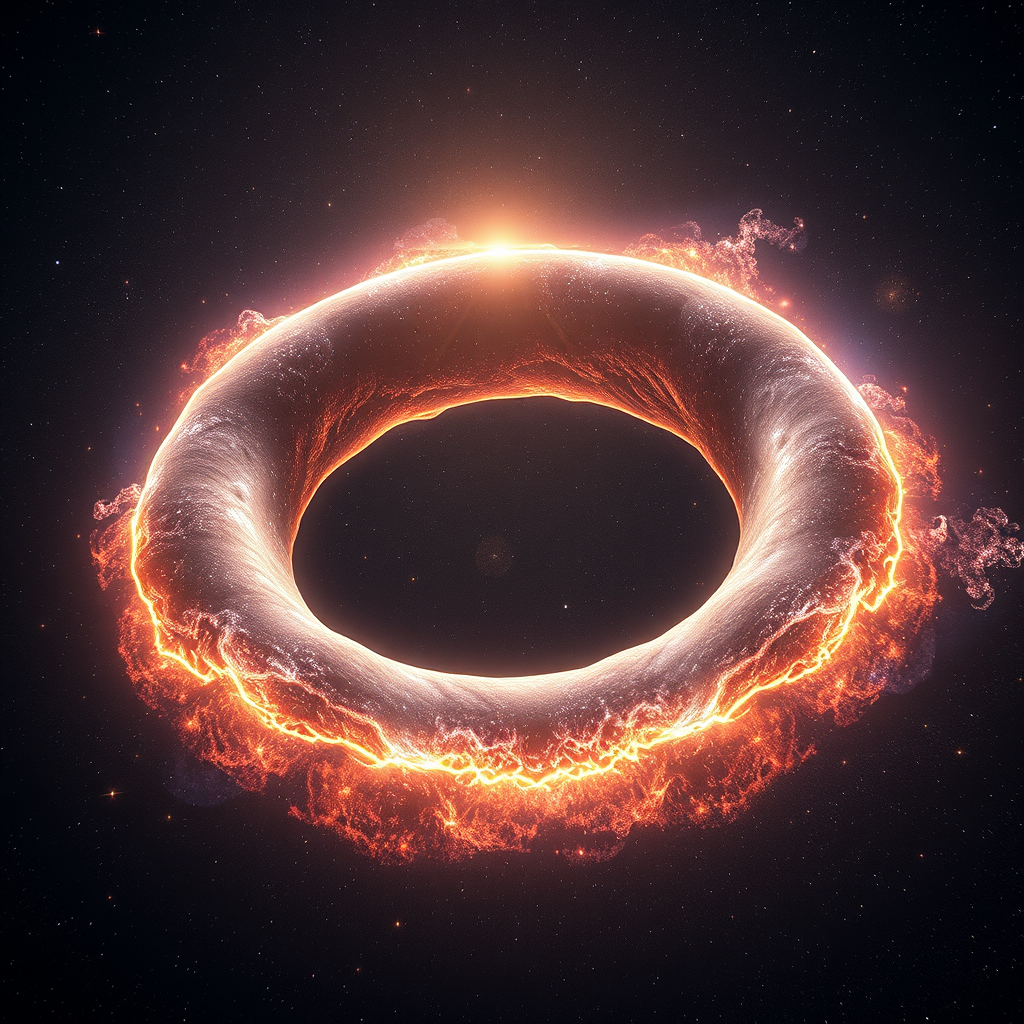
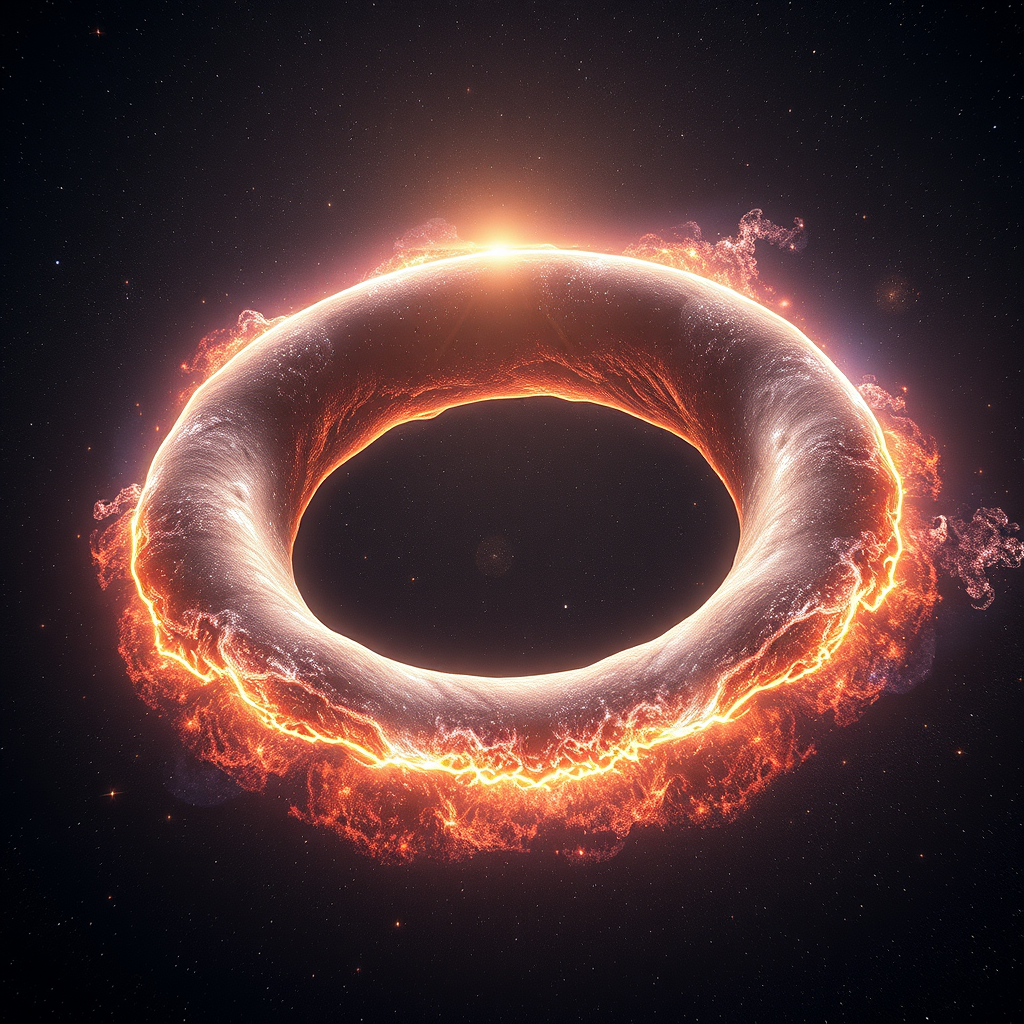
AI-generated image — a conceptual visualization
If the universe is a donut, that doesn't happen. The donut is finite. There's a specific amount of stuff in it. You are the only you. The life you're living is the only one on offer.
I don't know which is true. Nobody does, yet. But people are looking. Right now, today, there are scientists staring at the oldest light in existence, trying to find the fingerprints a donut would leave behind [4]. A specific pattern. A repeated shape. Something that says: this is a room, and here is the wall.
So far, they haven't found it. They also haven't ruled it out.
Which means, right now, as you read this sentence, the question of whether you live in an infinite everything or a finite something is genuinely open. We are alive during the part of history where we don't know yet. That seems worth paying attention to.
What would it change, for you, to find out?
Here's the thing about a donut. You think it's a weird shape to bring up. But the donut is doing something sneaky.
Walk along the top of a donut, all the way around. You come back to where you started. Okay, fine — same as a sphere. Now walk through the hole, around the underside, and back up. You also come back to where you started. Two different loops. Two ways of going "around" that don't cancel each other out.
This is the trick. This is why cosmologists keep muttering about donuts at conferences.
But forget donuts for a second. Think about Pac-Man.
You remember Pac-Man. The little yellow guy eats dots in a maze. And when he runs off the right side of the screen, he appears on the left side. Run off the top, appear on the bottom. The screen is small, but Pac-Man's world has no edges. He can run forever and never hit a wall. He just keeps re-entering his own neighborhood from the other side.
If Pac-Man were a physicist — bear with me — he might wonder how big his universe actually is. He'd look around. He'd see dots and ghosts. And then one day he'd notice something strange: that ghost over there, way off to the east? It looks suspiciously like the ghost to the west. Same shape. Same dent. Same haunted expression.
Maybe it's the same ghost. Seen twice. Because light, like Pac-Man, wraps around.
Now here's the part that should bother you a little. The Pac-Man screen is a donut. Mathematically. I'm not joking. If you take a flat rectangle and glue the top edge to the bottom, you get a tube. Glue the ends of the tube together, and you get a donut. [1] Pac-Man lives on the surface of a donut he can't see, because he's stuck inside it.
That last part matters. From the inside, his world looks flat. Perfectly flat. He could measure triangles all day and the angles would add up to 180 degrees like a good little Euclidean. *1 Nothing would tip him off that he's actually on a curved, looped, finite surface. Nothing except — maybe — seeing the same ghost twice.
Okay. Now scale this up.
You are not Pac-Man. You are bigger. But you might be inside the same kind of trick.
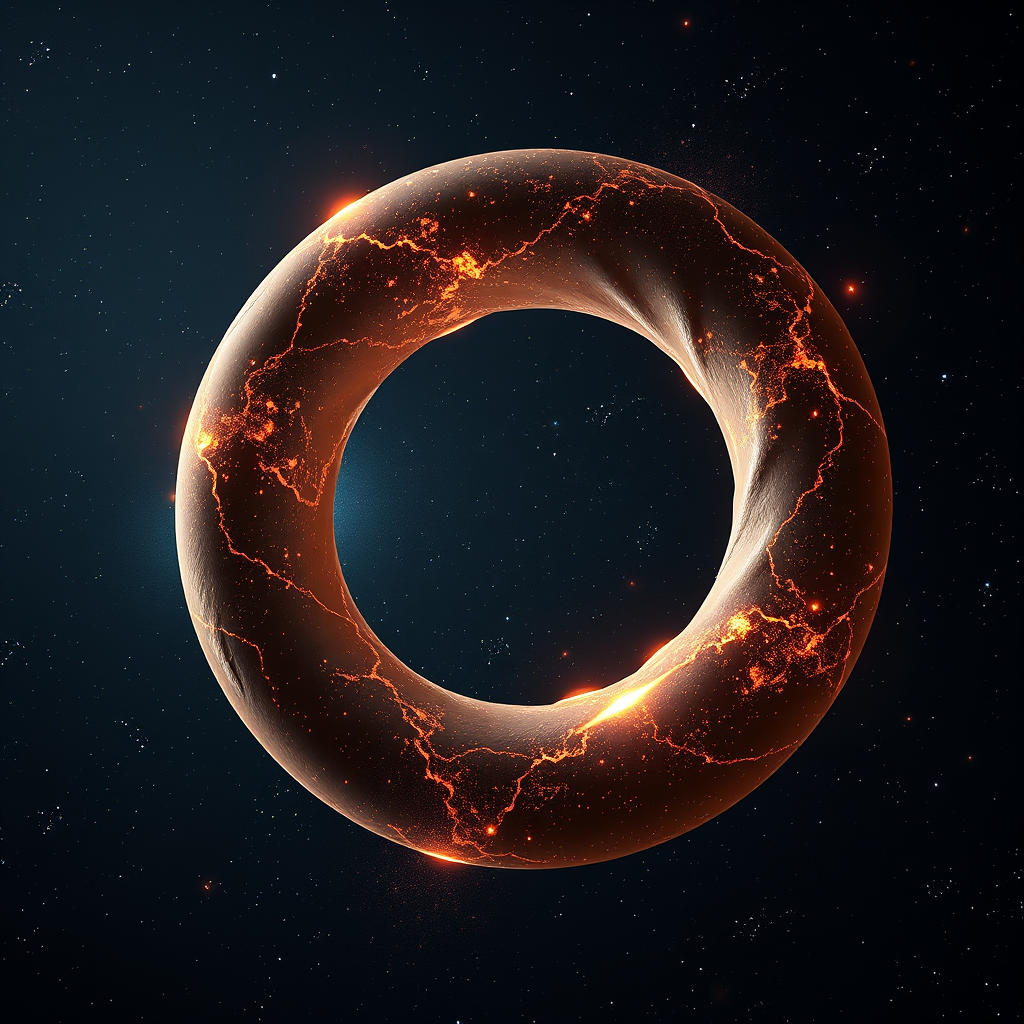
AI-generated image — a conceptual visualization
When astronomers measure the geometry of the universe — the actual shape of space — they look at the oldest light there is, this faint hum left over from when everything was hot and dense. [2] They measure triangles in it. And the triangles come out flat. That sounds like it settles things. Flat universe, infinite, end of story, go home.
It doesn't settle things.
Because flat doesn't mean infinite. Pac-Man's world is flat too. A donut, unrolled in your mind, is just a rectangle — and a rectangle is as flat as a tabletop. The curvature you'd need to detect to prove a donut is a donut isn't in the surface. It's in the connections. In the gluing. In the fact that going far enough in one direction brings you home.
So when cosmologists say space is flat, what they actually mean is: locally flat. In our neighborhood. The triangles we can draw, with the rulers we have, in the patch of universe we can see — those triangles behave. But the universe might still be doing something Pac-Man-ish at scales bigger than our view. [3]
And this is where it gets uncomfortable. Because there's a chance — not a wild chance, an actual chance some serious people take seriously — that the universe is a three-dimensional donut. [4]
A three-dimensional donut is hard to picture. Don't try too hard. You'll hurt yourself. The trick is to stop visualizing it and just hold the rule: if you fly far enough in any direction, you come back. Not because you turned around. Not because space curved you back like a sphere would. Just because the far side of the universe is glued to this side. The exit on the right is the entrance on the left. The top of the screen is the bottom.
If that's true, then somewhere out there — way out there, past everything we can currently see — there should be a copy of our galaxy. Or our cluster. Or at least a patch of sky we'd recognize from a different angle. The same ghost, seen twice.
People have looked. They've combed through that ancient leftover light, searching for matching patterns on opposite sides of the sky. Circles that should appear in two places if the universe loops back on itself. [5]
They haven't found them. Not definitively. But they also haven't ruled them out. The universe might just be too big for the loop to fit inside what we can see. Our entire observable bubble might be a small room inside a much larger donut, and we'd have no way of knowing.
This is the part I keep getting stuck on. We don't know the shape of the thing we live in. We've measured it, carefully, with extraordinary instruments, and the answer that came back was basically: could be infinite, could be a donut, could be something weirder, please send more telescopes.
Most of science feels like it's slowly closing in on answers. This one feels like it's keeping its options open on purpose.
And there's a question buried under all this that I can't shake. If the universe is a donut, and light wraps around, then some of the stars you see at night might not be where you think they are. They might be echoes. The same star, photographed by your eyes from two different sides of a loop you can't perceive.
You'd never know. The light arrives. The star is there. You make a wish on it. It's possibly the same wish, on the same star, from the other direction.
So here's where it gets real. Not metaphor anymore. Actual physicists, actual telescopes, actual papers with too many authors and not enough vowels in the title.
The shape of the universe is not a vibe. It's something you can, in principle, measure. And the way you measure it is weirder than you'd guess.
AI-generated image — a conceptual visualization
Start with this: when we look at the night sky, we see light. Some of that light has been traveling for a very long time. The oldest light we can see is something called the cosmic microwave background *1, or the CMB if you want to sound like you belong. It's the leftover glow from when the universe was about 380,000 years old [1]. Before that, everything was too hot and dense for light to travel freely — photons just bounced around like a panicked crowd. Then the universe cooled, the crowd thinned, and the light suddenly had room to run. It's been running ever since. It hits our telescopes today as a faint hum of microwaves coming from every direction.
This is the wall. The edge of what we can see. Not the edge of the universe — the edge of our sight.
And on that wall, there are patterns. Tiny temperature variations, hot spots and cold spots, fluctuations of about one part in a hundred thousand [1]. Maps of these spots have been made by satellites — COBE in the 90s, then WMAP, then Planck, which finished its survey in 2013 [2]. Planck's map is the good one. The one you've probably seen, the oval rainbow of red and blue blotches that looks like a cosmic Rorschach test.
Here's the clever part. If the universe is finite and wraps around — if it's shaped like a donut or some other closed thing — then the light from the CMB has had time, maybe, to go around. Which means some of those hot and cold spots on the wall might actually be the same spot, seen from two different angles. Like seeing the back of your own head in a hall of mirrors.
So you look for matching patterns. Circles in the sky that have the same temperature variations as other circles in the sky. If you find them, the universe is closed and you know its size. If you don't, either the universe is bigger than the part we can see, or it's actually infinite, or you just haven't looked hard enough.
A team led by Neil Cornish, David Spergel, Glenn Starkman, and Eiichiro Komatsu did exactly this in 2004, using the WMAP data [3]. They looked for matched circles. They didn't find any. Which let them put a lower bound on the size of the universe — if it's a donut or any other wrap-around shape, it has to be at least 24 gigaparsecs across [3]. That's about 78 billion light-years. Big. Bigger than the part we can currently see, which is about 93 billion light-years across in total *2.
So that should be the end of the story. Donut ruled out. Move on, write a paper about something else, go home.
Except.
In 2003, a year before Cornish and friends published their non-detection, a different group led by Jean-Pierre Luminet noticed something strange in the same kind of data [4]. The CMB has a feature physicists call the power spectrum *3 — basically, a chart of how much temperature variation you see at different angular sizes on the sky. Big patches, small patches, medium patches, how much of each. The chart has bumps and wiggles, and the bumps and wiggles are predicted by theory with eerie precision.
Except at the largest scales. There, the data went quiet. The biggest patches — the slow, sweeping variations across the whole sky — were weaker than expected. Much weaker. As if the universe was missing its longest wavelengths.
Luminet's team had an idea. If the universe is finite, then there's a maximum wavelength it can hold. You can't fit a wave longer than the room you're in. So if the cosmos is a closed shape of a certain size, the largest fluctuations would be suppressed — exactly as observed.
They proposed a specific shape: a Poincaré dodecahedral space *4. Not a donut. A soccer ball, sort of. Twelve pentagonal faces, glued together in a way that when you walk through one face, you come out the opposite one, rotated. Luminet called it "a well-proportioned space" [4]. He meant it like a compliment.
The paper landed in Nature. It got attention. It also got pushback. The matched-circle searches kept not finding anything. The dodecahedron prediction made specific claims about which circles should match where, and when people looked, the circles weren't there [5].
So the dodecahedron faded. But the missing large-scale power did not fade. It's still there in the Planck data, twenty years later. It's called the "low quadrupole anomaly" by people who name things badly [6]. Nobody knows what it means. It could be a statistical fluke — when you only have one universe to look at, you can't run the experiment again. It could be a hint about the shape of space. It could be something else nobody's thought of yet.
Then in 2023, a group of researchers — Ralf Aurich, Thomas Buchert, Martin France, and Frank Steiner — published a paper with a title that does not mess around: "The Variance of the CMB Temperature Gradient: A New Signature of a Multiply Connected Universe" [7]. They argued that the standard tests — the matched circle searches — might have been looking for the wrong thing. Or rather, looking in the wrong way.
Their idea: instead of looking for identical circles, look at the statistics of the temperature gradient across the sky. How sharply does the temperature change from one spot to the next? In a wrap-around universe, those statistics would be subtly different from an infinite one. And when they ran the numbers on the Planck data, they found that several donut-shaped topologies — three-tori, in the language of the paper *5 — actually fit the data slightly better than the standard infinite universe [7].
AI-generated image — a conceptual visualization
Slightly. Not definitively. Not "we found it." More like "we can't rule it out, and actually it might be a little preferred."
I want to quote Buchert here, because the way physicists talk about this is more honest than how it gets reported. In a 2024 interview with Quanta, he said: "We are not claiming that the universe has this or that topology. What we are saying is that the universe could be finite, and the data does not exclude it. In fact, in some respects, the data slightly prefers it" [8].
That's the actual state of things. Not "the universe is a donut." Not "the universe is infinite." It's: we looked, we have hints, the hints are ambiguous, here are the bounds.
The bounds, by the way, are interesting. If the universe is a three-torus — a 3D donut — its smallest dimension has to be at least about three times the radius of the observable universe, according to the most recent analyses [7]. Or maybe a bit less, depending on which test you trust. So if there are repeating copies of our galaxy out there, the nearest copy is far enough that the light from it hasn't reached us yet, and may never reach us, because the universe is expanding faster than that light can cross the gap.
Which is its own kind of cosmic joke. The universe might loop. We might never be able to prove it.
There's a collaboration now called COMPACT — Collaboration for Observations, Models and Predictions of Anomalies and Cosmic Topology *6. Real name. Started in 2022. They include Starkman (yes, the same one from the 2004 non-detection paper — he came back) along with Yashar Akrami, Stefan
Here's where I have to be honest with you. We don't know.
We have measurements. We have the cosmic microwave background [1] — that ancient light I just told you about, the leftover glow from when the universe first cooled enough to become transparent. We have years of data from a satellite called Planck *1, which spent four years staring at that glow with extraordinary patience. We have math. We have models.
And the answer those measurements give us, when you ask "is the universe a donut?" is something like: maybe. Probably not. But we can't rule it out, and that should bother you a little.
Here's the problem. If the universe is donut-shaped *2 — or shaped like any of the other weird possibilities, because there are several — then the loops have to be big enough that we haven't noticed them yet. If you walked around the donut and came back to your café, the café would have to be very, very far away. Farther, possibly, than we can see.
And that's the wall we keep hitting. There is a hard edge to what we can observe. Light travels at a fixed speed. The universe has only existed for so long. So there's a maximum distance light could have reached us from, and beyond that distance, we are simply blind. We call it the observable universe [2], which is a slightly arrogant name, because it implies the rest of the universe is somehow less real for being out of sight.
If the donut is bigger than that bubble of sight, we will never see the loop. We will never catch our own light coming back around. We could be inside a donut the size of a galaxy or a donut the size of a trillion galaxies, and from inside, both look like infinite flat space.
There's a 2023 paper [3] by a group of cosmologists who took this seriously and asked: okay, but how big could the donut be while still being consistent with what we've measured? Their answer was that the universe could be a donut as long as the loops are at least about three to four times the radius of the observable universe. Which is a polite scientific way of saying: it could be a donut, but if it is, the donut is enormous, and we are an ant on one tiny patch of it.
We also don't know if "donut" is even the right question. There are something like seventeen *3 possible shapes for a flat, finite universe. The donut — what mathematicians call a 3-torus — is just the easiest one to picture. The others have names that sound like prog rock albums. Hantzsche-Wendt. Klein bottle space. We don't know which, if any, is the one we live in.
And underneath all of this is a question I find genuinely uncomfortable: what if we can never know? What if the loop is bigger than our bubble of sight, and always will be, because the universe is expanding and that bubble has a maximum size it will ever reach [4]? Then the shape of the thing we live inside becomes a fact we are physically forbidden from learning. Not because we're not smart enough. Because the rules of the universe itself put up a curtain.
AI-generated image — a conceptual visualization
That's a strange kind of unknown. Not "we haven't figured it out yet." More like "the answer exists, and it's locked in a box, and the key was thrown away before we were born."
There are clever people working on cleverer ways around this. Looking for repeated patterns in the cosmic microwave background — the same patch of ancient sky showing up twice, like seeing the back of your own head in a mirror [5]. So far, nothing convincing. Just noise and hope.
So when someone tells you the universe is a donut, the honest version is: it might be. Or it might be infinite. Or it might be a shape we don't have a good name for yet. We have narrowed it down, a little. We have ruled some things out. But the big question — what shape is the room we're standing in — is still open.
And you're standing in it right now. Reading this. Inside a shape nobody has ever seen the edges of.
Does it matter, knowing you might be on a donut?
Here's what gets me, though. What keeps me up.
If the universe is a donut — or some other shape that loops back on itself — then somewhere out there, in some direction you've never thought about, there's a copy of this moment. Light from our galaxy that left billions of years ago, went the long way around, and is just now arriving back where it started. [2] We could, in theory, see ourselves. Not us, exactly. A younger us. A galaxy that looks like ours did when the light left.
Astronomers have actually looked for this. They've scanned the cosmic microwave background for matching patterns — circles of temperature that should appear twice if light is wrapping around. [3] They haven't found them. Not yet. Which either means the universe is too big for the loops to fit inside what we can see, or the loops aren't there at all.
Both options are strange in different ways.
If the universe is bigger than we can ever see, then most of it is permanently hidden from us. Forever. Not because it's far, but because the light hasn't had time to reach us and never will — space is stretching faster than the light can cross it. [4] There are galaxies out there right now that we will never, in any future, know about. They're real. They're just not for us.
And if the universe does loop — if it really is a donut, or a three-torus *2, or something even weirder — then "where am I" stops meaning what you thought it meant. You're not at a point in space. You're at a point in a pattern that repeats. Your address is also someone else's address, viewed from the other side.
I don't know which is true. Nobody does. The next round of telescopes might tell us. Or they might not. Sometimes the universe just keeps its receipts to itself.
But here's the part I can't shake. Before we even get to the shape of everything, there's a smaller question we haven't answered. A closer one. The light we're using to measure all this — that ancient glow — where did it actually come from?
What was the universe doing the moment before it became visible?
TERMS EXPLAINED
- *1Torus: The shape of a donut. In cosmology, it means a universe where if you travel far enough in one direction, you end up back where you started — like a video game where flying off the right side of the screen brings you in on the left.
- *2Donut-shaped universe (3-torus): A universe that is finite but has no edges. If you fly in one direction long enough, you come back to where you started. Imagine the old arcade game Asteroids, where flying off the right side of the screen brings you back on the left — except in three dimensions instead of two.
- *3Seventeen possible shapes: Mathematicians have proven there are exactly eighteen distinct shapes a flat, finite three-dimensional universe could have (including the basic donut). They differ in how the "edges" connect back to themselves — some with twists, some with flips, some with rotations. Most of them are very hard to picture and have names that nobody says out loud at parties.
SOURCES & REFERENCES
- [1]Bars, I. & Terning, J. (2009). "Extra Dimensions in Space and Time." Springer. — Observable universe diameter of approximately 93 billion light-years.
- [2]Aurich, R., Lustig, S., Steiner, F. (2005). "CMB Anisotropy of Spherical Spaces." Classical and Quantum Gravity, 22. — Observations consistent with multiple topologies including flat-infinite and finite-curved.
- [3]Tegmark, M. (2003). "Parallel Universes." Scientific American, 288(5). — In an infinite universe, all possible configurations of matter,including duplicates of any observer, must occur somewhere.
- [4]Cornish, N. J., Spergel, D. N., Starkman, G. D., Komatsu, E. (2004). "Constraining the Topology of the Universe." Physical Review Letters, 92(20). — Searches for matched circles in the cosmic microwave background as evidence of a finite, multiply-connected universe.
- [5]Cornish, N. J., Spergel, D. N., Starkman, G. D., Komatsu, E. (2004). "Constraining the Topology of the Universe." Physical Review Letters, 92, 201302. — Search for matched circles in the cosmic microwave background; no detection, lower bounds on universe size.
Inline citations [N] correspond to numbered references above.
A weekly journey from the present universe back to the Big Bang — and to what it means for us.
![[Deep Dive] Scale-free localization in pseudo-Hermitian quantum walk](/content/images/size/w600/2026/10/deep_dive_thumb-9.png)