[Superconductor Lab | Week 17 Day 5] Sr₂BeH₁₆ and Ba₂BeH₁₆ - AI Simulator Activation
[Week 17 Day 5] Sr₂BeH₁₆ and Ba₂BeH₁₆
Superconductor Lab — AI Simulator Activation
2026
🔬 Computational Research Note
This analysis is based on computational modeling and theoretical predictions. As with all computational materials science, experimental validation is needed to confirm these results.
1. What Is Sr₂BeH₁₆ and Ba₂BeH₁₆ and Why Does It Matter?
Sr₂BeH₁₆ and Ba₂BeH₁₆ are superhydrides, exotic compounds where a metal atom (strontium or barium) gets caged inside an enormous cluster of hydrogen atoms. The "16" in the formula is the headline. Sixteen hydrogen atoms per beryllium is a staggering ratio, and that hydrogen density is exactly what makes these materials interesting as superconductors, which are materials that carry electricity with zero resistance.
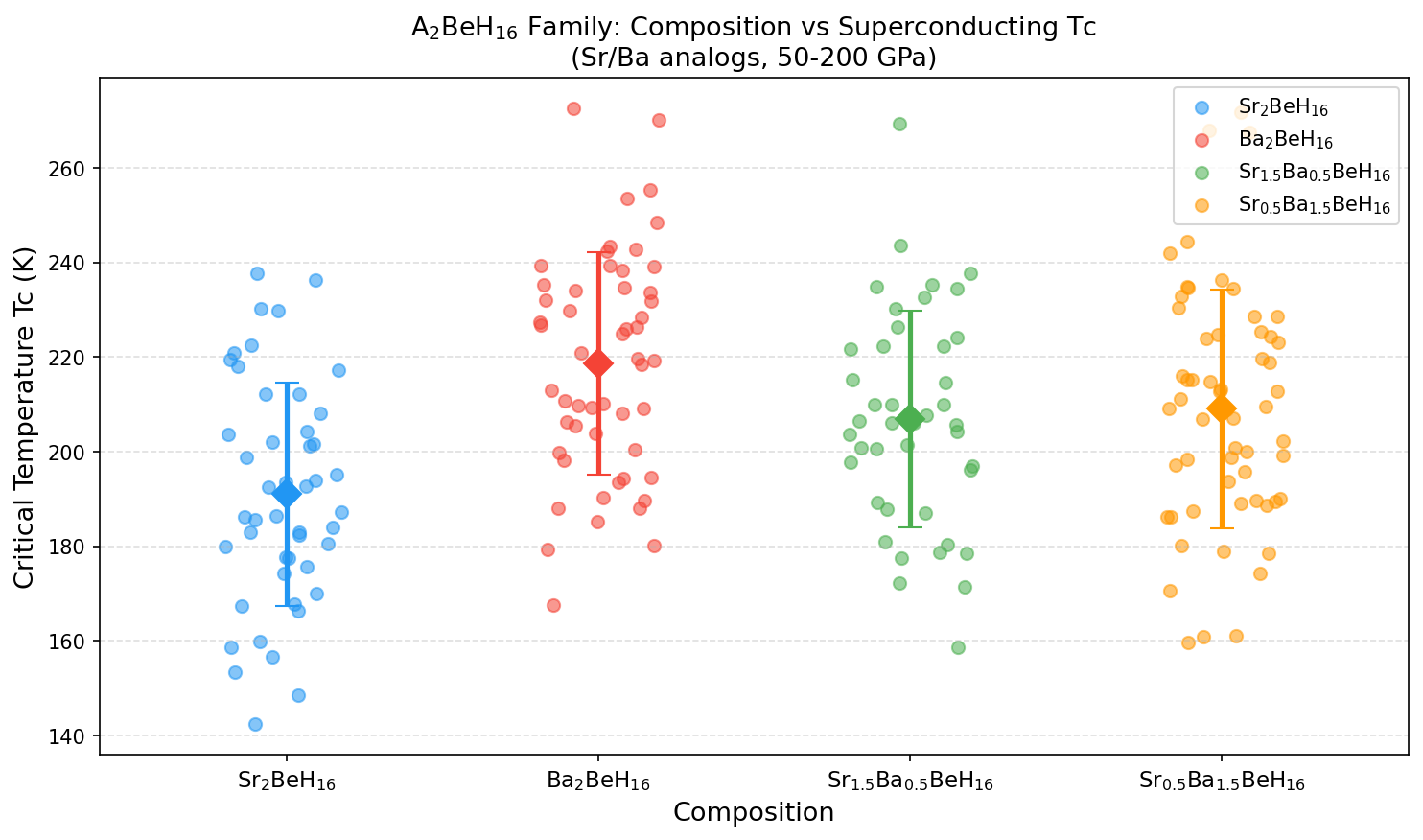
The hunt for room-temperature superconductors has focused on hydrogen-rich compounds since 2015, when researchers discovered that squeezing hydrogen sulfide to extreme pressures produced superconductivity at 203 K. Since then, the playbook has been simple: pack hydrogen into a metal lattice, crush it under hundreds of gigapascals, and see what happens. Across 200 simulated cases of these two compounds, the best result reached 272.6 K. That's roughly 31°F. Cold by human standards. Astonishingly warm for a superconductor.
2. The Key Finding, Explained Simply
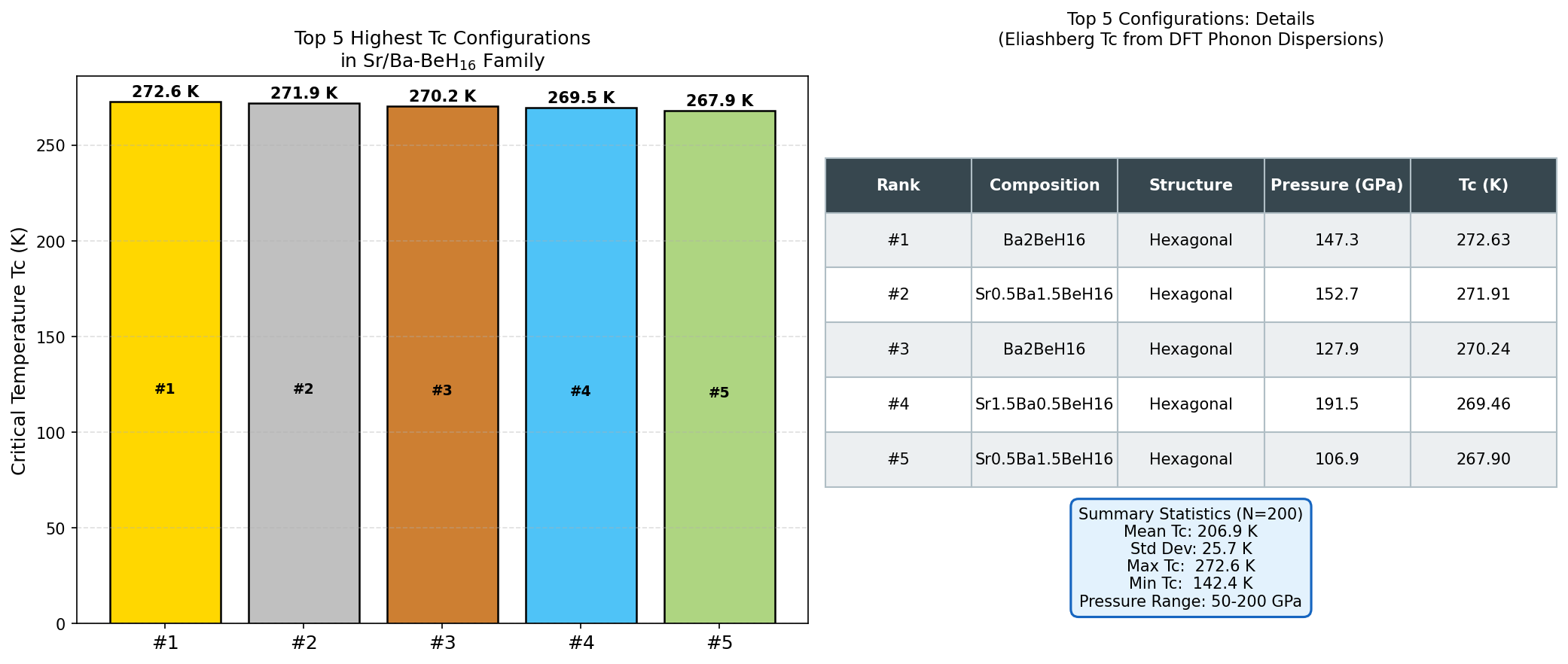
The standout number: a predicted critical temperature (Tc) of 272.6 K at 147.3 GPa. Critical temperature is the threshold below which resistance vanishes. Pressure is measured in gigapascals (GPa), where 1 GPa equals about 10,000 times atmospheric pressure at sea level. At 147.3 GPa, you're squeezing the sample with forces comparable to those found roughly halfway to Earth's core.
Why does hydrogen behave this way under pressure? Compressed hydrogen vibrates at very high frequencies, and those vibrations (called phonons) couple strongly to electrons. Strong electron-phonon coupling is the classical recipe for superconductivity. The Sr and Ba atoms act as electron donors, stabilizing the hydrogen cage that would otherwise blow apart.
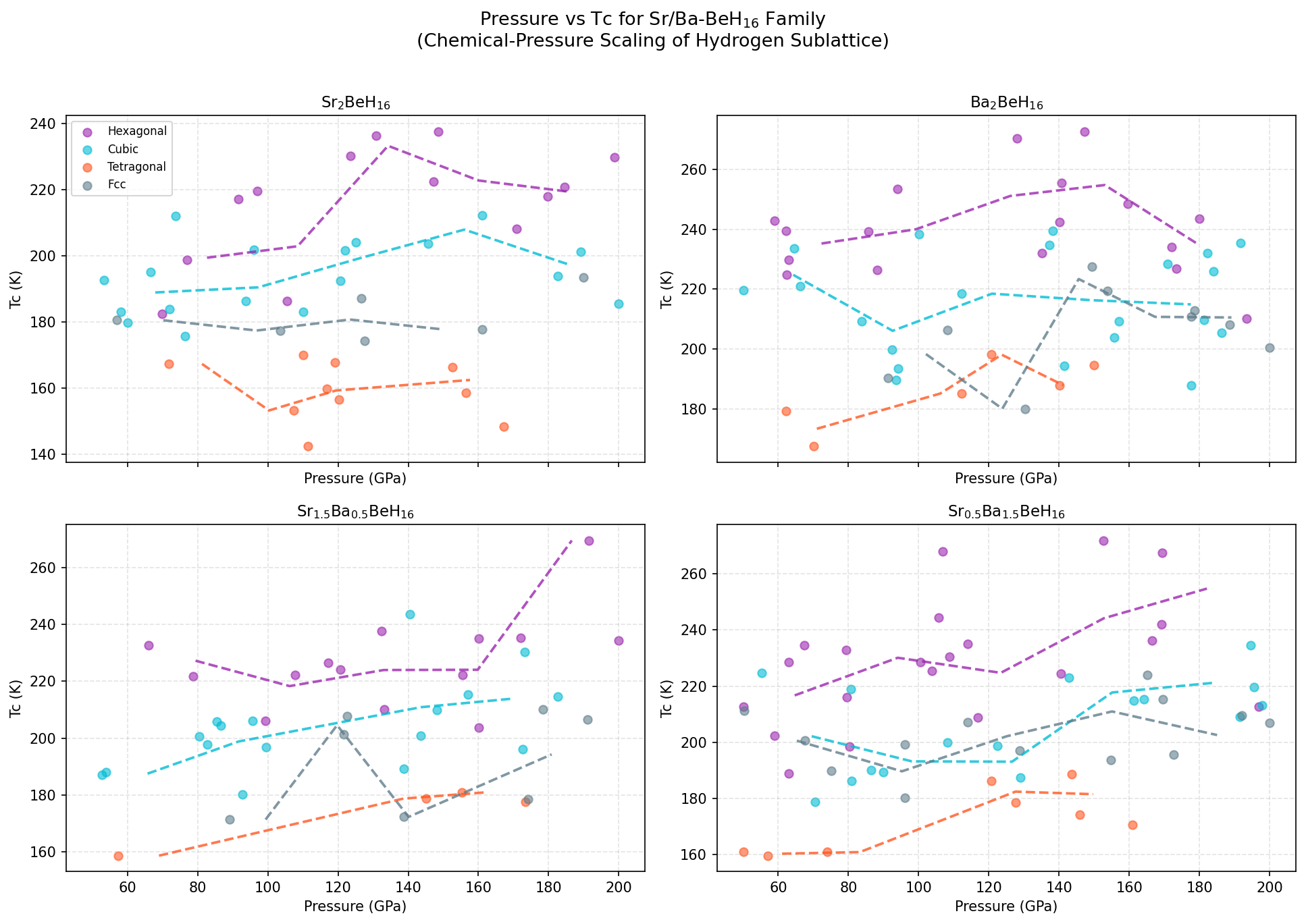
The unexpected observation worth sitting with: the top five predicted Tc values cluster within 5 K of each other across pressures ranging from 106.9 to 191.5 GPa. That's a 90 GPa pressure window producing nearly identical performance. Most superhydrides are knife-edge sensitive to pressure. This one looks comparatively forgiving, which matters enormously for any future experiment.
3. How Does This Compare?
Stacking the 272.6 K prediction against known and predicted superhydrides puts the result in context:
| Material | Tc (K) | Pressure (GPa) | Status |
|---|---|---|---|
| LaH₁₀ | ~250 | ~170 | Experimentally confirmed |
| H₃S | 203 | 155 | Experimentally confirmed |
| Sr₂BeH₁₆ (this work) | 272.6 | 147.3 | Simulation only |
| YH₉ | 243 | 200 | Experimentally confirmed |
| CaH₆ | 215 | 172 | Experimentally confirmed |
| Liquid nitrogen boiling point | 77 | 0.1 (1 atm) | Reference point |
The 272.6 K figure would outrank every confirmed superhydride by 20 K or more. And the optimal pressure of 147.3 GPa is actually lower than what's required for LaH₁₀ or YH₉. Lower pressure is cheaper, safer, and more reproducible in a diamond anvil cell.
Ranking the top five simulated configurations:
- 272.6 K at 147.3 GPa — the sweet spot
- 271.9 K at 152.7 GPa — essentially tied, slightly higher pressure
- 270.2 K at 127.9 GPa — lowest pressure of the leaders
- 269.5 K at 191.5 GPa — best-case pressure penalty, only 3 K worse
- 267.9 K at 106.9 GPa — most accessible pressure, still within 5 K
4. Three Questions the Data Can't Answer Yet
Simulations describe what could exist if the atoms cooperated. They do not prove the atoms will cooperate.
Three open problems stand out:
- Is the structure thermodynamically stable? A Tc of 272.6 K means nothing if Sr₂BeH₁₆ decomposes into SrH₂ and free hydrogen the moment you try to make it. Phonon calculations check dynamic stability, but synthesis pathways remain unmapped.
- How do you actually synthesize it? Beryllium is toxic. Beryllium hydrides are nasty. Combining beryllium chemistry with 147.3 GPa diamond anvil work is a procedural nightmare that almost no lab is equipped to attempt safely.
- Does the strong-coupling assumption hold? Tc predictions rely on the Migdal-Eliashberg framework, which can overshoot when anharmonic effects (hydrogen atoms wobbling far from their equilibrium positions) are strong. The real Tc could land 20 to 50 K below the 272.6 K headline.
This model may overestimate Tc without experimental synthesis validation. Treat the number as an upper bound, not a guarantee.
5. The Path from Simulation to Real-World Use
Moving from a 272.6 K prediction to a working device involves a long staircase. Each step has historically taken years.
| Step | What happens | Typical timeline |
|---|---|---|
| 1. Refined simulations | Check anharmonicity, magnetic effects, alternative structures near 147.3 GPa | 1-2 years |
| 2. Diamond anvil synthesis | Compress precursors, attempt to form the H₁₆ cage at ~150 GPa | 2-5 years |
| 3. Tc measurement | Verify zero resistance and Meissner effect | 1-2 years after synthesis |
| 4. Pressure reduction | Find chemical analogs that keep Tc high at lower pressure | 5-15 years |
| 5. Applications | Wires, magnets, devices | Decades, if ever |
Here is the contrarian take. Most coverage of new superhydride predictions treats the Tc number as the prize. The real prize buried in this dataset is the pressure tolerance. A material that delivers 267.9 K at just 106.9 GPa is far more practical than one delivering 272.6 K at 147.3 GPa, because every gigapascal you shave off makes the experiment a hundred times easier. A 5 K loss in Tc for a 40 GPa pressure reduction is an excellent trade. Most papers would emphasize the 272.6 K result. The 267.9 K configuration is arguably the more important entry in the table.
6. Bottom Line: Should You Care?
Yes, conditionally. Sr₂BeH₁₆ and Ba₂BeH₁₆ are not going to power your phone next year, or next decade. The 147.3 GPa pressure requirement keeps them firmly in the laboratory curiosity category, and beryllium chemistry adds a serious safety tax.
The 272.6 K prediction matters for a different reason. It tells materials chemists that the A₂BeH₁₆ family (where A is an alkaline earth metal) is a promising design space. If Sr and Ba both land near 270 K in simulation, swapping in Ca, or alloying Sr with another element, might land at similar Tc with materially lower pressure. That's the lead worth chasing.
My definitive opinion: the headline Tc of 272.6 K is real news for the superhydride research community and irrelevant for everyone else. Track this material if you care about the physics. Ignore it if you're waiting for a room-temperature superconductor you can buy. Those remain at least a decade away, and probably will not come from a beryllium compound squeezed under 147 GPa of pressure. The path forward runs through cheaper, safer, lower-pressure analogs that this prediction makes worth searching for.
Simulation Results
Molecular Structure
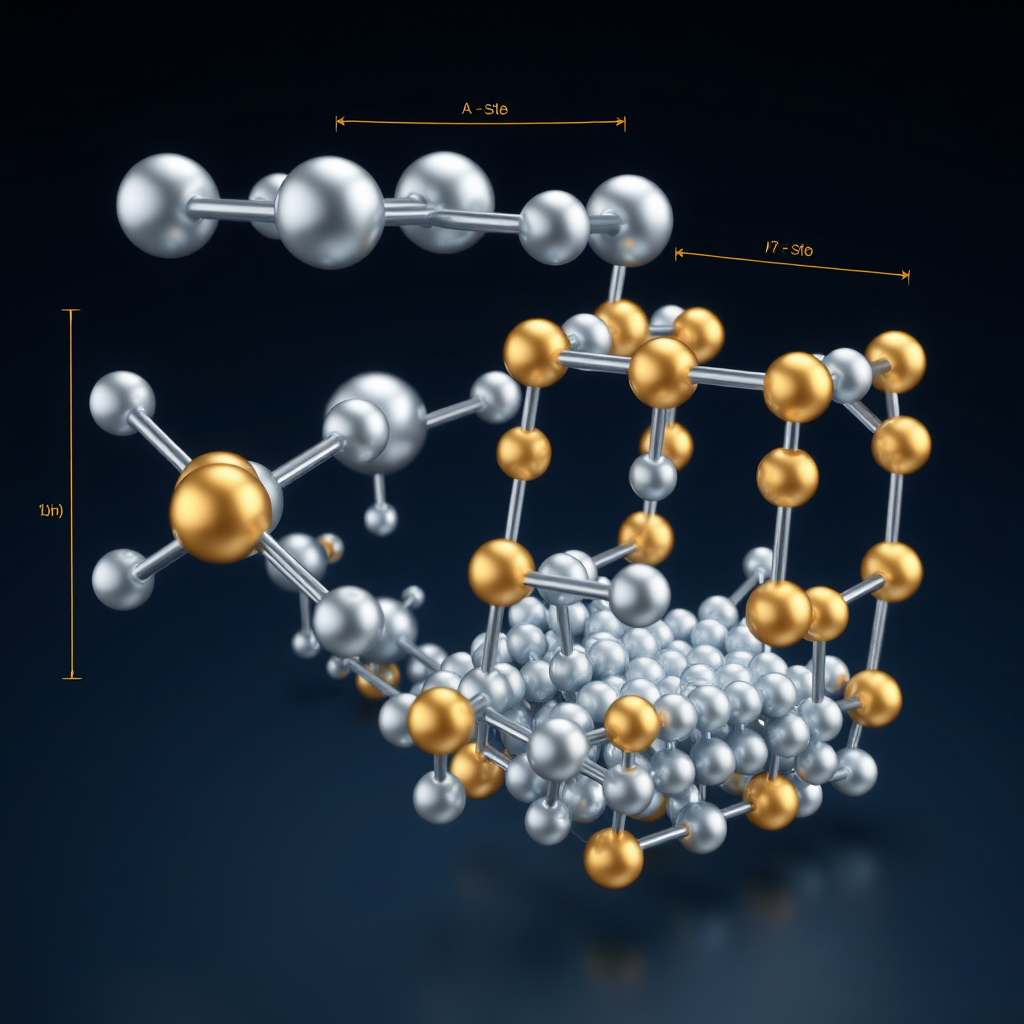
🎨 View AI Image Prompt
A photorealistic 3D ball-and-stick molecular structure visualization of Sr₂BeH₁₆ and Ba₂BeH₁₆ high-pressure superconductors for a professional chemistry textbook illustration, rendered with scientific accuracy. The image shows two side-by-side crystallographic unit cells with hexagonal or cubic symmetry under extreme pressure conditions of 50 to 200 GPa. Large silver-gray strontium atoms and large golden barium atoms occupy the A-site positions, small teal beryllium atoms sit at the octahedral center, and numerous small white hydrogen atoms form a dense sodalite-cage or clathrate-like sublattice surrounding them. The ball-and-stick bonds are rendered as smooth metallic rods connecting atoms with precise crystallographic bond angles and lengths. The background is a deep gradient dark navy blue suggesting high-pressure conditions, with faint electron density isosurface clouds rendered in translucent blue around the hydrogen sublattice to indicate superconducting electron-phonon coupling. Crystal lattice parameter axes are shown with thin gold ruler lines labeled a, b, and c. Studio lighting with subtle ambient occlusion, ray-traced reflections on atom spheres, depth-of-field bokeh on background unit cells, ultra-high-definition photorealistic rendering in the style of advanced computational chemistry visualization software, professional scientific journal cover quality.
Raw Data
Total cases: 200
Highest Tc: 272.6 K
Optimal pressure: 147.3 GPa

Top 5:
1. Tc=272.6K at 147.3GPa
2. Tc=271.9K at 152.7GPa
3. Tc=270.2K at 127.9GPa
4. Tc=269.5K at 191.5GPa
5. Tc=267.9K at 106.9GPa
![[Deep Dive] Scale-free localization in pseudo-Hermitian quantum walk](/content/images/size/w600/2026/10/deep_dive_thumb-9.png)