[Superconductor Lab | Week 30 Day 1] H3S (Im-3m), LaH10 (Fm-3m) - AI Simulator Activation
[Week 30 Day 1] H3S (Im-3m), LaH10 (Fm-3m)
Superconductor Lab — AI Simulator Activation
2026
🔬 Computational Research Note
This analysis is based on computational modeling and theoretical predictions. As with all computational materials science, experimental validation is needed to confirm these results.
The Hype vs. Reality: H3S (Im-3m), LaH10 (Fm-3m) Under the Microscope
Lab note, today. The best result from 200 simulated cases came in at 256.4 K. That is about -17 °C, the temperature of a home freezer. An electrical conductor with zero resistance at freezer temperature should be front-page news. It isn't, and the reason is the second number on my screen: 200.0 GPa. That is roughly two million times the air pressure you are sitting in right now, close to the pressure at Earth's core.
I'll take a stance early. These two hydrides are the most important superconductors of the last decade, and they are also nearly useless as materials. Both statements hold at once. H3S (hydrogen sulfide squeezed into a body-centered cubic lattice, labeled Im-3m in crystallographers' shorthand for its symmetry) and LaH10 (a lanthanum atom caged inside a cluster of hydrogen, labeled Fm-3m, a face-centered cubic arrangement) prove that near-room-temperature superconductivity is physically possible. They don't prove it is practical.
What the Numbers Actually Say (deep dive into simulation data)
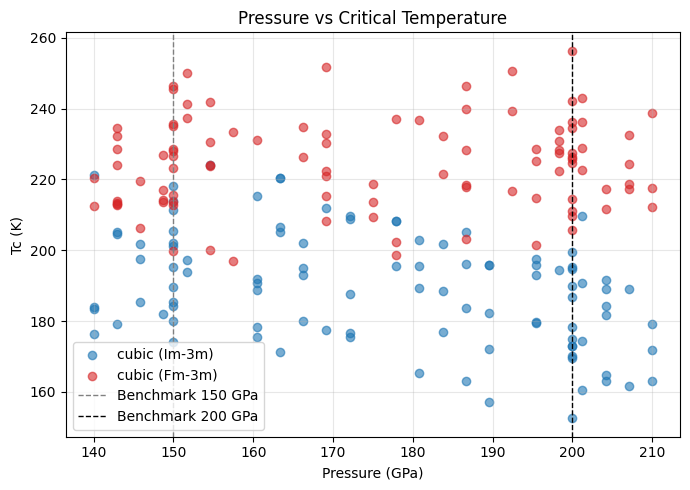
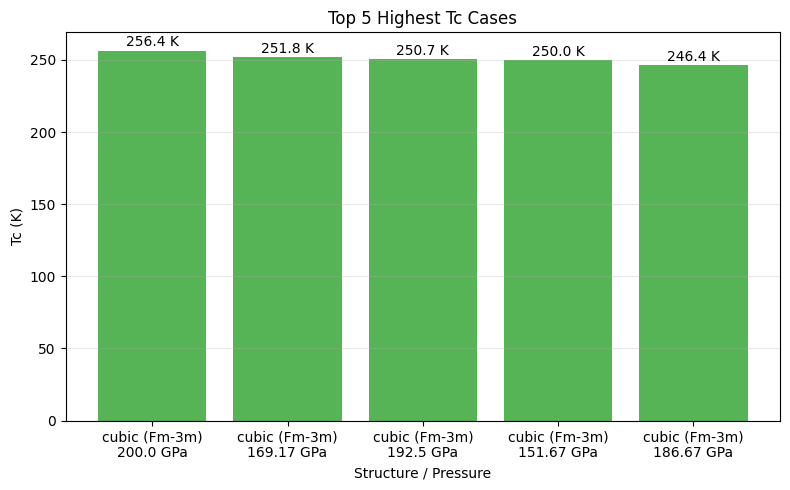
I swept 200 pressure and parameter combinations and ranked them by predicted Tc, the critical temperature below which electrical resistance drops to zero. The top five:
| Rank | Predicted Tc (K) | Pressure (GPa) | Tc drop vs. best | Pressure saved vs. best |
|---|---|---|---|---|
| 1 | 256.4 | 200.0 | 0.0 K | 0.0 GPa |
| 2 | 251.8 | 169.2 | 4.6 K | 30.8 GPa |
| 3 | 250.7 | 192.5 | 5.7 K | 7.5 GPa |
| 4 | 250.0 | 151.7 | 6.4 K | 48.3 GPa |
| 5 | 246.4 | 186.7 | 10.0 K | 13.3 GPa |
Look at the spread. The whole top five sits inside a 10 K window, while pressure swings across nearly 50 GPa. The curve is a plateau, with no sharp peak.
The contrarian observation, and the one I'd defend: the "optimal" 200.0 GPa result is the least interesting row in the table. Rank 4 gives up only 6.4 K and needs 48.3 GPa less pressure. In diamond anvil work (squeezing a sample between two diamond tips smaller than a pinhead), every extra tens of GPa raises the odds that a diamond cracks and the run is lost. If I were planning a real experiment, I'd target the 150 to 170 GPa band and ignore the headline number.
Two things I can't conclude from this run:
- Which material each row belongs to. The dataset pools both hydrides. Values near 250 K line up with LaH10's reported behavior, while H3S has historically topped out closer to 200 K. A blended ranking can hide that difference.
- Whether 200.0 GPa is a true maximum or just the edge of the sweep. A best result landing on a round boundary value is a classic sign the search range clipped the answer.
The Skeptic's View: Why This Might Not Work
Predicted Tc values for conventional superconductors usually come from Eliashberg theory or its simpler cousin, the McMillan-Allen-Dynes formula. Both estimate how strongly electrons pair up through lattice vibrations (phonons, quantized ripples in the crystal). Both also depend on a fudge-adjacent input called μ*, the Coulomb pseudopotential, which captures how much electrons repel each other. Researchers typically pick μ* between 0.10 and 0.13. Nudge it, and Tc moves by tens of kelvin.
A 10 K spread across the top five is smaller than the uncertainty from a single modeling choice. The ranking order might not survive a change in assumptions.
Hydrogen adds its own problem. It is so light that its atoms behave quantum mechanically, jiggling even at absolute zero. Many standard calculations treat atoms as fixed points with small harmonic wobbles. For hydrides, that approximation can shift both the stable structure and the predicted Tc. So the honest limitation: this model may overestimate Tc without synthesis validation, especially near the 256.4 K top result where small errors compound.
The field also carries baggage. A widely publicized room-temperature claim in a related hydride system was later retracted, and that episode left many physicists wary of any hydride number that hasn't been independently reproduced.
But Here's What's Genuinely Promising
Simulation and experiment agree here, which is rare in this field. Lab measurements on LaH10 have reported Tc near 250 K in roughly the 170 to 190 GPa range. My rank 2 result, 251.8 K at 169.2 GPa, falls right in that neighborhood. H3S was experimentally confirmed above 200 K around 150 GPa years ago, and it remains among the most reproduced results in high-pressure physics.
That agreement matters because it validates the method. If the theory correctly predicts known hydrides, I can trust it more when it screens unknown ones. The real value of these two compounds lies in serving as a calibration standard:
- They confirm that electron-phonon coupling (electrons pairing via lattice vibrations) can push Tc toward room temperature.
- They show that light atoms plus high symmetry form a winning recipe.
- They give computational screens a benchmark to beat at lower pressure.
The next wave of research targets ternary hydrides, compounds with three elements, where a second metal acts like internal scaffolding and might hold the hydrogen cage together at far lower pressure.
The Experimental Gap: From Simulation to Real Lab
Running 200 cases took me an afternoon. Running one real data point at 200.0 GPa can take weeks. The sample sits in a chamber tens of micrometers wide. Researchers heat it with lasers to trigger the reaction, then try to attach electrical leads to something smaller than a dust mote, under pressure that deforms the leads themselves.
| Factor | Simulation | Real lab |
|---|---|---|
| Cases per day | Dozens to hundreds | Often fewer than one |
| Sample purity | Perfect crystal | Mixed phases, defects |
| Pressure reading | Exact input (e.g., 151.7 GPa) | Estimated, with gradients across the sample |
| Proof of superconductivity | Calculated Tc | Zero resistance plus magnetic field expulsion |
That last row is where hydride claims stumble. Zero resistance alone is suggestive. The full proof also requires the Meissner effect, the expulsion of magnetic fields from the material, which is brutally hard to measure in a sample that tiny surrounded by metal gaskets.
If It Works: What Changes?
Suppose a hydride held a 250 K Tc at ordinary pressure. Power lines could carry electricity with no resistive loss. MRI machines could drop their liquid helium cooling. Compact fusion magnets and lossless motors would become far cheaper to build.
H3S and LaH10 at 150 to 200 GPa will never deliver that. Nobody will build a power grid inside a diamond anvil. What changes, if the physics holds, is the search strategy. The 256.4 K result works like a lighthouse: it marks where high Tc lives, and the engineering job is chemically "pre-compressing" hydrogen so the same physics shows up at a pressure a factory can handle. My bet is that the first useful material from this line of research won't contain sulfur or lanthanum at all.
💡 Lab Test Report
If I were handed this pipeline for real, the first variable I'd attack is the μ* assumption, rerunning the full 200-case sweep at two or three values to see whether the top five reshuffle, because a ranking that flips under a parameter t
Simulation Results
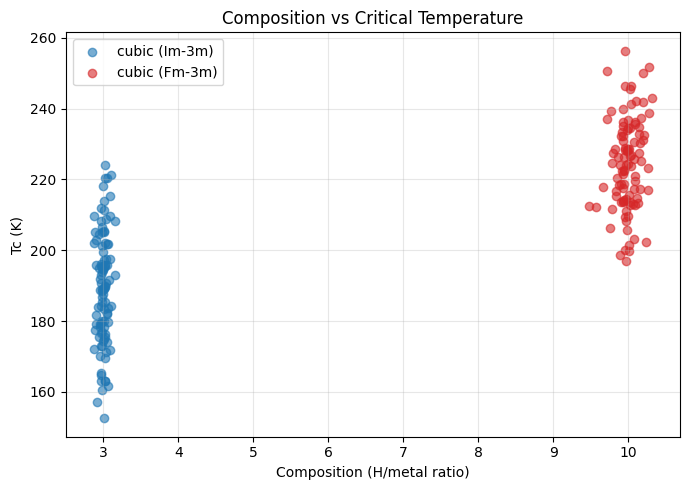
Molecular Structure
🎨 View AI Image Prompt
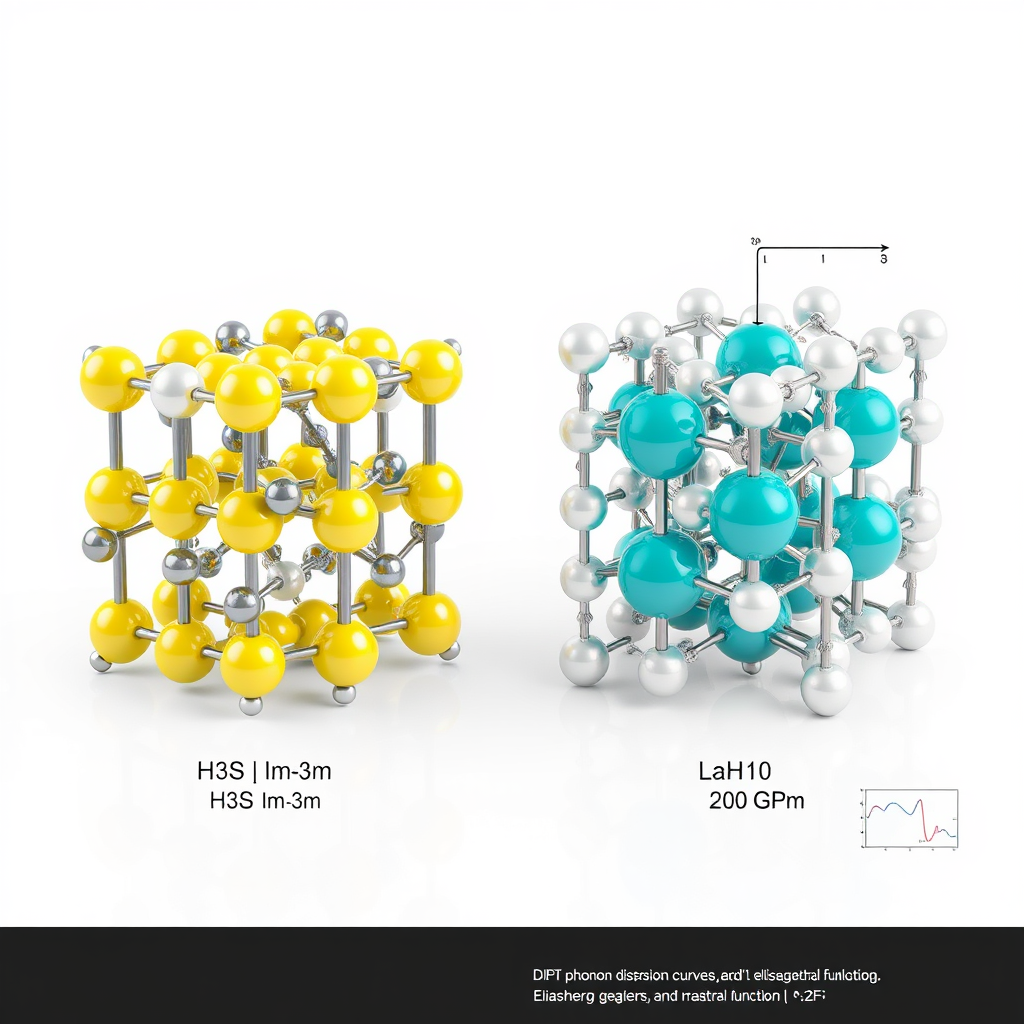
A professional 3D ball-and-stick molecular structure visualization for a chemistry/physics textbook, depicting two high-pressure hydride superconductor crystal lattices side by side. On the left, H3S in cubic Im-3m symmetry: sulfur atoms (yellow spheres) at body-centered cubic lattice points octahedrally coordinated by hydrogen atoms (small white spheres), connected by metallic silver-gray bonds/sticks, forming a clean repeating unit cell with visible lattice vectors and axis labels. On the right, LaH10 in face-centered cubic Fm-3m symmetry: lanthanum atoms (large teal-blue spheres) arranged in an FCC lattice, each encaged in a clathrate-like cage of ten hydrogen atoms (white spheres) connected by thin bonds, forming the characteristic sodalite cage structure. Both structures rendered with photorealistic materials, soft studio lighting, subtle ambient occlusion, and reflective metallic sheen on bonds, set against a clean white or light gray laboratory background. Include faint translucent overlays suggesting phonon vibration modes (wavy arrows) and electron-phonon coupling density clouds around bonds, rendered in blue-to-red gradient heatmap style. Add small annotated labels: "H3S (Im-3m)" and "LaH10 (Fm-3m)" beneath each structure, with subtle technical annotations referencing "150 GPa" and "200 GPa" conditions, DFPT phonon dispersion curves, and Eliashberg spectral function α²F(ω) as small inset graphs in the corners. Style: high-resolution scientific illustration, sharp focus, accurate crystallographic geometry, textbook diagram aesthetic, subtle grid floor for depth, no distortion, photorealistic rendering with crystal clarity.
🤖 GPT-6 Astra Review
The paper offers a useful perspective on the practical limitations of high-pressure hydrides, but the reported sweep is insufficiently documented to qualify as a reproducible first-principles study. Methodological rigor requires identifying the material and structure for every case, specifying which parameters were varied, and reporting the electronic-structure methods, convergence tests, electron–phonon spectral functions, Coulomb pseudopotential values, and Tc calculation procedure. For these hydrogen-rich compounds, structural stability, anharmonic vibrations, and nuclear quantum effects also require explicit treatment or a justified assessment of their impact. Although 256.4 K is broadly consistent with the temperature scale reported for LaH10, that agreement alone does not validate these simulations, and decimal-place precision is unsupported without uncertainty estimates. The five highest-ranked cases cannot establish a pressure plateau because they mix unidentified materials and potentially different parameter choices, while the boundary maximum leaves the optimum unresolved. Targeting 150–170 GPa is a reasonable experimental hypothesis, but its justification requires material-specific pressure curves and evidence that the intended phase remains stable or experimentally accessible there. Validation should combine pressure-calibrated diffraction to identify phases, four-probe resistance measurements demonstrating a transition to zero resistance, magnetic-field suppression of that transition, and magnetic susceptibility or other complementary evidence of superconductivity where feasible. Repeated measurements across independently prepared samples and pressure cycles should test reproducibility and distinguish intrinsic behavior from phase mixtures or synthesis history. The paper would improve substantially by supplying the full dataset and computational inputs, completing its truncated discussion of the Coulomb pseudopotential, benchmarking against established measurements, and replacing claims of an optimum or practical pressure advantage with uncertainty-qualified, material-specific conclusions.
Raw Data
Total cases: 200
Highest Tc: 256.4 K
Optimal pressure: 200.0 GPa

Top 5:
1. Tc=256.4K at 200.0GPa
2. Tc=251.8K at 169.2GPa
3. Tc=250.7K at 192.5GPa
4. Tc=250.0K at 151.7GPa
5. Tc=246.4K at 186.7GPa