In the Quantum World, Time Doesn't Exist
Episode 6: Does Time Actually Flow?
I like science that leaves room to imagine. When things that seemed unrelated turn out to share a hidden pattern — that moment feels like finding one of the world's secrets. Which opens a door I didn't know was there. Which leads somewhere unexpected. Which eventually leads back to me.
You know the feeling. You're waiting for a phone call that matters, and the clock on the wall seems stuck. Then you spend an evening with an old friend, and four hours vanish like someone stole them. We usually blame our brains. Time is steady, we tell ourselves, and attention just bends it. Out there, somewhere, a perfect clock ticks at the same pace for everyone.
Here's the problem. There is no such clock. In 2010, physicists placed two extremely precise atomic clocks at different heights, one about 33 centimeters above theother. The higher one ticked faster [1]. Not by much. Not by anything you could ever feel. But it was measured, and it was real.
Now think about your own body. Your head sits a little farther from Earth's center than your feet. So right now, as you read this, your head is aging slightly faster than your toes [1]. Over a whole lifetime, the difference comes to less than a millionth of a second. So no, this is not a reason to sleep standing on your head.
This isn't a lab curiosity, either. The satellites that guide your phone's map carry clocks that run faster than clocks on the ground, by about 38 millionths of a second every day [2]. Engineers build the correction right in. Without it, your blue dot would wander off by roughly ten kilometers a day [2]. Every time you find a coffee shop, you are quietly trusting that time runs differently up there.
Einstein saw this coming more than a century ago. His general relativity *1 says gravity doesn't just pull on things. It slows time itself [3]. The closer you are to something heavy, the slower your clock runs. So there is no single "now" ticking across the universe. There are only countless private clocks, each keeping its own pace.
That alone should make you uneasy. But it gets stranger. When physicists look at the smallest scale of nature, the world of atoms and the particles inside them, time starts to slip out of the equations altogether [4]. Some researchers suspect that time, the thing you feel passing right now, may not be built into reality at all [5]. It might be something that emerges, the way temperature emerges *2 from countless jiggling molecules [5].
Which leaves you with an odd thought. You feel every second pass. You remember yesterday and wonder about tomorrow. If the deepest laws of nature don't need time, then what, exactly, is passing?
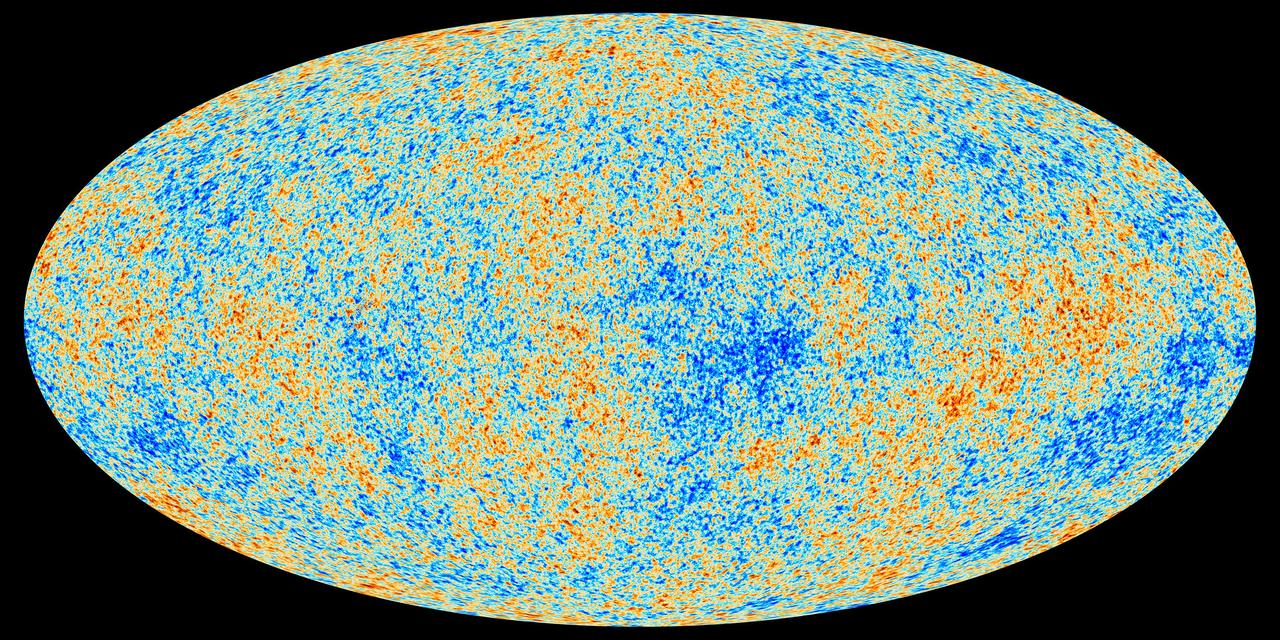
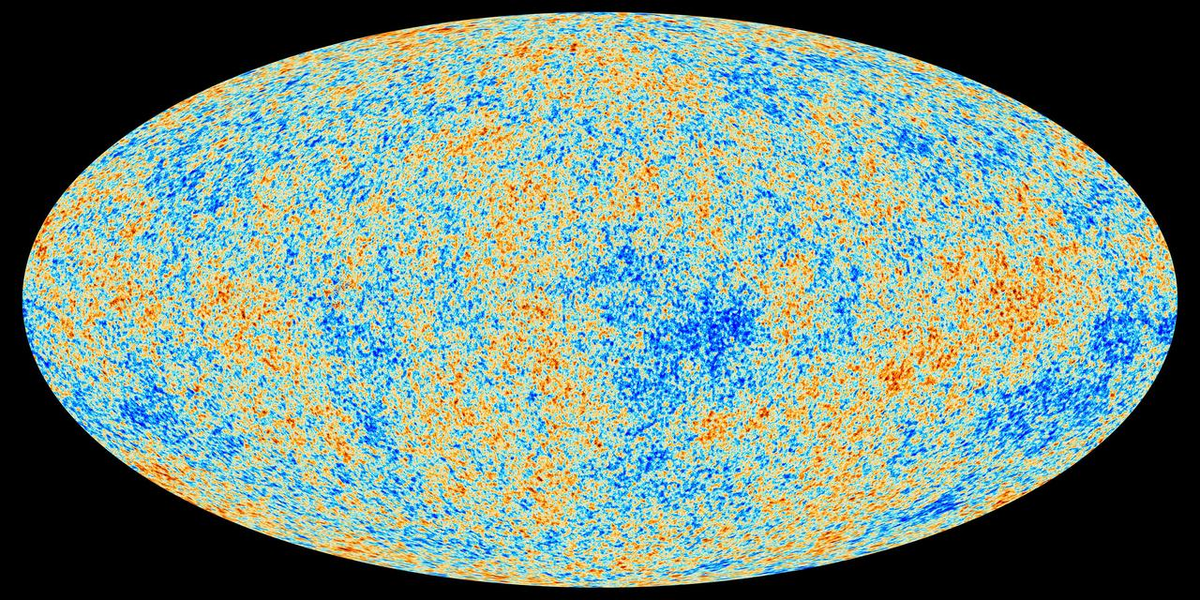
📷 Best Map Ever of the Universe — ESA and the Planck Collaboration (NASA Image and Video Library, Public Domain)
A Shoebox Full of Undated Photographs
Imagine you find a shoebox in your grandmother's attic. Inside are hundreds of photographs. No dates on the back. No captions. Just a pile.
Can you put them in order? Actually, yes. A baby in one. A toddler in another. The same face, older, holding a diploma. A birthday candle is tall in one shot and melted in the next. You don't need a calendar. You read the order from the things inside the pictures, compared against each other.
Now notice something strange. The box itself isn't moving. Nothing in it ticks. All the photos just sit there, at once. "Before" and "after" exist only in how one picture relates to another.
That, roughly, is what happens when physicists try to describe the entire universe with quantum mechanics. In 1967, Bryce DeWitt, building on ideas from John Wheeler, wrote down an equation for the quantum state of the whole cosmos [1]. It's called the Wheeler-DeWitt equation *1. And the letter t, the one for time, which shows up in almost every equation in physics, is gone [1][2]. Not hidden. Missing. The universe, described as a whole, just sits there. Like the shoebox.
That should sound absurd. You read this sentence after the previous one. Something is moving. So in 1983, Don Page and William Wootters proposed a way out [3]. Split the universe into two parts. Call one part "the clock" and the rest "everything else." The two parts are entangled *2. Their states are linked, so knowing one tells you something about the other. Ask how everything else looks when the clock reads three, then when it reads four, and you get change. Motion. A story. But step outside and look at the whole thing, and nothing changes at all [3].
Time, in this picture, isn't a river. It's the comparison between photographs.

AI-generated image — a conceptual visualization
For thirty years this was a nice idea on paper. Then a team in Italy built a tiny version of it [4]. They took two photons, which are single particles of light, and entangled them. One photon served as the clock. To an observer who was part of the system, measuring one photon against the other, the second photon's polarization *3 appeared to evolve. To an observer outside, looking at both together, the state was frozen [4]. Same photons. Two answers, depending on whether you were in the box or holding it.
I want to be careful here. Nobody has a finished theory of quantum gravity *4[2]. The Wheeler-DeWitt equation might be wrong, or incomplete. A two-photon experiment is not a universe. Physicists argue about this constantly, which is mostly what physicists are for.
But sit with the image for a second. You have never actually seen time. You've seen a clock hand, a sunset, a friend's face getting older, and noticed that they line up. Every time you've felt time pass, you were inside the box, comparing photographs.
Which leaves me with a question I can't shake. If nobody stands outside the box, who is holding it?
A stationary 16-state Page–Wootters illustration: every branch is fixed, while conditioning on different clock states selects different correlations.
The Equation With No Clock In It
Physics has two great rulebooks, and they disagree about time.
The first is Einstein's general relativity *1. It says time is stretchy. It runs slower near heavy things and faster far from them [1]. That's why the clock on the higher shelf in the hook ticked faster than the one below it [2]. Time isn't a backdrop. It's part of the stage, and the stage bends.
AI-generated image — a conceptual visualization
The second rulebook is quantum mechanics *2. It describes the very small: atoms, electrons, light. Here time is the opposite of stretchy. It's a fixed, outside ticker. Every quantum equation assumes a clock sitting off to the side, counting seconds, untouched by anything happening inside [3].
So one theory says time is flexible and woven into the universe. The other says time is rigid and stands outside it. Both have passed every test we've thrown at them. Physicists have spent about ninety years trying to make them agree.
In the 1960s, two of them tried something bold. John Wheeler and Bryce DeWitt took the quantum rules and applied them to the whole universe at once [4][5]. Not an atom. Everything. What came out is now called the Wheeler-DeWitt equation *3.
And here is the part that should make the hair on your arms stand up. When they finished the math, the time variable was gone [4].
Not hidden. Not small. Gone. The equation describes the universe completely, and nowhere in it is there a "t" ticking forward. The physicist Chris Isham later called this "the problem of time," and wrote a long, careful review explaining why nobody could make it go away [3]. You can have a quantum universe, it seems, or a universe where time flows. Not obviously both.
Your first reaction might be that the math is broken. Plenty of physicists thought so. But a British physicist named Julian Barbour took it literally. In his 1999 book The End of Time, he argued that the universe really is a collection of still moments, each one complete in itself [6]. He called them "Nows." No moment moves. No moment flows into the next.
AI-generated image — a conceptual visualization
Then why do you remember breakfast? Barbour's answer is that some moments contain records of other moments. He called these "time capsules" [6]. Your memory of breakfast isn't a trip to the past. It's a pattern in your brain, right now, that looks like evidence of a past. A fossil is a time capsule. So is the melted birthday candle in your grandmother's shoebox. The box doesn't move. The photographs just contain clues that let you line them up.
That's a beautiful idea. It's also very hard to test. So let's look at someone who found a way to test a version of it.
In 1983, Don Page and William Wootters published a paper with one of the best titles in physics: "Evolution without evolution" [7]. Their idea used entanglement *4. Entanglement means two things are linked so that you can't describe one without the other. Measure one and you learn something about its partner, no matter the distance.
Page and Wootters asked what happens if you split the universe into two parts, a clock and everything else, and entangle them. Their math showed something strange. Seen from outside, the whole thing is frozen. Nothing changes [7]. But seen from inside, by someone who uses one part as a clock, the rest appears to change over time. Time shows up only when you're part of the system. Step outside, and it disappears.
For thirty years, this was a thought experiment. Then in 2014, a team led by Ekaterina Moreva at the National Institute of Metrological Research in Turin built it on a lab bench [8]. They used two photons, two particles of light, entangled through their polarization *5, which is the direction the light wave wiggles.
One photon played the clock. The other played "the rest of the universe." When the researchers looked at the pair from the inside, using one photon to time the other, they saw the second photon change. When they measured the pair as a whole, from the outside, the combined state did not change at all [8]. Same photons. Same moment. Two answers, depending on where you stand.
AI-generated image — a conceptual visualization
Now, careful. This doesn't prove the universe is frozen. It's two photons, not a cosmos. The authors themselves called it an illustration, not a proof [8]. What it shows is that the Page-Wootters idea isn't just ink on paper. Time emerging from a timeless whole is at least physically possible.
Carlo Rovelli, an Italian physicist who works on quantum gravity, pushes the idea further. With mathematician Alain Connes, he proposed the "thermal time" hypothesis *6 [9]. The short version: the flow of time isn't fundamental. It comes from our blurry, incomplete view of the world. We can't track every particle, so we see averages, and the averages drift in one direction. That drift is what we feel as time passing [9][10]. Rovelli suggests the time we experience is tied to what we don't know [10].
Which, if true, means the most reliable feeling you have is built partly out of ignorance. Not a great look for ignorance, which has never before been credited with anything so useful.
Here's where honesty matters. Nobody has a working theory of quantum gravity. The Wheeler-DeWitt equation might be the wrong starting point. Barbour's timeless universe is a minority view. Rovelli's thermal time is a hypothesis, not a result. Many physicists think time is real and the equations are simply incomplete. We don't know. That's not a failure. That's the frontier.
But think about what this means for you, tonight. Einstein, near the end of his life, wrote to the family of his oldest friend after the friend died. He said that for people like them, "the distinction between past, present and future is only a stubbornly persistent illusion" [11]. He wasn't writing physics. He was writing condolence.
Maybe that's where these ideas land. If time is something that appears from the inside, then you aren't a passenger carried along by it. You're one of the places where it happens. The waiting room clock that froze. The evening with your friend that vanished. Those weren't errors in your perception of a real, outside time. They might be closer to what time actually is: a relationship between you and everything else.
AI-generated image — a conceptual visualization
And if time only exists for those inside the system, then who, or what, would ever be standing outside to see the universe holding perfectly still?
The Equation With No Clock
Here is the part that keeps me up at night. When physicists tried to force the two rulebooks into one, they got an equation. It's called the Wheeler-DeWitt equation *1, written down in 1967 [1]. And when you look for the letter t in it, the one that stands for time, it isn't there [1]. Not hidden. Not small. Gone.
Think back to the shoebox. According to this equation, the universe might be the box itself. Every moment sits there at once, and nothing moves. So where does the feeling of before and after come from? In 1983, Don Page and William Wootters offered a strange answer [2]. Time might come from entanglement *2. That's when two particles share a single story, so checking one tells you something about the other. Split the universe into a "clock" part and an "everything else" part. From the inside, the rest seems to change as the clock ticks. From the outside, the whole thing stands perfectly still [2].
In 2014, a team in Turin tested this idea with pairs of photons [3]. A photon is a tiny packet of light, the smallest piece of it you can have. An observer inside the experiment saw change. An observer outside saw nothing happen at all [3]. It's a toy model, not the universe. But it worked.
Now the honest part. We don't know if any of this is right. Nobody has a finished theory of quantum gravity *3 [4]. The effects live at scales so small that our best machines can't come close [4]. Carlo Rovelli suspects the flow we feel comes from blur. We can't see every detail of the world, and that missing detail might be what gives time its direction [4][5]. Others think time is real and the equation is simply missing something. Physicists have argued about this for over fifty years. That's longer than most marriages, with less progress.
So bring it back toyou. Maybe the slow phone call and the vanished evening aren't your brain failing to read some cosmic clock. Maybe there was never a clock to read. Just you, inside the box, noticing what changed. And if every moment already exists at once, which one are you in right now?
AI-generated image — a conceptual visualization
You Are One of the Photographs
So where does that leave us? In 1983, Don Page and William Wootters offered an idea that is strange and quietly beautiful [1]. Maybe time only appears from the inside. A universe frozen as a whole could still seem to change for anything within it, because its parts are entangled *1 with each other [1]. Entangled means linked so tightly that you can't describe one piece without describing the other.
In 2013, a team in Italy tested a tiny version of this with two particles of light [2]. Seen from outside, the pair didn't change at all. Seen by one particle using the other as its clock, things evolved [2]. Two particles of light are not a universe. But they're not nothing either.
Now bring it back to you. You aren't holding the shoebox. You're one of the photographs. Your memories, your stiffening knees, the coffee going cold on your desk are the clues that let you read an order from the inside. The flow you feel might simply be what it's like to be a part of something. Carlo Rovelli suggests that the direction we sense in time may come from our blurry, partial view of the world [3]. Nobody knows for sure. Your knees don't know either, though they keep filing complaints.
So the next time a phone call refuses to come, notice the waiting. It might be the only clock you've ever actually had.
And if time only lives on the inside, what was there before anything was inside?
TERMS EXPLAINED
- *1General relativity: Einstein's theory of gravity. Instead of an invisible force pulling things together, heavy objects bend space and time around them, and everything else follows those bends.
- *2Emergent (as in "temperature emerges"): A property that doesn't exist for any single piece but appears when you have lots of pieces together. One molecule has no temperature. Billions of them bouncing around do.
- *3Polarization: The direction a light wave wiggles in, like a rope shaken up-and-down versus side-to-side.
- *4Quantum gravity: The missingtheory that would join quantum physics, the rules for very small things, with gravity, the rules for very large things. We have both halves. We don't have the glue.
- *5Polarization: The direction a light wave wiggles as it travels, like up-and-down versus side-to-side.
- *6Thermal time hypothesis: The idea that time's flow isn't built into the universe. It appears because we only see averages of things, not every tiny detail, and those averages drift in one direction.
SOURCES & REFERENCES
- [1]Chou, C. W., Hume, D. B., Rosenband, T., & Wineland, D. J. (2010). "Optical Clocks and Relativity." Science, 329(5999). — Clocks separated by about 33 cm in height tick at measurably different rates, with the higher one running faster; the same effect applies across the height of a human body.
- [2]Ashby, N. (2003). "Relativity in the Global Positioning System." Living Reviews in Relativity, 6(1). — GPS satellite clocks run about 38 microseconds per day fast relative to ground clocks; uncorrected, position errors would grow by roughly 10 km per day.
- [3]Einstein, A. (1916). "Die Grundlage der allgemeinen Relativitätstheorie." Annalen der Physik, 49. — General relativity predicts that gravity slows the passage of time.
- [4]DeWitt, B. S. (1967). "Quantum Theory of Gravity. I. The Canonical Theory." Physical Review, 160(5). — The Wheeler-DeWitt equation, an attempt to combine quantum theory with gravity, contains no time variable.
- [5]Rovelli, C. (2018). "The Order of Time." Riverhead Books. — The argument that time may not be fundamental but may emerge, much as temperature emerges from molecular motion.
- [6]Barbour, J. (1999). "The End of Time: The Next Revolution in Physics." Oxford University Press. — The universe as a collection of timeless "Nows"; "time capsules" as records.
- [7]Page, D. N., & Wootters, W. K. (1983). "Evolution without evolution: Dynamics described by stationary observables." Physical Review D. — Time can emerge for an internal observer from a globally static entangled state.
- [8]Moreva, E., Brida, G., Gramegna, M., Giovannetti, V., Maccone, L., & Genovese, M. (2014). "Time from quantum entanglement: an experimental illustration." Physical Review A. — Two entangled photons appear to evolve from the inside while the global state stays static.
- [9]Connes, A., & Rovelli, C. (1994). "Von Neumann algebra automorphisms and time-thermodynamics relation in generally covariant quantum theories." Classical and Quantum Gravity. — The thermal time hypothesis: the flow of time arises from statistical states.
- [10]Rovelli, C. (2018). "The Order of Time." Riverhead Books / Allen Lane. — Accessible account of thermal time, and of time's flow as tied to our incomplete knowledge.
- [11]Einstein, A. (1955). Letter to the family of Michele Besso, in Speziali, P. (ed.), "Albert Einstein–Michele Besso Correspondance 1903–1955," Hermann (1972). — Source of the "stubbornly persistent illusion" quote.
Inline citations [N] correspond to numbered references above.
A weekly journey from the present universe back to the Big Bang — and to what it means for us.