Entropy: The Real Reason Time Has a Direction
Episode 6: Does Time Actually Flow?

I like science that leaves room to imagine. When things that seemed unrelated turn out to share a hidden pattern — that moment feels like finding one of the world's secrets. Which opens a door I didn't know was there. Which leads somewhere unexpected. Which eventually leads back to me.
You've seen it. Someone posts a clipof a glass shattering, but it's playing backwards. The shards leap off the floor. They find each other in midair. The glass lands on the table, whole, like nothing happened.
You laugh. You know instantly it's fake. Nobody had to explain it to you. A toddler would know.
But here's the thing that kept me up one night. Ask physics how you knew, and physics shrugs. The basic laws that move every particle in that glass work just as well in reverse [1]. Run the film backwards and every single collision still obeys the rules. Each atom, on its own, has no idea which way the movie is supposed to go. Physicists call this time-reversal symmetry *1 [1]. There's one tiny exception, buried in the behavior of certain rare particles [2]. It has nothing to do with your glass.
So the shards could, in principle, jump back up. Nothing forbids it. They just never do. Not once, in the whole history of anybody dropping anything. That's good news for your kitchen floor. It's bad news for anyone who thought the universe came with clear instructions.
Now notice something stranger. That same instinct, the one that told you the clip was backwards, is what you call time. You remember yesterday. You can't remember tomorrow. Coffee cools. It never heats itself back up. You get older. The astronomer Arthur Eddington gave this one-way street a name: the arrow of time *2 [3].
But if the rules don't contain an arrow, where does it come from? Something is pointing the way. It isn't inside the atoms. So it has to be somewhere else. And the place it actually lives is far bigger, and far older, than anything in that glass.
The Rubik's Cube That Never Solves Itself
Pick up a solved Rubik's cube. Close your eyes. Twist it at random, twenty times, fifty times, a hundred.
Open your eyes. It's a mess. Of course it is. You'd be shocked if it weren't.

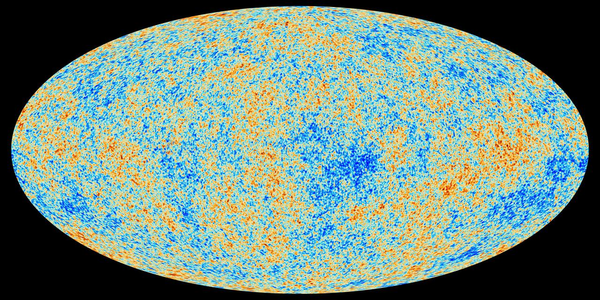
📷 The Big Bang left a permanent scare in the cosmic background, 5 billion light-years from Earth — GSFC (NASA Image and Video Library, Public Domain)
Now close your eyes again and keep twisting, hoping to land back on solved. You could do that until the sun burns out. A cube has about 43 quintillion possible arrangements [1]. Exactly one of them is solved. Every random twist is a lottery ticket in a lottery with 43 quintillion losing numbers and one winner.
Notice what didn't happen. No twist was illegal. Every move that scrambled the cube could be undone by the exact reverse move. The rules of the cube run perfectly well backwards, just like the laws moving the atoms in that glass [2]. Nothing forbids the cube from solving itself. The solved state is just absurdly, hopelessly outnumbered.
That's entropy *1. It's not a force pushing things toward mess. It's a count. In the 1870s, Ludwig Boltzmann realized that entropy measures how many ways the tiny pieces of something can be arranged while it still looks the same from the outside [3]. A shattered glass on the floor? An enormous number of ways to scatter those shards and molecules. A whole glass on the table? Almost none, by comparison. The second law of thermodynamics *2 says entropy tends to grow [3]. Boltzmann's insight was that this is just the cube. Things drift toward whatever has more arrangements, because there are so many more of them.
And the glass is far worse than the cube. It isn't 26 little blocks. It's trillions of trillions of atoms, all jiggling [4]. The odds of them leaping back together aren't small. They're so small that "never" is the honest word.
I own a Rubik's cube, by the way. It has been in a high-entropy state since roughly 2011. I consider it a physics demonstration.
Here's what got me. Your coffee cooling. Your bedroom getting messier. Your body, slowly, aging. You don't feel these as statistics. You feel them as time passing. But maybe the arrow you feel is just the cube being twisted, the universe drifting from rare arrangements toward common ones [4].
Which leaves one strange thing hanging. Scrambling only works if you start with a solved cube. Something had to hand the universe a cube that was almost perfectly ordered [4]. So who solved it?
Four hundred reversible ideal-gas particles trace a measured entropy curve forward and exactly backward; the low-entropy boundary condition supplies the arrow.
The Number on Boltzmann's Tombstone
The word came before anyone understood it. In 1865, the German physicist Rudolf Clausius was studying steam engines and the heat they kept losing. He needed a name for whatever was slipping away. He chose "entropy" *1, built from the Greek for transformation and deliberately made to sound like "energy" [1].

AI-generated image — a conceptual visualization
Clausius knew what entropy did. It went up. Heat flows from hot to cold, never back on its own. Coffee cools. It never spontaneously reheats while the room gets colder. That one-way rule became the second law of thermodynamics *2 [1].
What Clausius didn't know was why.
The answer came from a man in Vienna named Ludwig Boltzmann. In the 1870s he did something that sounds almost too simple. He counted.
Boltzmann said entropy measures how many ways the tiny pieces of a thing can be arranged while it looks exactly the same from the outside [2]. A solved Rubik's cube has one arrangement. A scrambled cube has billions upon billions that all look like "a mess." So a randomly twisted cube ends up scrambled. No force pushes it there. There's just more room in the mess.
He wrote it as a short formula, S = k log W. S is entropy. W is the number of arrangements *3. The formula is carved on his tombstone in Vienna [3]. Most of us get a name and two dates. Boltzmann got the reason your coffee goes cold.
This is the part that rearranged something in my head. Entropy isn't a law the way gravity is a law. It's statistics. Your shattered glass doesn't reassemble for the same reason your shuffled deck doesn't come out in order. It isn't forbidden. It's just absurdly unlikely.
Then came the objection. In 1876, Boltzmann's friend Josef Loschmidt pointed out a problem [4]. If the laws of motion run equally well backwards, then for every path where entropy goes up, there's a mirror path where it goes down. So how can motion that doesn't care about direction produce a rule that does?
The story goes that Boltzmann replied, "Go ahead and reverse them." Nobody is sure he said it. It's still the right answer. Reversal is allowed. It just never happens in practice.

AI-generated image — a conceptual visualization
But Loschmidt had found something deeper, and it took physicists about a century to fully face it. Boltzmann's counting works in both directions of time. Find a half-melted ice cube in a glass of water, and the statistics say it was probably more melted a minute ago, not less. The math predicts more disorder in the past just as firmly as in the future [5].
That's obviously wrong. You remember ice cubes. So something else is going on.
The philosopher David Albert gave it a name in 2000: the Past Hypothesis [6]. Entropy rises toward the future because the universe began in a state of incredibly low entropy. Everything since then has been the cube slowly scrambling. Richard Feynman made the same point back in 1964 in his Messenger Lectures. He argued that to explain irreversibility, you have to add an assumption to the laws of physics: the universe used to be more ordered than it is now [7].
So the arrow of time isn't written into the laws. It's written into the starting point.
Arthur Eddington coined the phrase "time's arrow" in 1928 [8]. He trusted the second law more than almost anything. "If your theory is found to be against the second law of thermodynamics I can give you no hope," he wrote; "there is nothing for it but to collapse in deepest humiliation" [8].
How special was that starting point? Roger Penrose tried to put a number on it. He estimated the odds of a universe like ours starting that ordered by chance at about 1 in 10 to the power of 10 to the power of 123 [9]. You couldn't even write that number out. You would need more zeros than there are particles in the observable universe. Next to it, solving the cube with your eyes closed starts to look like a solid plan.
And here's the twist I didn't see coming. The early universe was hot, smooth, and evenly spread out, almost the same everywhere. That sounds like maximum mess, like gas that has fully mixed. But gravity flips the rules. For ordinary gas, smooth means disordered. Under gravity, smooth is the rare, special arrangement, and clumping is what happens naturally. Stars, galaxies, and black holes are the universe scrambling itself [9][5]. The cosmos started out as a solved cube. We just didn't recognize it because it was solved in gravity's language.

AI-generated image — a conceptual visualization
Why did it start that way? We don't know. That's the honest answer. Sean Carroll and Jennifer Chen have suggested our universe might have budded off from a larger, older one [10]. Penrose argues for an endless cycle of universes [9]. Others think it's simply a brute fact with no deeper reason. None of these ideas has been tested.
Here's where it lands for me. Carlo Rovelli points out that memory itself depends on entropy [11]. A memory is a trace, a mark left behind, and traces can only form while entropy is increasing. You can remember yesterday and not tomorrow because the universe began ordered. Every memory you have is a small leftover of how the universe started.
So when you watch that backwards glass and laugh, you aren't using common sense. You're using the Big Bang.
If the direction of time comes down to a starting point, and not a law, does the flow you feel belong to time at all, or only to you?
Who Tidied Up Before the Big Bang
So entropy goes up. That explains the shattered glass. But it quietly smuggles in a bigger problem. If disorder always grows, the past must have been tidier than today. And the past before that, tidier still. Follow the thread all the way back and you hit the Big Bang. The universe must have started out absurdly neat.
How neat? Roger Penrose did the math. He put the odds of a beginning as orderly as ours at one in ten to the power of ten to the power of 123 [1]. You can't write that number out. There aren't enough atoms in the universe to hold the zeros. It's the Rubik's cube landing solved on the first twist, except the cube is everything.
Here's the twist. The early universe looks smooth, not tidy. Its leftover glow, the cosmic microwave background *1, has the same temperature everywhere to about one part in 100,000 [2]. For gas in a box, smooth means maximum mess. But gravity flips the rules. Gravity wants matter to clump into stars, galaxies, black holes. To gravity, smooth is the solved cube [3].
Philosophers call this starting assumption the past hypothesis *2 [4]. It's a hypothesis because nobody knows why it's true. Some physicists think our universe budded off a larger, older one [5]. Others expect a law we haven't found yet. Entropy explains why the universe gets messier. It does not explain who cleaned the room before the party.
AI-generated image — a conceptual visualization
And then there's you. Your memories point backward, not forward, because of that tidy beginning [4]. Every thought you've ever had leans on it. But whether entropy explains the feeling of time moving, this moment sliding into the next, is much less settled [3].
So why did everything begin so impossibly neat?
You Are Made of Spent Order
Here's the part that got personal for me. You remember yesterday. You can't remember tomorrow. That feels like the most obvious fact in the world. But some physicists argue it's entropy too [1]. A memory is a record, and records only form in the direction disorder is growing. Your sense of past and future may just be the universe's tidy beginning, echoing through your brain.
And you're not just watching entropy. You're doing it. Erwin Schrödinger noticed in 1944 that living things stay organized by eating order and exhaling mess [2]. Every sandwich you digest, every breath, every thought spends a little of the Big Bang's original neatness. You are, technically, a very sophisticated way of making a room messier. Parents of teenagers already knew this.
So when you say time flows, what's actually moving? Maybe nothing. Maybe there's just a long staircase of states, lowest disorder at one end, and you're a pattern that can only read it in one direction [3]. Which leaves the question I can't put down, and the one we'll chase next time.
If the arrow of time *1 lives in you rather than out there, is time flowing at all, or are you?
TERMS EXPLAINED
- *1Time-reversal symmetry: The idea that if you filmed tiny particles bouncing around and played the film backwards, you couldn't tell which version was real. Both would follow the same rules.
- *2Arrow of time: The simple fact that time seems to go only one way. Past to future, never the reverse. Eggs break but don't unbreak.
- *3S = k log W: Boltzmann's formula. W is the number of hidden arrangements. "Log" shrinks huge numbers down to manageable ones. k is a fixed conversion number that turns the count into ordinary heat-and-temperature units. Put simply, entropy grows with the number of ways things can be arranged.
SOURCES & REFERENCES
- [1]Carroll, S. (2010). "From Eternity to Here: The Quest for the Ultimate Theory of Time." Dutton. — The fundamental laws governing particle motion work the same forward and backward in time. Physicists call this time-reversal symmetry.
- [2]BaBar Collaboration, Lees, J. P. et al. (2012). "Observation of Time-Reversal Violation in the B0 Meson System." Physical Review Letters 109, 211801. — A small, direct violation of time-reversal symmetry exists in certain particle decays.
- [3]Eddington, A. S. (1928). "The Nature of thePhysical World." Cambridge University Press. — Eddington coined the phrase "arrow of time" to describe the one-way direction of time.
- [4]Carroll, S. (2010). "From Eternity to Here: The Quest for the Ultimate Theory of Time." Dutton. — Supports that everyday objects contain vast numbers of atoms, that the felt arrow of time tracks entropy increase, and that this arrow requires the universe to have begun in an extremely low-entropy state.
- [5]Carroll, S. (2010). "From Eternity to Here: The Quest for the Ultimate Theory of Time." Dutton. — Statistical reasoning predicts higher entropy in the past as well as the future. Under gravity, smooth matter is low entropy and clumping raises entropy.
- [6]Albert, D. Z. (2000). "Time and Chance." Harvard University Press. — Introduction of the term "Past Hypothesis," the assumption that the universe began in a low-entropy state.
- [7]Feynman, R. (1965). "The Character of Physical Law." MIT Press (based on the 1964 Messenger Lectures, Cornell University). — Irreversibility requires the added assumption that the universe was more ordered in the past.
- [8]Eddington, A. S. (1928). "The Nature of the Physical World." Cambridge University Press. — Origin of the phrase "time's arrow" and the quotation about the second law and "deepest humiliation."
- [9]Penrose, R. (2010). "Cycles of Time: An Extraordinary New View of the Universe." The Bodley Head. — Estimate of 1 in 10^10^123 for the special initial state, the gravitational reversal of what counts as high entropy, and the proposal of cycling universes.
- [10]Carroll, S. M., & Chen, J. (2004). "Spontaneous Inflation and the Origin of the Arrow of Time." arXiv:hep-th/0410270. — Proposal that our universe budded off from a larger parent spacetime, which would explain its low starting entropy.
- [11]Rovelli, C. (2018). "The Order of Time." Riverhead Books. — Memories and other traces of the past can only form in a world where entropy is increasing.
Inline citations [N] correspond to numbered references above.
A weekly journey from the present universe back to the Big Bang — and to what it means for us.