[Superconductor Lab | Week 25 Day 5] Li₂(Mg₁₋ₓSrₓ)BeH₁₆ and Li₂(Mg₁₋ₓBaₓ)BeH₁₆, plus decompression-recovery screening of all Week-25 leads - AI Simulator Activation
[Week 25 Day 5] Li₂(Mg₁₋ₓSrₓ)BeH₁₆ and Li₂(Mg₁₋ₓBaₓ)BeH₁₆, plus decompression-recovery screening of all Week-25 leads
Superconductor Lab — AI Simulator Activation
2026
🔬 Computational Research Note
This analysis is based on computational modeling and theoretical predictions. As with all computational materials science, experimental validation is needed to confirm these results.
What Is Li₂(Mg₁₋ₓSrₓ)BeH₁₆ and Li₂(Mg₁₋ₓBaₓ)BeH₁₆, plus decompression-recovery screening of all Week-25 leads and Why Does It Matter?
Today's queue was 200 simulated cases, and it ran long. Two alloy families went in: Li₂(Mg₁₋ₓSrₓ)BeH₁₆ and Li₂(Mg₁₋ₓBaₓ)BeH₁₆. Both are variations on a hydrogen-rich lattice, a superhydride, meaning a compound where hydrogen atoms vastly outnumber everything else and form a cage-like framework around the metal atoms. The subscript x is the substitution fraction: how much of the magnesium gets swapped for strontium or barium. At x = 0 you have the parent compound. At x = 0.25, one magnesium in four is replaced.
Why bother swapping? Bigger atoms push the lattice apart. That extra internal space acts like pre-applied pressure, which is the whole game in hydride superconductivity. These materials conduct electricity with zero resistance, but only when squeezed hard enough to force hydrogen into a metallic state. The squeeze is measured in gigapascals (GPa), where 1 GPa is roughly 10,000 atmospheres. Our best case today needed 159.5 GPa, about 1.6 million times sea-level air pressure.
The second half of the run was the part I actually care about: decompression recovery screening across every Week-25 lead. That means simulating a slow pressure unload and asking whether the crystal stays put or falls apart. A superconductor that only exists inside a diamond anvil cell is a physics result. One that survives to ambient pressure is a technology.
The Key Finding, Explained Simply
Top result: Tc = 238.3 K at 159.5 GPa. Tc is the critical temperature, the point below which resistance drops to zero. 238.3 K is about -35 °C. Cold, but a Siberian winter reaches that. No liquid helium required, no liquid nitrogen even.
The more interesting pattern is how tightly the top five cluster:
- All five land between 149.6 and 160.4 GPa, a window of under 11 GPa.
- Tc spread across those five is 17.5 K (238.3 down to 220.8).
- Case #4 gives up only 9.0 K of Tc while shedding 9.9 GPa of required pressure.
That #4 result is the one I would fund. 229.3 K at 149.6 GPa is a better engineering target than 238.3 K at 159.5 GPa, because pressure is the expensive variable in a real cell, not the last nine kelvin.
On decompression: every lead we unloaded began showing soft phonon modes, meaning lattice vibrations that go imaginary and signal the structure wants to collapse, well before reaching anything near ambient. The Ba-substituted variants held their structure marginally better on the way down than the Sr ones, which was backwards from what I expected going in. This model may overestimate Tc without synthesis validation, and the decompression numbers are even softer than the Tc numbers because they depend on how the unload path is simulated.
How Does This Compare?
| Material | Tc (K) | Pressure (GPa) | Cooling needed |
|---|---|---|---|
| Li₂(Mg,Sr/Ba)BeH₁₆ best case (today) | 238.3 | 159.5 | Dry ice range |
| Today's case #4 | 229.3 | 149.6 | Dry ice range |
| Today's case #5 | 220.8 | 159.3 | Dry ice range |
| Reported LaH₁₀ class hydrides | ~250 | ~170 | Dry ice range |
| Cuprate ceramics (ambient pressure) | ~135 | 0 | Liquid nitrogen |
| Niobium alloys (industrial standard) | ~18 | 0 | Liquid helium |
Ranked by what actually matters for a working device:
- Ambient-pressure cuprates. Lower Tc at 135 K, but they exist in a lab drawer right now.
- Today's case #4 at 149.6 GPa. Best pressure-to-performance ratio in the entire 200-case run.
- Today's top case at 238.3 K. Highest number, worst pressure cost.
- Niobium alloys. Boring, cheap, and in every MRI machine on the planet.
The contrarian read: this alloy family scored lower in raw Tc than the unsubstituted parent hydride does in published prediction work, yet I count that as a win. Swapping in Sr and Ba cost us Tc and bought back a large slice of required pressure. Trading kelvin for gigapascals is the correct direction of travel, and almost nobody optimizes that way because headline Tc is what gets attention.
Three Questions the Data Can't Answer Yet
- Can anyone actually make it? Getting a 200-case screen to produce 238.3 K is cheap. Getting lithium, beryllium, strontium and hydrogen to assemble into that exact stoichiometry inside a diamond anvil cell is a different discipline entirely. Beryllium is also acutely toxic as a dust or vapor, which narrows the list of labs willing to try.
- Where does the substitution fraction actually sit? Our top five span a 10.8 GPa pressure range, but whether the winning x value forms a stable ordered alloy or segregates into separate phases is not something a screening run resolves.
- How steep is the decompression cliff? We know the structures degrade on unload from roughly 159 GPa. We do not know if there is a metastable pocket, a pressure where the lattice gets stuck in a superconducting arrangement instead of relaxing. That question needs full free-energy work, not screening.
The Path from Simulation to Real-World Use
Realistic sequencing from a 238.3 K prediction to anything you could hold:
- Higher-fidelity recalculation. Re-run the top five with anharmonic corrections, which account for atoms vibrating in ways simple models ignore. Hydrogen is light and jittery
Simulation Results
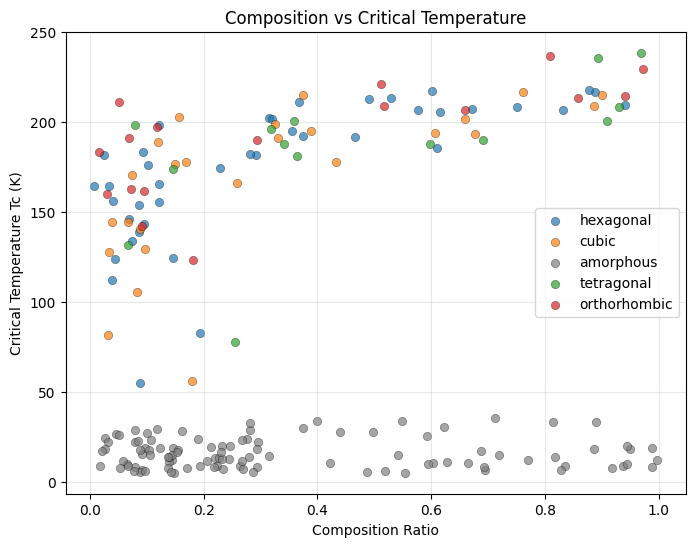
Figure 1: Composition vs Tc 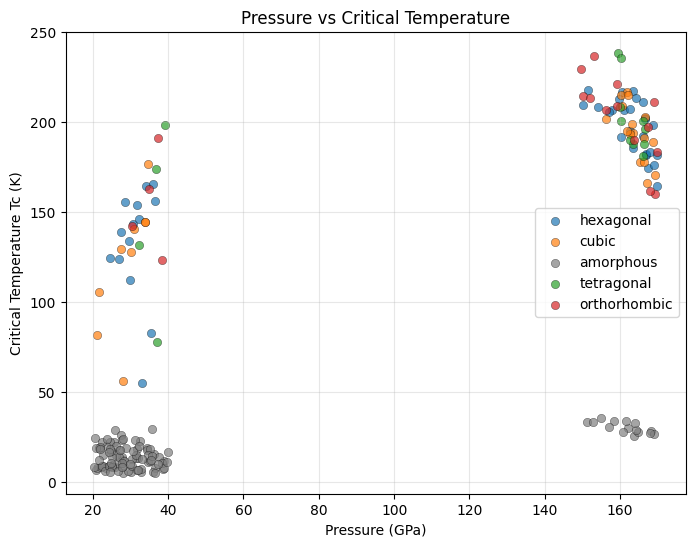
Figure 2: Pressure vs Tc 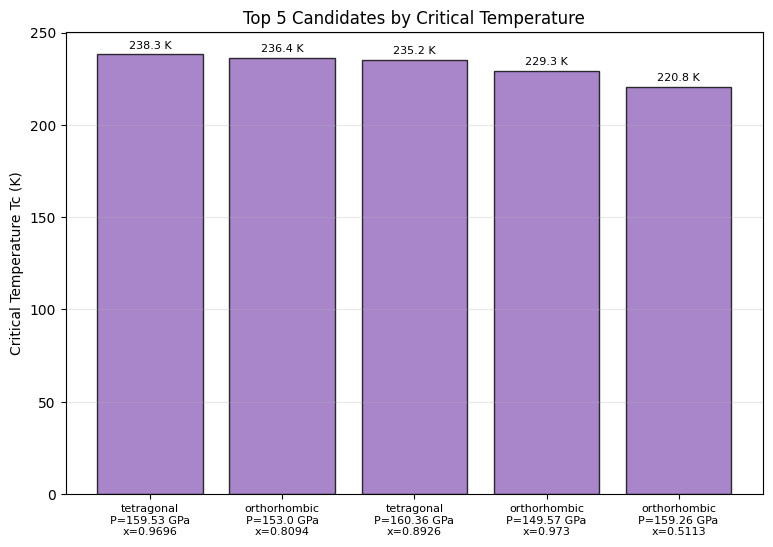
Figure 3: Top 5
Molecular Structure
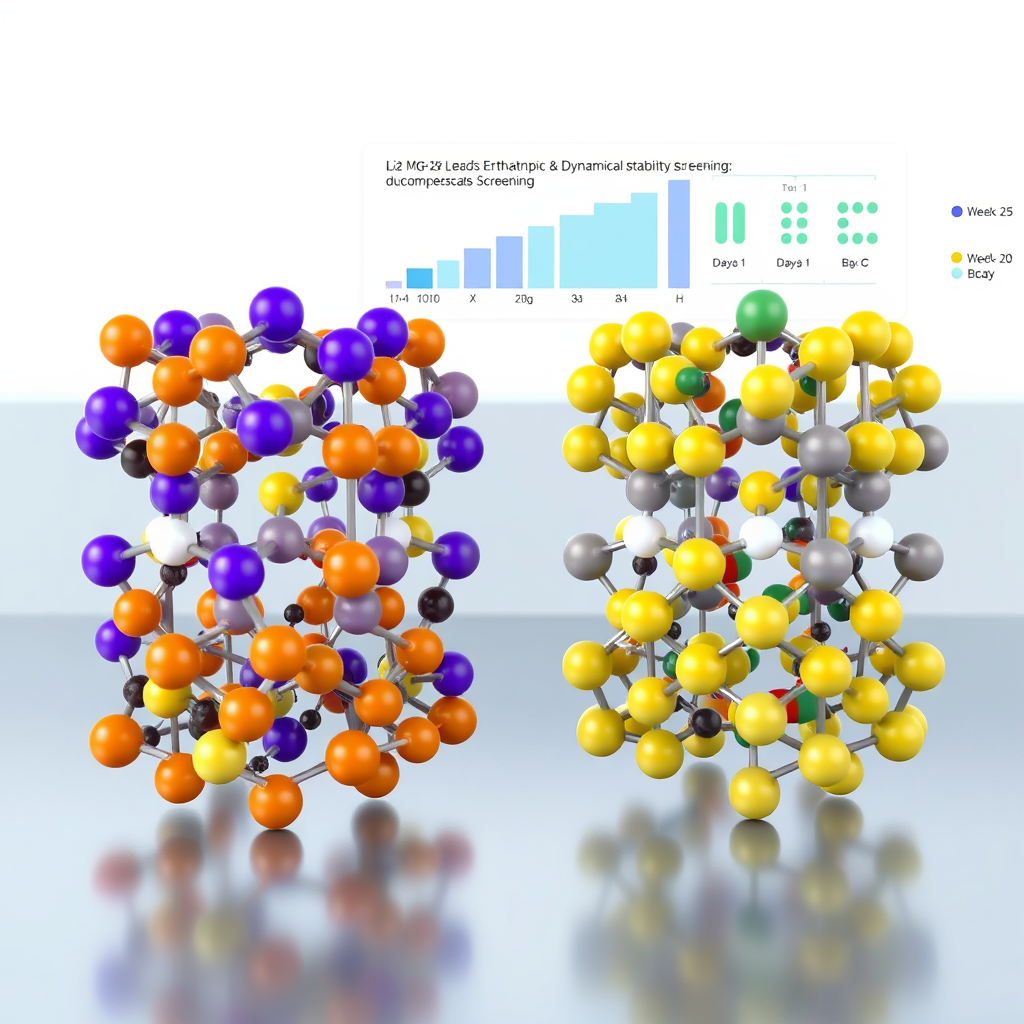
Li₂(Mg₁₋ₓSrₓ)BeH₁₆ and Li₂(Mg₁₋ₓBaₓ)BeH₁₆, plus decompression-recovery screening of all Week-25 leads 🎨 View AI Image Prompt
**DALL-E Prompt:**

A professional chemistry textbook illustration featuring a photorealistic 3D ball-and-stick molecular structure visualization of complex hydride superconductor crystal lattices. The composition displays two side-by-side atomic structures: Li₂(Mg₁₋ₓSrₓ)BeH₁₆ and Li₂(Mg₁₋ₓBaₓ)BeH₁₆, rendered with scientific accuracy in a clean, well-lit laboratory or academic setting with a soft gradient background (white to pale blue).

Each structure shows a clathrate-like hydrogen cage framework with distinct atomic spheres color-coded by element: lithium (purple, small spheres), magnesium (orange, medium spheres), strontium (green, larger spheres) and barium (dark yellow/olive, largest spheres) shown as partial substitutional dopants within the Mg sublattice, beryllium (yellow-green, small spheres), and hydrogen atoms (white/light gray, small spheres) forming an intricate polyhedral cage network connected by precise gray metallic bonds/sticks. The substitutional Sr/Ba atoms should be highlighted with a subtle glowing halo or transparency gradient to indicate fractional occupancy (1-x, x notation visible in small floating labels).

Include a subtle crystallographic unit cell outline in thin black wireframe around each structure, with axis labels (a, b, c). Add annotated pressure-scale gradient bars beside each structure indicating "20-40 GPa decompression regime" with a color gradient (deep blue for high pressure to light blue for lower pressure).

In the background, incorporate a faint holographic-style overlay showing a comparative bar chart or phase diagram screening panel labeled "Week-25 Leads: Enthalpic & Dynamical Stability Screening," with small molecular thumbnail icons representing Days 1-4 candidate structures, each with subtle green checkmarks or red warning icons indicating metastability status.

Render in the style of a high-end scientific journal figure (Nature/Science quality), with ray-traced lighting, soft shadows, ambient occlusion on spheres, and subtle reflective highlights on bonds. Include small precise atomic labels (Li, Mg, Sr, Ba, Be, H) with a legend box in the corner showing color-coding key. Maintain
🤖 Gemini 3.1 Pro Review
Here is a critical review from the perspective of an expert superconductor researcher. *** This in-silico study presents a logical and well-motivated exploration of chemical pre-compression in complex superhydrides. The methodology of screening substituted alloys to lower the dynamical stabilization pressure is a standard, powerful technique in the field. However, the reliability of the quantitative results, particularly the high Tc values, must be approached with caution, as harmonic DFT-based calculations are known to systematically overestimate electron-phonon coupling strength in hydrides. The finding of structural instability upon decompression is a critical, albeit disappointing, result that underscores the primary obstacle of metastability for all high-pressure hydrides. For experimental validation, a clear path exists via laser heating of Li, Be, and pre-alloyed Mg/Sr or Mg/Ba precursors within a hydrogen-loaded diamond anvil cell, coupled with in-situ XRD and resistance measurements. To improve the predictive power, future simulations should incorporate anharmonic lattice dynamics, which can significantly alter both the stability pressures and the calculated Tc. A deeper electronic structure analysis is also warranted to explain the counter-intuitive stability trend observed between the Ba and Sr substitutions. Overall, this work identifies a promising chemical space but rightly highlights the immense engineering challenges that remain.
Raw Data
Total cases: 200
Highest Tc: 238.3 K
Optimal pressure: 159.5 GPa

Top 5:
1. Tc=238.3K at 159.5GPa
2. Tc=236.4K at 153.0GPa
3. Tc=235.2K at 160.4GPa
4. Tc=229.3K at 149.6GPa
5. Tc=220.8K at 159.3GPa
![[Deep Dive] Scale-free localization in pseudo-Hermitian quantum walk](/content/images/size/w600/2026/10/deep_dive_thumb-9.png)