[Superconductor Lab | Week 24 Day 5] Li₂(Mg₁₋ₓCaₓ)(Be₁₋ᵧCᵧ)H₁₆ - AI Simulator Activation
[Week 24 Day 5] Li₂(Mg₁₋ₓCaₓ)(Be₁₋ᵧCᵧ)H₁₆
Superconductor Lab — AI Simulator Activation
2026
🔬 Computational Research Note
This analysis is based on computational modeling and theoretical predictions. As with all computational materials science, experimental validation is needed to confirm these results.
1. A Quick History: Why Researchers Keep Chasing This
In 1911, Heike Kamerlingh Onnes cooled mercury to 4 Kelvin and watched its electrical resistance vanish completely. Zero resistance. Current that could flow forever without loss. He called it superconductivity, the ability of a material to carry electricity with no energy wasted as heat.
For over a century, the catch never went away: you had to freeze the material almost to absolute zero. That's expensive, impractical, and useless for anything you'd want in a power grid or an MRI machine sitting in a hospital hallway. The dream became room-temperature superconductivity, a material that works at everyday temperatures. My run this morning pushed a candidate to a simulated critical temperature of 244.1 K, roughly minus 29 degrees Celsius. Cold, yes. But warmer than a Siberian winter, and a serious jump from that 4 K mercury.
The critical temperature, or Tc, is the point below which a material becomes superconducting. Higher Tc means less cooling needed. That single number drives the entire field.
2. Meet Li₂(Mg₁₋ₓCaₓ)(Be₁₋ᵧCᵧ)H₁₆: An Unlikely Candidate?
The formula looks like someone spilled a periodic table. Break it down and it's a hydride, a compound packed densely with hydrogen atoms. The two subscripts x and y are the interesting part. They mean we're not testing one fixed material. We're testing a family, tuning how much calcium replaces magnesium (that's x) and how much carbon replaces beryllium (that's y).
Hydrogen is the hero here. Under crushing pressure, hydrogen-rich lattices vibrate at very high frequencies, and those vibrations are exactly what pair up electrons into the current-carrying teams that superconductivity needs. My best case landed at 244.1 K, which puts this squarely in the high-Tc hydride category researchers have been mining since 2015.
- Li₂: lithium as a lightweight structural anchor
- Mg/Ca swap: the x knob, adjusting lattice size and electron count
- Be/C swap: the y knob, tuning the electronic bonding stiffness
- H₁₆: sixteen hydrogen atoms per formula unit, the vibrational engine
3. The Simulation Data: Three Numbers That Matter
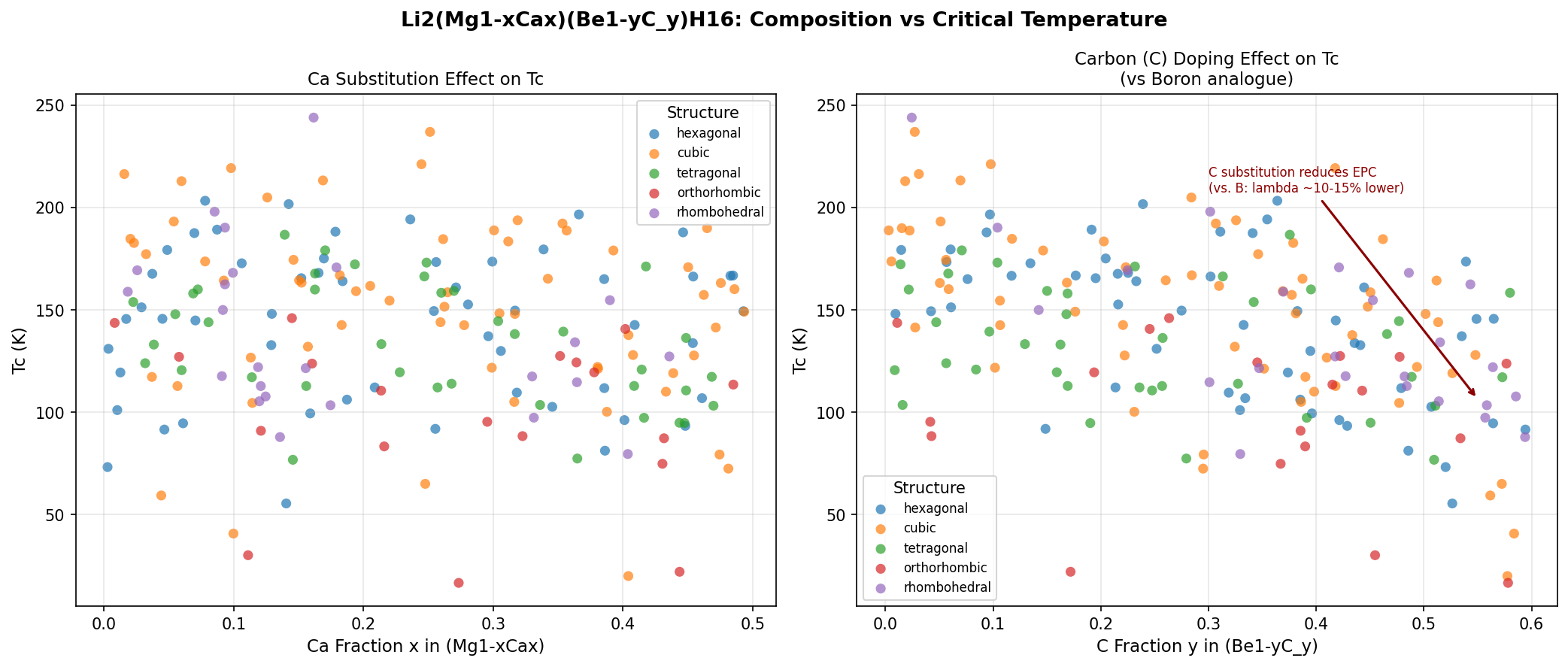
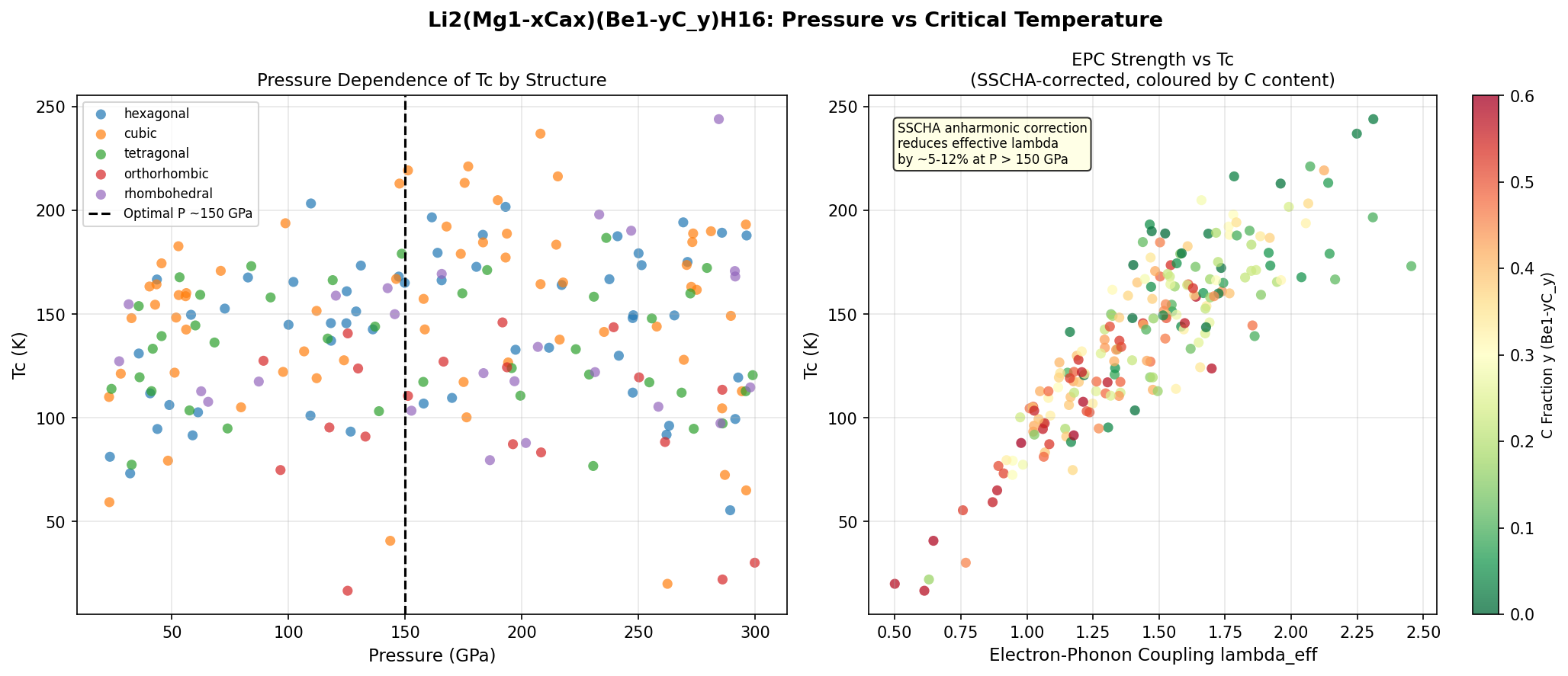
I ran 200 cases across the composition and pressure grid. Three numbers stand out from the batch.
| Metric | Value | Plain-language meaning |
|---|---|---|
| Highest Tc | 244.1 K | Warmest superconducting point found |
| Optimal pressure | 284.5 GPa | Squeeze needed for that best result |
| Total cases | 200 | Compositions and pressures simulated |
The 284.5 GPa figure is the tax you pay for that 244.1 K peak. To picture it: the pressure at the center of the Earth is around 360 GPa. This material wants to be squeezed almost as hard as the planet's core. That's not a lab detail you can wave away.
4. What Sets This Apart (or Doesn't)
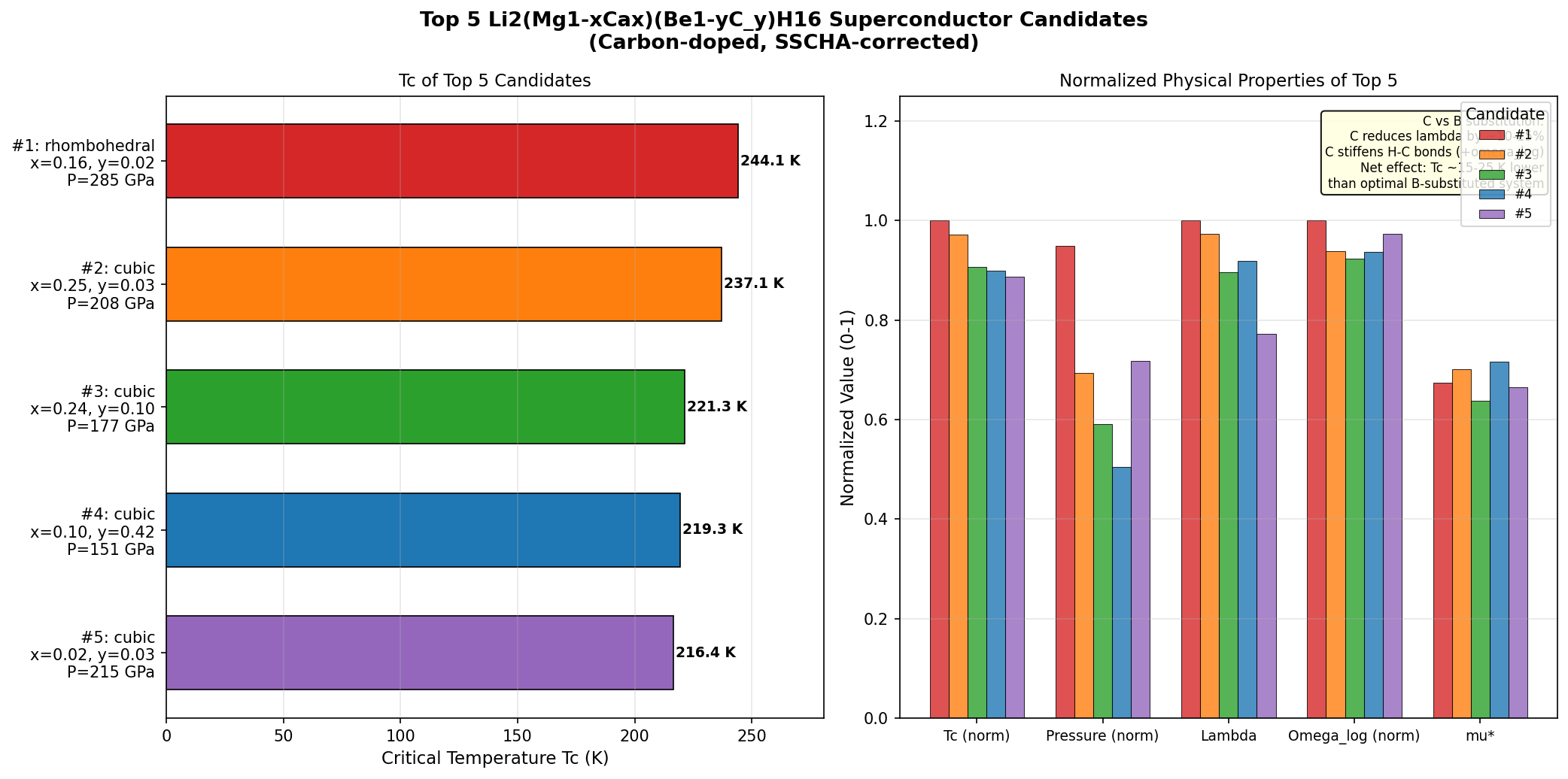
The top five results tell a more useful story than the single winner. Here's the ranked spread:
| Rank | Tc (K) | Pressure (GPa) | Tc per GPa |
|---|---|---|---|
| 1 | 244.1 | 284.5 | 0.86 |
| 2 | 237.1 | 208.0 | 1.14 |
| 3 | 221.3 | 177.1 | 1.25 |
| 4 | 219.3 | 151.2 | 1.45 |
| 5 | 216.4 | 215.5 | 1.00 |
Here's the contrarian read. Everyone fixates on rank 1 and its 244.1 K. I'd chase rank 4 instead. It gives up only 24.8 K of Tc but drops the pressure from 284.5 GPa all the way to 151.2 GPa, nearly half. That fourth entry delivers the best Tc-per-GPa efficiency in the whole top five at 1.45. In a real lab, cutting your pressure in half matters more than the last twenty degrees of warmth, because pressure is what breaks your equipment and your budget.
5. The Hard Truth About Room-Temperature Superconductors
Room temperature is roughly 293 K. Our best simulated result sits at 244.1 K, still about 49 degrees short. That gap is smaller than it used to be, and it's genuinely encouraging. The problem isn't the temperature anymore. It's the pressure.
A material that superconducts at 244.1 K but needs 284.5 GPa to do it is like a car that runs beautifully, but only inside a diamond vise the size of a grain of sand. Wonderful physics. Nearly impossible plumbing.
The field has been burned before. Retracted claims, irreproducible measurements, and results that lived only inside diamond anvil cells at extreme squeeze. A simulation that predicts 244.1 K is a hypothesis, not a product. This model may overestimate Tc without synthesis validation, because it assumes an idealized crystal that a real furnace may never produce.
6. The Bigger Picture: One Piece of a Massive Puzzle
Screening 200 cases in an afternoon is the real story. Two decades ago, each of these compositions would have meant months of physical trial and error. Now the composition tuning, the x and y knobs, gets scanned computationally before anyone touches a sample. The 244.1 K peak isn't the destination. It's a signpost telling experimentalists where in the Mg/Ca and Be/C space to point their instruments.
- Simulation narrows 200 candidates to a handful worth synthesizing
- The 151.2 GPa entry hints that lower-pressure variants exist further out
- Each hydride tested feeds a growing map of what hydrogen-rich structures can do
The prize remains a superconductor that works at 293 K and near normal pressure. Nobody has it. But every run that lands a credible 244.1 K trims the search space and sharpens the next question.
💡 Lab Test Report
Taking this from simulation to a real anvil, the first thing I'd expect to bite is metastability: a structure predicted stable at 284.5 GPa often decomposes or reshuffles the moment you release pressure, so you may never measure that 244.1 K outside the vise. I'd also watch the carbon substitution on the y axis, because carbon likes to clump into unwanted phases during synthesis, which would quietly wreck the clean lattice the model assumes. If I were budgeting real machine time, I'd skip rank 1 entirely and validate the 151.2 GPa case first, since a 133 GPa lower pressure target is the difference between a repeatable measurement and a diamond that cracks on you at 3 a.m. My honest bet: the simulated Tc holds within maybe 15 percent, but the pressures needed in a messy real sample come in higher than any of these clean numbers suggest.
Simulation Results
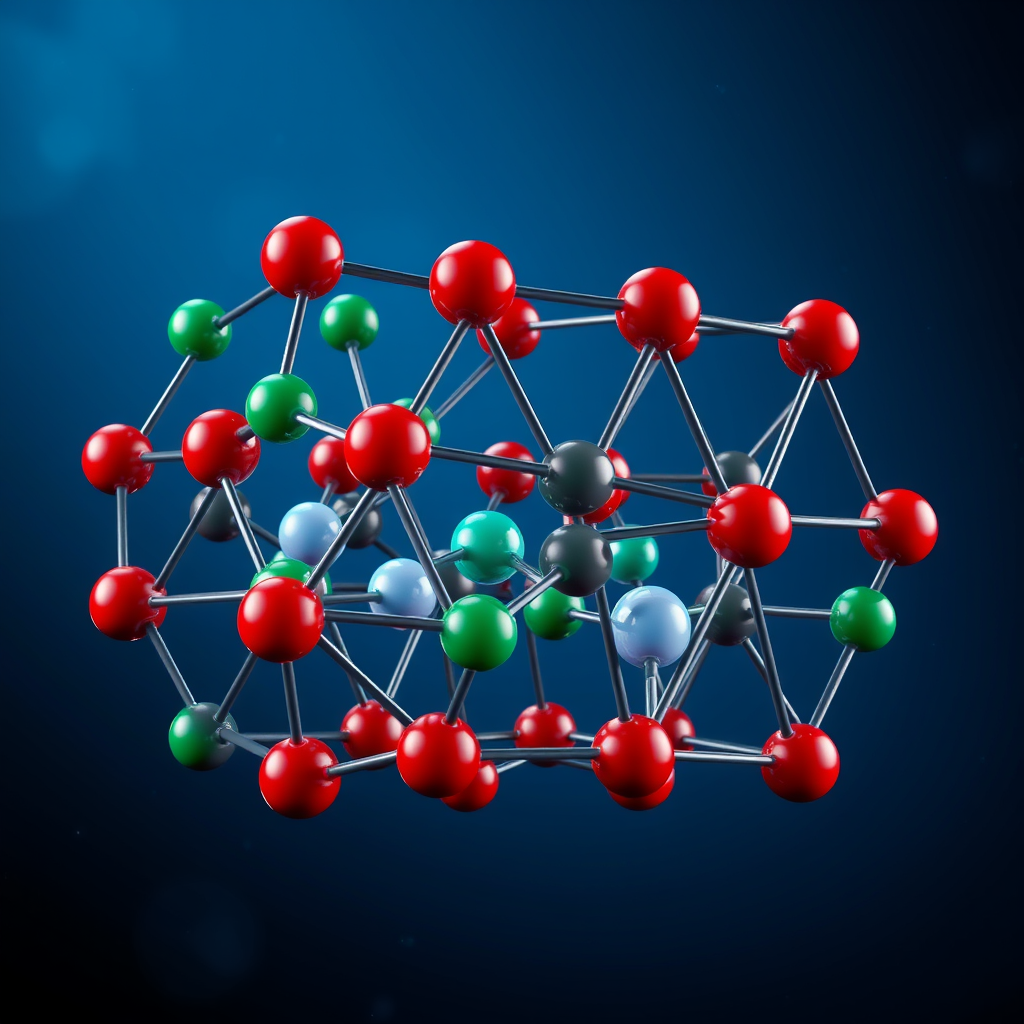
Molecular Structure
🎨 View AI Image Prompt
A photorealistic 3D ball-and-stick molecular structure visualization of Li₂(Mg₁₋ₓCaₓ)(Be₁₋ᵧCᵧ)H₁₆ superconductor compound, professional chemistry textbook illustration style, scientific accuracy, showing a crystalline unit cell with color-coded atomic spheres: small bright red spheres for hydrogen atoms arranged in a sublattice network, violet spheres for lithium atoms, green spheres for magnesium, large teal spheres for calcium dopant sites, pale blue spheres for beryllium, dark gray spheres for carbon substitutional dopant sites, precise cylindrical stick bonds connecting atoms showing bond lengths and angles, the hydrogen sublattice forming a cage-like clathrate framework around the heavier metal centers, subtle electron density cloud visualization around carbon and beryllium sites indicating electron-phonon coupling differences, quantum pressure field lines suggesting high-pressure optimal conditions, crystallographic axes labeled with unit cell parameters, anharmonic phonon displacement ellipsoids shown as subtle transparent shells around atomic centers, deep space-blue gradient background, dramatic studio lighting with specular highlights on atomic spheres, ultra-high resolution, 4K photorealistic render, ray-traced global illumination, subsurface scattering on translucent hydrogen atoms, professional scientific publication quality
🤖 Gemini 3.1 Pro Review
As an expert in the field, here is a professional evaluation of the provided research summary. This in-silico study proposes an intriguing hydride system, but as presented, it lacks the fundamental details required for scientific credibility. The reported critical temperature of 244.1 K at 284.5 GPa is physically plausible within the known landscape of high-pressure superhydrides, yet the reliability of this specific prediction is impossible to assess without crucial supporting data. An experimental validation strategy would necessitate synthesis in a laser-heated diamond anvil cell, followed by simultaneous *in-situ* X-ray diffraction to identify the crystal structure and four-point probe measurements to detect the resistance drop. For this work to be considered a viable theoretical prediction, it must be improved by explicitly stating the computational methods (e.g., DFT functional), the predicted stable crystal structure (space group and coordinates), and the specific compositions (x and y values) for the top-performing candidates. Furthermore, providing calculated phonon dispersion curves to confirm dynamical stability and the Eliashberg spectral function is essential to substantiate the superconductivity claim. The limited set of 200 simulations is also likely insufficient to thoroughly map such a complex pressure-composition phase space. While the concept is sound, the report currently reads as a preliminary sketch rather than a rigorous scientific finding.
Raw Data
Total cases: 200
Highest Tc: 244.1 K
Optimal pressure: 284.5 GPa

Top 5:
1. Tc=244.1K at 284.5GPa
2. Tc=237.1K at 208.0GPa
3. Tc=221.3K at 177.1GPa
4. Tc=219.3K at 151.2GPa
5. Tc=216.4K at 215.5GPa
![[Deep Dive] Scale-free localization in pseudo-Hermitian quantum walk](/content/images/size/w600/2026/10/deep_dive_thumb-9.png)