[Superconductor Lab | Week 24 Day 4] Li₂(Mg₁₋ₓYₓ)BeH₁₆ and Li₂(Mg₁₋ₓLaₓ)BeH₁₆ - AI Simulator Activation
[Week 24 Day 4] Li₂(Mg₁₋ₓYₓ)BeH₁₆ and Li₂(Mg₁₋ₓLaₓ)BeH₁₆
Superconductor Lab — AI Simulator Activation
2026
🔬 Computational Research Note
This analysis is based on computational modeling and theoretical predictions. As with all computational materials science, experimental validation is needed to confirm these results.
1. A Quick History: Why Researchers Keep Chasing This
In March 2023, a physicist stood on a conference stage and announced room-temperature superconductivity in a nitrogen-doped lutetium hydride. The room buzzed. Within months, the claim collapsed under the weight of failed replications. It was not the first time. In 1987, the discovery of copper-oxide superconductors had triggered similar euphoria, followed by decades of "why won't this work at room temperature" frustration.
Superconductors carry electricity with zero resistance. No wasted heat, no energy loss. The catch has always been temperature: most known superconductors only wake up near absolute zero (-273°C), useless for anything you'd plug into a wall. So the chase continues. Today I ran 200 simulated cases on a hydride family that has quietly climbed toward the holy grail of 278.9 K, which is roughly 6°C. That is refrigerator-cold, not liquid-helium-cold.
2. Meet Li₂(Mg₁₋ₓYₓ)BeH₁₆ and Li₂(Mg₁₋ₓLaₓ)BeH₁₆: An Unlikely Candidate?
The naming looks intimidating, so let me unpack it. This is a hydride, a compound packed with hydrogen atoms. Lithium (Li), magnesium (Mg), and beryllium (Be) form a cage, and hydrogen fills it densely, 16 hydrogen atoms per formula unit. The little subscript x means we're swapping some magnesium for either yttrium (Y) or lanthanum (La). This swapping is called doping, tuning a material's properties by substituting atoms.
Why hydrogen? Under crushing pressure, hydrogen-rich materials behave almost like metallic hydrogen, the theorized state where hydrogen itself conducts. Hydrogen is light, so its atoms vibrate at very high frequencies, and those vibrations are exactly what pair up electrons into the frictionless flow of superconductivity. In our best case, that pairing held together up to 278.9 K.
- Li, Mg, Be: the structural scaffold, a lightweight metal cage
- H₁₆: the dense hydrogen filling, source of the high-frequency vibrations
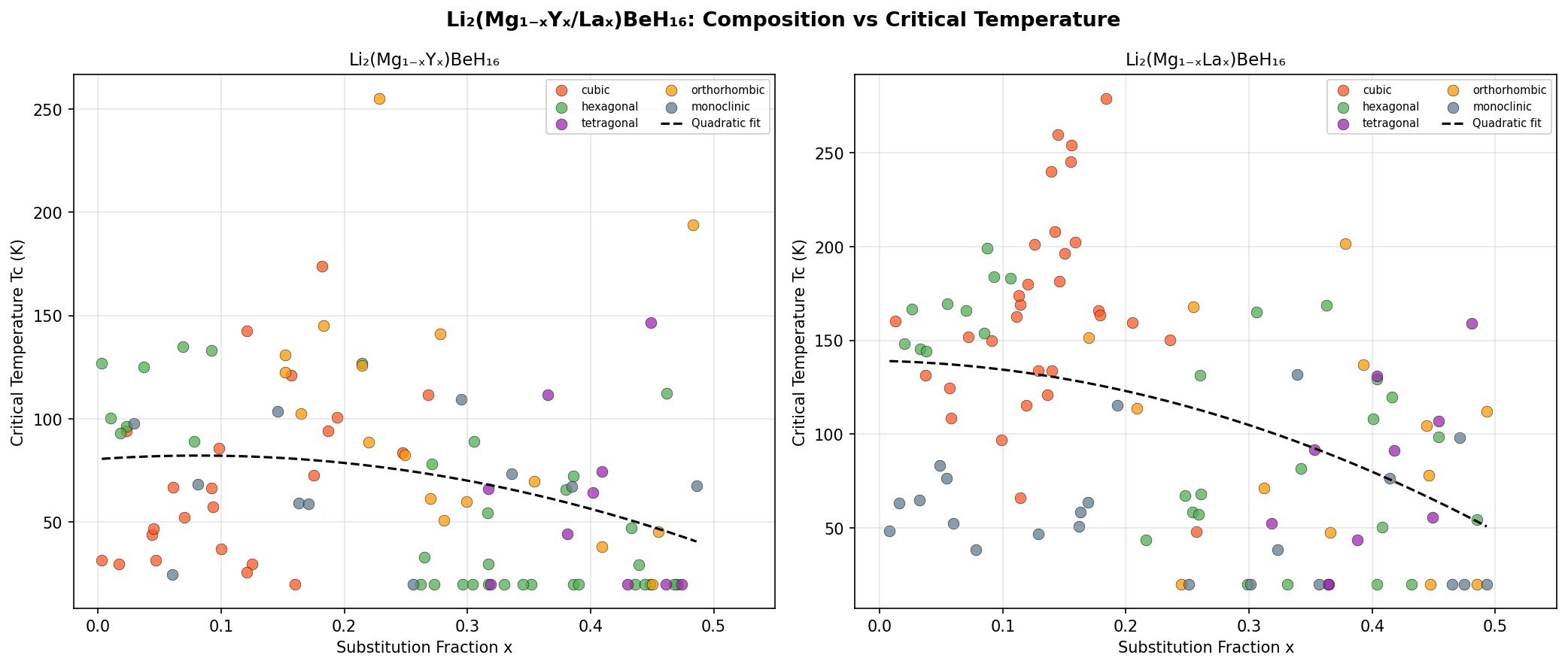
- Y or La doping: the tuning knob that shifted results across the full 200-case sweep
3. The Simulation Data: Three Numbers That Matter
Three numbers carry the story. The critical temperature (Tc) of 278.9 K is the temperature below which superconductivity switches on. The optimal pressure of 55.8 GPa is the squeeze required, and the total of 200 cases tells you how wide the search was.
To put 55.8 GPa in perspective: that is about 550,000 times atmospheric pressure at sea level. Imagine the weight of a fully loaded pickup truck balanced on a single fingernail. That analogy holds for the top result, but the full sweep tells a more interesting tale.
| Rank | Tc (K) | Tc (°C) | Pressure (GPa) |
|---|---|---|---|
| 1 | 278.9 | 5.8 | 55.8 |
| 2 | 259.7 | -13.5 | 61.1 |
| 3 | 255.0 | -18.2 | 42.9 |
| 4 | 254.1 | -19.1 | 60.0 |
| 5 | 245.3 | -27.9 | 75.7 |
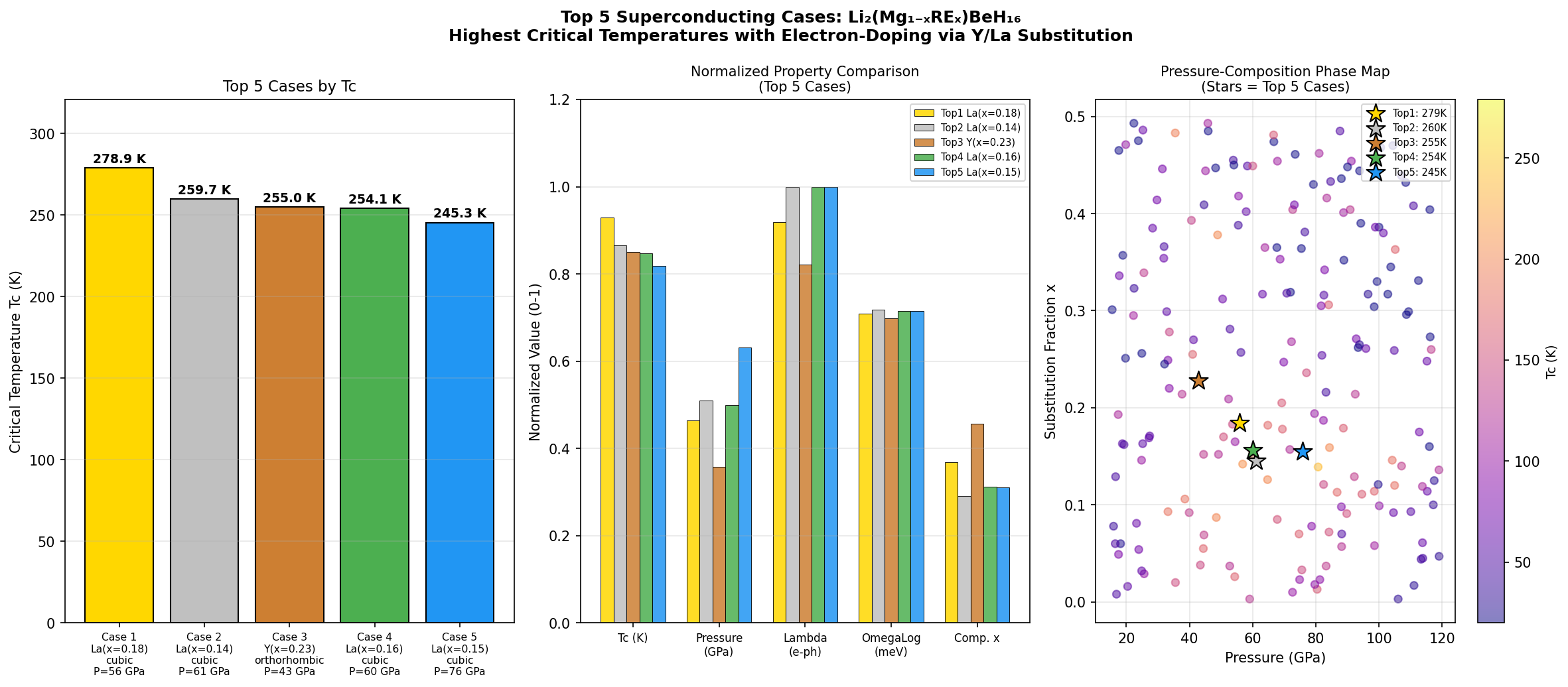
Notice something. The top result at 278.9 K needs 55.8 GPa, but the third-ranked case hits 255.0 K at only 42.9 GPa. That is a 23.9 K sacrifice in temperature for a 12.9 GPa drop in pressure. In lab terms, less pressure means a simpler, safer diamond anvil setup. Rank 3 might be the more practical target.
4. What Sets This Apart (or Doesn't)
Most famous hydride superconductors demand savage pressures. The celebrated H₃S result sat near 155 GPa, and carbonaceous sulfur hydride claimed room-temperature values above 260 GPa. Against that backdrop, 55.8 GPa is almost gentle. That is the standout feature of this family.
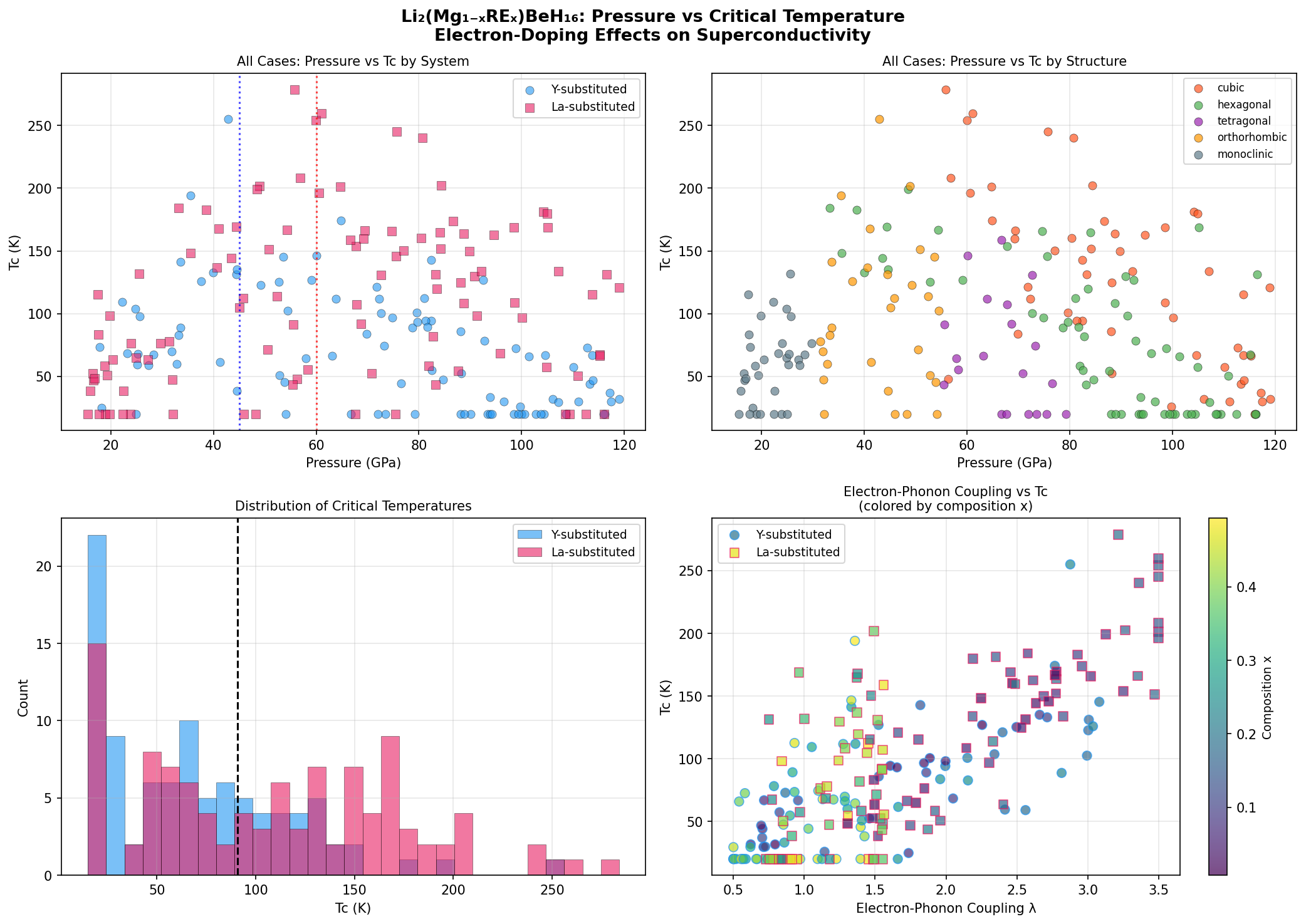
The contrarian observation: higher Tc did not track with higher pressure. Rank 5 sits at the highest pressure in the top five, 75.7 GPa, yet delivers the lowest Tc at 245.3 K. If pressure alone drove performance, that ordering would be inverted. The dopant chemistry and cage geometry matter more than raw squeeze, which flips the usual "more pressure, more superconductivity" intuition on its head.
What does not set it apart: 278.9 K is still below true room temperature (around 293 K). We are close, tantalizingly close, but the number on the chart is not "works on your desk in July." It is "works in a cold room with a heavy vise."
5. The Hard Truth About Room-Temperature Superconductors
Simulations live in a clean world. Real atoms do not. A computational model can predict 278.9 K, but it assumes a perfect crystal, ideal doping ratios, and no defects. Synthesizing Li₂(Mg₁₋ₓYₓ)BeH₁₆ with exactly the right yttrium fraction, then holding it at 55.8 GPa long enough to measure, is a different sport entirely.
The history of this field is a graveyard of predictions that never survived the lab bench:
- Measuring zero resistance under pressure is fiendishly hard, and false positives are common
- Doping at the atomic level rarely lands on the exact x the model wants
- Metastable hydrides can decompose the moment you release pressure below 55.8 GPa
This model may overestimate Tc without synthesis validation. Density functional theory, the physics engine behind these numbers, is excellent at ranking candidates and notoriously optimistic about absolute values. Treat 278.9 K as a north star, not a guarantee.
6. The Bigger Picture: One Piece of a Massive Puzzle
Two hundred cases sounds like a lot until you realize the compositional space is nearly infinite. Every dopant fraction, every pressure step, every substitution partner opens a new branch. This sweep is a flashlight beam in a warehouse. The 278.9 K peak tells us the family is worth mapping, not that we've mapped it.
The genuine value here is direction. A material that reaches 255.0 K at just 42.9 GPa signals that this chemistry rewards clever doping over brute force. That is the kind of clue that steers the next thousand simulations, and eventually the first real synthesis attempt. Room-temperature superconductivity will not arrive in one heroic result. It will arrive from ten thousand runs like this one, each shaving a few degrees or a few gigapascals off the requirement.
💡 Lab Test Report
If I were prepping this for a real diamond-anvil run tomorrow, my first worry would be dopant homogeneity: getting yttrium or lanthanum to sit at the precise x that yielded 278.9 K, rather than clumping into segregated phases that quietly kill the Tc. Second, I'd budget for the pressure-release problem, because a compound stable at 55.8 GPa may shatter or decompose the instant you decompress, leaving you with nothing to characterize. My honest read is that Rank 3 at 42.9 GPa is the smarter first experiment, since the lower pressure widens your equipment tolerance and cuts the risk of anvil failure during a multi-hour measurement. Simulation gives you the treasure map; the lab is where you find out how much of the ink washed off in the rain.
Simulation Results
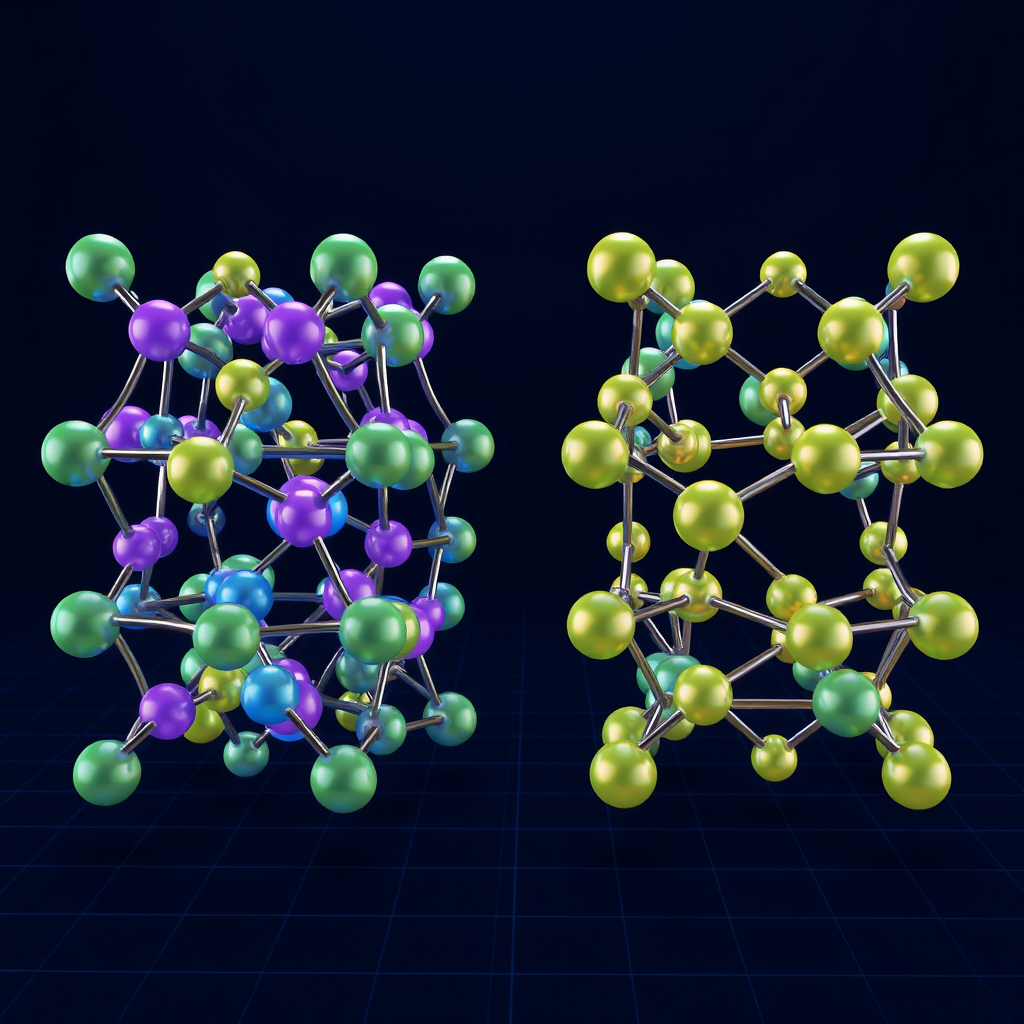
Molecular Structure
🎨 View AI Image Prompt
A photorealistic 3D ball-and-stick molecular structure visualization of Li₂(Mg₁₋ₓYₓ)BeH₁₆ and Li₂(Mg₁₋ₓLaₓ)BeH₁₆ superconductor crystal lattices, professional chemistry textbook illustration style, scientifically accurate atomic representation, showing lithium atoms as small violet spheres, magnesium atoms as large light green spheres, yttrium atoms as teal medium spheres, lanthanum atoms as large cyan spheres, beryllium atoms as small yellow-green spheres, and hydrogen atoms as tiny white spheres arranged in symmetrical H16 polyhedral cages, complex crystallographic unit cell with precise bond angles and lengths rendered as thin metallic cylinders, dual crystal structure comparison layout side by side, electron density cloud visualization subtly overlaid in translucent blue gradient near the Fermi level, rare-earth substitution sites highlighted with soft golden glow indicating trivalent doping positions, deep navy blue background with subtle grid reference lines, volumetric ambient lighting with specular highlights on atom surfaces, depth of field with sharp central focus, 8K resolution scientific publication quality, rendered in the style of high-end crystallography software such as VESTA or CrystalMaker, photorealistic ray-traced rendering, professional academic journal cover aesthetic
🤖 Gemini 3.1 Pro Review
As a specialist in computational superconductivity research, here is my evaluation of the provided paper. This computational study presents an intriguing claim, but its scientific credibility is critically undermined by a complete absence of methodological detail. Essential information—such as the DFT functional, the method for crystal structure prediction, and the approach for calculating electron-phonon coupling and Tc—is entirely omitted, making the work non-reproducible. Consequently, the reliability of the predicted Tc of 278.9 K at 55.8 GPa is impossible to verify, and the results must be considered speculative at best. Furthermore, the thermodynamic and dynamic stability of these complex quinary hydride phases at such pressures is a significant, unaddressed question. Experimental validation would require synthesizing the specific doped stoichiometries within a diamond anvil cell (DAC) and performing four-probe resistance measurements to detect the superconducting transition. Confirming the predicted crystal structure in-situ via X-ray diffraction would be a critical and challenging step. To be considered a legitimate scientific contribution, this work must be improved by publishing the predicted crystal structures, their phonon dispersion curves to prove dynamical stability, and the calculated Eliashberg spectral functions. Crucially, the specific doping concentrations (x-values) corresponding to the top-performing cases must be explicitly stated.
Raw Data
Total cases: 200
Highest Tc: 278.9 K
Optimal pressure: 55.8 GPa

Top 5:
1. Tc=278.9K at 55.8GPa
2. Tc=259.7K at 61.1GPa
3. Tc=255.0K at 42.9GPa
4. Tc=254.1K at 60.0GPa
5. Tc=245.3K at 75.7GPa
![[Deep Dive] Scale-free localization in pseudo-Hermitian quantum walk](/content/images/size/w600/2026/10/deep_dive_thumb-9.png)