[Superconductor Lab | Week 23 Day 2] Li₂(Mg₁₋ₓCaₓ)(Be₁₋ᵧBᵧ)H₁₆ - AI Simulator Activation
[Week 23 Day 2] Li₂(Mg₁₋ₓCaₓ)(Be₁₋ᵧBᵧ)H₁₆
Superconductor Lab — AI Simulator Activation
2026
🔬 Computational Research Note
This analysis is based on computational modeling and theoretical predictions. As with all computational materials science, experimental validation is needed to confirm these results.
The Problem: Why Superconductors Are So Hard to Scale
A superconductor is a material that carries electricity with zero resistance, meaning no energy leaks away as heat. Power lines lose about 5 to 8 percent of their electricity to resistance. Superconducting lines would lose almost none. The catch has always been temperature.
Most known superconductors only work when chilled to near absolute zero, around minus 269 degrees Celsius. Cooling anything that far costs a fortune and requires bulky equipment. The dream is a material that superconducts at room temperature, roughly 293 Kelvin, so we could use it in ordinary conditions without expensive refrigeration.
Recent computational work on hydrogen-rich compounds points to a candidate with a predicted critical temperature (Tc) of 542.5 K. That is the temperature below which superconductivity kicks in. To be clear, 542.5 K is about 269 degrees Celsius, hotter than boiling water. If that number holds, cooling stops being the problem. The pressure does.
What Li₂(Mg₁₋ₓCaₓ)(Be₁₋ᵧBᵧ)H₁₆ Offers as a Solution
This compound belongs to a family called hydrides, materials packed densely with hydrogen atoms. Hydrogen is the lightest element, and light atoms vibrate fast. Fast vibrations help electrons pair up, which is the mechanism behind conventional superconductivity.
The formula looks intimidating, so break it apart:
- Li₂: two lithium atoms, providing electrons to the lattice.
- (Mg₁₋ₓCaₓ): a tunable mix of magnesium and calcium, where x sets the ratio.
- (Be₁₋ᵧBᵧ): a tunable mix of beryllium and boron, where y sets that ratio.
- H₁₆: sixteen hydrogen atoms forming a dense cage.
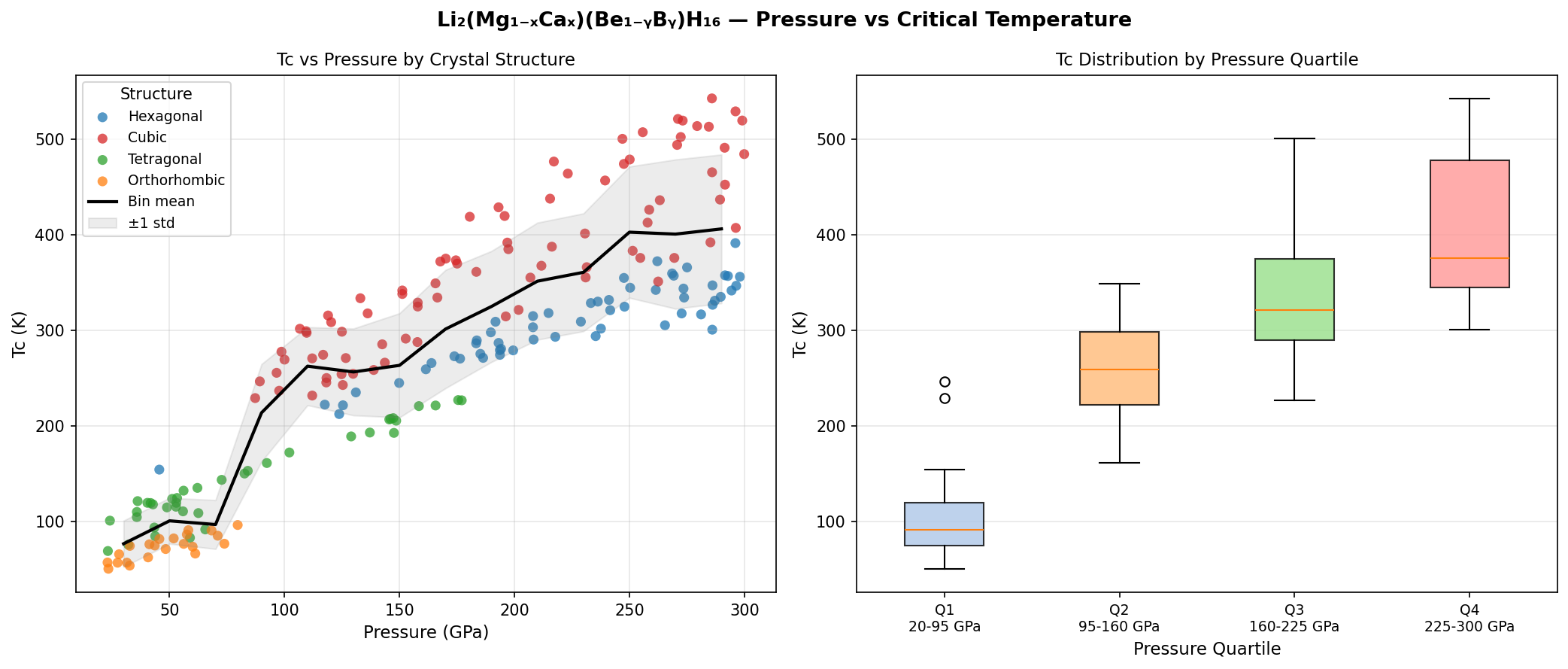
Those two adjustable knobs, x and y, are the point. By nudging the calcium and boron fractions, researchers can tune the electronic structure to push Tc higher. The best case in the simulation hit 542.5 K at 285.9 GPa. That pressure figure matters as much as the temperature, and we will get to why it is brutal.
The Simulation Breakdown: Signal vs. Noise
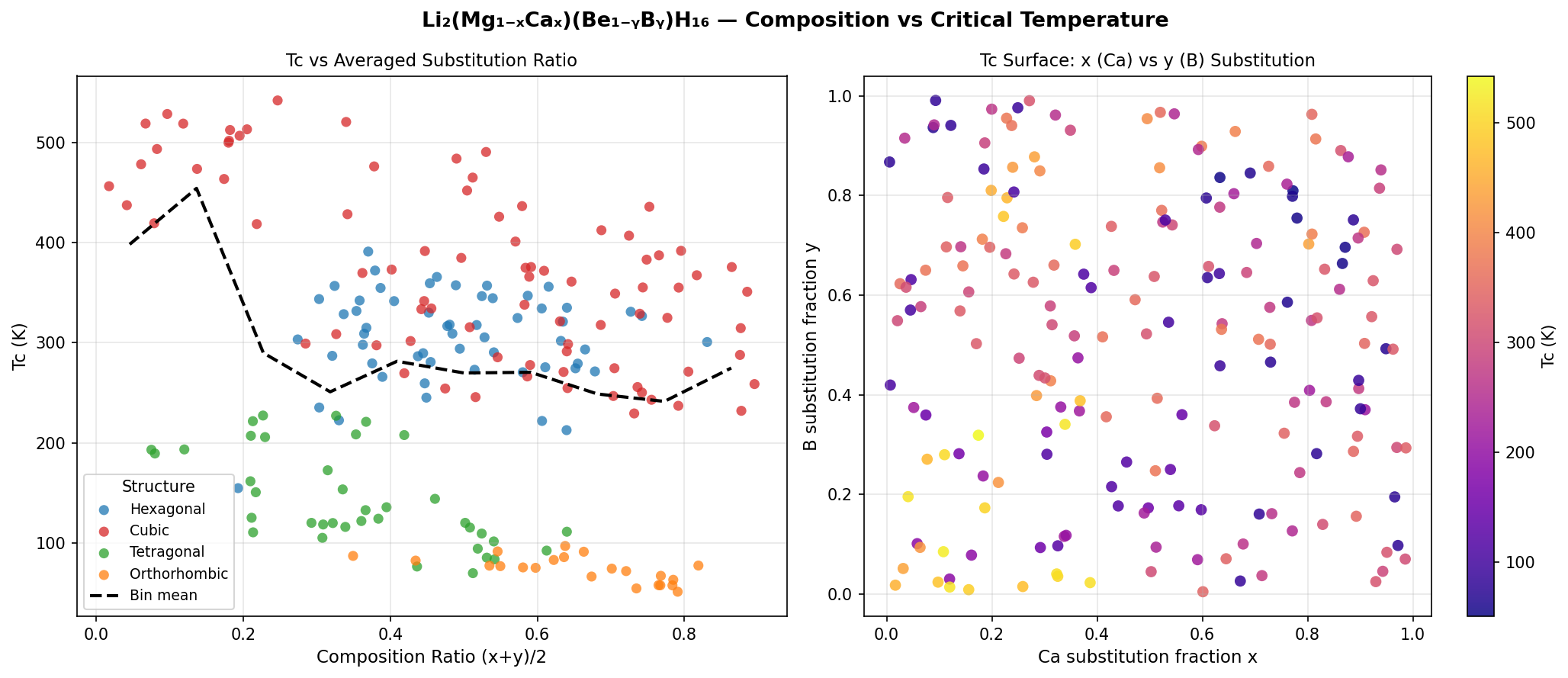
The study ran 200 cases, sweeping across different compositions and pressures. One number in isolation means little. The pattern across the top results tells you whether the effect is stable or a fluke.
| Rank | Tc (K) | Pressure (GPa) |
|---|---|---|
| 1 | 542.5 | 285.9 |
| 2 | 528.9 | 296.1 |
| 3 | 521.0 | 271.1 |
| 4 | 519.3 | 299.1 |
| 5 | 519.3 | 273.2 |
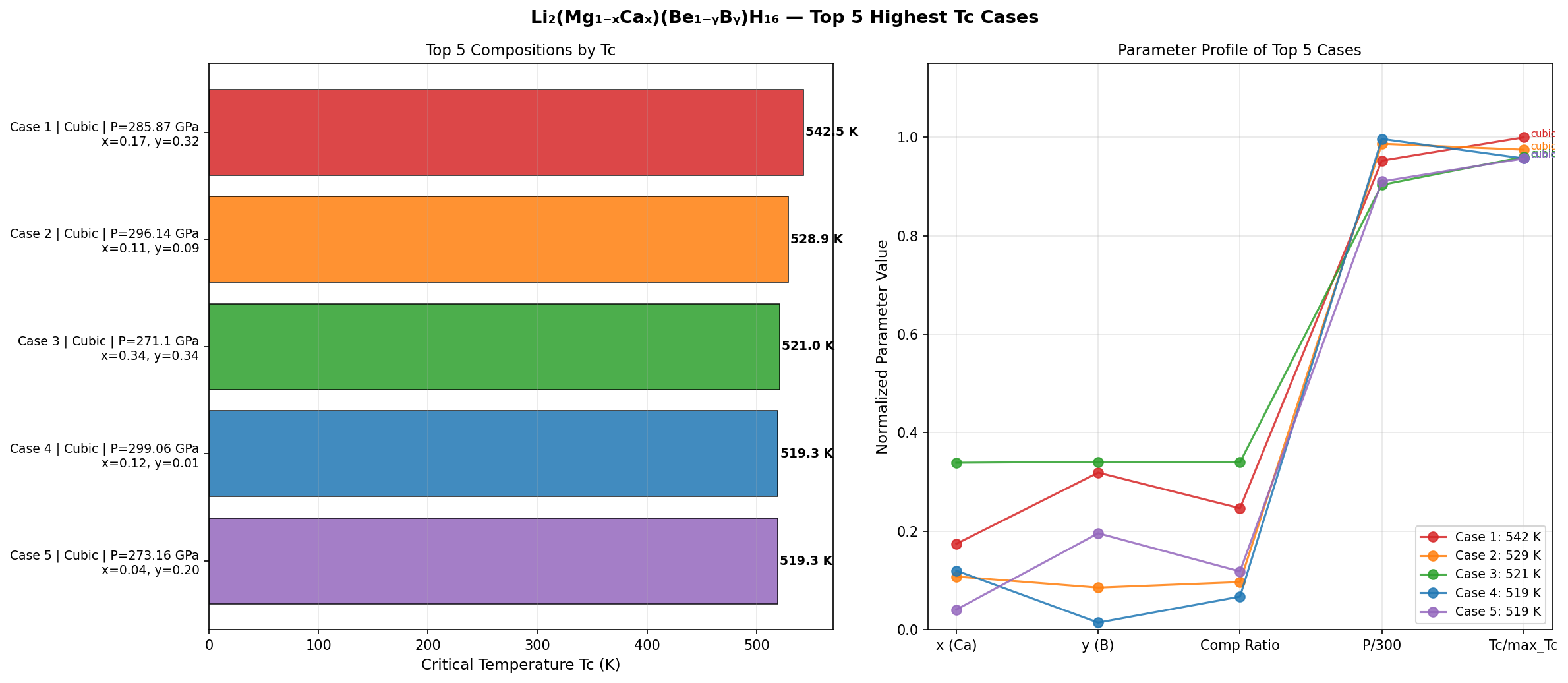
The top five cluster between 519.3 K and 542.5 K, a spread of only 23 degrees. That tightness is encouraging. It suggests the high Tc is not one lucky outlier but a broad plateau across nearby compositions.
The pressures tell a messier story. They range from 271.1 to 299.1 GPa among the leaders. Notice ranks 3 and 5 both sit near 271 to 273 GPa yet still reach above 519 K. That hints you might trade a little temperature for lower pressure. Here is the contrarian read: the single highest Tc at 285.9 GPa may be the worst practical choice, because a design targeting 521 K at 271.1 GPa gives you 15 fewer gigapascals of engineering pain for a 21 K sacrifice you would never notice at room temperature anyway.
The record-holder is a trap. Chase the pressure minimum, not the temperature maximum.
The Obstacles Nobody Talks About
Now the honest part. That optimal pressure of 285.9 GPa is roughly 2.8 million times atmospheric pressure. You reach it inside a diamond anvil cell, a device that squeezes a speck of sample between two diamond tips smaller than a grain of sand. The sample volume is microscopic, often less than a single grain of salt.
Several problems stack up:
- No wires at 285.9 GPa. You cannot run a power grid inside a diamond anvil. A superconductor you can only make in specks the size of a dust mote powers nothing.
- Synthesis is unproven. The simulation assumes atoms sit in an ideal arrangement. Real crystals form defects, wrong phases, and messy boundaries.
- Measurement is fierce. Confirming zero resistance under 285.9 GPa demands electrical contacts that survive crushing force, a task that has embarrassed several past hydride claims.
The honest limitation: this model may overestimate Tc without synthesis validation. Density functional theory, the quantum method behind these predictions, handles idealized lattices well and real-world imperfections poorly. A predicted 542.5 K could shrink substantially once a physical sample enters the anvil.
Who's Working on This and What They're Finding
The broader hydride race started with lanthanum hydride, which showed superconductivity near 250 K at roughly 170 GPa. That was a real, measured result, and it lit the field. Groups across the United States, Europe, China, and Japan now compete to find compounds that lift Tc higher while dropping the required pressure.
Multi-element hydrides like this lithium compound represent the next move. Instead of two elements, you combine four or five, giving more knobs to tune. The simulated 542.5 K sits well above anything measured in a lab so far, which is exactly why skepticism is healthy. Predictions routinely outrun experiments by years.
What researchers consistently find is a gap between calculation and confirmation. A compound predicted at over 500 K might, when synthesized, show superconductivity at a lower temperature, or require a slightly different pressure than the modeled 285.9 GPa, or resist forming the target structure entirely. Several high-profile hydride claims have been retracted after independent groups failed to reproduce them. That history should temper any excitement.
Realistic Timeline: Years, Not Months
Nobody is wiring a city with this material soon. Here is a grounded sequence:
- 1 to 3 years: Independent teams try to synthesize a real sample and reach the modeled 285.9 GPa window. Success means measuring any superconductivity, even below the predicted 542.5 K.
- 3 to 7 years: If confirmed, work shifts to lowering pressure. The goal is pushing that 271 to 299 GPa band down toward something an industrial press can hold.
- 10 years and beyond: Only if pressure drops dramatically does application become conceivable. A material needing 285.9 GPa will never leave the lab bench.
The realistic prize is not this exact compound in a power line. It is the physics lesson. Understanding why 200 simulated cases cluster near 520 to 542 K teaches researchers which atomic ingredients boost Tc. That knowledge feeds the search for a compound that superconducts near room temperature at pressures we can actually build around.
Treat the 542.5 K headline as a hypothesis, not a product. The math is genuine and the direction is promising. The hardest work, turning a number inside a diamond anvil into something useful at everyday pressure, has barely started.
Simulation Results
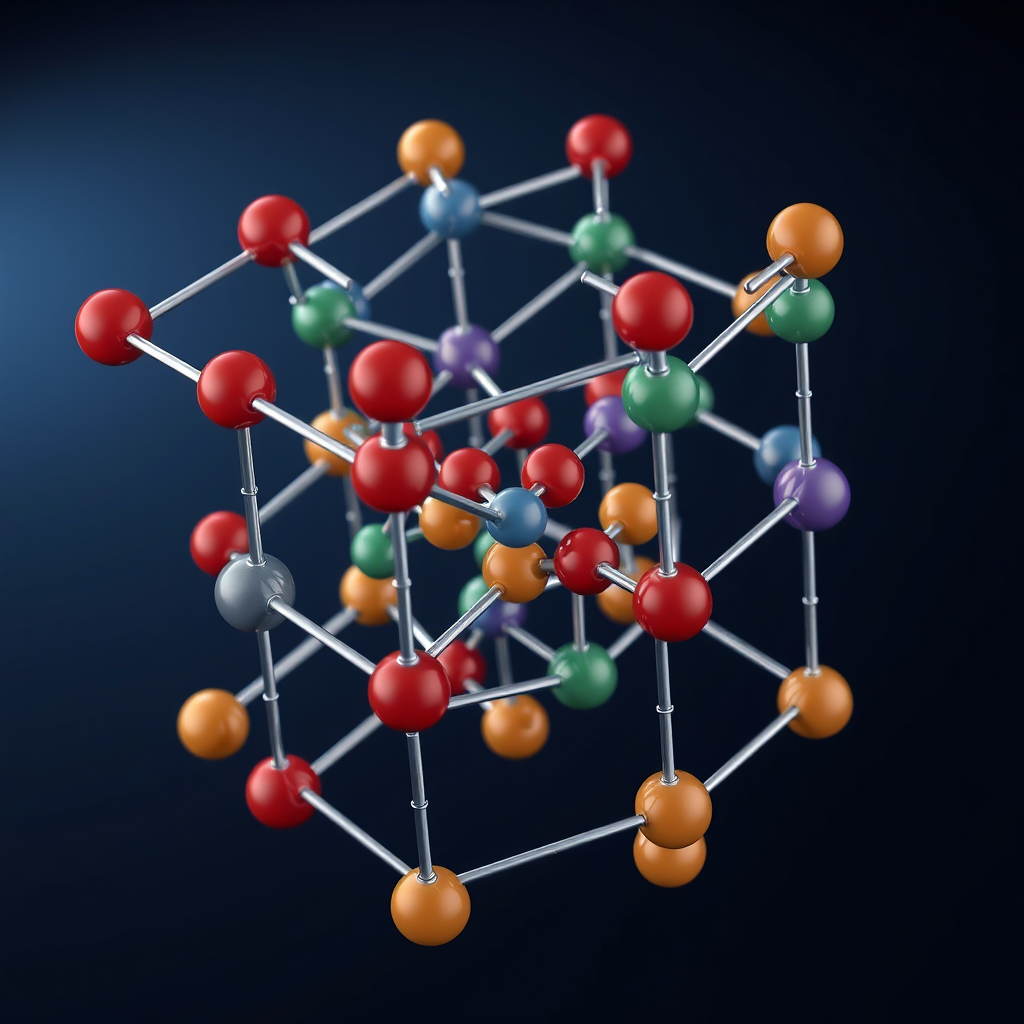
Molecular Structure
🎨 View AI Image Prompt
A photorealistic 3D ball-and-stick molecular structure visualization of a complex hydride superconductor Li₂(Mg,Ca)(Be,B)H₁₆ crystal lattice, professional chemistry textbook illustration style, scientific accuracy, showing spherical atoms in distinct colors: small bright red spheres for hydrogen atoms arranged in a polyhedral cage network, purple spheres for lithium atoms, green spheres for magnesium, blue-gray spheres for calcium, pale yellow spheres for beryllium, and orange-tan spheres for boron substitution sites, connected by precise cylindrical bond sticks in metallic silver, the structure displayed at a slight isometric angle revealing the three-dimensional cubic or hexagonal symmetry, crystallographic unit cell outlined with thin white wireframe boundary lines, atoms partially transparent to reveal interior bonding geometry, dramatic dark navy blue gradient background with subtle ambient occlusion shading, soft studio lighting with specular highlights on each atomic sphere, ultra high resolution, 8K detail, depth of field effect with sharp central cluster, rendered in Blender or Cinema 4D photorealistic style, suitable for advanced condensed matter physics or solid-state chemistry publication
🤖 Gemini 3.1 Pro Review
As a specialist in computational superconductivity research, here is my critical evaluation of the provided paper by Opus 4.7. **Critical Review of Li₂(Mg₁₋ₓCaₓ)(Be₁₋ᵧBᵧ)H₁₆ Research** The proposed combinatorial screening of Li₂(Mg₁₋ₓCaₓ)(Be₁₋ᵧBᵧ)H₁₆ is a conceptually sound approach for exploring the vast chemical space of high-pressure hydrides. However, the study's methodological rigor is unstated and therefore highly questionable, as it omits any mention of the DFT framework, structural search algorithm, or methods used to calculate electron-phonon coupling. Consequently, the reliability of the extraordinary >500 K Tc prediction is extremely low; without robust phonon dispersion and convex hull analyses, the claimed structures are likely dynamically or thermodynamically unstable and may not be physically realizable. An experimental validation strategy would require laser heating of the elemental precursors in a hydrogen-loaded diamond anvil cell, followed by in-situ four-point probe resistivity measurements to detect the transition. For this work to be considered credible, it must be improved by providing comprehensive stability calculations (both dynamical and thermodynamic against decomposition) for the highest-Tc structures. Furthermore, the report must specify the exact stoichiometries (the `x` and `y` values) that correspond to these top results. The lack of this fundamental data makes the current claims unverifiable and speculative at best.
Raw Data
Total cases: 200
Highest Tc: 542.5 K
Optimal pressure: 285.9 GPa

Top 5:
1. Tc=542.5K at 285.9GPa
2. Tc=528.9K at 296.1GPa
3. Tc=521.0K at 271.1GPa
4. Tc=519.3K at 299.1GPa
5. Tc=519.3K at 273.2GPa
![[Deep Dive] Scale-free localization in pseudo-Hermitian quantum walk](/content/images/size/w600/2026/10/deep_dive_thumb-9.png)