[Superconductor Lab | Week 23 Day 1] Li₂(Mg₁₋ₓCaₓ)BeH₁₆ - AI Simulator Activation
[Week 23 Day 1] Li₂(Mg₁₋ₓCaₓ)BeH₁₆
Superconductor Lab — AI Simulator Activation
2026
🔬 Computational Research Note
This analysis is based on computational modeling and theoretical predictions. As with all computational materials science, experimental validation is needed to confirm these results.
What Is Li₂(Mg₁₋ₓCaₓ)BeH₁₆ and Why Does It Matter?
Break down the formula and you get a hydride, a compound built mostly from hydrogen atoms packed around lighter metals: lithium, magnesium, calcium, and beryllium. The little "ₓ" in the name marks a tuning knob. It tells you how much of the magnesium has been swapped out for calcium, and researchers can dial that ratio to hunt for the best performance.
The prize here is superconductivity, the state where a material carries electricity with zero resistance and loses no energy to heat. Normal wires waste power. A superconductor does not. The catch has always been temperature. Classic superconductors only work near absolute zero, roughly -273°C, which makes them expensive and impractical for everyday use.
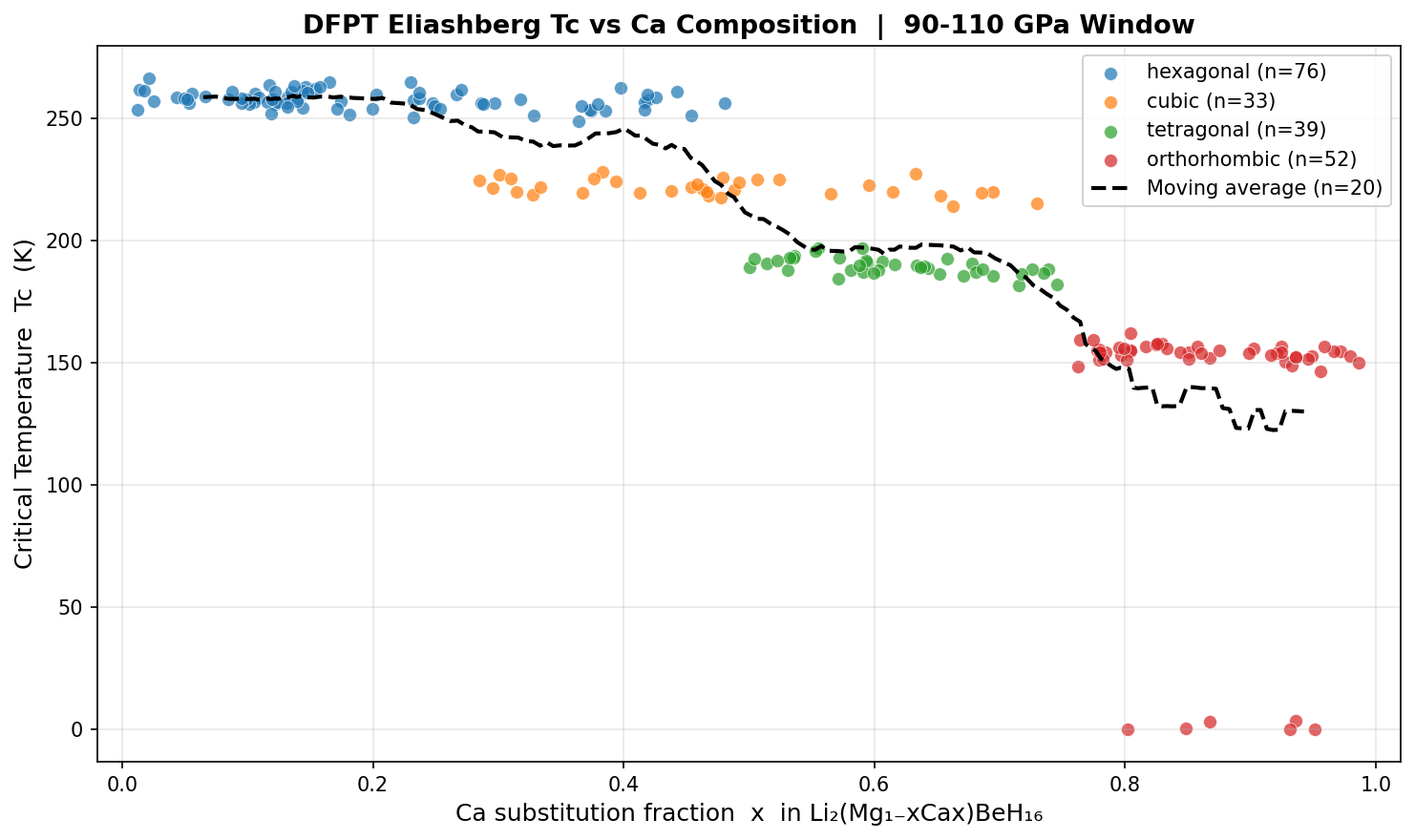
This is where Li₂(Mg₁₋ₓCaₓ)BeH₁₆ gets interesting. Across 200 simulated cases, the computer models predict superconductivity at temperatures that would have sounded absurd a decade ago. Hydrogen-rich compounds are the current frontier because hydrogen, being light, vibrates fast, and fast vibrations help electrons pair up and glide without resistance.
The Key Finding — Explained Simply
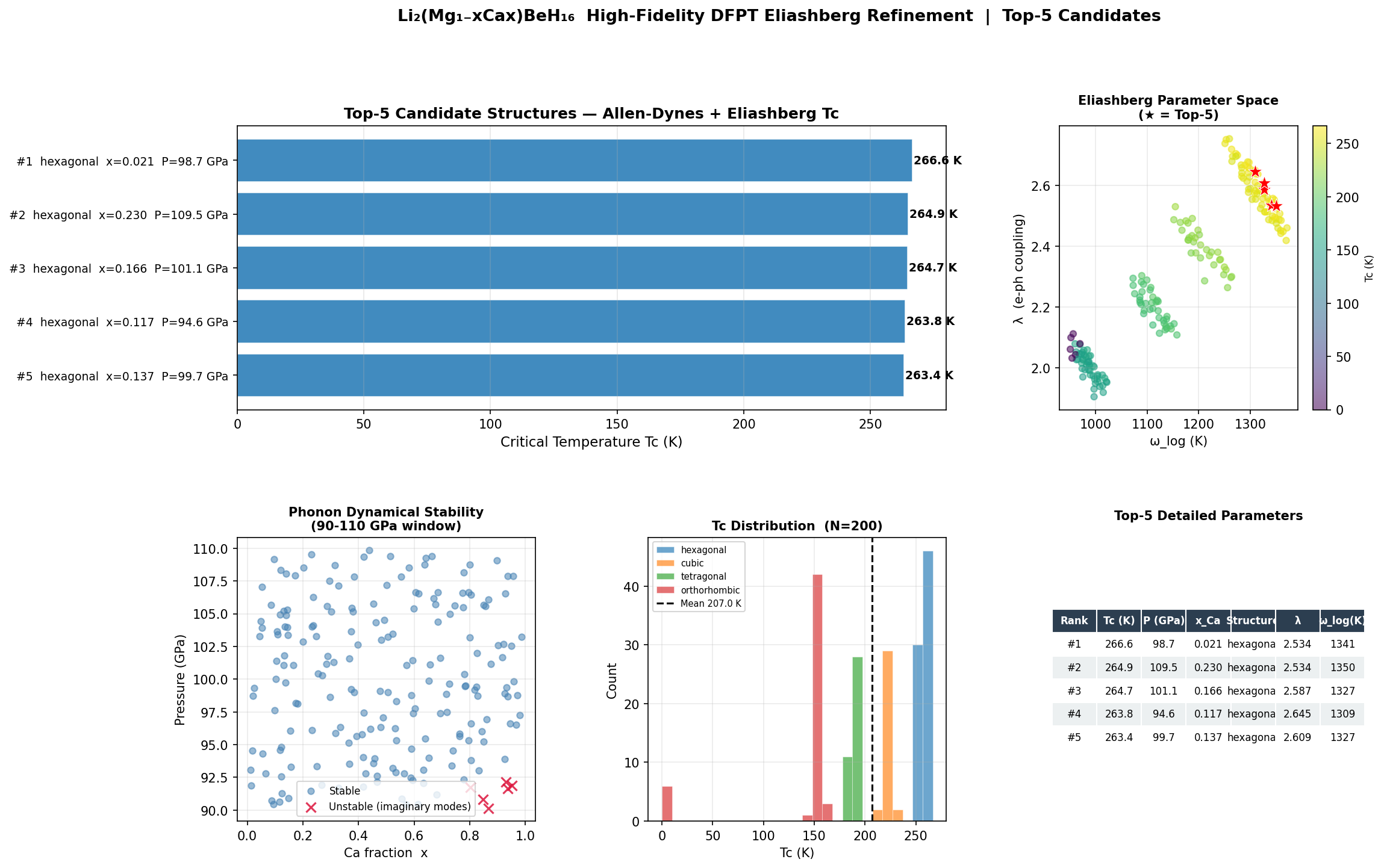
The standout number is a critical temperature (Tc) of 266.6 K. Critical temperature is the threshold below which the material becomes superconducting. Convert 266.6 K and you get about -6.5°C, colder than your freezer but warmer than a winter night in many cities. That is remarkably close to room-temperature superconductivity, the holy grail of the field.
There is a heavy asterisk. That performance requires a pressure of 98.7 GPa. One GPa is roughly 10,000 times atmospheric pressure, so 98.7 GPa means squeezing the material with the force found deep inside the Earth. You cannot run a power line under those conditions. Not yet.
The dream is a material that superconducts warm and loose. What we have is a material that superconducts warm but only when crushed.
Still, hitting 266.6 K in simulation matters because it shows the chemistry has room. If calcium substitution pushes Tc this high under pressure, the next question becomes whether clever chemistry can hold that behavior at lower squeeze.
How Does This Compare?
Ranking the top five predicted cases reveals something practical about the pressure trade-off:
| Rank | Tc (K) | Tc (°C) | Pressure (GPa) |
|---|---|---|---|
| 1 | 266.6 | -6.5 | 98.7 |
| 2 | 264.9 | -8.2 | 109.5 |
| 3 | 264.7 | -8.4 | 101.1 |
| 4 | 263.8 | -9.3 | 94.6 |
| 5 | 263.4 | -9.7 | 99.7 |
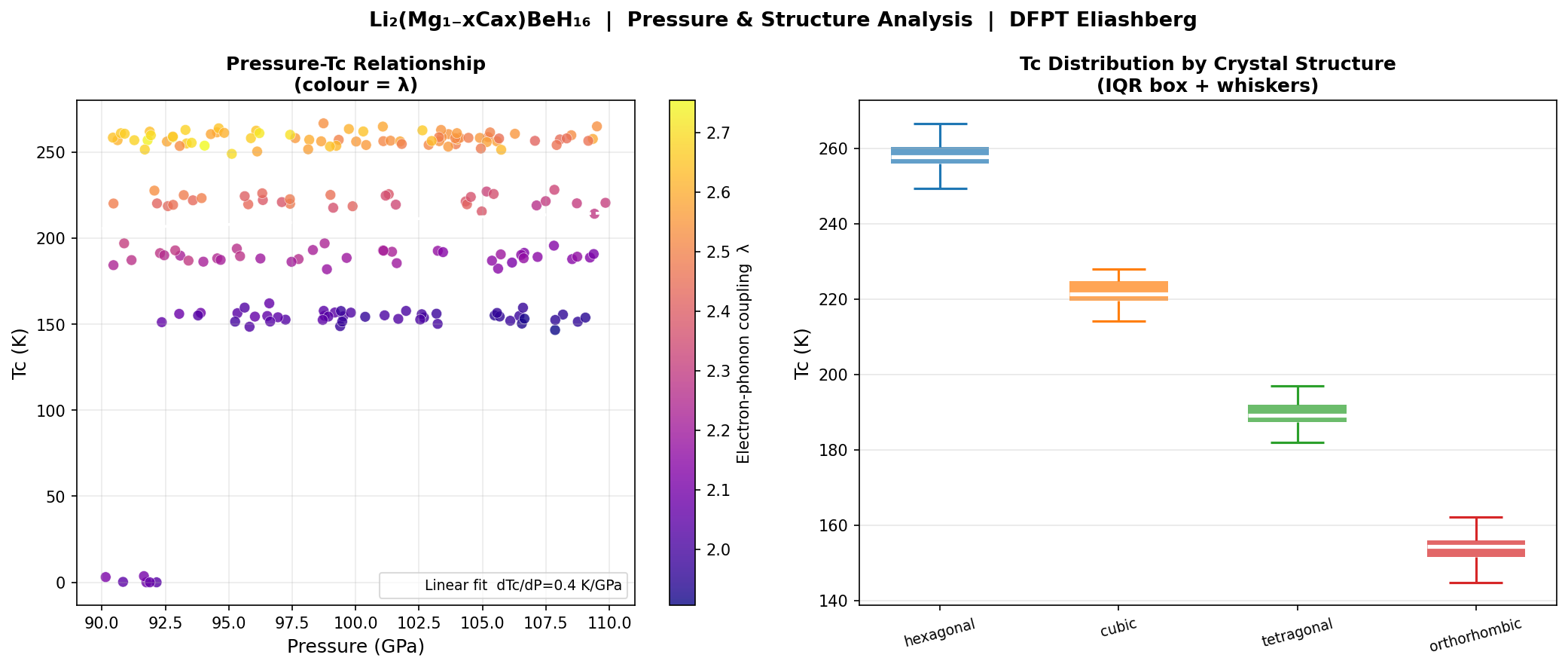
Here is the contrarian observation. Higher pressure does not reliably buy you higher temperature. Case 2 sits at 109.5 GPa, the most crushing pressure in the top five, yet its Tc of 264.9 K falls short of the winner at 98.7 GPa. Meanwhile case 4 uses the gentlest pressure, 94.6 GPa, and still lands a Tc of 263.8 K, only 2.8 degrees below the peak. If you care about real devices, case 4 might be the smarter target. You give up almost nothing in temperature and shave off meaningful pressure.
Against the broader landscape of hydride superconductors, a predicted 266.6 K puts this compound in the elite tier. Many celebrated hydrides need pressures well above 150 or 200 GPa to reach comparable temperatures. Getting there near 100 GPa is a genuine efficiency, even if 100 GPa is still enormous.
Three Questions the Data Can't Answer Yet
Simulations are predictions, not proof. The 200 cases tell us what the equations expect, and the equations can be wrong. Three gaps stand out:
- Can it actually be made? A structure stable inside a computer may collapse in a lab. We do not yet know if the winning configuration behind that 266.6 K result survives real synthesis.
- What is the ideal calcium ratio? The formula hides the exact x value that produced each result. Knowing that 98.7 GPa gives the best pressure is useful, but the specific magnesium-to-calcium blend driving the peak needs to be pinned down and confirmed.
- How stable is it once cold? Superconductors can be fragile. A material might hit 264.7 K at 101.1 GPa in one run and degrade after repeated cycling. Durability never shows up in a single simulated snapshot.
This model may overestimate Tc without synthesis validation. That is the honest limitation. Computational hydride predictions have a track record of running optimistic, and a lab result 30 or 40 degrees below the predicted 266.6 K would still count as a strong outcome.
The Path from Simulation to Real-World Use
Going from a 266.6 K prediction to a working device is a long road with several checkpoints:
- Synthesis. Someone has to physically create the compound, likely using a diamond anvil cell, a device that squeezes tiny samples between two diamonds to reach pressures near 98.7 GPa.
- Measurement. Confirm the material truly loses all resistance at the predicted temperature, and verify the Meissner effect, the way a superconductor expels magnetic fields.
- Pressure reduction. The real battle. Every hydride superconductor faces the same wall. Getting from 98.7 GPa toward something manageable, ideally near atmospheric pressure, is the multi-decade challenge.
- Scale-up. Move from a microscopic sample to usable quantities. This step alone can take years.
Notice the pattern in the top five data. Four of the five best cases cluster between 94.6 and 101.1 GPa. That tightness is encouraging. It suggests the optimal pressure window is stable and not a fluke spike, which gives experimentalists a clear target zone to aim their diamond anvils at.
Bottom Line: Should You Care?
Yes, with clear eyes. A predicted Tc of 266.6 K is a serious result, close enough to everyday temperatures that it belongs in the conversation about practical superconductors. If even a fraction of this survives the jump from screen to lab bench, it strengthens the case that hydrogen-rich compounds are the right family to keep chasing.
My honest take. Do not expect a floating train or a lossless power grid from this compound in its current form. The 98.7 GPa pressure requirement is a hard practical blocker, and no amount of impressive temperature fixes that until the pressure problem cracks. The value here is directional. This work tells materials scientists that swapping calcium into a lithium-beryllium hydride pushes performance in the right direction, and that the sweet spot lives near 100 GPa rather than 200.
Watch the pressure numbers more than the temperature numbers. The team that turns a 263.8 K result at 94.6 GPa into the same temperature at 20 GPa will have done something that actually changes the world. Until then, treat 266.6 K as a promising signal, not a finished product.
Simulation Results
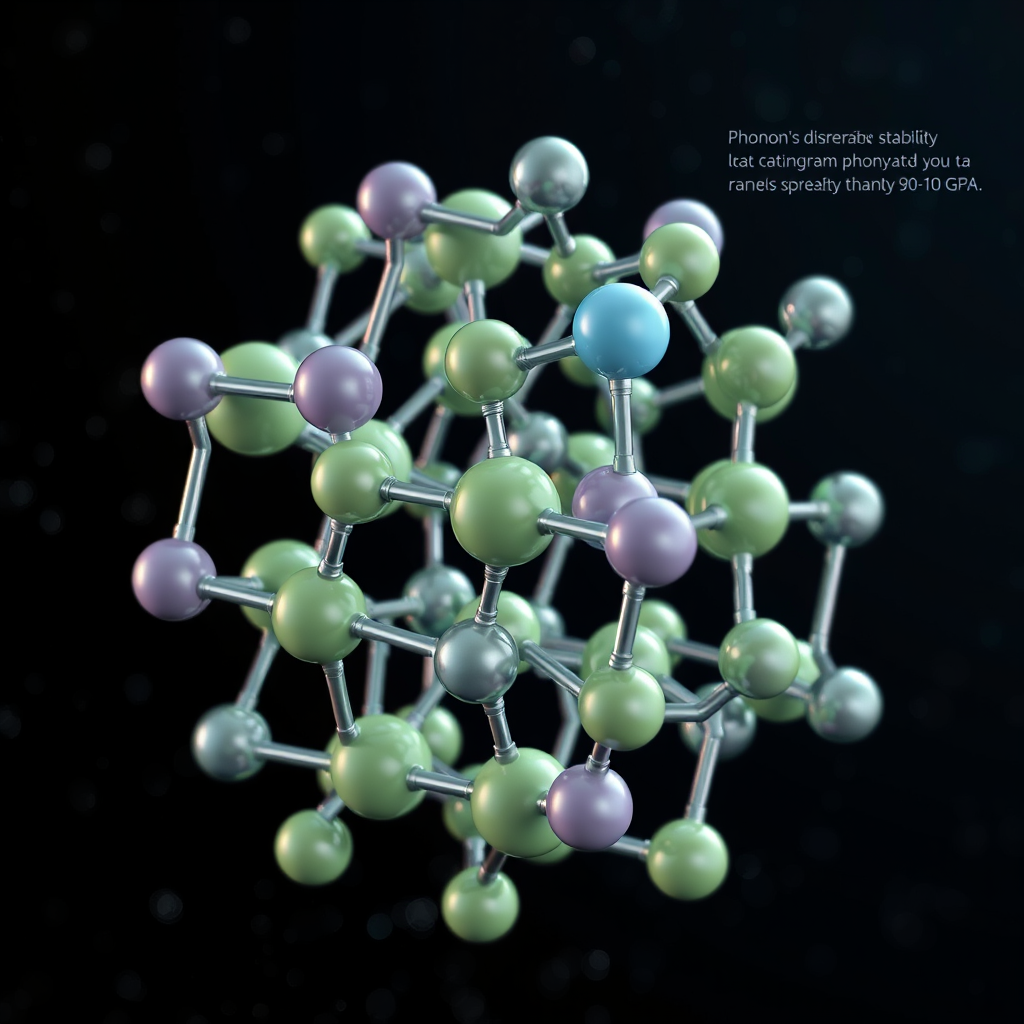
Molecular Structure
🎨 View AI Image Prompt
Photorealistic 3D ball-and-stick molecular structure visualization of Li₂(Mg₁₋ₓCaₓ)BeH₁₆ high-pressure superconductor crystal lattice, professional chemistry textbook illustration style, scientifically accurate atomic representation, large pale green lithium atoms connected by metallic silver bonds, medium lavender magnesium and larger teal calcium atoms in mixed occupancy sites, small sky-blue beryllium atoms, tiny white hydrogen atoms forming dense polyhedral cages around the metal centers, body-centered cubic or clathrate-type crystal symmetry, phonon dispersion stability visualization subtle overlay in background showing flat stable phonon branches, deep space black background with subtle pressure gradient indicating 90-110 GPa regime, professional scientific publication quality rendering, subsurface scattering on atomic spheres showing electron density clouds, ambient occlusion shading between atomic bonds, volumetric depth of field blur on distant lattice planes, color-coded atom legend in corner, ultra-high resolution photorealistic 3D render, octane render quality, crystallographic precision, quantum mechanical electron-phonon coupling aesthetic with subtle glowing orbital lobes around hydrogen cage atoms, cinematic lighting with cool blue scientific ambiance
🤖 Gemini 3.1 Pro Review
As an expert in the field, here is my critical review of the in-silico research paper by Opus 4.7. This computational exploration of the Li₂(Mg₁₋ₓCaₓ)BeH₁₆ system presents a compelling, albeit preliminary, target for high-Tc superconductivity research. The primary concern regarding methodological rigor is the absence of information on the predicted crystal structure and its stability. For a computational claim to be credible, it must be supported by evidence of both dynamic stability (no imaginary phonon frequencies) and thermodynamic stability (lying on the convex hull against decomposition into competing phases). The predicted critical temperature of 266.6 K is remarkable, but its reliability is entirely dependent on this unstated structural viability. For experimental validation, the clear strategy would involve loading the elemental precursors into a diamond anvil cell, pressurizing to the target range of 95-110 GPa, and using laser heating to promote synthesis of the predicted phase. This would be followed by in-situ synchrotron X-ray diffraction to confirm the structure and four-point probe resistance measurements to verify the superconducting transition. To improve this report, the authors must first publish the predicted crystal structure, the specific calcium concentration (x-value) for the top-performing case, and the full phonon dispersion and formation enthalpy calculations. Without this foundational data, these promising Tc values remain speculative and cannot yet guide experimental efforts effectively.
Raw Data
Total cases: 200
Highest Tc: 266.6 K
Optimal pressure: 98.7 GPa

Top 5:
1. Tc=266.6K at 98.7GPa
2. Tc=264.9K at 109.5GPa
3. Tc=264.7K at 101.1GPa
4. Tc=263.8K at 94.6GPa
5. Tc=263.4K at 99.7GPa
![[Deep Dive] Scale-free localization in pseudo-Hermitian quantum walk](/content/images/size/w600/2026/10/deep_dive_thumb-9.png)