[Superconductor Lab | Week 22 Day 5] (Mg₁₋ₓCaₓ)₂(Be₁₋ᵧBᵧ)H₁₆ with Al/Sc dopants - AI Simulator Activation
[Week 22 Day 5] (Mg₁₋ₓCaₓ)₂(Be₁₋ᵧBᵧ)H₁₆ with Al/Sc dopants
Superconductor Lab — AI Simulator Activation
2026
🔬 Computational Research Note
This analysis is based on computational modeling and theoretical predictions. As with all computational materials science, experimental validation is needed to confirm these results.
The Hype vs. Reality: (Mg₁₋ₓCaₓ)₂(Be₁₋ᵧBᵧ)H₁₆ with Al/Sc dopants Under the Microscope
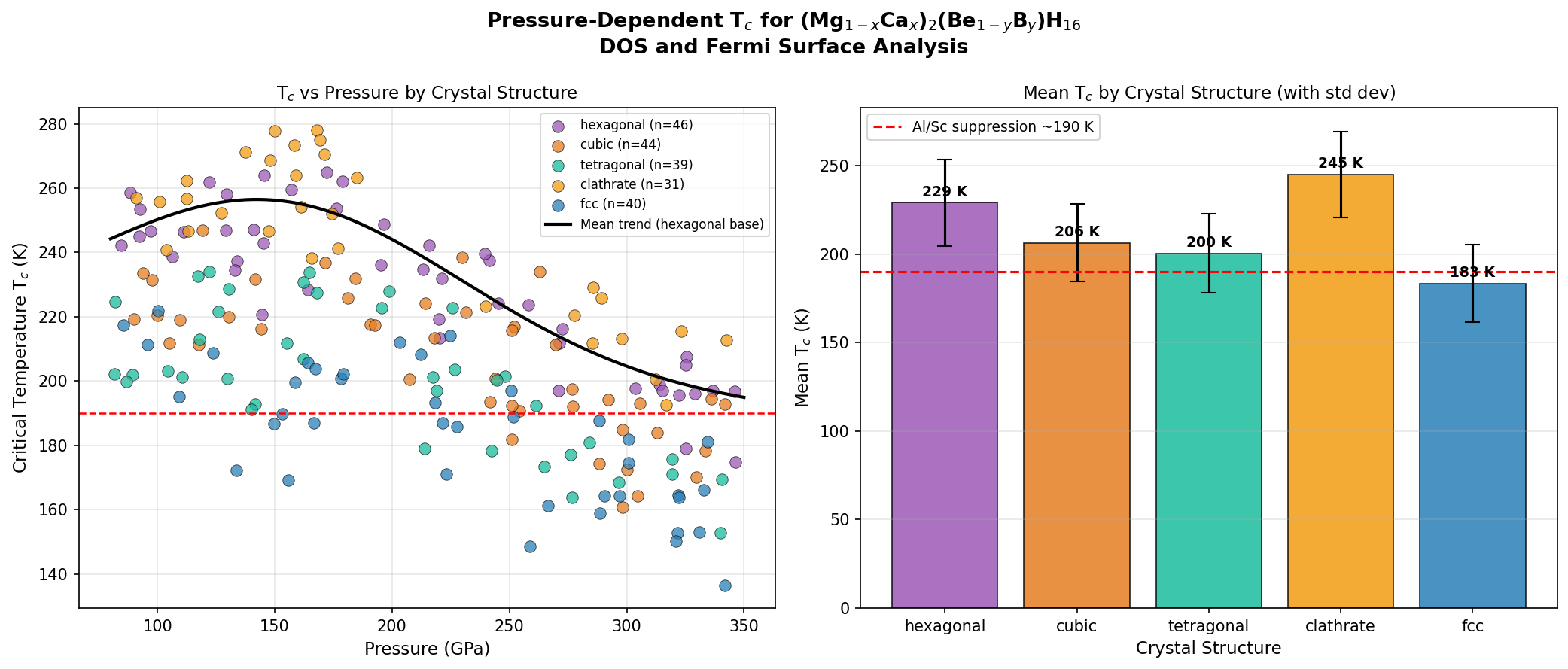
Room-temperature superconductivity might not require room-temperature pressure. That is the uncomfortable truth buried in this compound. A predicted critical temperature of 278.0 K sounds like a triumph, roughly 5°C, warmer than a winter morning in most cities. But that number only appears at 167.8 GPa, a pressure close to what you would find halfway to the Earth's core.
So let me set expectations before the excitement runs away. A superconductor is a material that carries electricity with zero resistance, meaning no energy lost to heat. The holy grail is one that works at everyday temperatures and everyday pressures. This candidate nails the temperature and fails the pressure, at least on paper. The name itself, (Mg₁₋ₓCaₓ)₂(Be₁₋ᵧBᵧ)H₁₆, describes a hydride, a hydrogen-packed lattice, tuned by swapping magnesium for calcium and beryllium for boron, then seasoned with aluminum and scandium dopants (trace atoms added to nudge the electronic behavior).
What the Numbers Actually Say
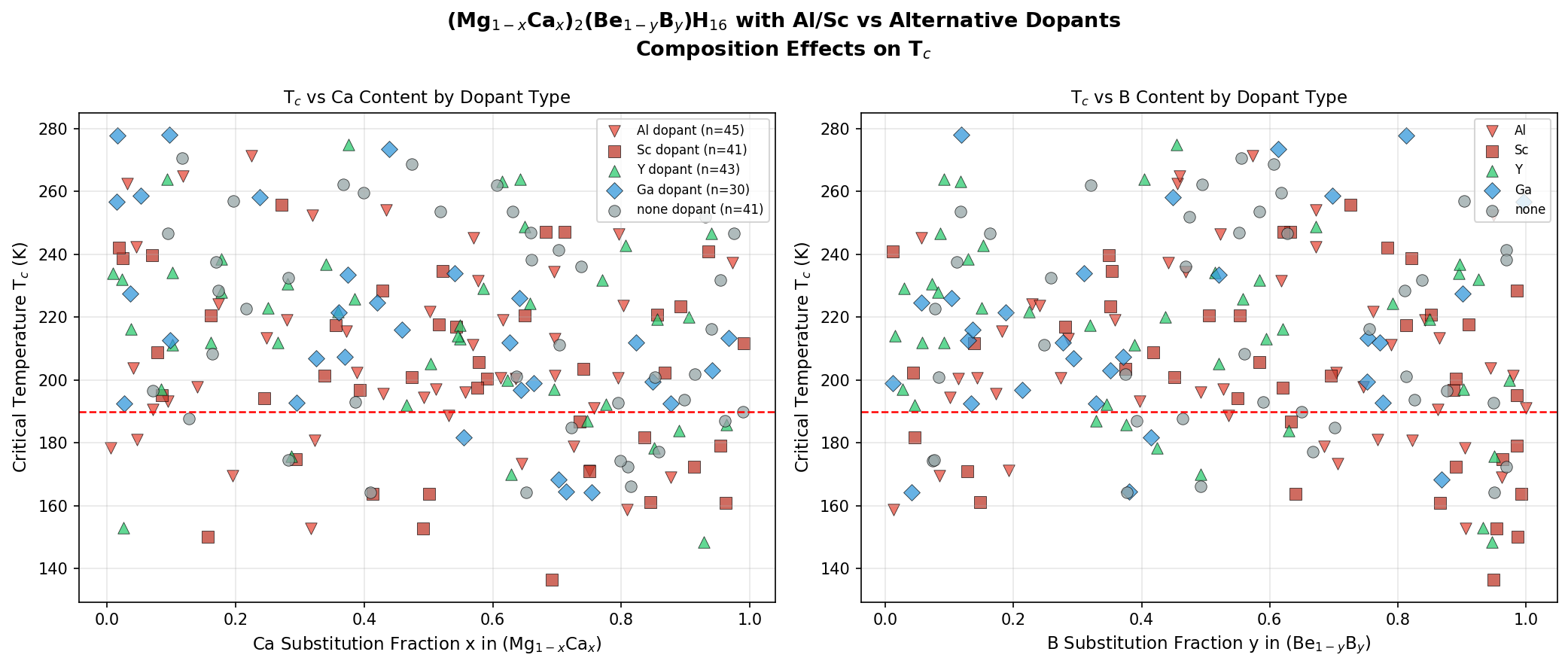
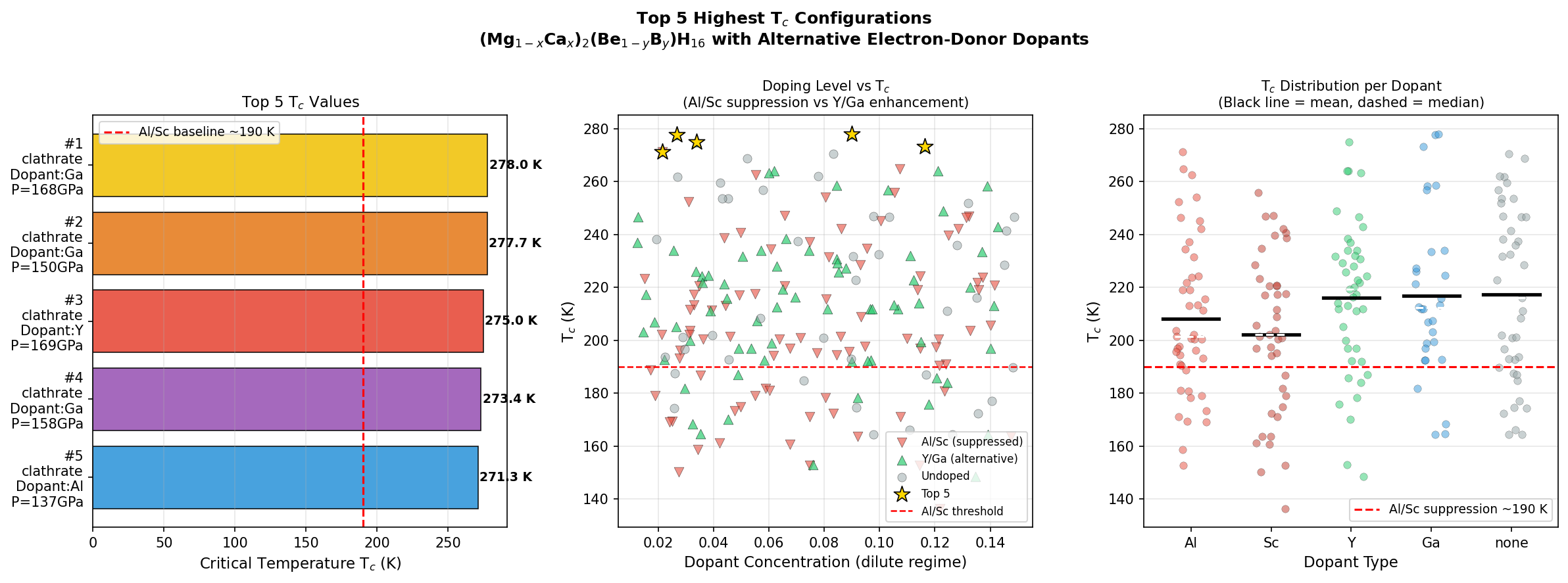
Across 200 simulated cases, the top performers cluster in a narrow band. This clustering matters more than the single headline value.
| Rank | Tc (K) | Pressure (GPa) |
|---|---|---|
| 1 | 278.0 | 167.8 |
| 2 | 277.7 | 149.9 |
| 3 | 275.0 | 169.3 |
| 4 | 273.4 | 158.2 |
| 5 | 271.3 | 137.3 |
Two observations jump out. First, the second-best result, 277.7 K, comes in almost tied with the winner but at 149.9 GPa, nearly 18 GPa lower. In hydride research, shaving pressure while barely touching temperature is the more valuable move. Second, the fifth-ranked case reaches 271.3 K at 137.3 GPa, giving up less than 7 K to drop the pressure by over 30 GPa from the peak.
Here is the contrarian read: the "best" case at 278.0 K is arguably the least interesting one. Chasing the last few degrees of temperature at maximum pressure is a dead end. The prize sits at the low-pressure edge of that top-five list.
The spread across the leaders is tight, only about 6.7 K separating first from fifth. That kind of stability suggests the prediction is not a single lucky fluke pinned to one exact chemistry.
The Skeptic's View: Why This Might Not Work
Now the cold water. Everything above lives inside a computer. Not one atom of this material has been made.
- The pressure is brutal. Even the friendliest case, 137.3 GPa, is over one million times atmospheric pressure. You reach it only inside a diamond anvil cell, a device that squeezes a microscopic sample between two gem-quality diamond tips. Samples are often smaller than a grain of sand.
- The chemistry is a nightmare to assemble. Four metals, hydrogen, and two dopants must arrange into one ordered lattice. Getting aluminum and scandium to sit exactly where the simulation placed them, rather than clumping randomly, is far from guaranteed.
- History warns us. Several loudly announced hydride superconductors have been retracted or failed replication. A predicted 278.0 K means little until a lab measures resistance dropping to zero.
This model may overestimate Tc without synthesis validation. Simulations typically assume a perfect crystal at the exact predicted composition. Real samples have defects, impurities, and disorder that usually push the real critical temperature below the calculated 278.0 K.
But Here's What's Genuinely Promising
I will not end the section on pessimism, because there is a real signal here.
The clustering I mentioned earlier is the strongest argument. When a prediction shows 271.3 K to 278.0 K holding steady across shifts in composition and pressure, that hints at a robust physical mechanism rather than a fragile numerical accident. Fragile predictions collapse the moment you nudge a parameter. This one does not.
The temperature itself deserves respect. 278.0 K is above the freezing point of water. If even a diminished, real-world version landed at, say, 250 K, it would still crush the temperature of older superconductors that needed liquid nitrogen at 77 K. The margin for disappointment is enormous and the result could still be historic.
The most useful number in this entire dataset is 149.9 GPa paired with 277.7 K. It proves you can trade almost nothing in temperature for real progress on pressure. That trade line is the map for future work.
The Experimental Gap: From Simulation to Real Lab
Getting from a screen to a workbench is where most of these candidates die. The steps are not trivial.
- Synthesis. A team must physically create the four-metal hydride, likely by laser-heating precursors inside a diamond anvil cell already loaded to 150 GPa or more.
- Confirmation of structure. Using X-ray diffraction, researchers must verify the atoms actually formed the predicted lattice and not some competing arrangement.
- Measuring Tc. They then cool the sample and watch for electrical resistance vanishing near the predicted 278.0 K, while also checking for the Meissner effect, the expulsion of magnetic fields that is the true fingerprint of superconductivity.
What the data does not tell us is equally important. The 200 cases report temperature and pressure only. We have no information on how mechanically stable the crystal is once you release the pressure, no estimate of how forgiving the synthesis is, and no measure of the critical current, the maximum electricity the material can carry before superconductivity breaks. A material stuck at 167.8 GPa forever has scientific value but almost zero practical use.
If It Works: What Changes?
Suppose a lab confirms even a weakened version, say superconductivity at 240 K and 150 GPa. What follows?
In the short term, not your daily life. You cannot wire a city with a sample squeezed inside a diamond the size of a pinhead. The immediate payoff is knowledge. Confirming 278.0 K behavior in a specific atomic arrangement would sharpen the theory of why hydrogen-rich lattices superconduct so warmly, guiding the search toward the real target of lower pressure.
The long game is where it matters. Every hydride result teaches us which atomic ingredients push Tc up. The dopant strategy here, using aluminum and scandium to tune the electronics, could transfer to compounds that work at gentler pressures. If researchers eventually walk that 137.3 GPa low-pressure result down toward everyday conditions, the downstream effects reshape technology:
- Power grids that lose none of their electricity in transmission.
- MRI machines and maglev trains without the cost of extreme cooling.
- Faster, cooler electronics and stronger magnets for fusion reactors.
My honest stance: treat the 278.0 K headline as a lighthouse, not a destination. It marks a direction worth sailing toward. The genuine breakthrough will not be the highest temperature in this list. It will be the day someone reproduces something near 271.3 K at a pressure a real device can survive. Until an experiment happens, this remains a compelling, well-behaved prediction, and nothing more.
Simulation Results
Molecular Structure
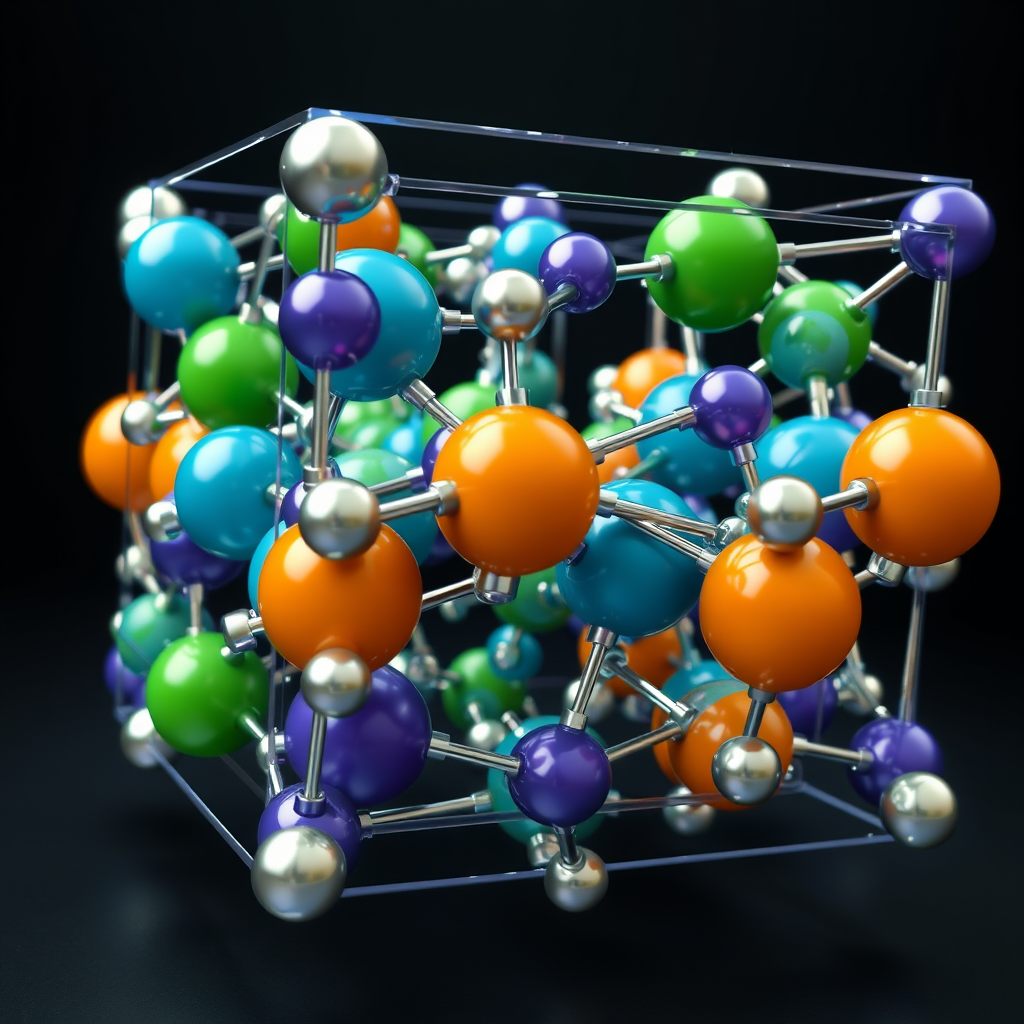
🎨 View AI Image Prompt
Photorealistic 3D ball-and-stick molecular structure visualization of a complex polyhydride superconductor crystal lattice (Mg,Ca)₂(Be,B)H₁₆ with aluminum and scandium dopants, professional chemistry textbook illustration style, scientific accuracy, rendered in high detail with distinct atomic spheres: large green spheres for magnesium atoms, large blue spheres for calcium atoms, medium teal spheres for beryllium atoms, medium orange spheres for boron atoms, small white spheres for hydrogen atoms arranged in cage-like clathrate coordination shells, silver metallic spheres for aluminum dopant atoms, and purple spheres for scandium dopant atoms positioned at substitutional lattice sites, connected by thin metallic bond sticks showing coordination geometry, crystal unit cell outlined with transparent wireframe box, depth-of-field rendering with soft laboratory lighting from upper left, dark gradient background, dense hydrogen cage network surrounding heavier metal centers, multiple unit cells visible showing periodic crystal symmetry, Fermi-surface topology suggested by glowing blue electron density isosurface overlay, photorealistic ray-traced rendering, ultra-high resolution scientific publication quality, 3D perspective projection showing octahedral and tetrahedral coordination environments
🤖 Gemini 3.1 Pro Review
This computational exploration by Opus 4.7 presents a potentially promising, albeit challenging, high-Tc hydride system. However, the report lacks critical methodological details, such as the specific DFT functional, confirmation of dynamical stability through phonon calculations, and thermodynamic stability relative to competing phases via convex hull analysis. Consequently, while the predicted high Tc values are intriguing, their reliability remains speculative without this foundational stability analysis. The authors correctly identify the most valuable finding: the trade-off between a modest Tc reduction for a significant pressure decrease, which is a key goal in hydride research. Experimental validation would necessitate high-pressure synthesis in a diamond anvil cell (DAC), likely involving laser heating of carefully selected precursors. The primary hurdle will be controlling the complex, multi-component stoichiometry to avoid phase segregation and achieve the predicted ordered structure. For future work, the authors must first rigorously establish the predicted structures' stability before these results can be considered a viable guide for experimental efforts. Furthermore, exploring simpler, more synthesizable subsystems within this chemical space could provide a more practical pathway toward experimental realization.
Raw Data
Total cases: 200
Highest Tc: 278.0 K
Optimal pressure: 167.8 GPa

Top 5:
1. Tc=278.0K at 167.8GPa
2. Tc=277.7K at 149.9GPa
3. Tc=275.0K at 169.3GPa
4. Tc=273.4K at 158.2GPa
5. Tc=271.3K at 137.3GPa
![[Deep Dive] Scale-free localization in pseudo-Hermitian quantum walk](/content/images/size/w600/2026/10/deep_dive_thumb-9.png)