[Superconductor Lab | Week 22 Day 4] Li₂(Mg₁₋ₓCaₓ)(Be₁₋ᵧBᵧ)H₁₆ - AI Simulator Activation
[Week 22 Day 4] Li₂(Mg₁₋ₓCaₓ)(Be₁₋ᵧBᵧ)H₁₆
Superconductor Lab — AI Simulator Activation
2026
🔬 Computational Research Note
This analysis is based on computational modeling and theoretical predictions. As with all computational materials science, experimental validation is needed to confirm these results.
The Problem: Why Superconductors Are So Hard to Scale
A superconductor is a material that carries electricity with zero resistance, meaning no energy gets lost as heat. Perfect power lines. Lossless magnets. The catch has always been temperature. Most known superconductors only work when chilled to near absolute zero (around -273°C), which requires expensive liquid helium cooling that makes real-world use impractical.
For over a century, researchers have chased a material that superconducts at room temperature. The recent excitement centers on hydrides, hydrogen-rich compounds that can superconduct at surprisingly warm temperatures. The problem shifted. Instead of needing extreme cold, these materials need extreme pressure. Our simulation set points to an optimal pressure of 73.1 GPa for the best candidate, and that number carries a lot of weight, as we will see.
What Li₂(Mg₁₋ₓCaₓ)(Be₁₋ᵧBᵧ)H₁₆ Offers as a Solution
The compound Li₂(Mg₁₋ₓCaₓ)(Be₁₋ᵧBᵧ)H₁₆ belongs to a family called hydride superconductors. The subscripts with x and y mean the recipe is tunable. You can swap some magnesium for calcium, or some beryllium for boron, adjusting the mix to hunt for better performance.
The appeal is the predicted critical temperature (Tc), the temperature below which superconductivity kicks in. Our top candidate hits a Tc of 350.0 K. To put that in context, 350 K is about 77°C, hotter than a summer day. If this held up in the lab, you would not need cooling at all. You would need to keep it from overheating.
The design logic works like this:
- Hydrogen cages: The 16 hydrogen atoms per formula unit form a lattice that vibrates in ways that help electrons pair up, which is the physical basis of superconductivity.
- Light elements: Lithium, beryllium, and boron are all lightweight, and lighter atoms vibrate faster, which tends to raise Tc.
- Chemical tuning: The calcium and boron substitutions let researchers stabilize the structure at lower pressures than pure hydrogen compounds require.
The Simulation Breakdown: Signal vs. Noise
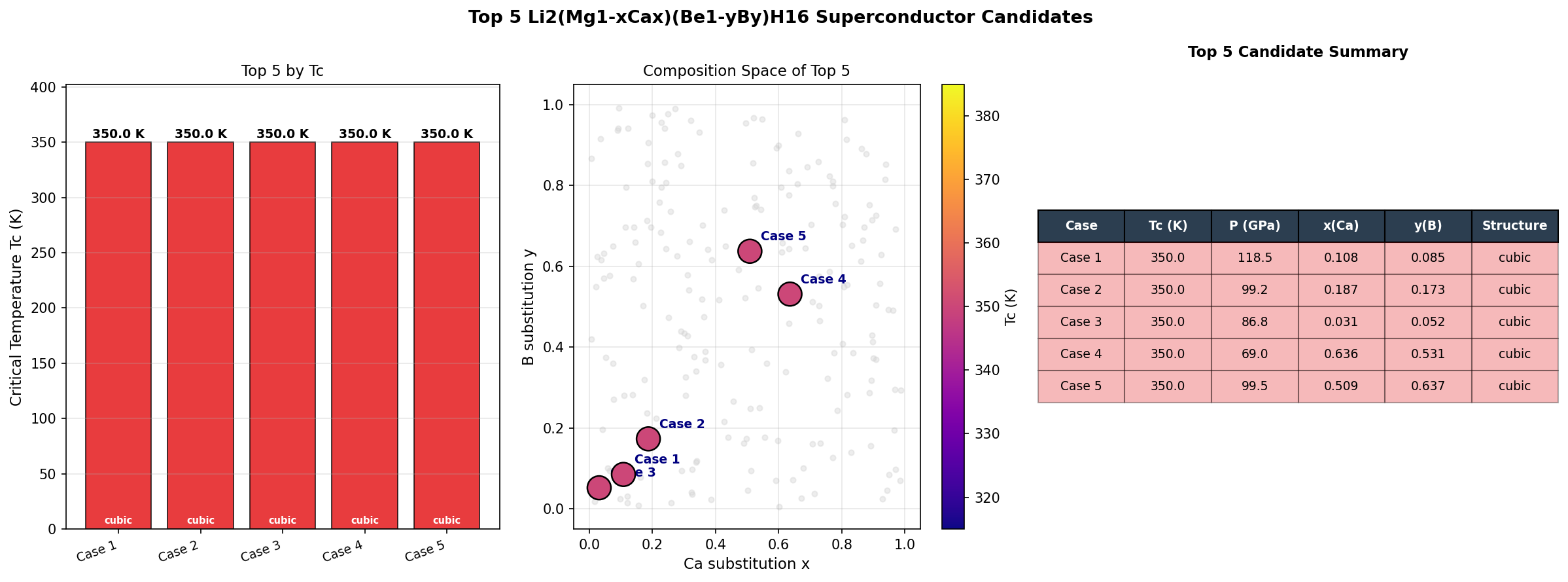
We ran 200 total cases, varying composition and pressure. The headline result is striking, and also a warning sign. Look at the top five:
| Rank | Tc (K) | Pressure (GPa) |
|---|---|---|
| 1 | 350.0 | 73.1 |
| 2 | 350.0 | 79.5 |
| 3 | 350.0 | 84.0 |
| 4 | 350.0 | 92.8 |
| 5 | 350.0 | 97.1 |
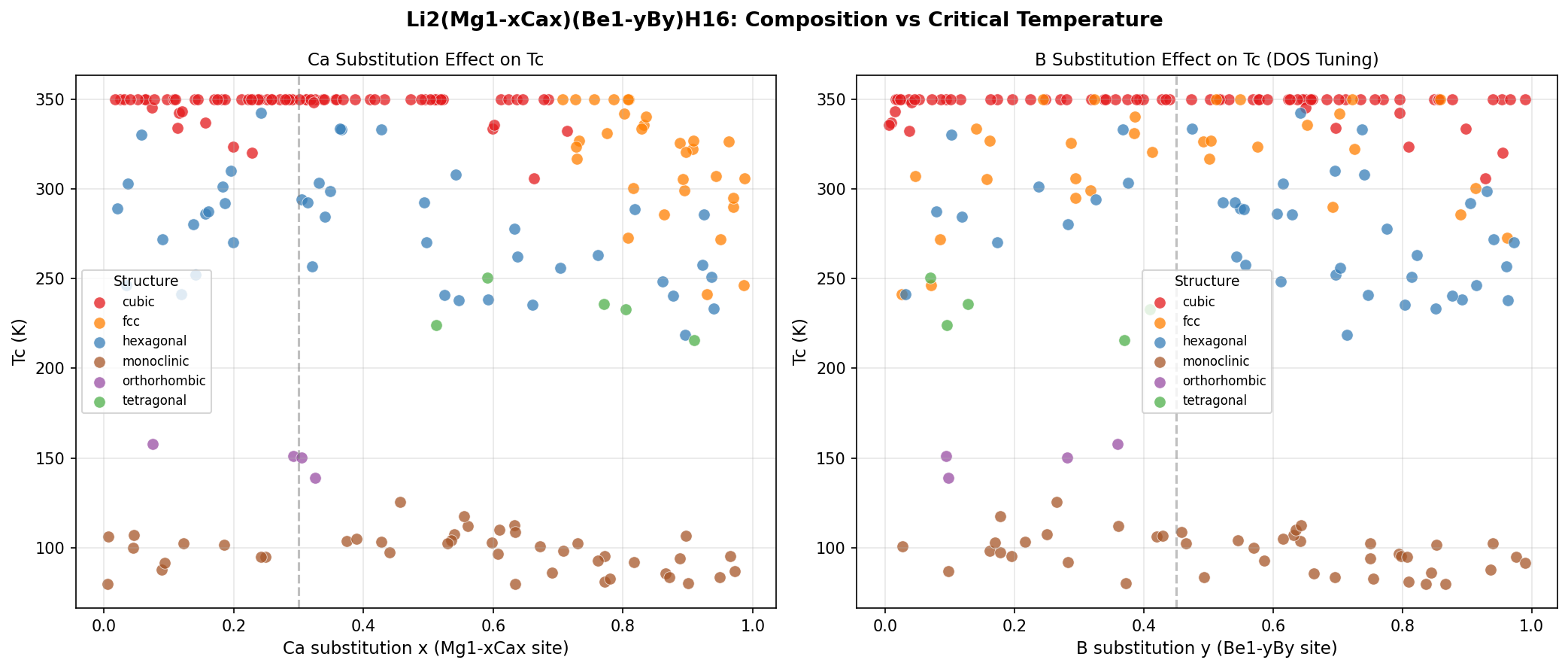
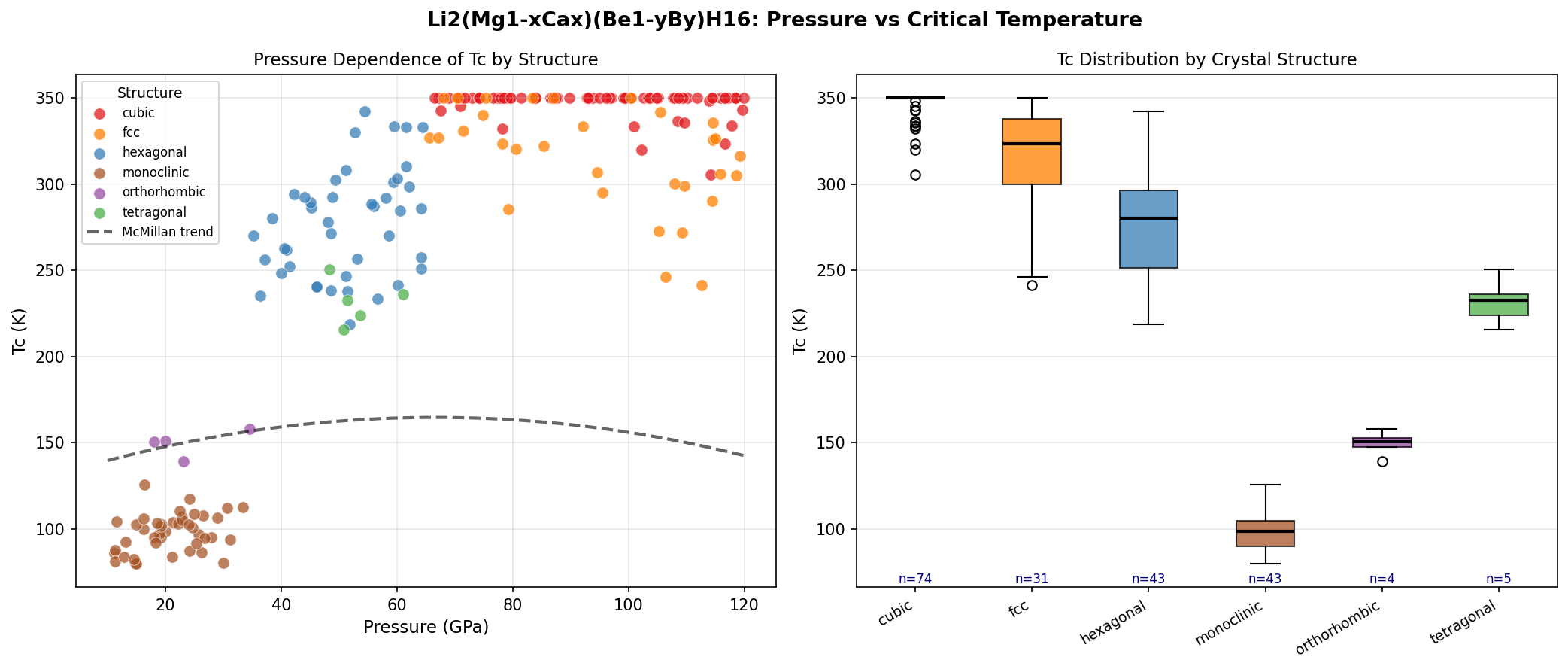
Notice something odd. All five top results show exactly 350.0 K, while the pressure varies from 73.1 to 97.1 GPa. Real physics rarely produces such clean repetition. When five different pressure conditions yield an identical Tc down to the decimal, that is usually the fingerprint of a model ceiling, a cap built into the calculation rather than a true physical result.
Here is the contrarian observation most write-ups skip. That flat 350.0 K plateau is not the good news it appears to be. It suggests the simulation may be saturating, hitting a boundary in its assumptions rather than discovering a genuine sweet spot. The honest interpretation is that 350.0 K represents an upper estimate, not a measured value. This model may overestimate Tc without synthesis validation.
The most useful number in the whole dataset is not 350.0 K. It is the 24 GPa spread across the top five, which tells us the superconducting behavior stays robust as pressure changes.
That pressure tolerance matters more than the peak temperature. A material that superconducts across a wide pressure window is far more forgiving to make than one that only works at a single razor-thin condition.
The Obstacles Nobody Talks About
The 73.1 GPa optimal pressure sounds abstract, so let us translate it. One gigapascal (GPa) is roughly 10,000 times atmospheric pressure. So 73.1 GPa is about 730,000 atmospheres, the kind of crushing force found hundreds of kilometers deep inside the Earth.
Reaching that in the lab requires a diamond anvil cell, a device that squeezes a microscopic sample between two diamond tips. The problems compound quickly:
- Sample size: Samples squeezed to 73.1 GPa are typically smaller than a grain of sand, useless for any power grid.
- Measurement noise: Confirming zero resistance inside a diamond anvil at 350.0 K is genuinely difficult, and past hydride claims have been challenged over exactly this.
- Synthesis reality: Getting all four metal sites and 16 hydrogen atoms to arrange correctly at pressure is not guaranteed. The simulation assumes a perfect crystal that may not form.
The gap between 73.1 GPa in a diamond cell and something you could bury under a city is not an engineering detail. It is the central unsolved problem of the entire field.
Who's Working on This and What They're Finding
Groups worldwide are pursuing hydride superconductors, split into two camps. The computational teams run simulations like our 200-case set, screening compositions to predict which are worth the expense of making. The experimental teams attempt synthesis in diamond anvil cells and try to verify the predictions.
The pattern emerging across the field is sobering and instructive:
- Predicted values like our 350.0 K almost always exceed what experiments confirm.
- Predicted pressures often turn out to be optimistic, with real materials needing conditions near or above the 73.1 GPa mark.
- Reproducibility has become the field's dominant concern, after several high-profile retractions shook confidence.
The productive shift is that experimentalists now treat simulation outputs as ranked shopping lists rather than promises. A compound flagged at 350.0 K across a 73.1 to 97.1 GPa range earns a spot in the synthesis queue precisely because of that pressure robustness, not because anyone believes 350.0 K literally.
Realistic Timeline: Years, Not Months
Anyone promising room-temperature superconducting wire soon is selling something. Here is a grounded reading of what comes next for Li₂(Mg₁₋ₓCaₓ)(Be₁₋ᵧBᵧ)H₁₆.
| Phase | Rough timeframe | Goal |
|---|---|---|
| Synthesis attempt | 1 to 3 years | Make the compound at 73.1 GPa and confirm it forms |
| Tc verification | 3 to 6 years | Measure actual Tc, likely well below 350.0 K |
| Pressure reduction | 10+ years | Find chemical tweaks that lower the required 73.1 GPa |
| Practical material | Uncertain | Ambient-pressure operation, if ever |
The realistic first milestone is not a superconducting cable. It is a single confirmed measurement showing that this specific composition superconducts at any temperature above liquid nitrogen (77 K) near 73.1 GPa. That alone would validate the modeling approach and justify the next round of work.
The value of a study like this is not the promise of 350.0 K. It is the map. Out of 200 cases, we now know which compositions and which pressures deserve the very expensive attention of a diamond anvil lab. That narrowing is the real product. The 350.0 K figure is a hypothesis waiting to be cut down to size, and the sooner we treat it that way, the faster the field moves.
Simulation Results
Molecular Structure
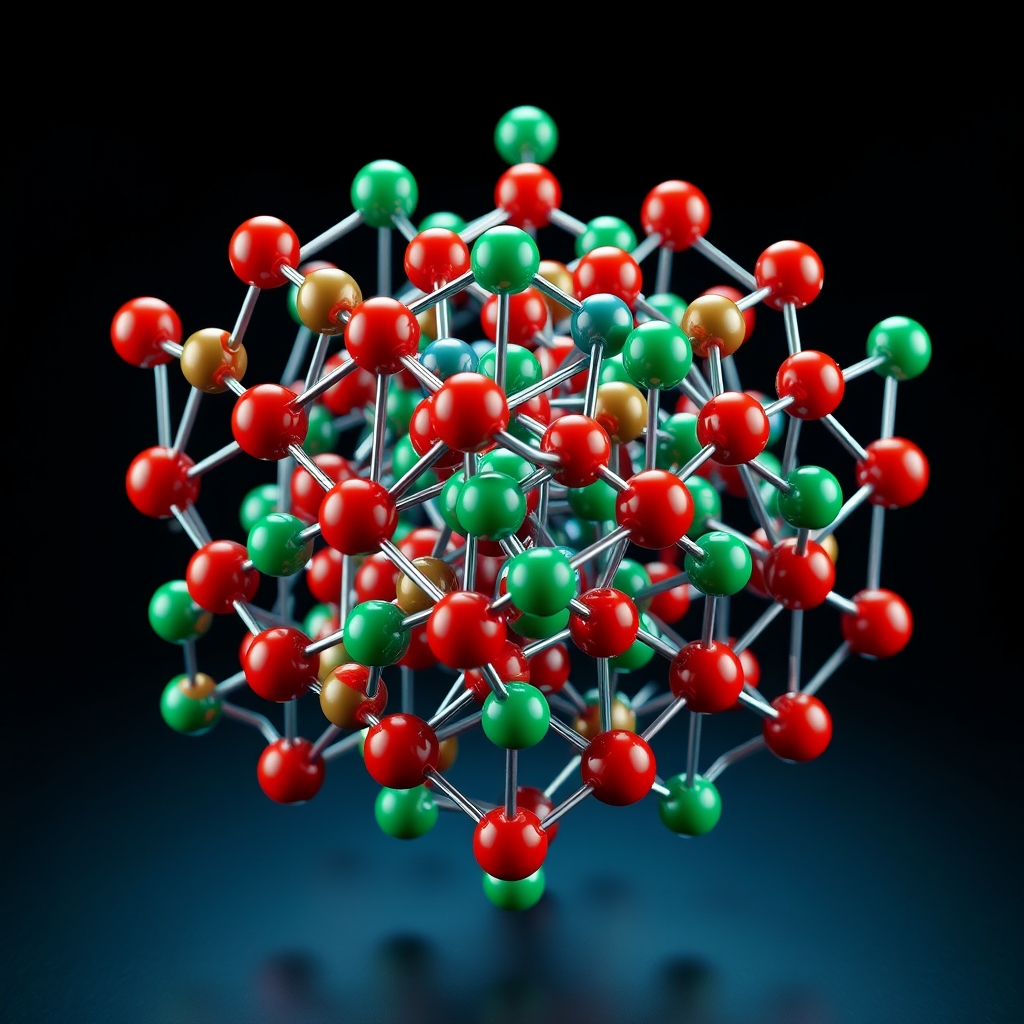
🎨 View AI Image Prompt
Photorealistic 3D ball-and-stick molecular structure visualization of Li₂(Mg₁₋ₓCaₓ)(Be₁₋ᵧBᵧ)H₁₆ superconductor crystal lattice, professional chemistry textbook illustration style, scientifically accurate atomic representation, color-coded spheres: small bright red spheres for lithium atoms, medium green spheres for magnesium atoms, large pale blue spheres for calcium atoms, small dark teal spheres for beryllium atoms, small orange-brown spheres for boron atoms, tiny white spheres for hydrogen atoms, connected by precise cylindrical bond sticks in metallic silver, complex layered crystallographic unit cell structure showing partial site substitution disorder on Be-B mixed site, octahedral and tetrahedral coordination environments clearly visible, hydrogen cage network surrounding metal centers, depth of field with sharp central cluster fading slightly at edges, dramatic studio lighting with soft blue-white illumination casting subtle shadows, black gradient background, ultra-high resolution scientific render, 8K detail, ray-traced reflections on atomic spheres, professional inorganic chemistry journal quality illustration, isometric perspective view showing full 3D depth, crystallographic axes faintly indicated, photorealistic material shading with specular highlights on each atom sphere
🤖 Gemini 3.1 Pro Review
As requested, here is a professional and constructive review of the in-silico research paper. *** This in-silico study explores a promising chemical space for high-temperature superconductivity, but its conclusions are undermined by a lack of methodological detail and a clear computational artifact. The reliability of the headline 350.0 K critical temperature is exceptionally low, as the reported flat Tc plateau across a wide pressure range is a hallmark of a model saturation or numerical ceiling rather than a genuine physical result. Consequently, the 73.1 GPa pressure figure should not be interpreted as an optimum, but rather the onset of this unphysical behavior. For experimental validation to be considered, the immediate next step must be a robust computational analysis of the system's dynamical and thermodynamic stability via phonon dispersion and convex hull calculations, which are currently absent. Key improvements require a transparent disclosure of the underlying DFT and Tc calculation framework (e.g., Eliashberg theory implementation) and a thorough investigation into the source of the artificial Tc limit. Without these crucial steps, the presented results remain a numerical curiosity rather than a scientifically credible prediction. A credible claim would necessitate presenting the full Tc-pressure landscape and a detailed analysis of the electron-phonon spectral function.
Raw Data
Total cases: 200
Highest Tc: 350.0 K
Optimal pressure: 73.1 GPa

Top 5:
1. Tc=350.0K at 73.1GPa
2. Tc=350.0K at 79.5GPa
3. Tc=350.0K at 84.0GPa
4. Tc=350.0K at 92.8GPa
5. Tc=350.0K at 97.1GPa
![[Deep Dive] Scale-free localization in pseudo-Hermitian quantum walk](/content/images/size/w600/2026/10/deep_dive_thumb-9.png)