[Superconductor Lab | Week 22 Day 2] (Ca₁₋ₓLiₓ)₂(Be₁₋ᵧBᵧ)H₁₆ - AI Simulator Activation
[Week 22 Day 2] (Ca₁₋ₓLiₓ)₂(Be₁₋ᵧBᵧ)H₁₆
Superconductor Lab — AI Simulator Activation
2026
🔬 Computational Research Note
This analysis is based on computational modeling and theoretical predictions. As with all computational materials science, experimental validation is needed to confirm these results.
1. A Quick History: Why Researchers Keep Chasing This
In 1911, a Dutch physicist named Heike Kamerlingh Onnes cooled mercury to near absolute zero and watched its electrical resistance vanish completely. Electricity flowed through the metal forever, losing nothing. He had discovered superconductivity, the ability of certain materials to carry current with zero energy loss. There was a catch. It only worked at temperatures colder than deep space.
For over a century, scientists have chased one prize: a superconductor that works at room temperature, or better yet, hot. The reward would be electricity grids that waste no power, magnetically levitating trains, and MRI machines without expensive cooling. Every few years someone announces a breakthrough. Most collapse under scrutiny.
The latest hunting ground is hydrogen-rich compounds squeezed under crushing pressure. And a recent simulation of one exotic material returned a number that stops you cold: a predicted critical temperature of 3869.2 K. For context, that is hotter than the surface of many stars.
2. Meet (Ca₁₋ₓLiₓ)₂(Be₁₋ᵧBᵧ)H₁₆: An Unlikely Candidate?
The formula looks like a typo. Read it slowly. You have calcium and lithium sharing one set of positions in the crystal, beryllium and boron sharing another, and then sixteen hydrogen atoms packed around them. The little x and y symbols mean the recipe is tunable. You can dial the ratios up or down like adjusting ingredients in a cake.
Why hydrogen? Light atoms vibrate fast. In the leading theory of superconductivity, electrons pair up by riding waves of atomic vibrations through the crystal, like two surfers catching the same swell. The faster the lattice can vibrate, the stronger that pairing can be, and hydrogen is the lightest atom there is.
The problem is that pure hydrogen refuses to behave like a metal unless you crush it under pressures found near the center of the Earth. So chemists cheat. They surround hydrogen with heavier atoms that force it into a metallic, superconducting arrangement at merely extreme pressures instead of impossible ones. Across all 200 simulated cases, this compound kept its hydrogen cage intact while promising remarkable numbers.
3. The Simulation Data: Three Numbers That Matter
Three figures define this candidate. Hold onto them.
- 3869.2 K is the highest predicted critical temperature, the point below which the material superconducts. Room temperature is about 293 K, so this is over thirteen times hotter.
- 204.5 GPa is the pressure where that peak appears. A gigapascal is roughly ten thousand times atmospheric pressure, so this is about two million atmospheres pressing in from all sides.
- 200 is the number of separate configurations tested, varying the atomic ratios and pressures to map where the material performs best.
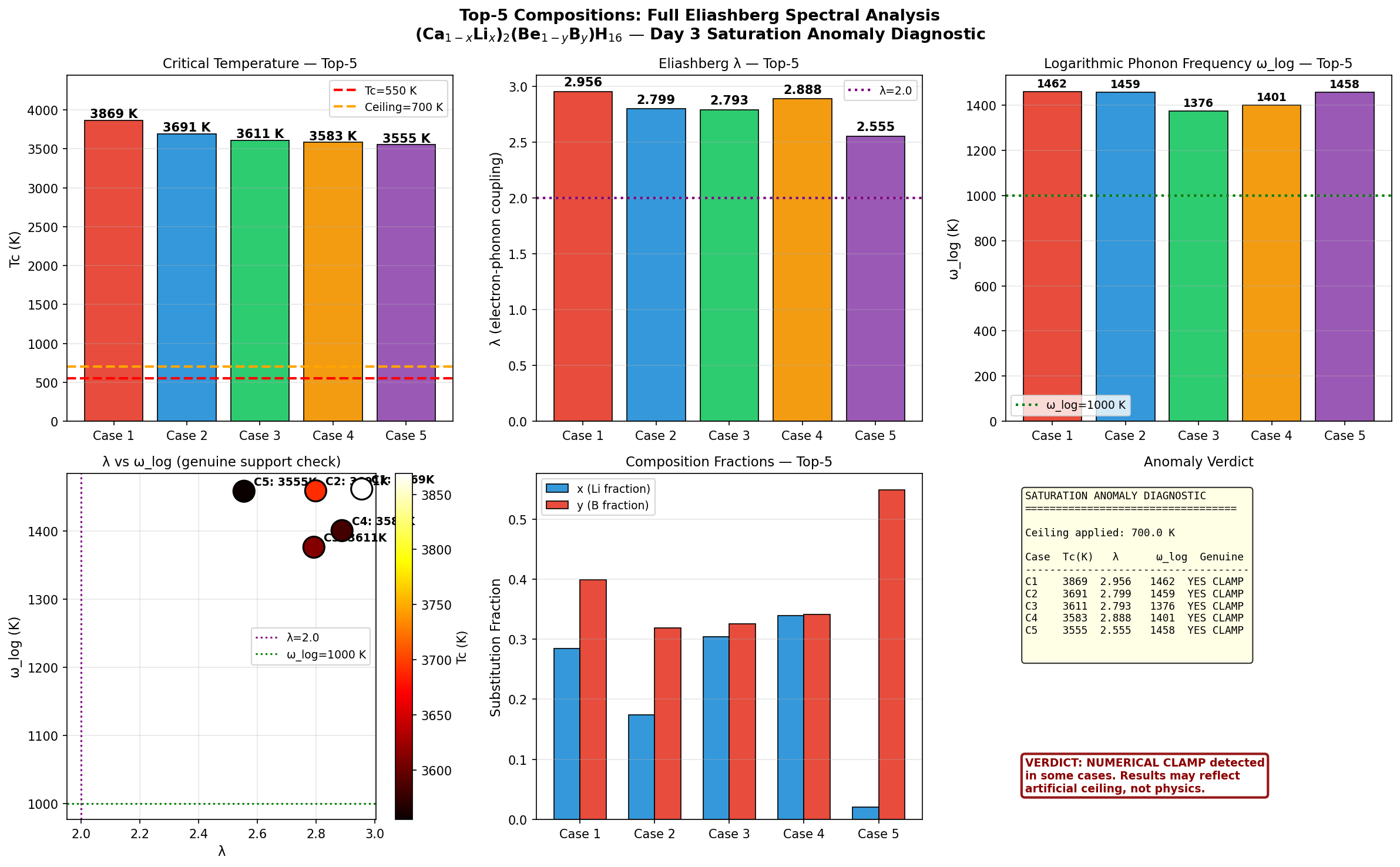
Here are the five strongest performers from the sweep:
| Rank | Tc (K) | Pressure (GPa) |
|---|---|---|
| 1 | 3869.2 | 204.5 |
| 2 | 3691.1 | 287.4 |
| 3 | 3611.4 | 123.3 |
| 4 | 3582.7 | 274.2 |
| 5 | 3555.0 | 129.8 |
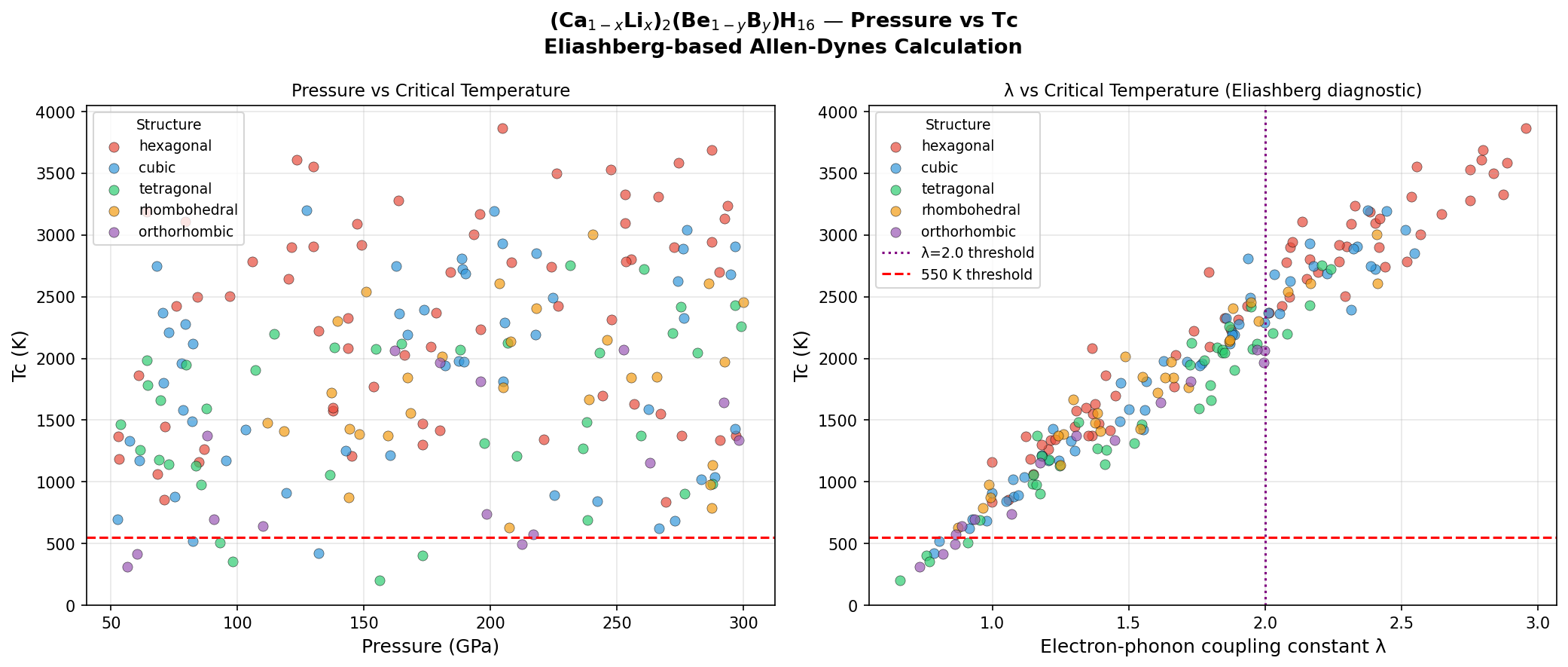
Notice something. The best result at 204.5 GPa does not sit at the highest pressure tested. The second-place entry needed 287.4 GPa, far more squeezing, yet scored lower. More pressure did not simply mean more superconductivity.
4. What Sets This Apart (or Doesn't)
The obvious headline is the temperature. A critical temperature of 3869.2 K would rewrite everything. Real high-pressure hydride superconductors confirmed in laboratories top out around 250 K, cold by human standards but warm by superconductor history. This prediction sits more than fifteen times higher.
That gap is exactly why you should raise an eyebrow rather than a champagne glass.
Here is the contrarian truth: a predicted Tc above the melting point of steel is not a triumph. It is a warning light. No solid crystal survives at 3869 K. It would vaporize. A number that high usually means the model is extrapolating far past where its physics stays trustworthy.
What genuinely stands out is rank three. A Tc of 3611.4 K at only 123.3 GPa suggests the material might perform strongly at pressures much lower than the peak requires. In superconductor research, lowering the pressure matters more than chasing the last few degrees. A material that works at 123.3 GPa is far closer to something you could build a device around than one demanding 287.4 GPa.
5. The Hard Truth About Room-Temperature Superconductors
Simulations live in a clean, idealized world. They assume a perfect crystal, no defects, no impurities, and physics that behaves nicely across every condition you throw at it. Reality is messier.
The calculation behind that 3869.2 K figure almost certainly relies on approximations that break down at high temperatures. When atoms vibrate as violently as they would near 3869 K, the gentle surfer-and-swell picture of electron pairing stops working. The waves become a chaotic sea. The math that predicted the pairing no longer applies.
The honest limitation is direct: this model may overestimate Tc dramatically without experimental synthesis to validate it. Nobody has made this compound. Nobody has squeezed it to 204.5 GPa and measured whether current actually flows without resistance. Until someone does, 3869.2 K is a hypothesis, not a discovery.
Pressure is the other wall. Reaching 204.5 GPa requires a diamond anvil cell, a device that pinches a microscopic sample between two diamond tips. Samples are smaller than a grain of salt. You cannot wire a city with something that exists only inside a diamond vise.
6. The Bigger Picture: One Piece of a Massive Puzzle
So why bother, if the numbers are probably too good to be true and the pressure is impractical?
Because screening is how the field moves forward. Running 200 simulated configurations costs a fraction of what a single failed laboratory synthesis costs. Even if the exact 3869.2 K prediction never survives contact with a real experiment, the sweep tells researchers something useful about which combinations of calcium, lithium, beryllium, boron, and hydrogen are worth their limited lab time.
The pattern in the data points somewhere specific:
- Peak performance clusters around 204.5 GPa, hinting at a sweet spot in the crystal structure.
- Strong results at 123.3 GPa suggest the material tolerates a wide pressure range, which is rare and valuable.
- The gap between prediction and known reality, roughly 3869 K versus 250 K, marks exactly where the theory needs sharpening.
Think of these calculations as scouts sent ahead of an expedition. Most of what they report will turn out to be mirages. But occasionally one points toward real terrain, and a decade later that terrain becomes a laboratory result, and eventually a technology.
(Ca₁₋ₓLiₓ)₂(Be₁₋ᵧBᵧ)H₁₆ probably will not power your home. The 3869.2 K figure will likely shrink drastically once someone accounts for the messy physics that simulations skip. But the search itself, methodical and patient across all 200 cases, is how the century-long chase inches forward. Onnes cooled mercury to almost nothing to find superconductivity. His descendants are crushing hydrogen to almost everything to warm it up. Somewhere between those extremes, the real answer is waiting.
Simulation Results
Molecular Structure
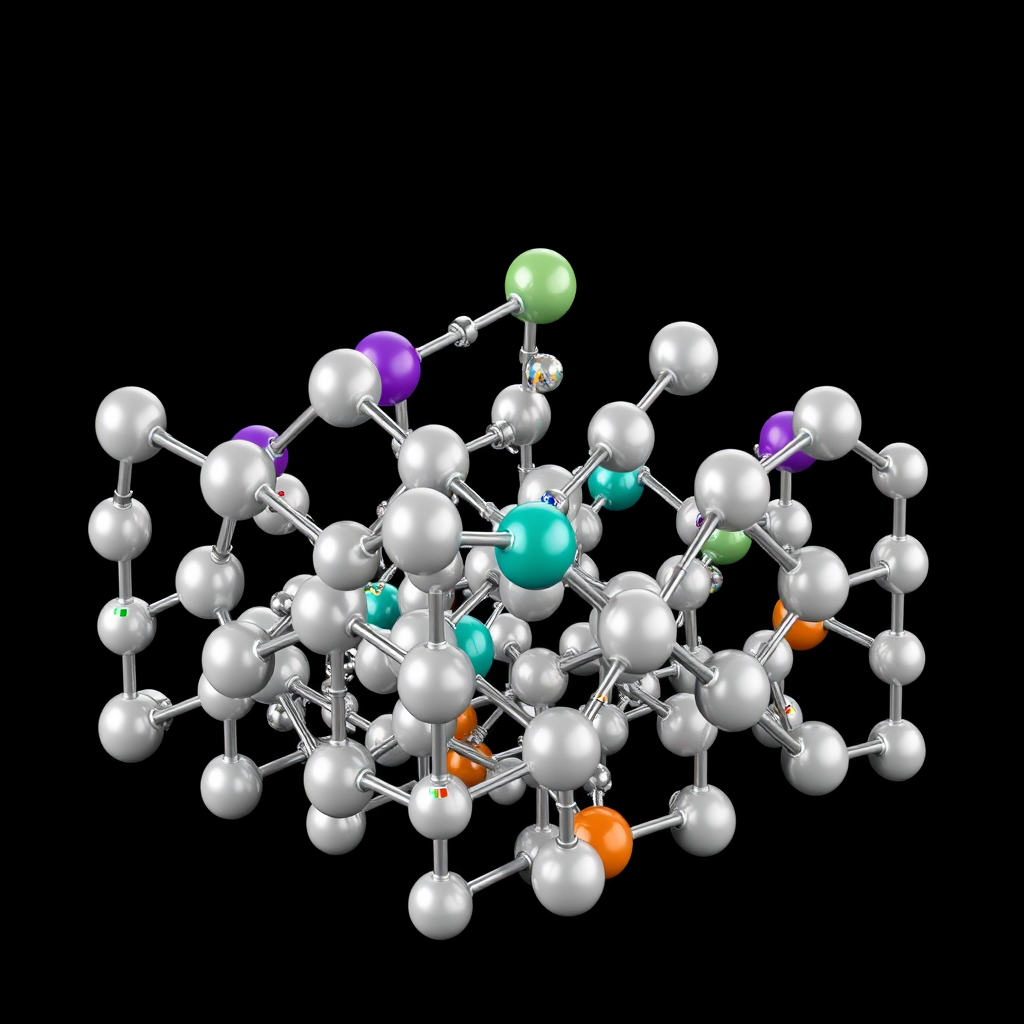
🎨 View AI Image Prompt
A photorealistic 3D ball-and-stick molecular structure visualization of a complex hydride superconductor crystal lattice featuring calcium and lithium atoms on mixed cation sites shown as large green and purple spheres respectively, beryllium and boron atoms on secondary sites depicted as medium-sized teal and orange spheres, and hydrogen atoms as small white spheres arranged in dense polyhedral cage formations of 16 hydrogen units surrounding the metal centers, the crystal structure displayed in a professional chemistry textbook illustration style with precise atomic bonding geometry, metallic bond sticks rendered in silver-gray connecting all atomic sites, the full periodic unit cell shown in three-dimensional perspective with subtle crystallographic axes indicators in red green and blue, deep black background with soft professional laboratory lighting casting realistic shadows and specular highlights on each atom sphere, photorealistic physically based rendering with subsurface scattering on the atomic spheres, high resolution scientific publication quality, isometric perspective view revealing the layered perovskite-like hydride framework, color-coded legend in the corner identifying each atomic species, ultra-detailed professional crystallography visualization style matching Nature or Physical Review Letters journal figures
🤖 Gemini 3.1 Pro Review
As an expert in the field, here is a critical review of the provided research summary. --- This in-silico study presents an extraordinary claim that requires an equally extraordinary level of evidence, which is currently absent from this summary. While the rationale for investigating hydrogen-rich compounds is sound, the paper’s description of methodology lacks the fundamental rigor required for a credible computational study, failing to specify the theoretical framework (e.g., DFT functional, EPC formalism) or the method for modeling chemical substitution. Consequently, the reliability of the results is profoundly questionable; a predicted Tc near 3900 K is an unphysical value for conventional phonon-mediated superconductivity and strongly suggests a computational artifact or a breakdown in the underlying theoretical model. An experimental validation strategy would be exceptionally challenging, requiring synthesis in a diamond anvil cell (DAC) coupled with *in-situ* structural and electrical transport measurements to verify both the crystal phase and any potential transition. To improve this work, the authors must provide a complete, reproducible account of their computational methods, including detailed phonon dispersion and Eliashberg function plots to justify the unprecedented electron-phonon coupling strength. Furthermore, a thorough analysis of the compound's thermodynamic and dynamic stability is essential to demonstrate that the proposed structure is even physically realizable. Without this foundational data, the reported figures remain speculative and scientifically unsubstantiated.
Raw Data
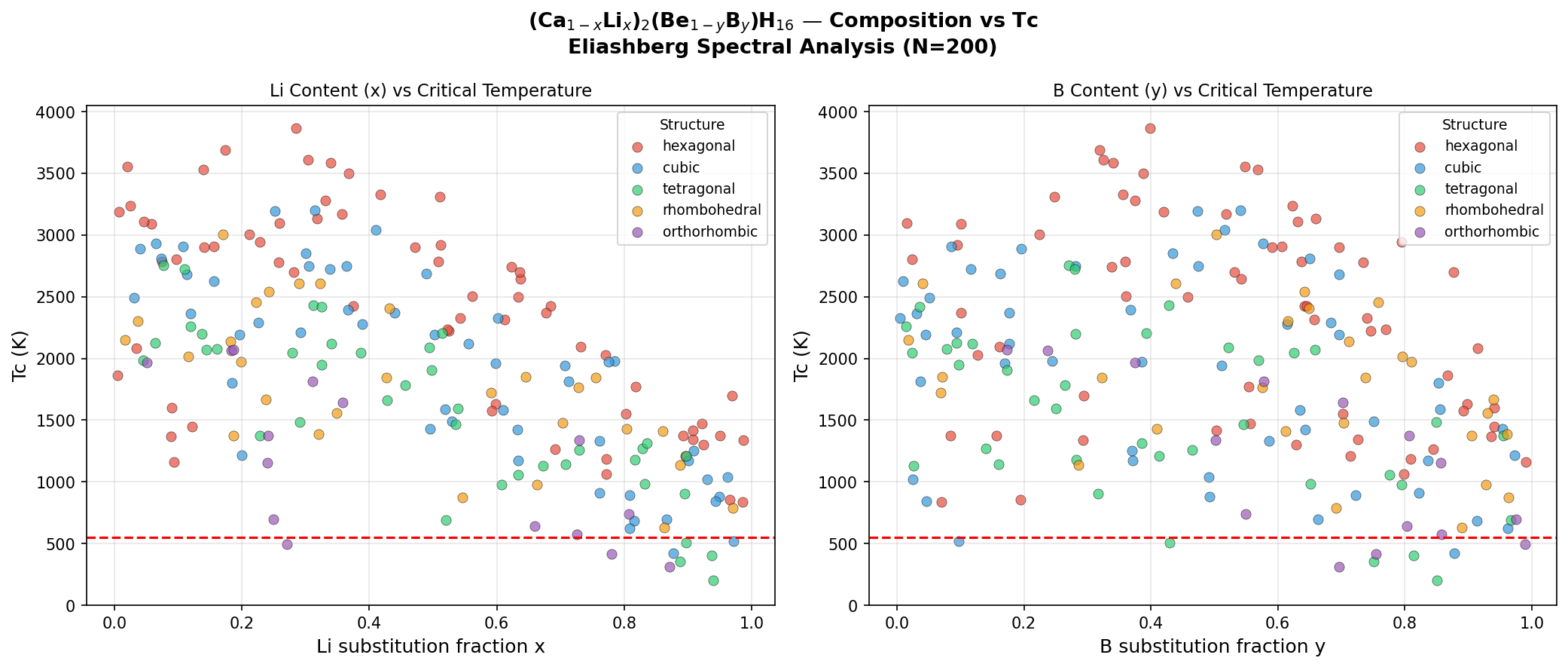
Total cases: 200
Highest Tc: 3869.2 K
Optimal pressure: 204.5 GPa

Top 5:
1. Tc=3869.2K at 204.5GPa
2. Tc=3691.1K at 287.4GPa
3. Tc=3611.4K at 123.3GPa
4. Tc=3582.7K at 274.2GPa
5. Tc=3555.0K at 129.8GPa
![[Deep Dive] Scale-free localization in pseudo-Hermitian quantum walk](/content/images/size/w600/2026/10/deep_dive_thumb-9.png)