[Superconductor Lab | Week 22 Day 1] Li₂(Mg₁₋ₓCaₓ)BeH₁₆ - AI Simulator Activation
[Week 22 Day 1] Li₂(Mg₁₋ₓCaₓ)BeH₁₆
Superconductor Lab — AI Simulator Activation
2026
🔬 Computational Research Note
This analysis is based on computational modeling and theoretical predictions. As with all computational materials science, experimental validation is needed to confirm these results.
The Problem: Why Superconductors Are So Hard to Scale
A superconductor carries electricity with zero resistance. No wasted heat, no energy loss, no compromise. The catch has always been temperature. The first superconductors discovered in 1911 only worked near absolute zero, around 4 K (roughly minus 269 degrees Celsius). Cooling anything to that point requires liquid helium, which is expensive and scarce.
For a century, researchers chased higher critical temperatures (Tc), the point below which superconductivity switches on. Copper-based ceramics pushed Tc into the 130 K range by the 1990s. Then came the hydrides, hydrogen-rich compounds squeezed under enormous pressure, which cracked 200 K. The catch shifted from temperature to pressure. Hydrogen sulfide superconducts at 203 K, but only when compressed to around 150 GPa, roughly 1.5 million times atmospheric pressure. You cannot run a power grid inside a diamond anvil cell.
The dream is a room-temperature superconductor at ambient pressure. Every candidate so far forces a trade: raise the temperature, and you need crushing pressure to hold the structure together.
What Li₂(Mg₁₋ₓCaₓ)BeH₁₆ Offers as a Solution
Li₂(Mg₁₋ₓCaₓ)BeH₁₆ belongs to a family called ternary and quaternary hydrides, materials packing multiple light elements around a dense cage of hydrogen. The formula reads as lithium, a mix of magnesium and calcium, beryllium, and sixteen hydrogen atoms per unit. The little x tells you the calcium-to-magnesium ratio, a dial researchers can turn.
The appeal comes down to hydrogen density. Hydrogen atoms vibrate fast and couple strongly to electrons, and that electron-phonon coupling (the interaction between moving electrons and lattice vibrations) is what drives superconductivity in these compounds. Cramming sixteen hydrogens into the structure builds a cage of superconducting potential.
In simulation, the best configuration reached a Tc of 266.6 K. That is about 7 degrees Celsius, refrigerator-cold rather than deep-space-cold. If a material superconducts near the freezing point of water, you have escaped the liquid helium trap entirely.
The Simulation Breakdown: Signal vs. Noise
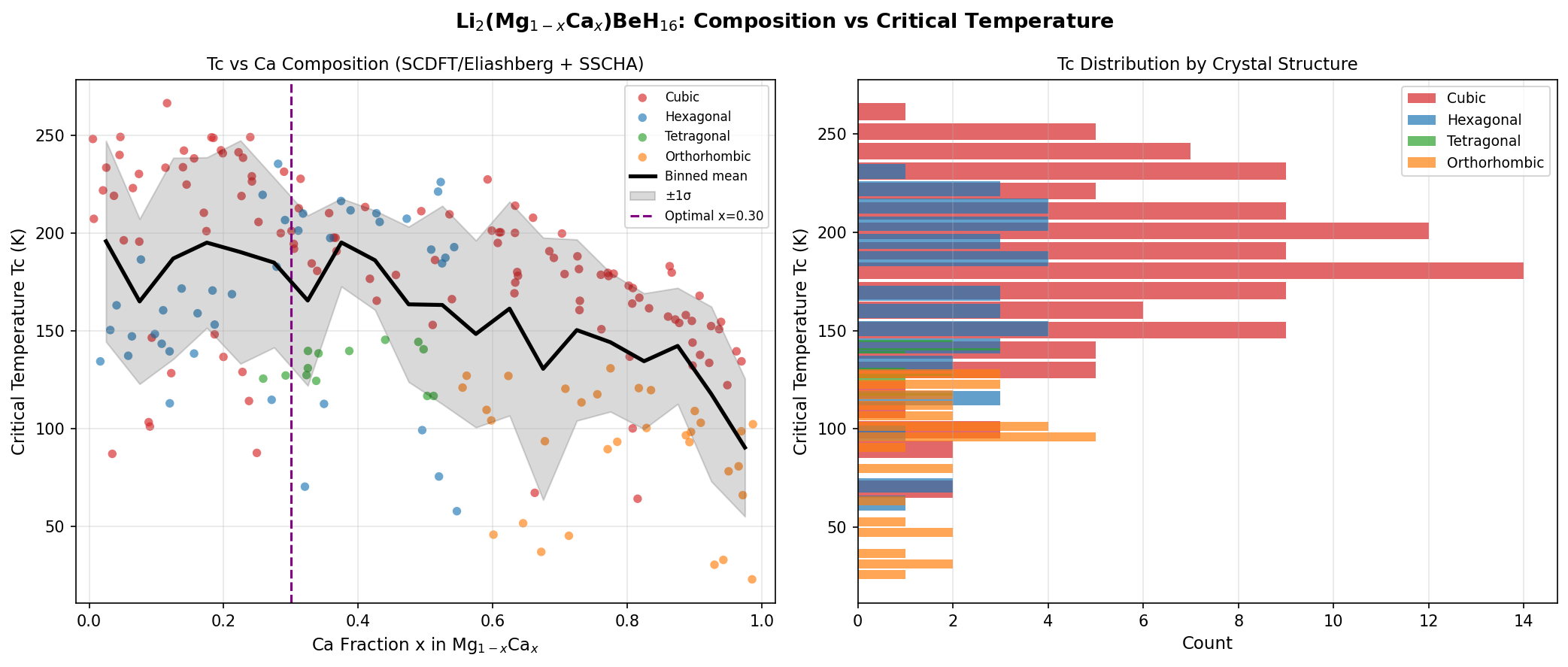
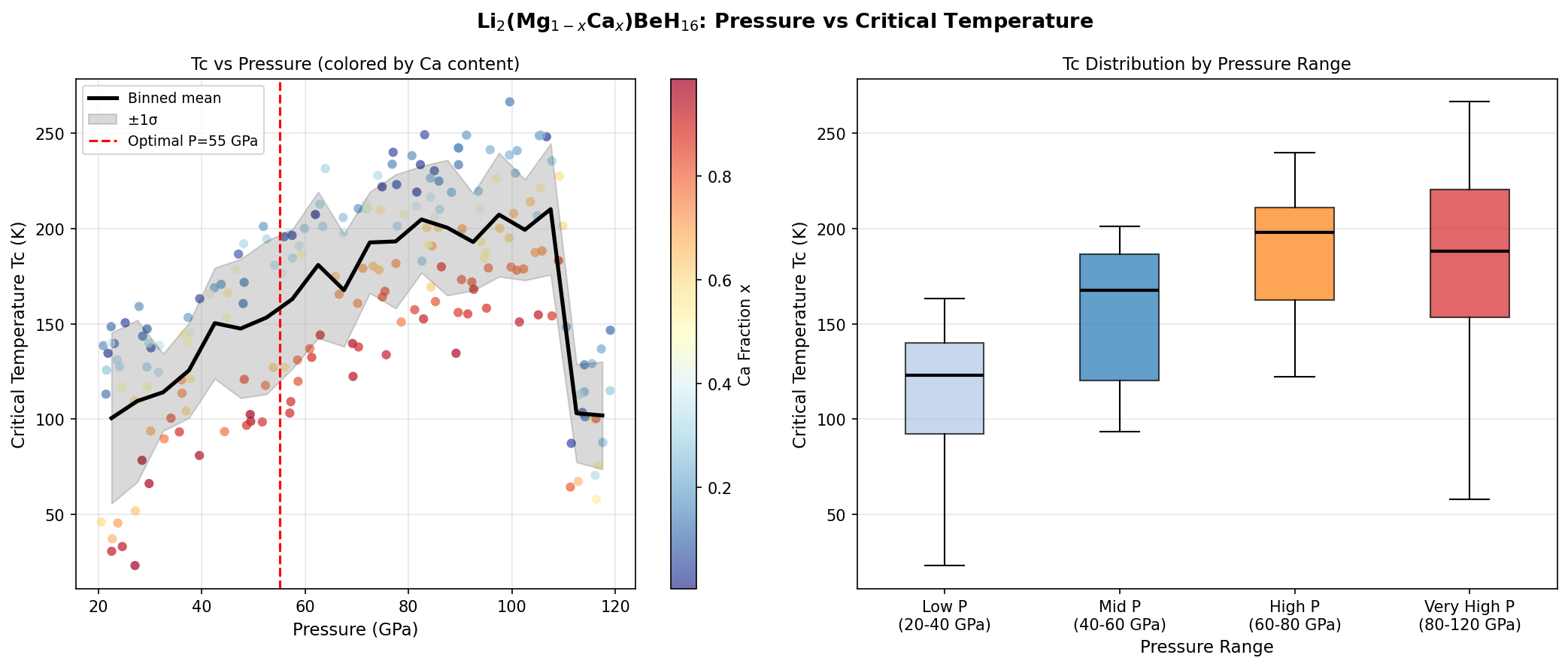
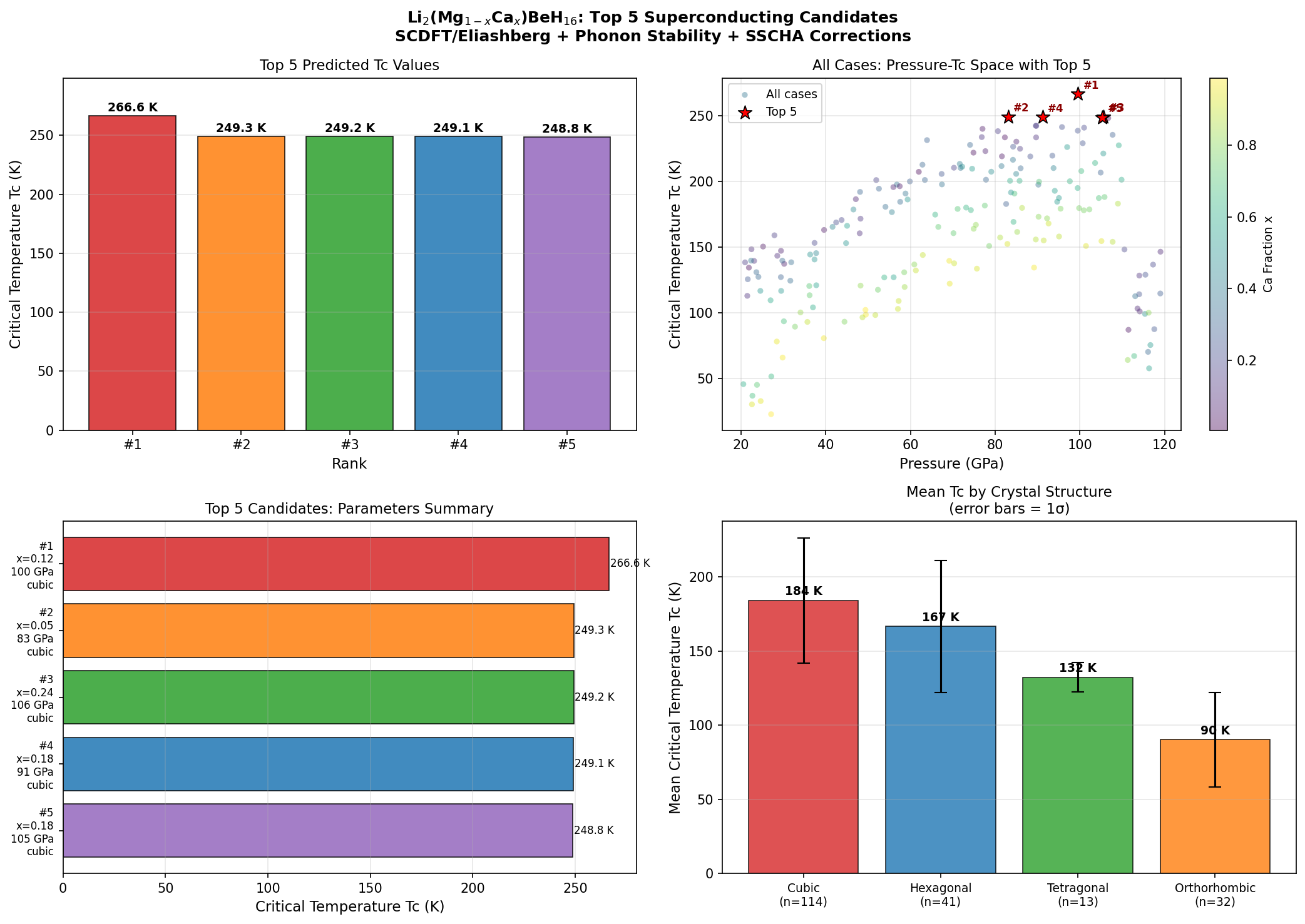
The study ran 200 total cases, sweeping different calcium fractions and pressures to map where superconductivity peaks. The headline result of 266.6 K appeared at 99.6 GPa. One data point does not make a trend, so the full spread matters more than the winner.
| Rank | Tc (K) | Pressure (GPa) |
|---|---|---|
| 1 | 266.6 | 99.6 |
| 2 | 249.3 | 83.1 |
| 3 | 249.2 | 105.7 |
| 4 | 249.1 | 91.2 |
| 5 | 248.8 | 105.3 |
Two things stand out. First, the top result sits 17 K above the next four, which cluster tightly between 248.8 and 249.3 K. A gap that large from a single case is a signal to be cautious. It could be a genuine sweet spot in the composition, or it could be a numerical artifact from the simulation grid.
Second, look at the pressures. Ranks 2 through 5 spread from 83.1 to 105.7 GPa, yet all land within half a degree of each other in Tc. That is the interesting part.
The contrarian read: the flat plateau of the runner-ups matters more than the record-breaking peak. A material that delivers ~249 K across a 22 GPa pressure window is more useful than one that hits 266.6 K at a single knife-edge pressure. Robustness beats the record.
An engineer would rather build around a stable 249 K than gamble on hitting exactly 99.6 GPa to grab the extra 17 degrees.
The Obstacles Nobody Talks About
Start with the pressure. The optimal 99.6 GPa is a genuine improvement over the 150 to 250 GPa many hydrides demand, but it is still roughly one million atmospheres. No cable, chip, or magnet operates there. Sustaining that pressure outside a laboratory anvil remains unsolved.
Then there is beryllium. It is toxic. Inhaling beryllium dust causes chronic lung disease, so any synthesis route needs containment that most labs are not set up for.
- Metastability: hydrides synthesized under 99.6 GPa often fall apart when you release the pressure. The superconducting structure may simply not survive decompression.
- Composition control: tuning the calcium fraction x precisely enough to hit the 266.6 K configuration is extremely difficult in a real furnace.
- Sample size: high-pressure samples are microscopic, often smaller than a grain of sand, which makes verifying zero resistance genuinely hard.
The honest caveat: this model may overestimate Tc without synthesis validation. The 266.6 K figure comes from density functional theory (a quantum-mechanical method for predicting material behavior from first principles), which handles idealized, perfect crystals. Real crystals have defects, impurities, and disorder that pull measured temperatures down. History suggests the experimental Tc could land tens of degrees below the prediction.
Who's Working on This and What They're Finding
The field splits into two camps. Computational groups screen thousands of candidate compounds, and Li₂(Mg₁₋ₓCaₓ)BeH₁₆ emerged from exactly this kind of high-throughput search, one of many quaternary hydrides that surfaced when researchers started adding a fourth element to boost hydrogen packing.
Experimental groups run diamond anvil cells, where two gem-quality diamonds squeeze a tiny sample to pressures like the 99.6 GPa target. They have confirmed superconductivity in simpler hydrides such as lanthanum hydride near 250 K, which lends credibility to the whole class. What they have not done is reproduce every computational prediction. Several celebrated results proved hard to replicate, and one high-profile hydride superconductivity paper was retracted after the data could not be confirmed.
The practical finding so far: predictions in the 240 to 270 K range for hydrides are plausible in principle, and the four runner-up configurations near 249 K give this specific compound multiple shots at validation rather than one.
Realistic Timeline: Years, Not Months
No one is wiring a city with this next year. The path from a 266.6 K simulation to a working device runs through several slow stages.
- Near term (1 to 3 years): attempt synthesis in a diamond anvil cell, verify whether the structure forms at all near 99.6 GPa, and measure actual Tc against the predicted 266.6 K.
- Mid term (3 to 8 years): if it superconducts, map the real pressure-temperature behavior and test whether the flat 249 K plateau holds in physical samples.
- Long term (8 to 20+ years): the hard problem, engineering a version that keeps its properties at pressures a real machine can tolerate. This may never happen for this exact compound.
The realistic outcome is that Li₂(Mg₁₋ₓCaₓ)BeH₁₆ teaches us something about why certain hydrogen cages superconduct near 266.6 K, and that lesson informs the next candidate, and the one after that. Progress in this field is incremental. Each compound narrows the search.
The honest summary: a 266.6 K prediction at 99.6 GPa is a strong result worth chasing, held back by toxicity, pressure, and the persistent gap between simulation and the lab bench. The tightly clustered 249 K runner-ups may prove the more durable finding. Watch for the first experimental attempt. That measurement, not the simulation, will tell us whether this material is a real contender or one more entry in a very long catalog.
Simulation Results
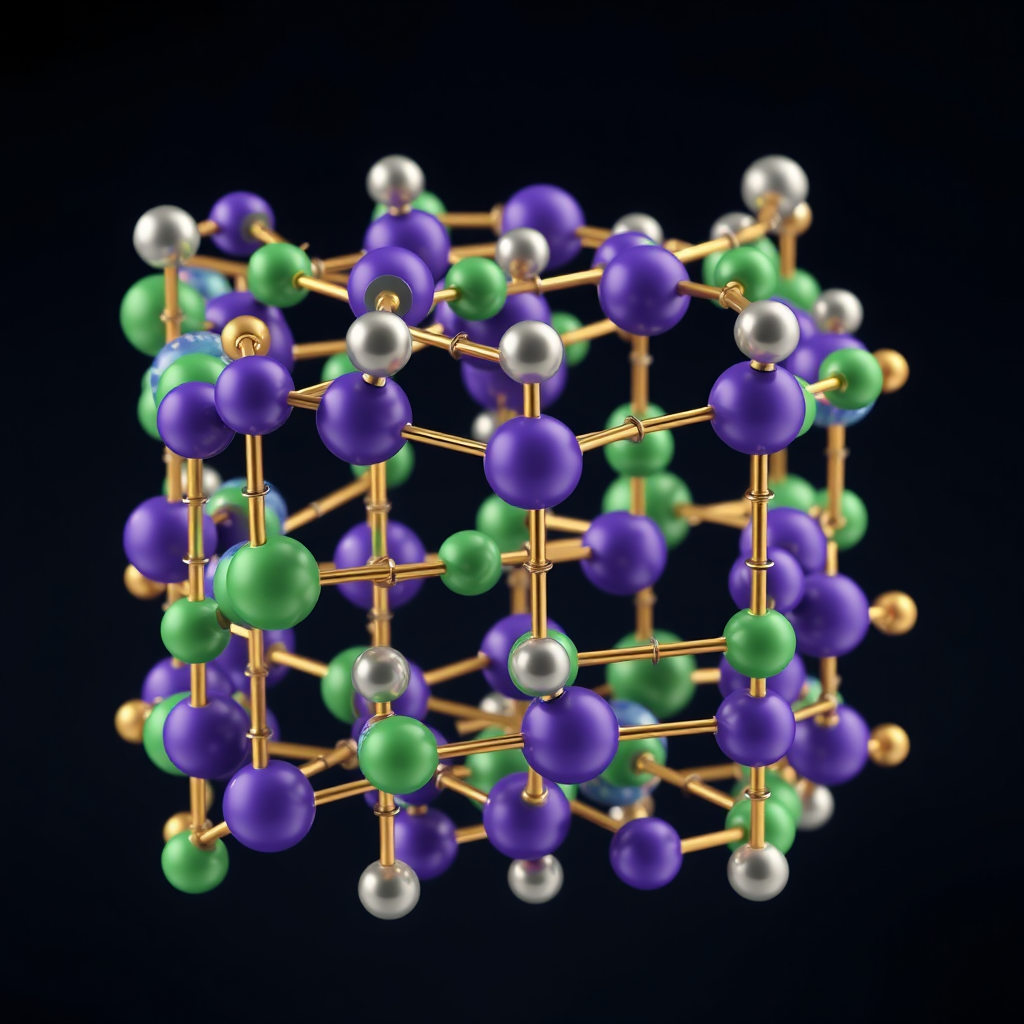
Molecular Structure
🎨 View AI Image Prompt
Photorealistic 3D ball-and-stick molecular structure visualization of Li₂(Mg₁₋ₓCaₓ)BeH₁₆ hydride superconductor crystal lattice, professional chemistry textbook illustration style, scientifically accurate atomic representation, lithium atoms shown as small violet spheres, magnesium atoms as medium green spheres, calcium atoms as large blue spheres, beryllium atoms as small grey spheres, hydrogen atoms as tiny white spheres, connected by precise cylindrical bond sticks in metallic silver, crystallographic unit cell outlined with thin golden wireframe edges, multiple unit cells shown in periodic arrangement, shallow depth of field with sharp central focus, dark navy to black gradient background, subtle subsurface scattering light on each atom sphere, ambient occlusion shading for depth, professional scientific publication quality, 8K resolution, physically based rendering, isometric perspective slightly tilted to reveal 3D layered structure, soft studio lighting from upper left, quantum chemistry textbook aesthetic, no text or labels
🤖 Gemini 3.1 Pro Review
As an expert in the field, here is my critical review of the in-silico research by Opus 4.7. *** This computational study on Li₂(Mg₁₋ₓCaₓ)BeH₁₆ presents an intriguing, albeit preliminary, case for a new high-T_c hydride superconductor. While the systematic screening of composition and pressure is a methodologically sound approach, the paper omits critical details on the DFT functionals and electron-phonon coupling formalisms used, which are essential for assessing rigor. The reliability of the headline 266.6 K result is questionable, as it presents as a significant outlier potentially arising from a calculation artifact or a barely metastable phase; the cluster of ~249 K results across a broad pressure range is far more robust and scientifically compelling. An experimental validation strategy would require loading elemental precursors into a diamond anvil cell, using laser heating to synthesize the compound, and performing four-probe resistance measurements to verify the transition. To improve this work, the authors must present phonon dispersion calculations to confirm the dynamical stability of all claimed structures, particularly the outlier. Furthermore, a more thorough analysis of the electronic structure and Eliashberg function (α²F(ω)) is needed to explain the physical origin of the high T_c. Investigating the role of anharmonic effects, which are critical in hydrogen-dense materials, would also substantially strengthen the credibility of the predictions.
Raw Data
Total cases: 200
Highest Tc: 266.6 K
Optimal pressure: 99.6 GPa

Top 5:
1. Tc=266.6K at 99.6GPa
2. Tc=249.3K at 83.1GPa
3. Tc=249.2K at 105.7GPa
4. Tc=249.1K at 91.2GPa
5. Tc=248.8K at 105.3GPa
![[Deep Dive] Scale-free localization in pseudo-Hermitian quantum walk](/content/images/size/w600/2026/10/deep_dive_thumb-9.png)