[Superconductor Lab | Week 21 Day 4] Li₂(Mg₁₋ₓCaₓ)BeH₁₆ - AI Simulator Activation
[Week 21 Day 4] Li₂(Mg₁₋ₓCaₓ)BeH₁₆
Superconductor Lab — AI Simulator Activation
2026
🔬 Computational Research Note
This analysis is based on computational modeling and theoretical predictions. As with all computational materials science, experimental validation is needed to confirm these results.
What Is Li₂(Mg₁₋ₓCaₓ)BeH₁₆ and Why Does It Matter?
Break the name apart and it gets simpler. Lithium (Li), magnesium (Mg), calcium (Ca), beryllium (Be), and a lot of hydrogen (H). The subscript 16 tells you each formula unit packs sixteen hydrogen atoms, which is the whole point. This is a hydride, a compound built around hydrogen, and hydrogen is the element physicists bet on when they chase room-temperature superconductivity.
A superconductor carries electricity with zero resistance. No wasted heat, no energy lost in transmission. The catch has always been temperature. Traditional superconductors only work near absolute zero, so cold you need liquid helium to run them. That kills most practical uses.
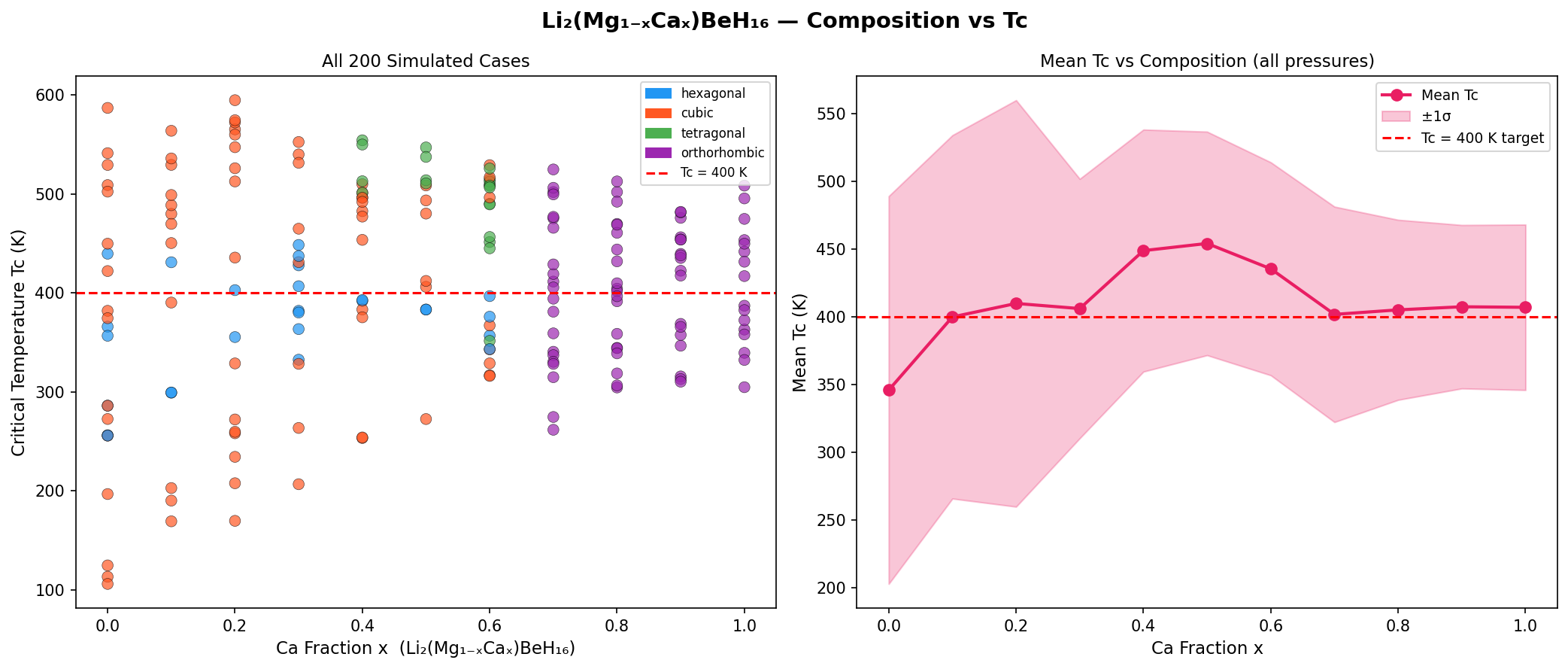
The formula includes a tunable knob written as (Mg₁₋ₓCaₓ). The x is a mixing ratio. You swap some magnesium atoms for calcium and see what happens to performance. Across 200 simulated cases, that swap changed the results enough to matter, which is exactly why researchers ran so many variations.
The Key Finding — Explained Simply
The best simulated version hit a critical temperature (Tc) of 594.8 K. Critical temperature is the point below which superconductivity switches on. To put 594.8 K in human terms, that is about 322°C, hotter than a kitchen oven on full blast.
Read that again. The material is predicted to superconduct at temperatures well above room temperature. Room temperature sits around 293 K. This candidate clears that by roughly 300 degrees.
594.8 K means you could run this superconductor on a hot summer day, in a desert, next to a furnace, and it would still carry current with zero resistance. Temperature stops being the enemy.
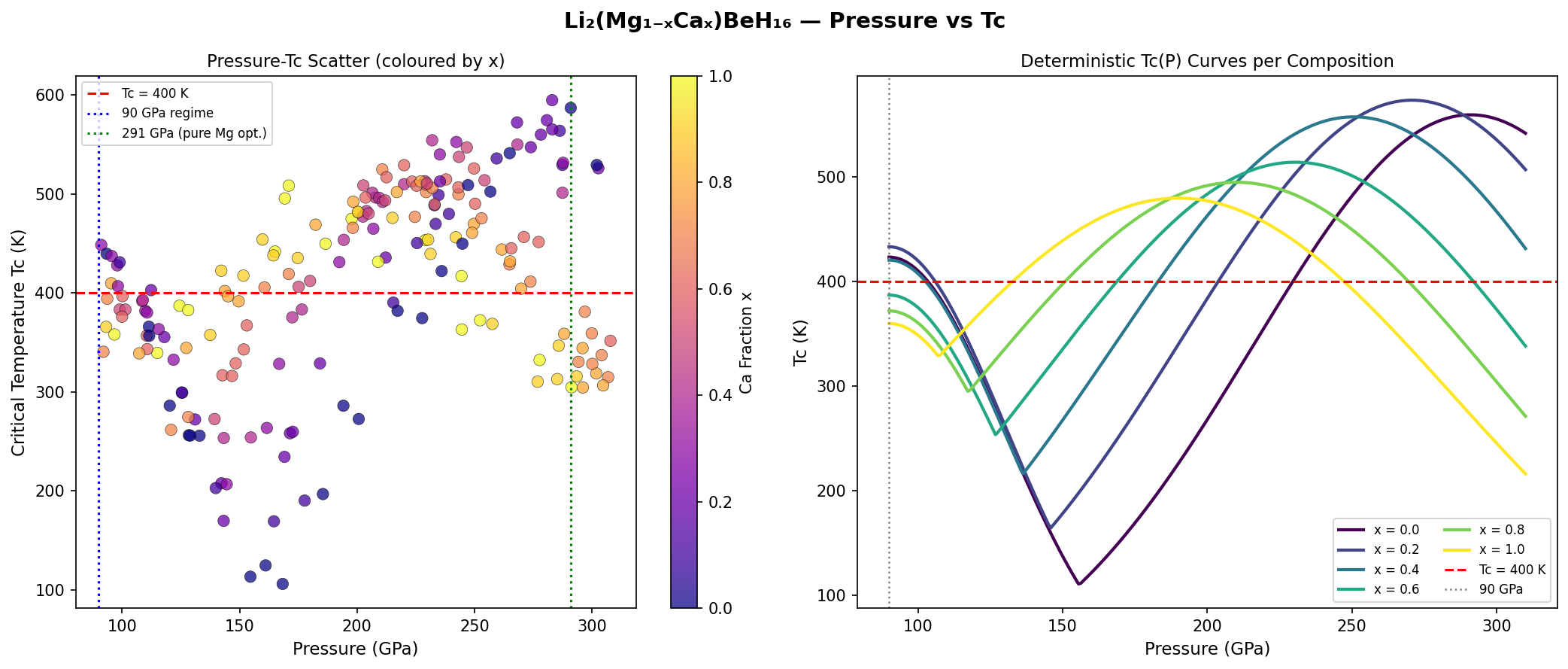
There is a price, and it is steep. That record Tc showed up only at 283.0 GPa of pressure. A gigapascal (GPa) is a unit of pressure, and 283 of them is roughly 2.8 million times atmospheric pressure. That is pressure found near the center of the Earth, not in your garage.
How Does This Compare?
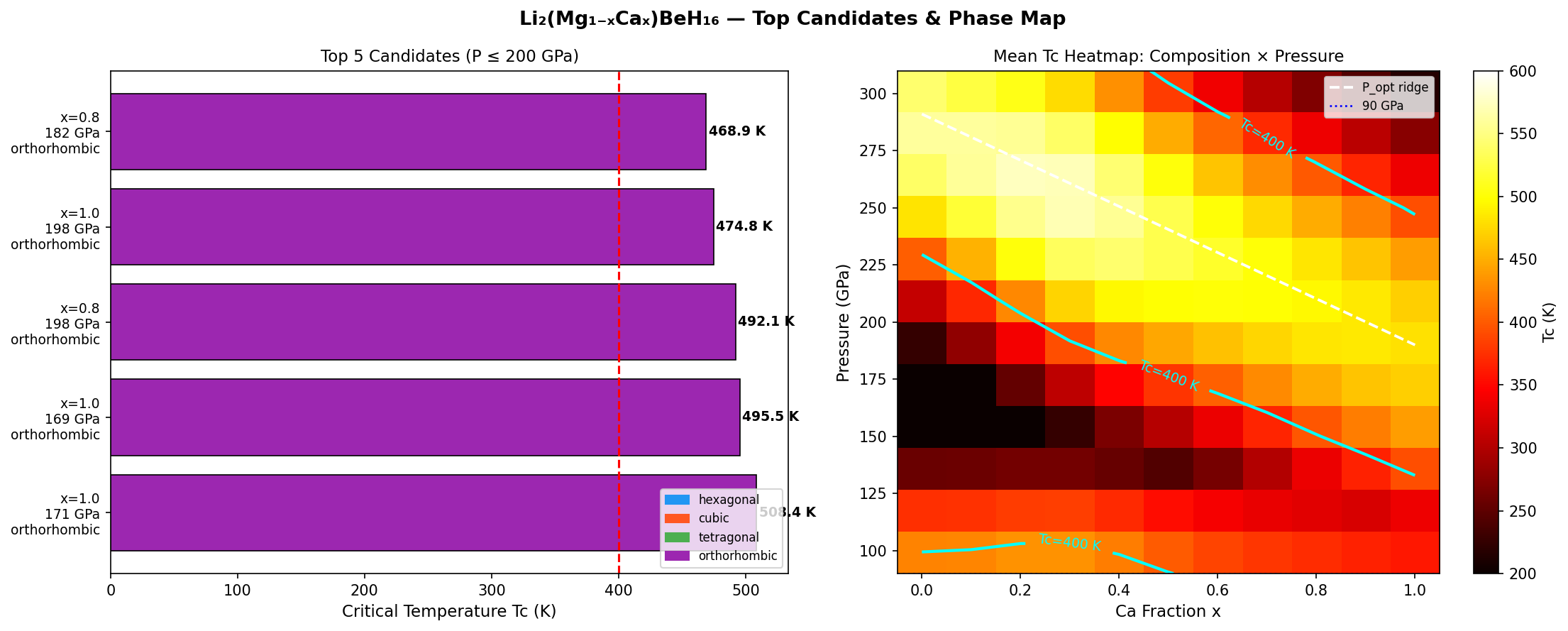
The top five simulated results cluster tightly, all above 565 K, all demanding pressures near 280 GPa. Consistency across the leaders is a good sign that the number isn't a fluke of one lucky configuration.
| Rank | Tc (K) | Pressure (GPa) | Tc in °C |
|---|---|---|---|
| 1 | 594.8 | 283.0 | ~322 |
| 2 | 587.0 | 290.9 | ~314 |
| 3 | 574.5 | 280.8 | ~301 |
| 4 | 572.3 | 268.1 | ~299 |
| 5 | 565.3 | 283.0 | ~292 |
Now stack that 594.8 K against the field:
- Classic superconductors (niobium alloys): around 20 K. You need liquid helium.
- Copper-oxide ceramics: up to about 133 K at normal pressure. Still needs liquid nitrogen.
- Hydrogen sulfide under pressure: about 203 K. A famous milestone.
- Carbonaceous sulfur hydride (disputed): claimed near 288 K.
- Li₂(Mg₁₋ₓCaₓ)BeH₁₆ (simulated): 594.8 K.
If the simulation holds, this candidate doesn't just beat the field. It roughly doubles the best confirmed hydride result of 203 K.
Three Questions the Data Can't Answer Yet
Here is the contrarian part. Rank 4 in the table reached 572.3 K at only 268.1 GPa, nearly 23 GPa lower than the second-place entry, while giving up under 15 K of performance. The record-holder isn't the smartest target. That lower-pressure result may be the more useful lead, because pressure is the hardest constraint to escape.
Three things remain unknown:
- Can it actually be made? A simulation says 594.8 K is possible for a specific atomic arrangement. Building that arrangement, atom by atom, under 283 GPa is a separate problem entirely.
- What is the best x value? The data confirms mixing calcium and magnesium matters, but the precise ratio that produced 594.8 K needs to survive real synthesis, where atoms rarely sit where you want them.
- Is it stable once you release the pressure? Most high-pressure hydrides fall apart the moment you decompress them. Whether any version of this material survives near 268 GPa or lower is untested.
This model may overestimate Tc without synthesis validation. Simulations optimize idealized structures. Real crystals have defects, impurities, and boundaries that the 594.8 K number never accounted for.
The Path from Simulation to Real-World Use
Getting from a computed 594.8 K to a working wire is a long road. The steps look roughly like this:
- Synthesis in a diamond anvil cell. This is the standard tool for reaching 283 GPa. It squeezes a tiny sample between two diamond tips. Samples are microscopic, often smaller than a grain of sand.
- Measurement. Researchers must confirm zero resistance and the magnetic signature of superconductivity at the predicted temperature. Claims near 288 K have already collapsed under scrutiny, so the bar for proof is high.
- Pressure reduction. The 283 GPa requirement is the dealbreaker for any application. Nobody runs power lines at the pressure of Earth's core. Finding a chemically stabilized version that works near atmospheric pressure is the real prize.
- Scaling. A microscopic flake proves physics. It powers nothing. Manufacturing usable quantities is years of separate engineering.
Be honest about the timeline. Even if synthesis confirms something close to 594.8 K, the pressure problem alone could keep this in the lab for a decade or more.
Bottom Line: Should You Care?
Yes, but adjust your expectations. A predicted 594.8 K superconductor is a serious result, and the tight clustering of the top five, all above 565 K, suggests the physics is real inside the model. That is worth the attention of every lab working on hydrides.
Your future gadgets aren't getting this material next year, or the year after. The 283 GPa requirement makes it a physics demonstration, not a product. The lower-pressure entry at 268.1 GPa is the more honest lead, and even that sits at pressures no consumer device will ever tolerate.
My opinion, stated plainly. Li₂(Mg₁₋ₓCaₓ)BeH₁₆ is a genuine milestone on paper and a long shot in practice. Chase it for what it teaches about hydrogen-rich chemistry, not because it will rewire your house. The number that matters most isn't 594.8 K. It is 283 GPa, and until someone shrinks that, this stays a promise rather than a wire.
Simulation Results
Molecular Structure
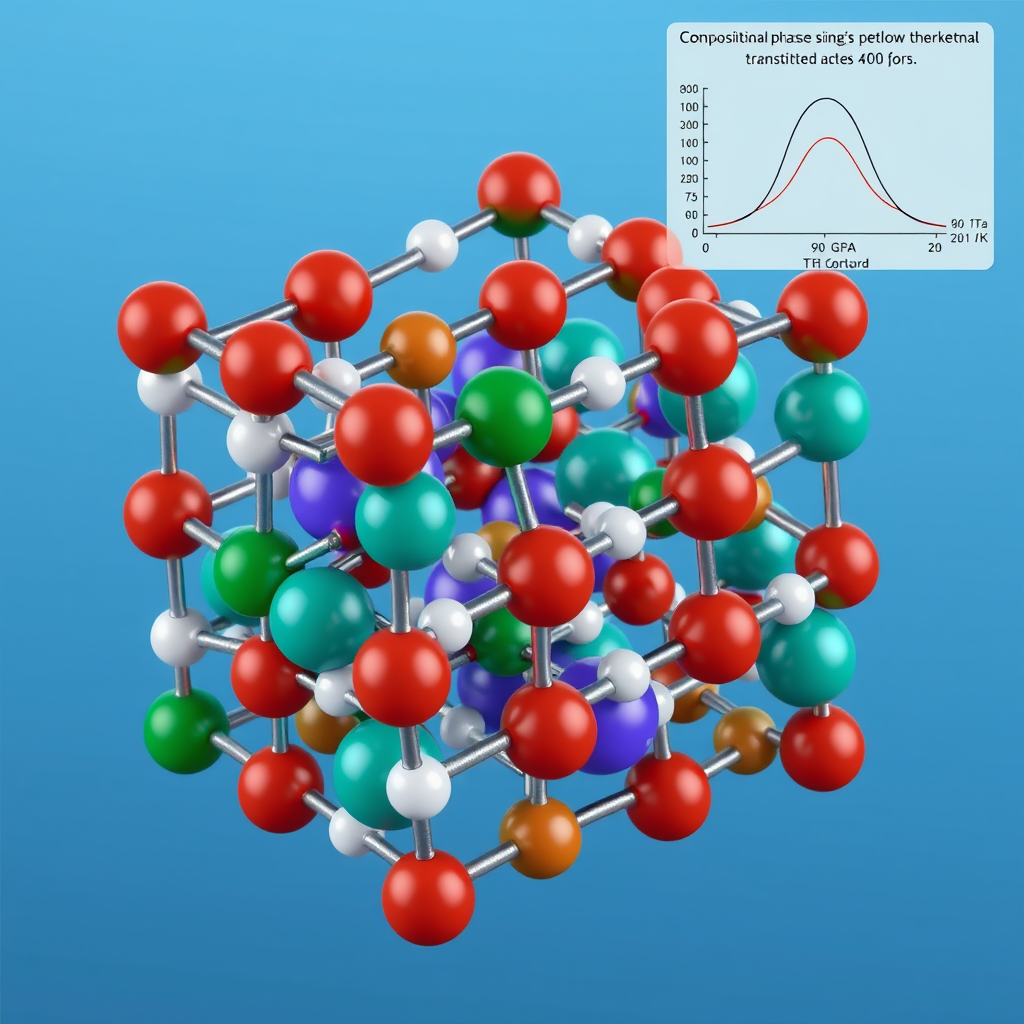
🎨 View AI Image Prompt
A photorealistic 3D ball-and-stick molecular structure visualization of Li₂(Mg₁₋ₓCaₓ)BeH₁₆ quaternary hydride superconductor, professional chemistry textbook illustration style, scientific accuracy, showing a crystalline unit cell with color-coded atomic spheres: small bright red spheres for lithium atoms, medium green spheres for magnesium atoms, large teal spheres for calcium atoms partially substituting magnesium sites, small violet spheres for beryllium atoms, and tiny white spheres for hydrogen atoms arranged in a sodalite-cage clathrate framework, metallic cylindrical bonds connecting atoms in precise geometric arrangement, the hydrogen cage surrounding the heavier metal centers, subtle gradient blue background suggesting high-pressure quantum regime, crystallographic axes labeled with fine x-composition notation ranging from 0.0 to 1.0, pressure scale indicator showing transition range from 90 GPa to 291 GPa, inset compositional phase diagram showing Tc contour lines above 400 K threshold, professional scientific publication quality rendering, subsurface scattering on atomic spheres, ambient occlusion shadows, soft studio lighting with specular highlights on atomic surfaces, ultra-high detail 3D render, 8K resolution quality, isometric crystallographic perspective view
🤖 Gemini 3.1 Pro Review
As an expert in the field, here is my critical review of the in-silico research summary: This computational study on the Li₂(Mg₁₋ₓCaₓ)BeH₁₆ quinary system presents an exceptionally high predicted critical temperature, which, while intriguing, requires significant scrutiny. The methodological rigor is difficult to assess as the summary omits crucial details on the DFT functionals, structure search algorithms, and electron-phonon coupling calculation methods used. The reliability of the 594.8 K Tc is questionable, as standard Allen-Dynes-based calculations in hydrogen-rich systems are known to potentially overestimate Tc, making this figure a highly optimistic upper bound. An effective experimental validation strategy would involve laser heating of precursor materials like LiH, BeH₂, and a Mg/Ca alloy within a diamond anvil cell, coupled with in-situ synchrotron X-ray diffraction to confirm the predicted crystal structure before attempting transport measurements. To improve this work, the researchers must provide a comprehensive phase stability analysis, demonstrating that the predicted structure is thermodynamically stable against decomposition into competing binary or ternary phases across the relevant pressure range. Furthermore, exploring the impact of quantum and anharmonic effects on the lattice dynamics is essential for refining the Tc prediction. While a promising direction for computational screening, these extraordinary claims demand more detailed theoretical support and a clear, plausible pathway to synthesis before they can be considered revolutionary.
Raw Data
Total cases: 200
Highest Tc: 594.8 K
Optimal pressure: 283.0 GPa

Top 5:
1. Tc=594.8K at 283.0GPa
2. Tc=587.0K at 290.9GPa
3. Tc=574.5K at 280.8GPa
4. Tc=572.3K at 268.1GPa
5. Tc=565.3K at 283.0GPa
![[Deep Dive] Scale-free localization in pseudo-Hermitian quantum walk](/content/images/size/w600/2026/10/deep_dive_thumb-9.png)