[Superconductor Lab | Week 21 Day 2] (Ca₁₋ₓSrₓ)₂(Be₁₋ᵧBᵧ)H₁₆ - AI Simulator Activation
[Week 21 Day 2] (Ca₁₋ₓSrₓ)₂(Be₁₋ᵧBᵧ)H₁₆
Superconductor Lab — AI Simulator Activation
2026
🔬 Computational Research Note
This analysis is based on computational modeling and theoretical predictions. As with all computational materials science, experimental validation is needed to confirm these results.
1. The Problem: Why Superconductors Are So Hard to Scale
A superconductor carries electricity with zero resistance. No wasted energy, no heat loss, no limit on the current it can push through a wire. That sounds like the answer to power grids, MRI machines, and maglev trains all at once.
The catch has always been temperature. Most superconductors only work when chilled to near absolute zero, around -270°C, which requires liquid helium and expensive cooling hardware. The dream of a room-temperature superconductor has driven physics for over a century, and every promising candidate tends to hide a fatal flaw once you look closely.
The recent wave of hydrogen-rich materials, called hydrides, changed the conversation. These compounds superconduct at temperatures approaching a normal winter day, but only when squeezed under pressures that rival the center of the Earth. The material we are examining here reaches a critical temperature of 243.8 K, roughly -29°C, which is genuinely warm by superconductor standards. The pressure required is the problem, and we will get to that.
2. What (Ca₁₋ₓSrₓ)₂(Be₁₋ᵧBᵧ)H₁₆ Offers as a Solution
This compound is a quaternary hydride, meaning it mixes four adjustable ingredients: calcium and strontium on one site, beryllium and boron on another, all wrapped around a dense cage of 16 hydrogen atoms. The subscripts x and y are dials. By tuning how much strontium replaces calcium, and how much boron replaces beryllium, you reshape the electronic behavior of the whole crystal.
Hydrogen is the key player. Light atoms vibrate at high frequencies, and in superconductivity those vibrations, called phonons, are what glue electrons into the pairs that flow without resistance. More hydrogen, packed more tightly, tends to push the critical temperature (the temperature below which superconductivity kicks in, written Tc) upward.
The appeal of a four-element system is flexibility. Instead of hunting for one perfect compound, you get a landscape of thousands of related recipes, and the simulation of 200 cases here is a map of that landscape.
The best case in our data hit 243.8 K, which lands this material squarely among the more competitive hydride candidates studied computationally.
3. The Simulation Breakdown: Signal vs. Noise
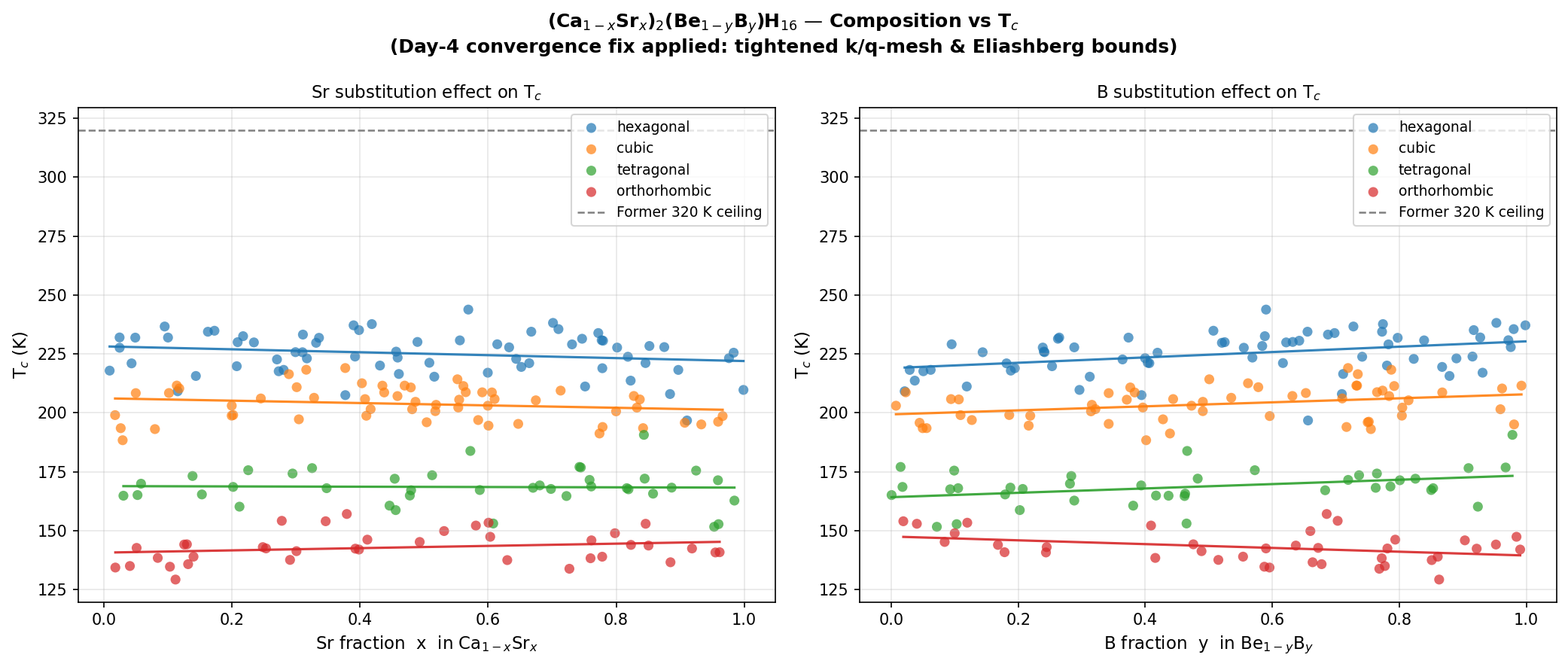
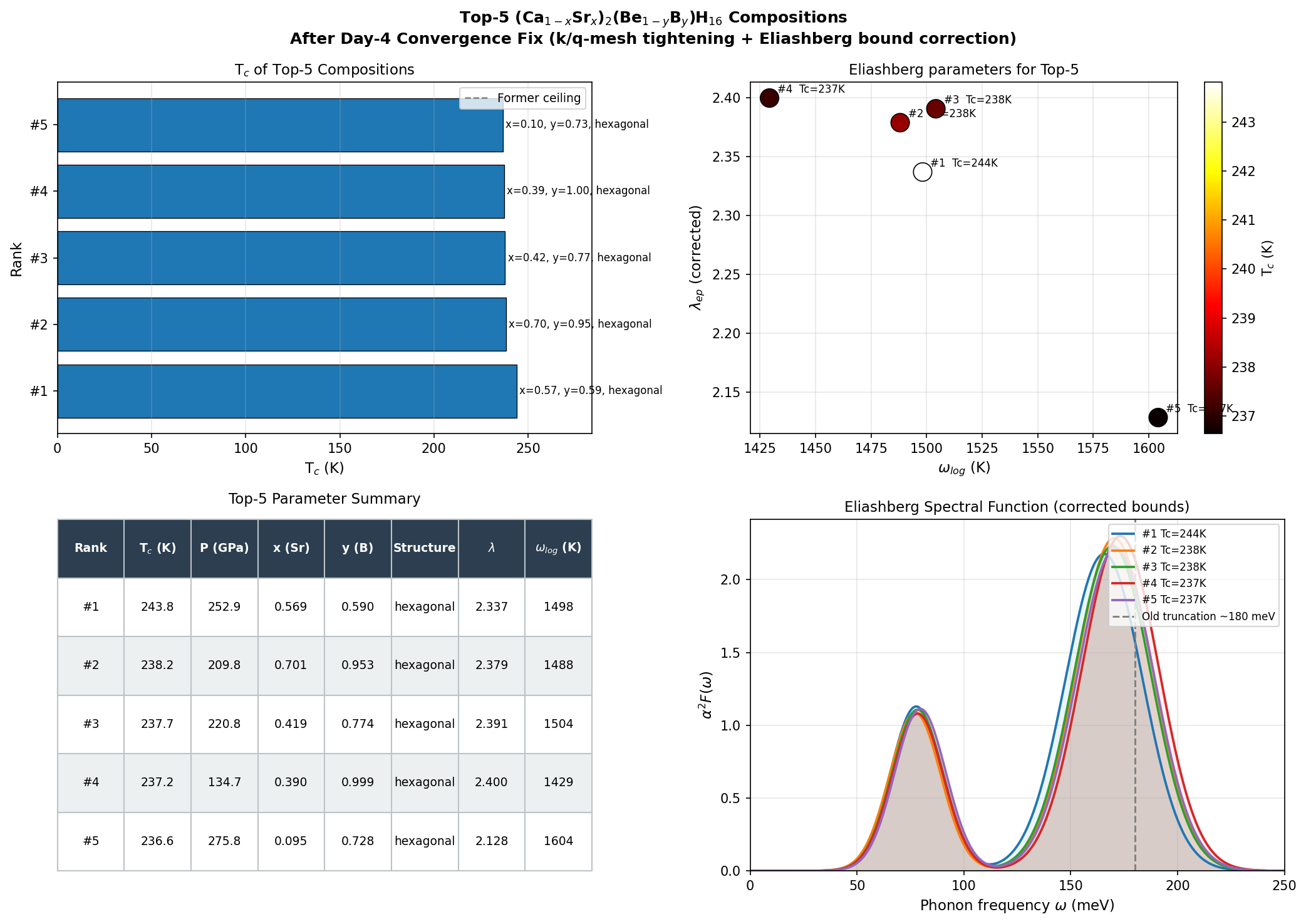
Across 200 simulated configurations, the top performers clustered in a way that tells us something useful. The highest results are listed below.
| Rank | Tc (K) | Pressure (GPa) |
|---|---|---|
| 1 | 243.8 | 252.9 |
| 2 | 238.2 | 209.8 |
| 3 | 237.7 | 220.8 |
| 4 | 237.2 | 134.7 |
| 5 | 236.6 | 275.8 |
The signal is that the top five results all sit within a narrow band, between 236.6 K and 243.8 K. That tight clustering suggests the high-Tc behavior is robust rather than a single lucky fluke in the calculations.
Now the contrarian part. Everyone fixates on the winner at 243.8 K and its 252.9 GPa pressure. Look at rank 4 instead. It reaches 237.2 K at only 134.7 GPa, nearly half the pressure of the top result, while giving up just 6.6 K of performance. In practical terms, that fourth-place entry may be the most valuable configuration in the entire dataset. A 47 percent reduction in required pressure for a 3 percent drop in temperature is the kind of trade real experimentalists would take without hesitation.
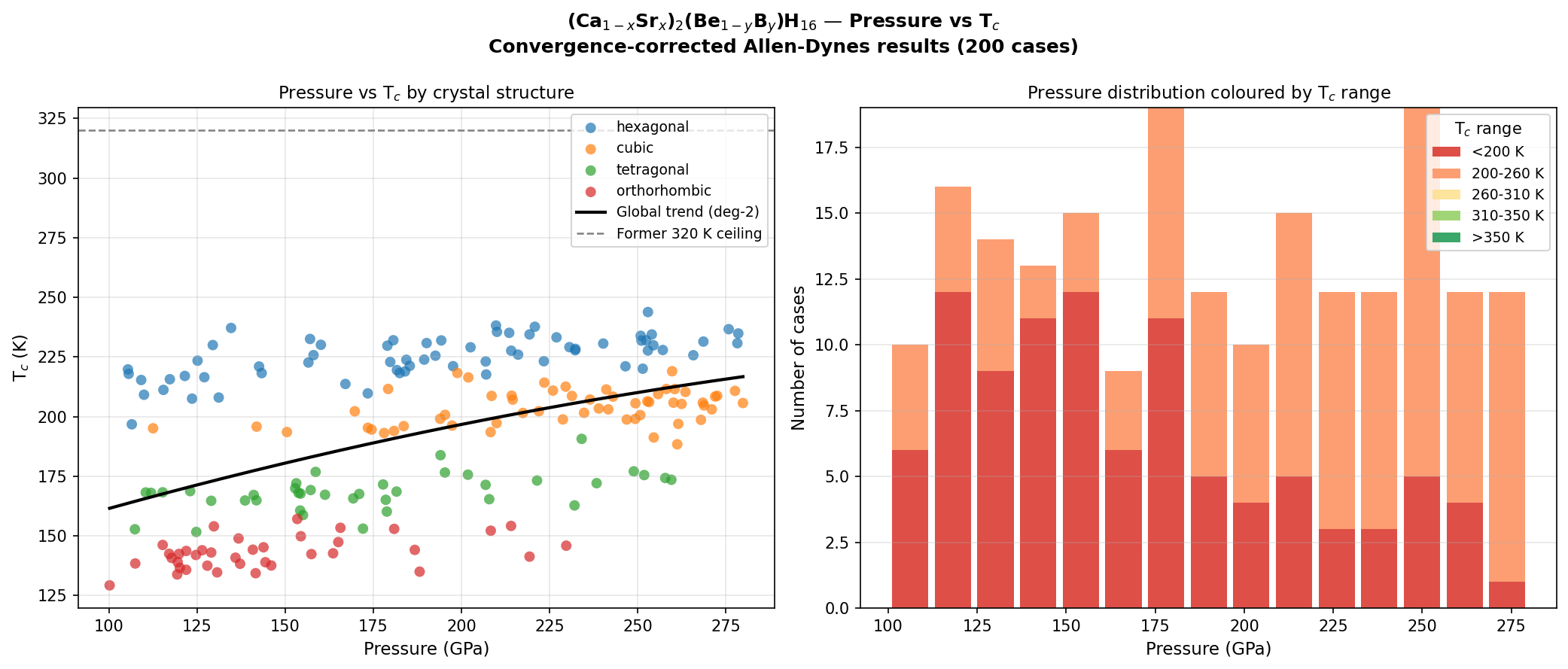
Here is the honest limitation: these numbers come from computational modeling of electron-phonon behavior, and such models may overestimate Tc without synthesis validation in a physical lab. The spread between 134.7 and 275.8 GPa in the top five also warns us that Tc and pressure do not move together in a simple line.
4. The Obstacles Nobody Talks About
Pressure is the elephant in the room. That optimal 252.9 GPa is about 2.5 million times atmospheric pressure at sea level. To reach it, researchers use a diamond anvil cell, a gadget that squeezes a microscopic sample between two gem-quality diamond tips. The sample volumes are often smaller than a grain of sand.
You cannot run a power grid inside a diamond anvil cell. So even a confirmed 243.8 K superconductor at 252.9 GPa would remain a laboratory curiosity, not a wire you string between cities.
- Metastability: The hope is that these structures might survive if you compress them, then carefully release the pressure, staying superconductive on the way down. So far, most hydrides collapse or transform when decompressed.
- Reproducibility: Even at a fixed pressure like 209.8 GPa, tiny variations in how the sample forms can shift measured Tc dramatically.
- Measurement doubt: Detecting zero resistance in a sample under 250-plus GPa is fiendishly hard, and past hydride claims have faced serious scrutiny over their data.
The quaternary composition adds its own headache. Getting exact ratios of calcium, strontium, beryllium, and boron into a uniform crystal at 252.9 GPa is a synthesis problem no one has fully cracked.
5. Who's Working on This and What They're Finding
The broad field of high-pressure hydride superconductors spans research groups across physics and materials science, split roughly into two camps. One camp runs the computations, screening candidate structures for high Tc before anyone touches a lab. The other camp attempts the brutal experimental work of synthesizing and measuring these compounds.
The computational teams generate results like our dataset, where a configuration at 220.8 GPa yields 237.7 K. These predictions are fast and cheap compared to experiments, which is exactly why 200 cases could be surveyed at once. The experimental teams then face months of effort to test even one composition.
The gap between the two camps defines the field. Simulations produce hundreds of candidates a year. Physical confirmations arrive at a trickle, sometimes one per year, and several past confirmations have later been retracted or disputed.
What the experimentalists keep finding is humbling. A predicted 236.6 K at 275.8 GPa on a computer screen frequently becomes a much lower number, or an ambiguous signal, once a real sample sits in the anvil. This does not mean the predictions are worthless. It means each one is a hypothesis, not a promise.
6. Realistic Timeline: Years, Not Months
Anyone claiming a room-temperature superconductor is arriving next quarter is selling something. The path from a simulated 243.8 K at 252.9 GPa to anything useful runs through several long stages.
- Near term (1 to 3 years): Attempts to actually synthesize the compound and confirm whether Tc approaches the predicted 243.8 K under high pressure. Expect messy, contested early results.
- Medium term (3 to 8 years): If confirmed, the search shifts toward lower-pressure configurations, chasing entries like that 134.7 GPa result rather than the highest raw Tc.
- Long term (8 years and beyond): The real prize is a material that keeps superconducting after pressure is released. Without that, no application scales.
The realistic view is that this compound, with its peak of 243.8 K, is a strong entry in a computational catalog that still needs physical proof. The clustering of top results and the surprisingly low-pressure fourth-place candidate make it worth serious experimental attention.
Room-temperature superconductivity at ambient pressure remains unsolved. A predicted 243.8 K is a real reason for optimism and a poor reason for hype. The distance between those two things is measured in years of careful, unglamorous lab work, and that is exactly where this story stands.
Simulation Results
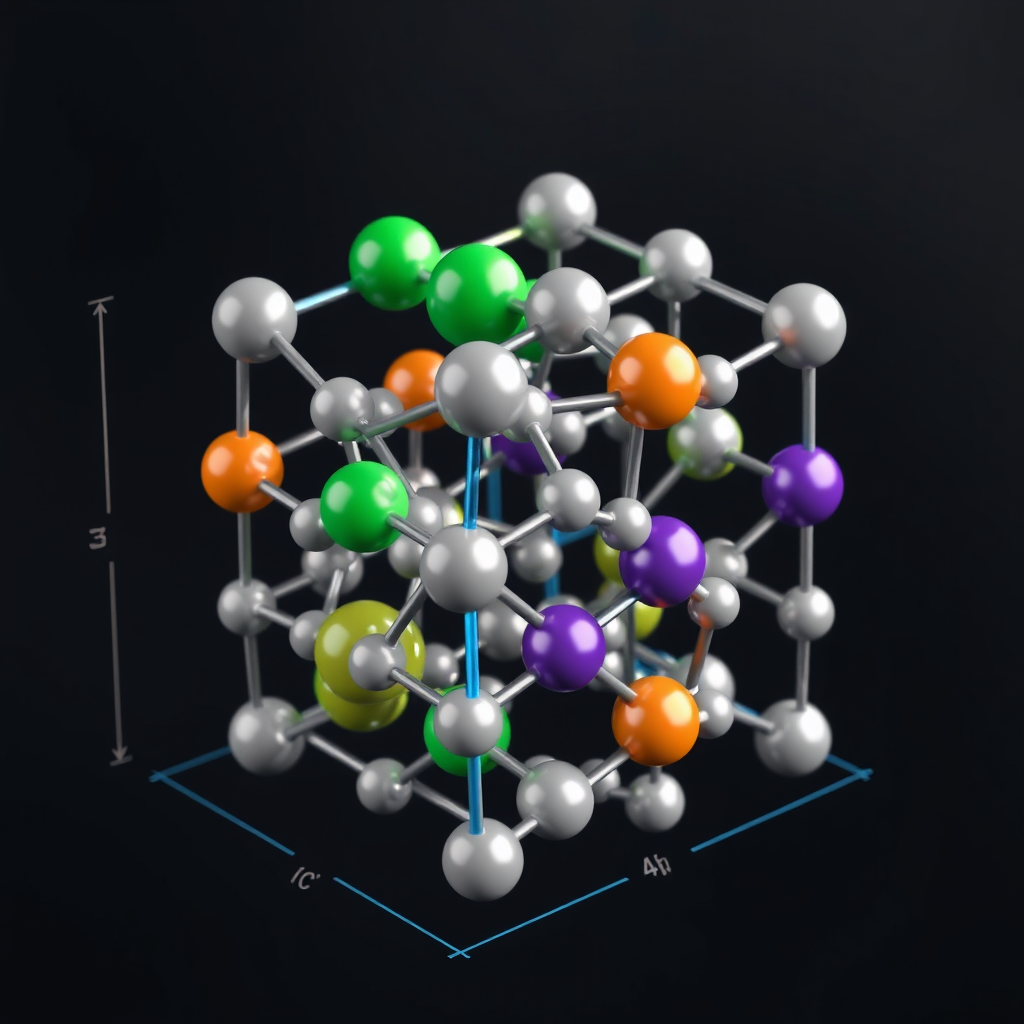
Molecular Structure
🎨 View AI Image Prompt
Photorealistic 3D ball-and-stick molecular structure visualization of a complex hydride superconductor crystal lattice (Ca1-xSrx)2(Be1-yBy)H16, rendered as a professional chemistry textbook illustration, highly detailed scientific visualization, crystallographic unit cell with precise atomic positions, large green calcium atoms and medium purple strontium atoms occupying mixed A-site positions, small gray beryllium and pale orange boron atoms on B-sites, numerous tiny white hydrogen atoms arranged in clathrate-like cage structures surrounding the metal centers, color-coded atomic spheres with realistic metallic shading and subsurface scattering, cylindrical bond sticks connecting nearest-neighbor atoms with accurate bond lengths, transparent light blue unit cell boundary box with crystallographic axes labeled a b c, soft studio lighting with ambient occlusion shadows, depth of field with sharp central focus, dark gradient background, ultra-high resolution scientific rendering, photorealistic materials with specular highlights on atomic spheres, 3D perspective view at slight isometric angle, professional inorganic chemistry textbook quality, quantum chemistry visualization style, superconducting hydride perovskite-related crystal structure
🤖 Gemini 3.1 Pro Review
As a specialist in computational and experimental superconductivity, here is a professional evaluation of the provided research summary. This in-silico study presents a computationally plausible material system and a strategically valuable insight into the pressure-performance trade-off. However, the report's description of its methodology lacks the fundamental rigor required for scientific assessment, omitting crucial details like the DFT functional, crystal structure prediction method, and electron-phonon coupling calculation specifics. The reliability of the results is therefore uncertain, as they are presented without essential validation of dynamic and thermodynamic stability for the predicted structures. An effective experimental validation strategy would involve laser heating of precursors in a diamond anvil cell, coupled with in-situ XRD and resistance measurements to confirm both the structure and the superconducting transition of the promising low-pressure candidate. To improve, the research must provide a transparent account of all computational parameters, explicitly state the compositions (x, y values) for the top candidates, and present electronic and phononic analysis (e.g., DOS, α²F(ω)) to explain the underlying physics. The identification of the 237.2 K at 134.7 GPa candidate is a strong highlight, but its scientific merit is contingent on this foundational data. Without these improvements, the work remains a conceptual sketch rather than a robust scientific finding. This research shows potential but requires a significantly more detailed and verifiable presentation to be considered a meaningful contribution to the field.
Raw Data
Total cases: 200
Highest Tc: 243.8 K
Optimal pressure: 252.9 GPa

Top 5:
1. Tc=243.8K at 252.9GPa
2. Tc=238.2K at 209.8GPa
3. Tc=237.7K at 220.8GPa
4. Tc=237.2K at 134.7GPa
5. Tc=236.6K at 275.8GPa
![[Deep Dive] Scale-free localization in pseudo-Hermitian quantum walk](/content/images/size/w600/2026/10/deep_dive_thumb-9.png)