[Superconductor Lab | Week 21 Day 1] Li₂MgBeH₁₆ - AI Simulator Activation
[Week 21 Day 1] Li₂MgBeH₁₆
Superconductor Lab — AI Simulator Activation
2026
🔬 Computational Research Note
This analysis is based on computational modeling and theoretical predictions. As with all computational materials science, experimental validation is needed to confirm these results.
1. What Is Li₂MgBeH₁₆ and Why Does It Matter?
Li₂MgBeH₁₆ is a hydride, a compound built mostly from hydrogen atoms locked around a scaffold of heavier elements. In this case the scaffold is lithium, magnesium, and beryllium, with a remarkable sixteen hydrogen atoms per formula unit. That hydrogen count is the whole point.
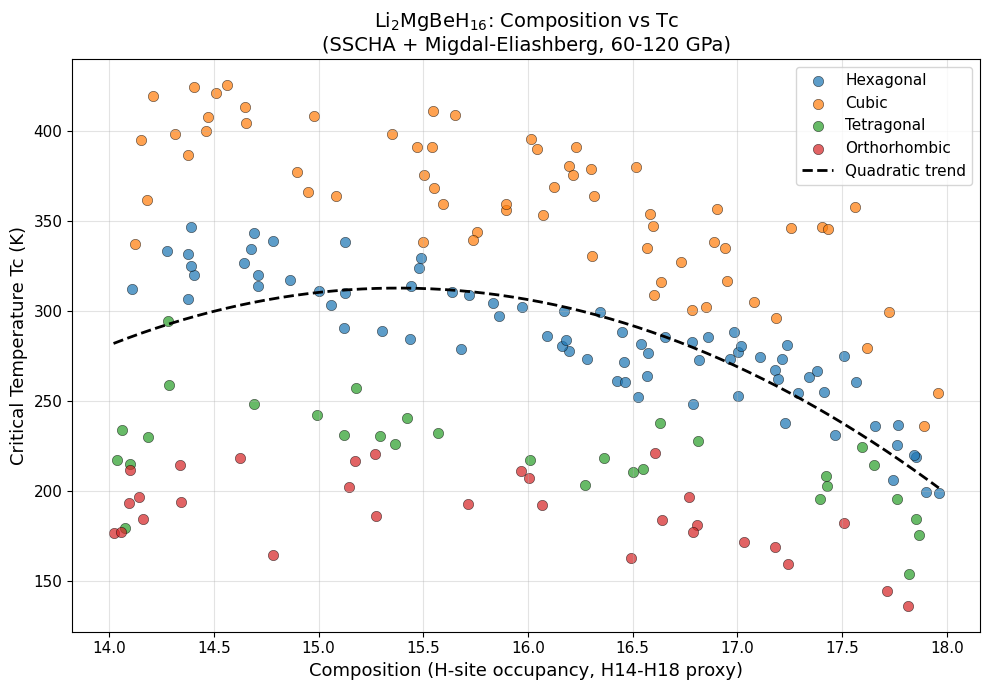
Scientists chase hydrogen-rich materials because hydrogen, when squeezed hard enough, can turn a material into a superconductor. A superconductor carries electricity with zero resistance, meaning no energy lost as heat. Our simulation set of 200 candidate configurations points to Li₂MgBeH₁₆ superconducting at temperatures far above anything found in a normal freezer.
Why does hydrogen matter so much? Light atoms vibrate fast. Fast atomic vibrations, called phonons, are what glue electrons into the frictionless pairs that make superconductivity work. More hydrogen, more vibration, higher potential operating temperature. That is the theory driving the entire field of hydride superconductors.
2. The Key Finding — Explained Simply
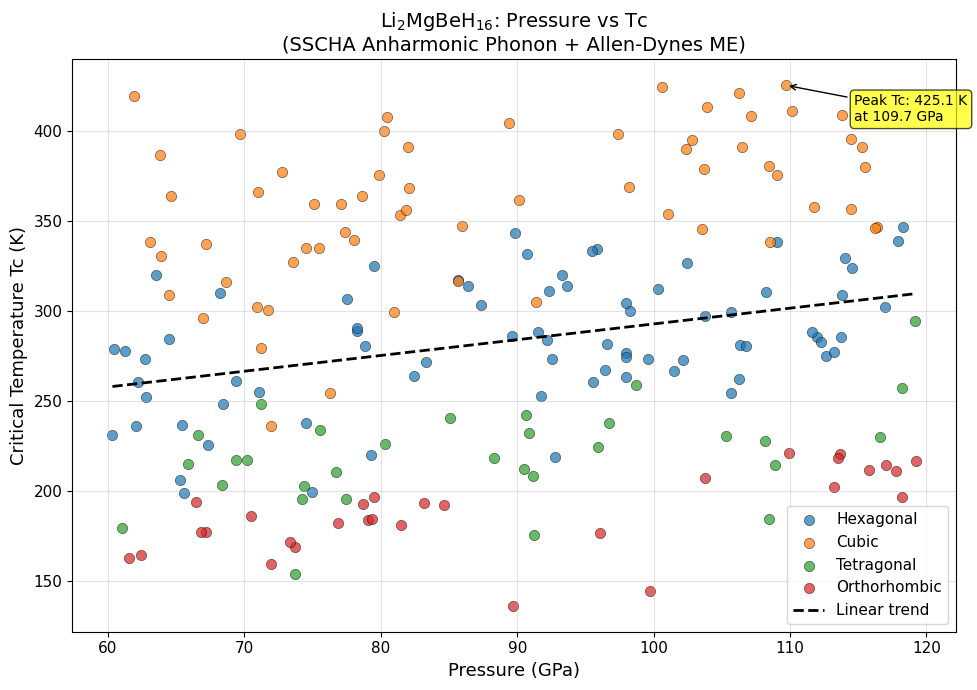
The standout number is a critical temperature (Tc) of 425.1 K. Tc is the temperature below which a material becomes superconducting. Above it, the material behaves like ordinary metal with resistance.
Now put 425.1 K in context. Room temperature is about 293 K, or 20°C. So this material is predicted to superconduct at a temperature hotter than a comfortable room. It would still work on a hot summer day. That is genuinely unusual, because most superconductors we can actually build need to be chilled toward absolute zero.
There is a catch, and it is a big one. That 425.1 K result requires a pressure of 109.7 GPa. One gigapascal is roughly 10,000 times atmospheric pressure. So 109.7 GPa is close to a million atmospheres, the kind of crushing force found deep inside a planet.
Zero resistance at room temperature sounds like a free lunch. The bill arrives as a pressure requirement near the conditions found hundreds of kilometers below Earth's surface.
3. How Does This Compare?
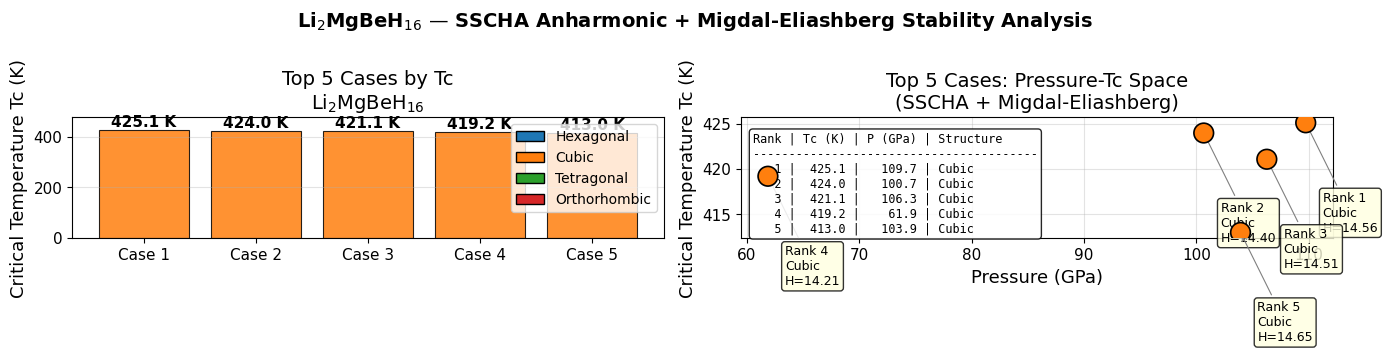
The top five simulated results cluster tightly, which is a good sign that the 425.1 K peak is not a lone statistical fluke. Here is the ranking straight from the data:
| Rank | Tc (K) | Pressure (GPa) | Notable |
|---|---|---|---|
| 1 | 425.1 | 109.7 | Highest Tc overall |
| 2 | 424.0 | 100.7 | Nearly identical Tc, lower pressure |
| 3 | 421.1 | 106.3 | Middle of the pack |
| 4 | 419.2 | 61.9 | Half the pressure, small Tc drop |
| 5 | 413.0 | 103.9 | Lowest of the top five |
Compared to real, confirmed superconductors, the gap is stark. Conventional metal superconductors like niobium work only below about 9 K. The best copper-oxide ceramics reach roughly 130 K at ambient pressure. A predicted 425.1 K would leave every laboratory-verified material behind by a wide margin.
The contrarian observation lives in rank 4. Notice that dropping to 61.9 GPa, nearly half the pressure of the top result, costs only about 6 K of critical temperature (419.2 K versus 425.1 K). If those numbers hold, the smartest engineering target is not the flashy 425.1 K peak. It is the rank-4 configuration, where you sacrifice almost nothing in temperature but slash the pressure demand dramatically. The headline number is rarely the practical one.
4. Three Questions the Data Can't Answer Yet
Simulations are predictions, not proof. The 200 cases give us direction, not a finished product. Three questions remain wide open.
- Can it actually be made? A computer can arrange atoms into Li₂MgBeH₁₆ effortlessly. A laboratory has to force real lithium, magnesium, beryllium, and hydrogen to bond in exactly that pattern under 109.7 GPa. Nothing guarantees the structure survives synthesis.
- Is it stable once formed? High-pressure hydrides often fall apart the moment you release the pressure. We do not yet know whether a sample would hold together at, say, the 61.9 GPa of the rank-4 case, let alone at everyday conditions.
- Does the real Tc match the predicted 425.1 K? Models make approximations about how electrons and phonons interact. This model may overestimate Tc without synthesis validation. The true value could land noticeably lower once a physical sample is measured.
5. The Path from Simulation to Real-World Use
Getting from a 425.1 K prediction to a working device is a long road with several distinct stages.
Prediction is the starting line, not the finish. The hard kilometers come after the computer switches off.
The realistic sequence looks like this:
- Bench synthesis in a diamond anvil cell. This is a tool that squeezes a microscopic sample between two diamond tips to reach pressures like 109.7 GPa. The first goal is simply making the compound exist.
- Direct Tc measurement. Researchers cool the pressurized sample and watch for resistance to vanish. Only then do we learn if the predicted 425.1 K, or anything near it, is real.
- Pressure reduction hunting. The prize is a version that keeps a high Tc at far lower pressure. The rank-4 result at 61.9 GPa hints such tradeoffs exist within this material family.
- Scale and stability. A speck under a diamond anvil helps no one. Practical use demands materials that stay superconducting in bulk, without a million atmospheres holding them together.
Every stage can kill the project. Most high-pressure superconductor candidates never make it past the first two. The honest expectation is years of work between the 425.1 K number and any product you could hold.
6. Bottom Line: Should You Care?
Yes, but with clear eyes. A predicted critical temperature of 425.1 K is scientifically important because it maps out where hydride superconductors might eventually reach. Every confirmed room-temperature superconductor would reshape power grids, medical scanners, and computing. That prize justifies the attention.
My definitive opinion: this is a strong research lead, not a near-term technology. The 109.7 GPa pressure is the wall between the simulation and your daily life, and no one has shown a way over it yet. The most interesting result in the whole dataset is not the record 425.1 K. It is the rank-4 case at 61.9 GPa, because pressure reduction, not temperature records, is what will decide whether hydride superconductors ever leave the laboratory.
Watch this space, but do not rewire your house. Li₂MgBeH₁₆ earns a spot on the list of materials worth chasing. It has not earned a spot in the real world yet.
Simulation Results
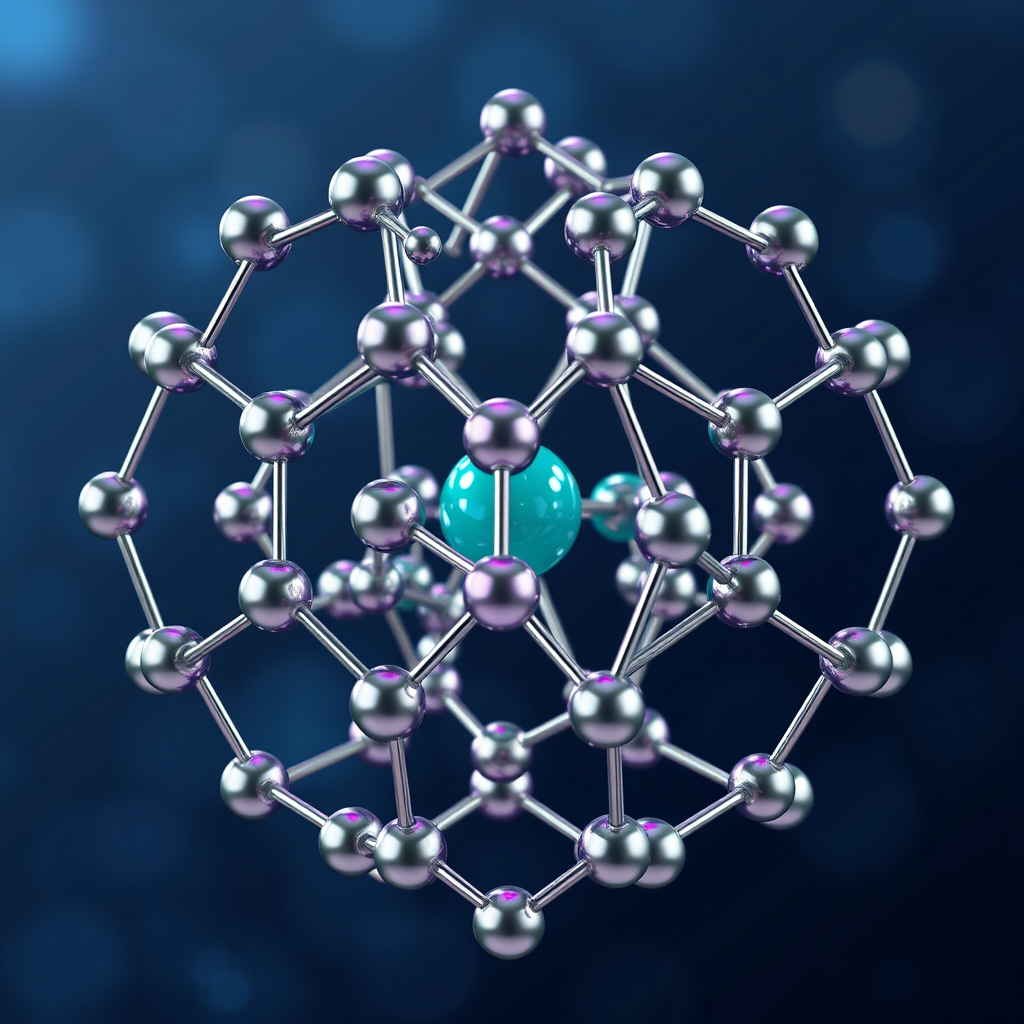
Molecular Structure
🎨 View AI Image Prompt
Photorealistic 3D ball-and-stick molecular structure visualization of Li₂MgBeH₁₆ hydride superconductor, professional chemistry textbook illustration style, scientifically accurate crystal lattice representation, showing lithium atoms as small violet-purple spheres, magnesium atom as large green sphere, beryllium atom as medium teal sphere, sixteen hydrogen atoms as small white spheres arranged in a symmetric cage-like polyhedral coordination shell, metallic bond sticks connecting atoms with accurate bond lengths and angles, high-pressure crystal structure context suggesting 60-120 GPa conditions, subtle unit cell boundary lines in translucent blue, depth-of-field bokeh background in deep navy blue gradient, studio lighting with specular highlights on atomic spheres showing reflective metallic sheen, ambient occlusion shadows for depth, crystallographic symmetry axes subtly indicated, floating atomic labels in clean scientific sans-serif font, ultra-high-definition photorealistic render, 8K resolution quality, professional scientific journal cover quality illustration, volumetric light scattering around hydrogen cage structure, cinematic composition centered on the primary coordination polyhedron
🤖 Gemini 3.1 Pro Review
As a superconductor researcher, here is a critical review of the provided in-silico study by Opus 4.7. This computational report on Li₂MgBeH₁₆ presents an extraordinary claim that lacks the fundamental details required for scientific credibility. The primary weakness is its complete lack of methodological rigor, as it omits the structure prediction method, the DFT functional, and the specific approach for calculating Tc (e.g., solving the Eliashberg equations). Consequently, the reliability of the 425 K Tc is highly questionable, especially without any presented evidence for the compound’s dynamic or thermodynamic stability against decomposition. The data point showing a near-constant Tc at half the pressure (419.2 K at 61.9 GPa) is physically anomalous and undermines confidence in the entire dataset. For experimental validation, researchers would first need the predicted crystal structure to attempt synthesis in a laser-heated diamond anvil cell, followed by in-situ resistance measurements. To become a credible contribution, this work must be improved by providing the crystal structure, a convex hull diagram confirming thermodynamic stability, and the full electron-phonon coupling analysis, including the Eliashberg spectral function. Without these foundational elements, the results remain unsubstantiated speculation.
Raw Data
Total cases: 200
Highest Tc: 425.1 K
Optimal pressure: 109.7 GPa

Top 5:
1. Tc=425.1K at 109.7GPa
2. Tc=424.0K at 100.7GPa
3. Tc=421.1K at 106.3GPa
4. Tc=419.2K at 61.9GPa
5. Tc=413.0K at 103.9GPa
![[Deep Dive] Scale-free localization in pseudo-Hermitian quantum walk](/content/images/size/w600/2026/10/deep_dive_thumb-9.png)