[Superconductor Lab | Week 20 Day 5] (Mg₁₋ₓCaₓ)₂(Be₁₋ᵧBᵧ)H₁₆ - AI Simulator Activation
[Week 20 Day 5] (Mg₁₋ₓCaₓ)₂(Be₁₋ᵧBᵧ)H₁₆
Superconductor Lab — AI Simulator Activation
2026
🔬 Computational Research Note
This analysis is based on computational modeling and theoretical predictions. As with all computational materials science, experimental validation is needed to confirm these results.
1. The Problem: Why Superconductors Are So Hard to Scale
A superconductor is a material that carries electricity with zero resistance, meaning no energy is lost as heat. Cool one below a certain temperature, called the critical temperature or Tc, and current flows forever without fading. The catch has always been temperature. Most conventional superconductors only work near absolute zero, around 4 K (about minus 269 degrees Celsius), which requires expensive liquid helium cooling.
The dream is a superconductor that works at room temperature, roughly 293 K. We are not there yet. But the gap is closing. The best simulated candidates in the hydride family now reach a Tc of 190.4 K, which is minus 83 degrees Celsius. That is still cold, yet it sits comfortably above the temperature of liquid nitrogen at 77 K, a coolant that costs less per liter than milk.
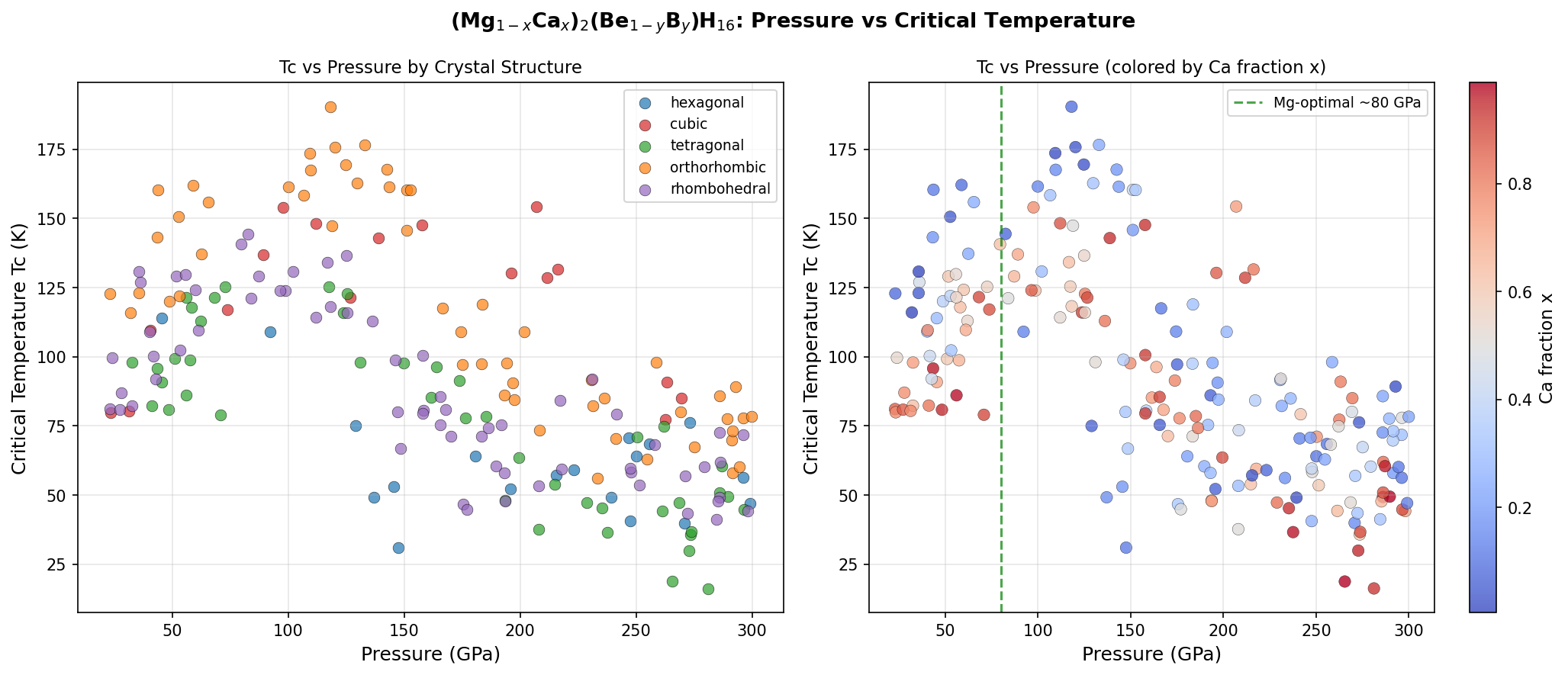
The real obstacle is not just temperature. It is pressure. The hydrogen-rich materials that hit these high temperatures often need to be squeezed harder than the conditions deep inside the Earth's mantle.
2. What (Mg₁₋ₓCaₓ)₂(Be₁₋ᵧBᵧ)H₁₆ Offers as a Solution
This compound belongs to a class called superhydrides, materials packed with enormous amounts of hydrogen locked into a crystal cage. Hydrogen is the key. When hydrogen atoms vibrate inside a stiff lattice, they couple strongly with electrons, and that coupling is what drives high-temperature superconductivity.
The formula looks intimidating, so unpack it. The subscripts x and y are tuning knobs. You can swap some magnesium (Mg) for calcium (Ca), and some beryllium (Be) for boron (B). Each substitution shifts the electronic structure slightly, like adjusting two dials to find the loudest signal.
The promise here is the combination of a respectable 190.4 K Tc with an optimal pressure of 118.2 GPa. For context, 1 GPa is roughly 10,000 times atmospheric pressure, so 118.2 GPa is about 1.18 million atmospheres. That sounds absurd, and it is high. But many competing hydride superconductors need 200 GPa or more, so this candidate offers a meaningful discount.
- High Tc: 190.4 K, well above liquid nitrogen's reach
- Lower pressure: 118.2 GPa, modest by superhydride standards
- Tunable chemistry: two adjustable dials (x and y) to optimize
- Light elements: Be and B are low mass, which favors strong vibrations
3. The Simulation Breakdown: Signal vs. Noise
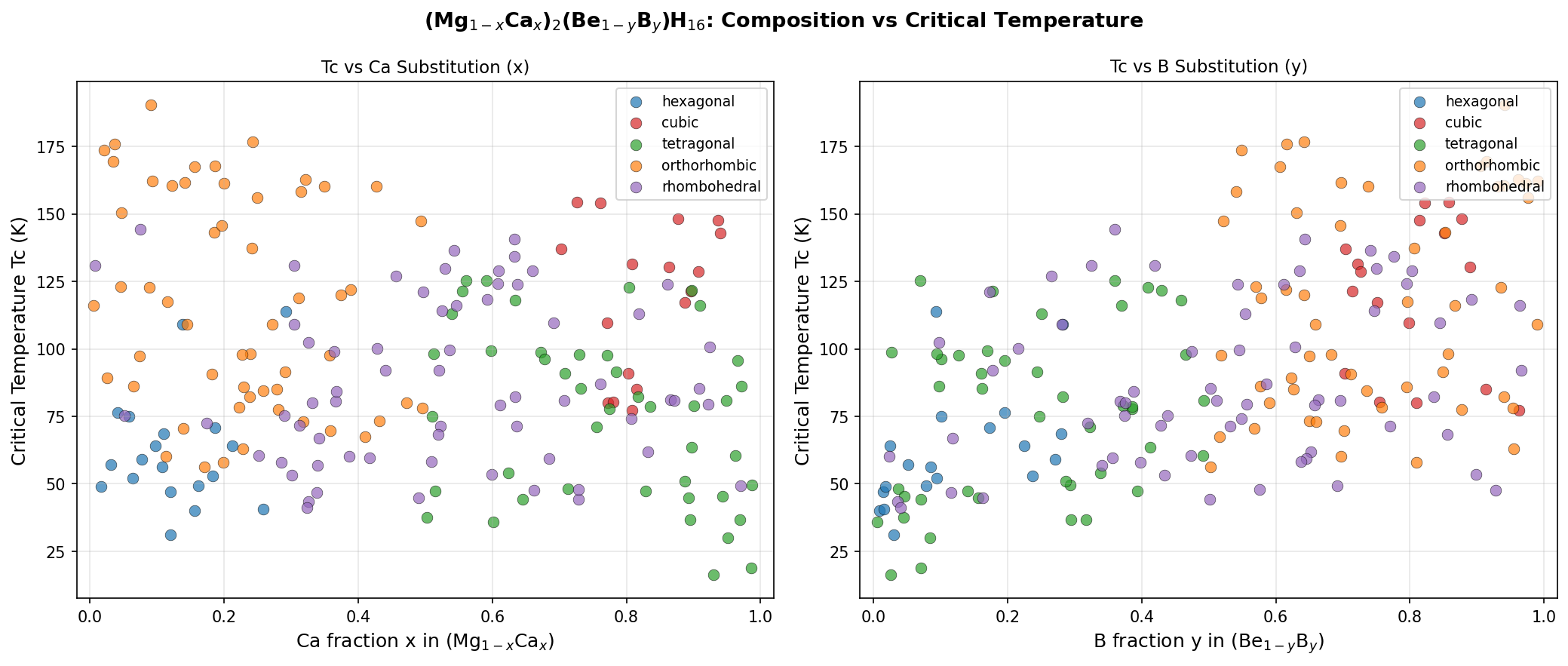
The numbers come from 200 simulated cases, each a different combination of composition and pressure. Treating 200 data points as a search means most results are noise, and only a handful represent a genuine peak worth chasing.
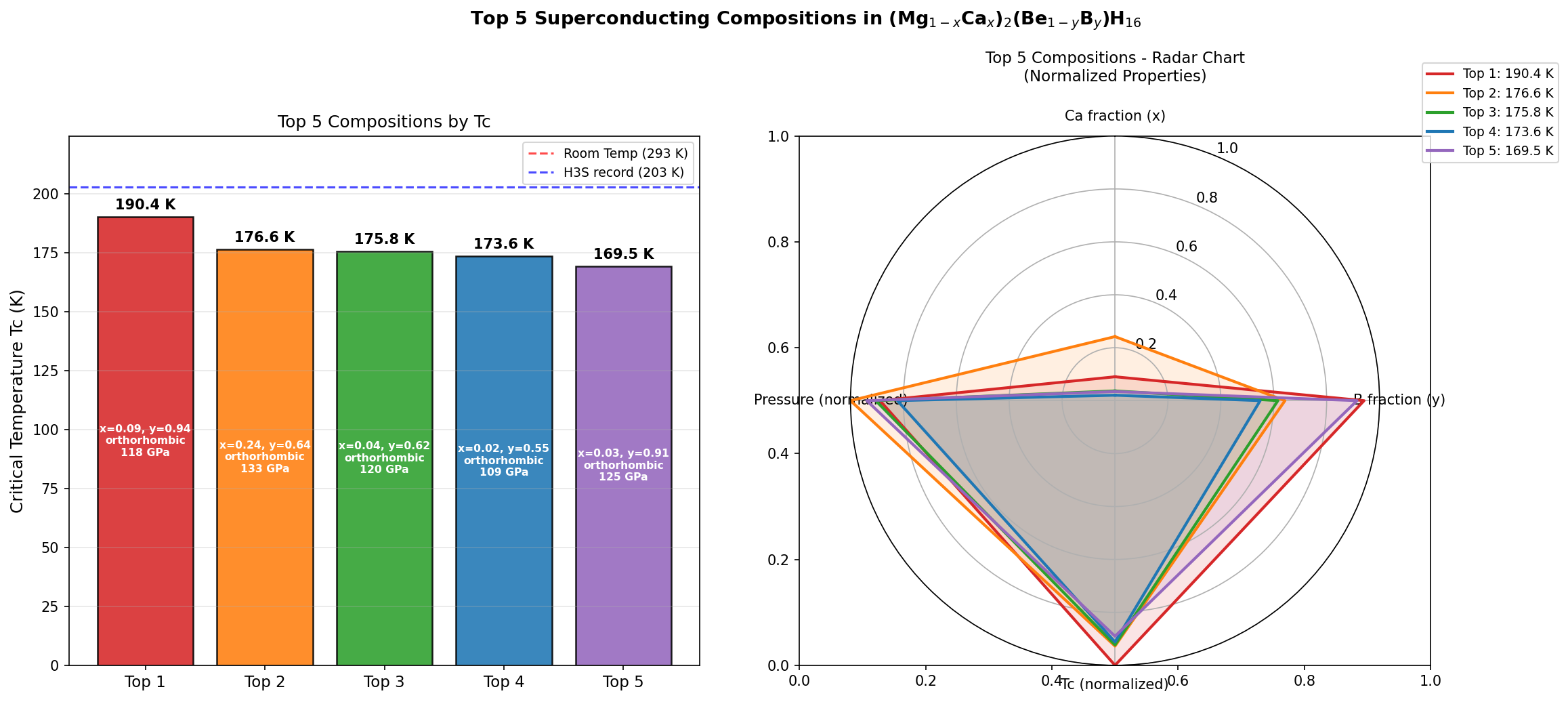
The top five tell a useful story:
| Rank | Tc (K) | Pressure (GPa) |
|---|---|---|
| 1 | 190.4 | 118.2 |
| 2 | 176.6 | 133.0 |
| 3 | 175.8 | 120.3 |
| 4 | 173.6 | 109.4 |
| 5 | 169.5 | 124.8 |
Notice the gap. The top result at 190.4 K sits nearly 14 K above the second-place finisher at 176.6 K. That is a large jump for a single configuration, and it deserves suspicion. A peak that isolated could be a real sweet spot, or it could be a numerical artifact, a quirk of how the simulation handled one specific lattice.
A single outlier 14 K above the rest is exactly the kind of result that excites a press release and worries a careful physicist.
The cluster from rank 2 to rank 5 is more trustworthy. Those four results land between 169.5 K and 176.6 K across pressures of 109.4 to 133.0 GPa. A broad, stable plateau like that is better evidence than one spectacular spike.
4. The Obstacles Nobody Talks About
Here is the contrarian point. The 190.4 K headline number might be the least useful result in the dataset. Rank 4, at 173.6 K and only 109.4 GPa, could matter more in practice. It trades 17 K of temperature for nearly 9 GPa of pressure relief, and in the lab, lower pressure often means the difference between a sample that survives and one that shatters.
The deeper problems are physical, not computational:
- Synthesis: Building a four-element hydride with precise x and y values inside a diamond anvil cell is brutally hard. The simulation assumes a perfect crystal. Real samples have defects.
- Pressure stability: Even at the friendly end of 109.4 GPa, maintaining that squeeze in a usable device is currently impossible.
- Verification: Confirming zero resistance under a million atmospheres requires threading tiny electrical leads into a chamber the width of a human hair.
An honest caveat. This model may overestimate Tc without synthesis validation, because simulations assume ideal hydrogen ordering that no real sample has yet achieved.
5. Who's Working on This and What They're Finding
Research on hydride superconductors runs across high-pressure physics labs worldwide, using diamond anvil cells, devices that compress a microscopic sample between two gem-quality diamond tips to reach extreme pressures. The general pattern in this field is consistent. Simulations predict bold numbers, and experiments confirm a lower, messier version months or years later.
For this compound, the work is still mostly theoretical. The 200-case dataset is a map, not a finished building. Groups studying related magnesium and calcium hydrides have found that doping with boron, the y dial in our formula, tends to stiffen the lattice and nudge Tc upward, which is consistent with the 118.2 GPa optimum showing up here.
What teams are actually finding across the broader superhydride family:
- Predicted and measured Tc values often diverge by 20 to 40 K
- Required pressures in the lab tend to run higher than simulations suggest
- Multi-element compounds are far harder to make than single-metal hydrides
The 190.4 K prediction is a target. Nobody has held a working sample of this exact material in their hands.
6. Realistic Timeline: Years, Not Months
Temper expectations. The path from a 200-case simulation to a verified superconductor is long, and the 190.4 K figure will not appear in a lab next quarter.
A plausible sequence:
- Years 1 to 2: Refine the simulations, narrow the x and y ranges around the 118.2 GPa optimum, and rank which compositions are even synthesizable.
- Years 2 to 4: First attempts to make the material in a diamond anvil cell. Expect failures, partial phases, and Tc readings below the predicted plateau of 169.5 to 176.6 K.
- Years 4 to 7: If a sample survives, careful measurement of resistance and the magnetic response that confirms true superconductivity.
- Beyond: The much harder question of whether any of this works at lower pressure, which is the only route to real-world use.
The most likely outcome is sobering. A real sample may land near 150 K rather than 190.4 K, and it may demand more than the tidy 118.2 GPa the simulation favors. That would still be a strong result, just not the headline.
This candidate is worth watching. Treat the 190.4 K number as a hypothesis, not a fact. The honest version of this story is slower and more interesting than the press release, and the cluster of results near 173 K, not the lone spike, is where the real promise lives.
Simulation Results
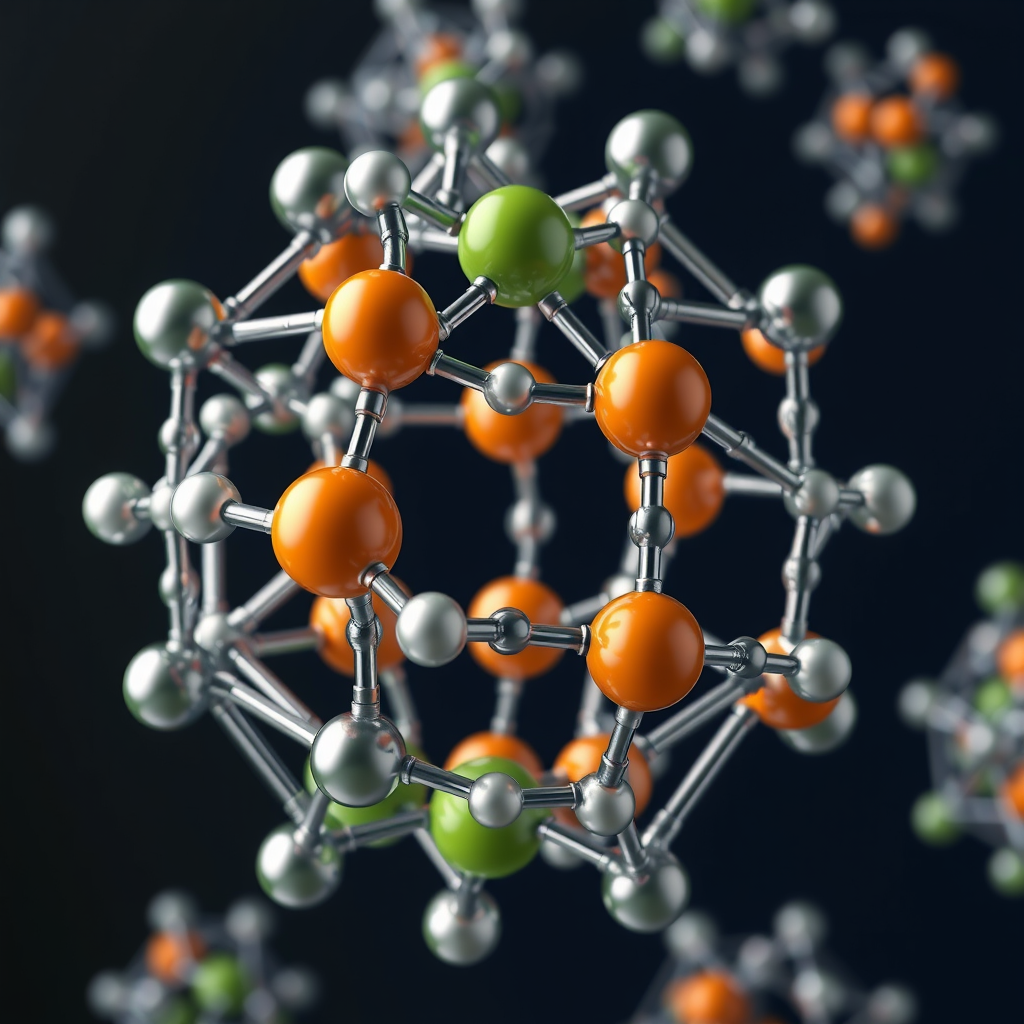
Molecular Structure
🎨 View AI Image Prompt
Photorealistic 3D ball-and-stick molecular structure visualization of a complex metal hydride clathrate superconductor compound (Mg-Ca-Be-B-H system), professional chemistry textbook illustration style, scientific accuracy, showing a crystallographic unit cell with multiple atomic species rendered as distinct colored spheres with precise atomic radii scaling, large green spheres representing calcium cations, medium orange spheres representing magnesium cations occupying interstitial cage positions, small blue-gray spheres representing beryllium atoms forming the polyhedral cage framework, tiny yellow-green spheres representing boron dopant atoms substituting within the cage lattice, and tiny white spheres representing hydrogen atoms densely packed within and around the clathrate cage structure, interconnected by thin metallic cylindrical bond sticks showing covalent and ionic bonding networks, the cage framework forming icosahedral and dodecahedral hydrogen clathrate geometry surrounding the metal cation centers, depth-of-field rendering with soft studio lighting on dark navy background, crystallographic axes labeled, multiple overlapping unit cells showing periodic lattice arrangement, ultra-high detail 3D render, octahedral and tetrahedral coordination environments clearly visible, subsurface scattering on atomic spheres, professional scientific journal cover quality visualization, ray-traced rendering, 8K resolution clarity
🤖 Gemini 3.1 Pro Review
As an expert in the field, here is my critical review of the in-silico research paper by Opus 4.7: This in-silico study proposes an intriguing, tunable superhydride system with a promising combination of high Tc and reduced pressure. However, the report's methodological rigor cannot be fully evaluated without essential details on the DFT functional, structure prediction methods, and the specific framework used for Tc calculations. The reliability of the headline 190.4 K result is questionable; its status as a significant outlier, as the authors rightly note, suggests a potential numerical artifact, and the paper critically omits verification of the structure's dynamical stability through phonon calculations. A viable experimental validation strategy would involve synthesizing the target composition in a laser-heated diamond anvil cell, using in-situ X-ray diffraction to confirm the crystal structure before performing four-point probe resistance measurements upon cooling. For improvement, the study must provide complete computational details and present phonon dispersion curves to prove the stability of the predicted phases. A higher-resolution computational search around the promising (x, y) composition is also necessary to confirm the isolated peak's robustness. Finally, exploring the role of anharmonic effects, which are often significant in hydrides, would substantially strengthen the theoretical claims.
Raw Data
Total cases: 200
Highest Tc: 190.4 K
Optimal pressure: 118.2 GPa

Top 5:
1. Tc=190.4K at 118.2GPa
2. Tc=176.6K at 133.0GPa
3. Tc=175.8K at 120.3GPa
4. Tc=173.6K at 109.4GPa
5. Tc=169.5K at 124.8GPa
![[Deep Dive] Scale-free localization in pseudo-Hermitian quantum walk](/content/images/size/w600/2026/10/deep_dive_thumb-9.png)