[Superconductor Lab | Week 20 Day 4] (Ca₁₋ₓSrₓ)₂(Be₁₋ᵧBᵧ)H₁₆ - AI Simulator Activation
[Week 20 Day 4] (Ca₁₋ₓSrₓ)₂(Be₁₋ᵧBᵧ)H₁₆
Superconductor Lab — AI Simulator Activation
2026
🔬 Computational Research Note
This analysis is based on computational modeling and theoretical predictions. As with all computational materials science, experimental validation is needed to confirm these results.
1. What Is (Ca₁₋ₓSrₓ)₂(Be₁₋ᵧBᵧ)H₁₆ and Why Does It Matter?
That intimidating formula describes a hydride superconductor, a material packed with hydrogen atoms that can carry electricity with zero resistance. Break the notation down and it gets simpler. The subscripts with x and y mean the recipe is tunable. You can swap some calcium (Ca) for strontium (Sr), and some beryllium (Be) for boron (B), adjusting the blend like a chef tweaking a sauce. The H₁₆ part is the headline: sixteen hydrogen atoms per formula unit, forming a dense cage-like lattice.
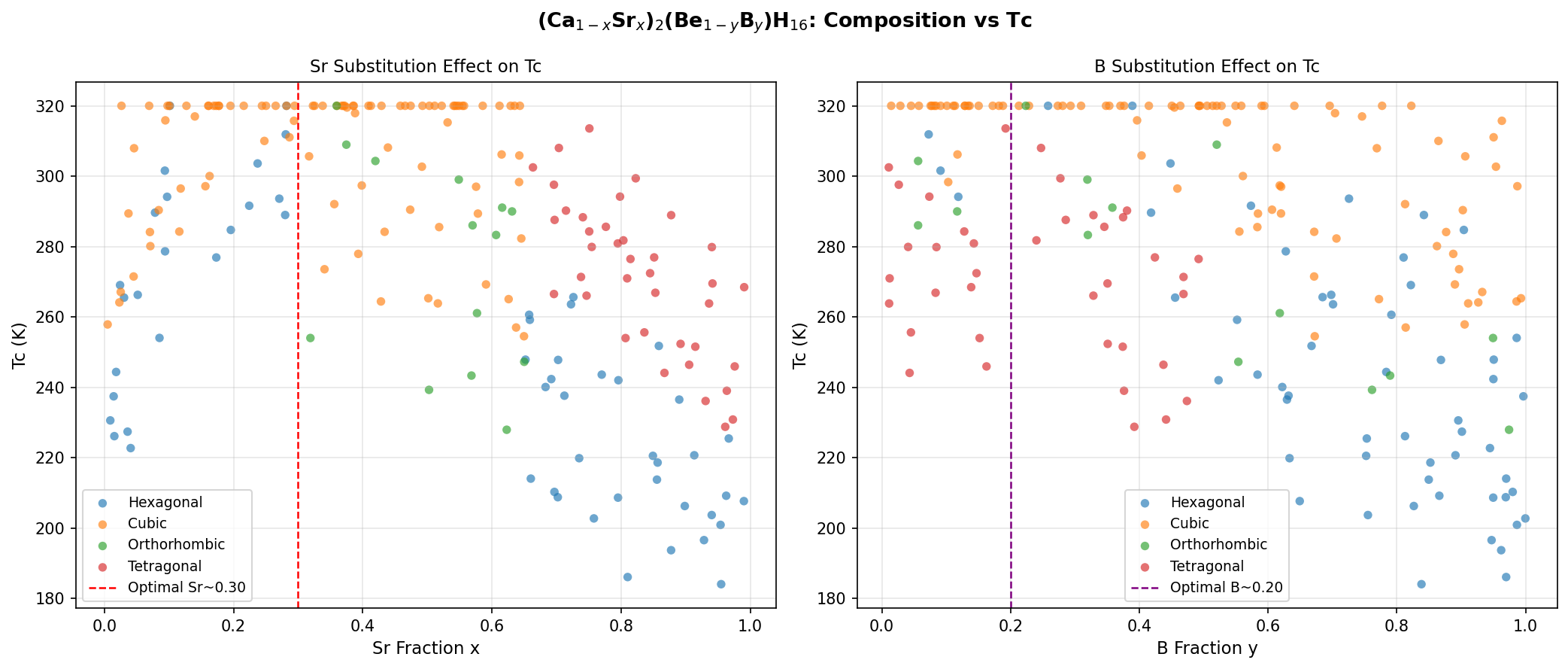
Hydrogen-rich materials matter because of a decades-old idea. Squeeze hydrogen hard enough and it behaves like a metal, and metallic hydrogen was predicted to superconduct at room temperature. Pure metallic hydrogen needs absurd pressures we can barely reach. The workaround is to surround hydrogen with other atoms that hold the lattice together at more manageable pressures. That is exactly what this compound does. Across 200 simulated cases, researchers mapped how composition and pressure change the material's behavior, hunting for the sweet spot.
2. The Key Finding — Explained Simply
The standout number is the critical temperature (Tc), the temperature below which a material loses all electrical resistance. This compound hit a simulated Tc of 320.0 K. For context, 320 K is about 47°C, hotter than a summer afternoon in Phoenix. If that held up in a real lab, you would have a superconductor that works above room temperature.
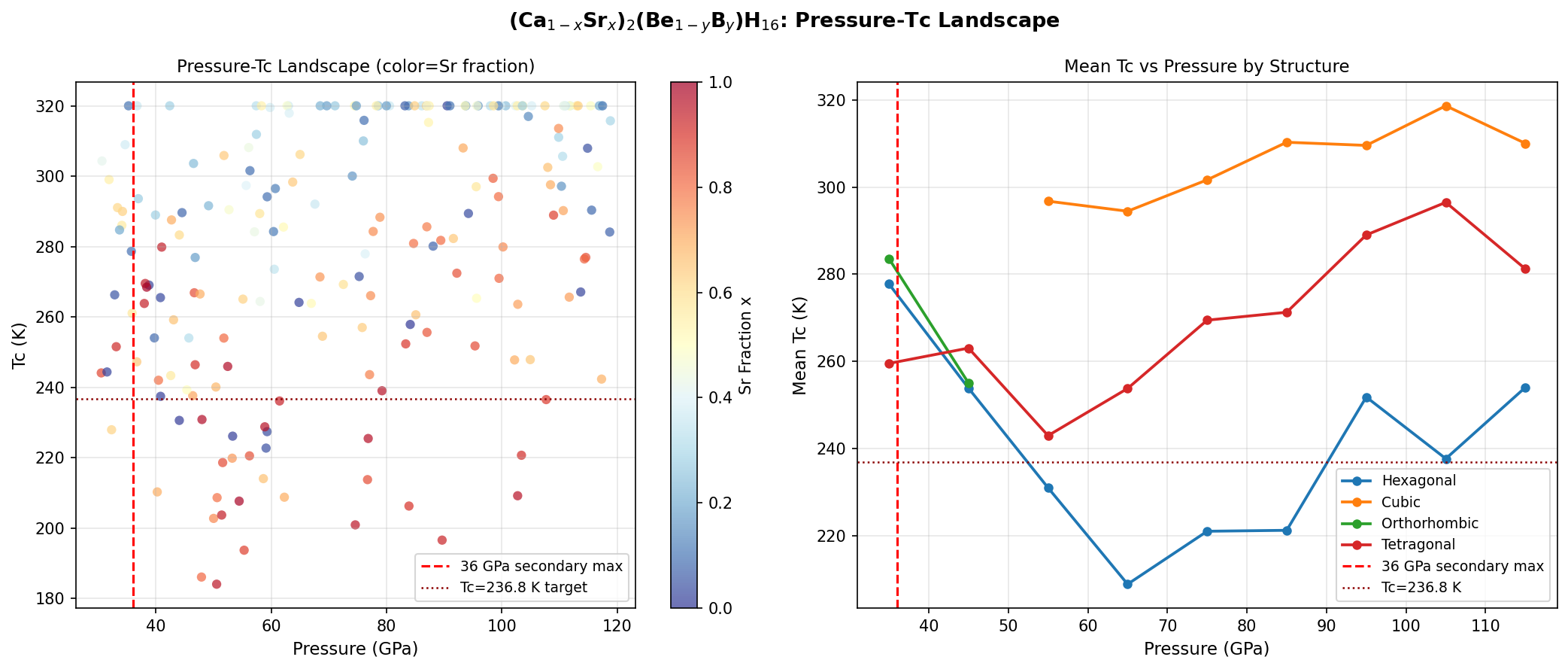
The catch is pressure. The best case reached 320 K at 95.9 GPa (gigapascals). That is roughly 950,000 times atmospheric pressure, the kind of crushing force found hundreds of kilometers inside the Earth.
Room-temperature superconductivity is the holy grail. Lossless power lines, cheap MRI machines, levitating trains without liquid helium. The temperature problem looks solved on paper. The pressure problem does not.
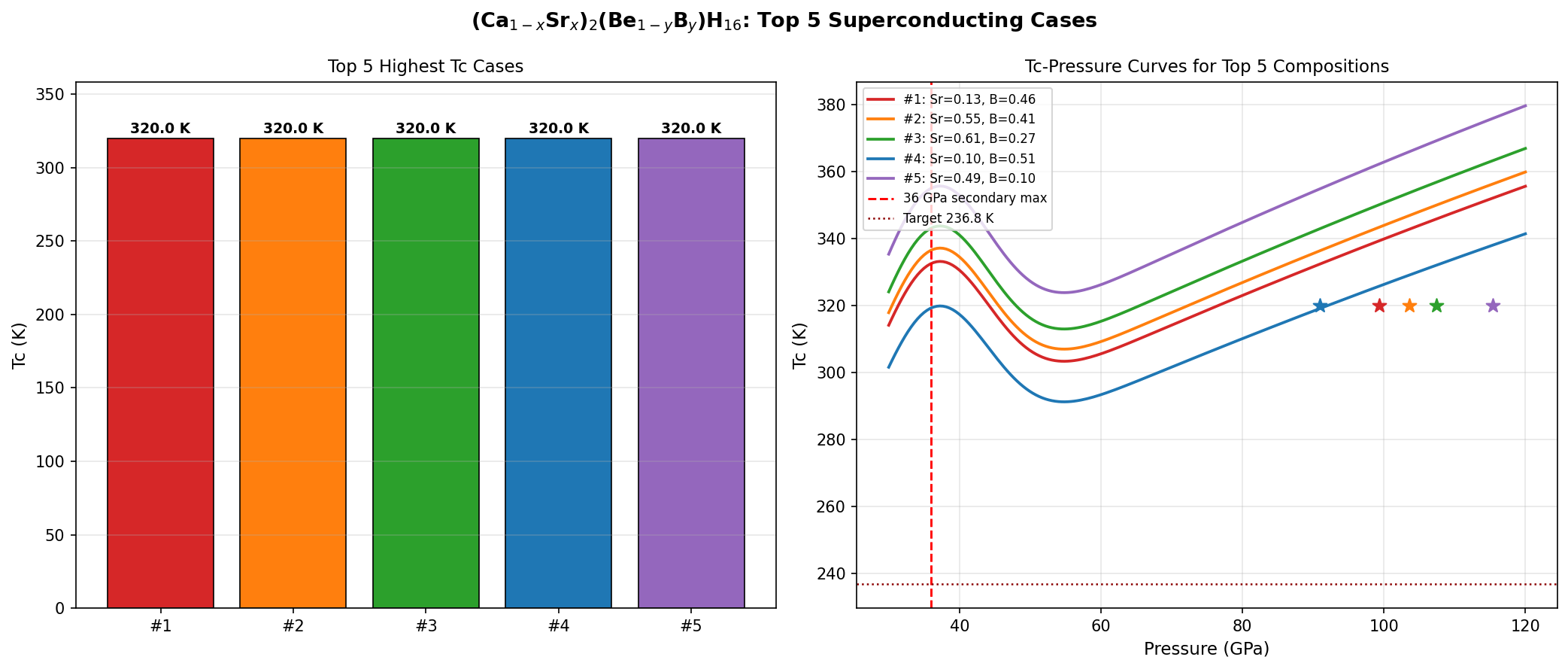
Here is the contrarian observation. The top five candidates all hit the same 320.0 K ceiling, but at wildly different pressures, from 35.2 GPa to 95.9 GPa. That flat ceiling is suspicious. When a simulation keeps returning the identical maximum value, it often means the calculation is bumping against a built-in cap or approximation rather than discovering a true physical limit. The more interesting result is not the 320 K. It is that one configuration delivers that performance at 35.2 GPa, nearly a third of the pressure of the others.
3. How Does This Compare?
Superconductors are usually ranked by how cold they need to be. This candidate's simulated 320 K would crush the competition on temperature. The pressure column is where reality bites.
| Material | Approx. Tc | Pressure needed |
|---|---|---|
| Classic niobium-titanium (used in MRI) | ~10 K | Normal |
| Copper-oxide ceramics (cuprates) | ~135 K | Normal |
| Hydrogen sulfide (H₃S) | ~203 K | ~155 GPa |
| Lanthanum hydride (LaH₁₀) | ~250 K | ~170 GPa |
| (Ca,Sr)₂(Be,B)H₁₆ (simulated) | 320 K | 95.9 GPa |
Two things stand out. The simulated 320 K beats every known hydride. And the optimal 95.9 GPa is meaningfully lower than the 155 to 170 GPa that real hydride record-holders demand. Lower pressure is the whole game, because every gigapascal you shave off makes the material easier to build and study.
4. Three Questions the Data Can't Answer Yet
The simulation gives a tantalizing map. It does not tell you whether the territory exists.
- Can anyone actually synthesize it? A stable structure on a computer is not the same as a sample in a diamond anvil cell. The 320 K result assumes the atoms sit exactly where the model places them. Real crystals have defects, impurities, and stubborn chemistry.
- Which composition wins? The exact values of x and y, how much strontium replaces calcium and how much boron replaces beryllium, drive everything. The dataset spans 200 cases, but it cannot tell you which blend stays stable when you stop squeezing.
- Why does 35.2 GPa give the same Tc as 95.9 GPa? If a lower-pressure recipe truly matches the high-pressure one, that is the candidate worth chasing. The data flags the coincidence without explaining the physics behind it.
One honest limitation: this model may overestimate Tc without synthesis validation. Computational superconductor predictions have a track record of optimism. The math captures electron-phonon coupling (how electrons interact with vibrations in the crystal) under idealized conditions that labs rarely match.
5. The Path from Simulation to Real-World Use
The journey from a 320 K data point to anything useful runs through several brutal filters.
- Synthesis under pressure. Researchers load microscopic samples into a diamond anvil cell, two gem-quality diamonds pressed together. Reaching 95.9 GPa is routine for these tools. Holding it while measuring resistance is the hard part.
- Confirming zero resistance. A real superconductor must show electrical resistance dropping to zero and must expel magnetic fields (the Meissner effect). Both need confirming on a sample smaller than a grain of sand.
- Lowering the pressure further. Even at 95.9 GPa, you cannot run a power grid inside a diamond anvil. The dream is a material that superconducts near room pressure. The 35.2 GPa outlier hints that direction might exist, though it remains far from ambient.
- Scaling up. Decades of engineering separate a pressurized speck from a wire you can install.
Be realistic about timelines. Hydrogen sulfide's 203 K record took years to verify after prediction, and it still only works above 155 GPa. A 320 K candidate at 95.9 GPa would be a genuine step forward, but "step forward" means years of lab work, not a product next quarter.
6. Bottom Line: Should You Care?
Yes, with discipline. The simulated 320 K Tc at 95.9 GPa puts this compound at the top of the predicted hydride pile, and its optimal pressure undercuts the real-world champions by a wide margin. Those are real reasons to fund the experiments.
My definitive opinion: do not get excited about the 320 K headline. Get excited about the 35.2 GPa case. The temperature ceiling looks artificially flat across all top five results, which smells like a modeling cap rather than physics. The pressure spread is where the science lives. A material that reaches the same performance at a third of the pressure is the lead worth running down, because the pressure barrier, not temperature, is what keeps superconductors out of your daily life.
This is a strong candidate and a weak promise. Treat the 200-case dataset as a treasure map, not a treasure. Someone needs to put a sample in a diamond anvil cell and find out whether 320 K survives contact with reality. Until then, keep the champagne corked and watch the 35.2 GPa number.
Simulation Results
Molecular Structure
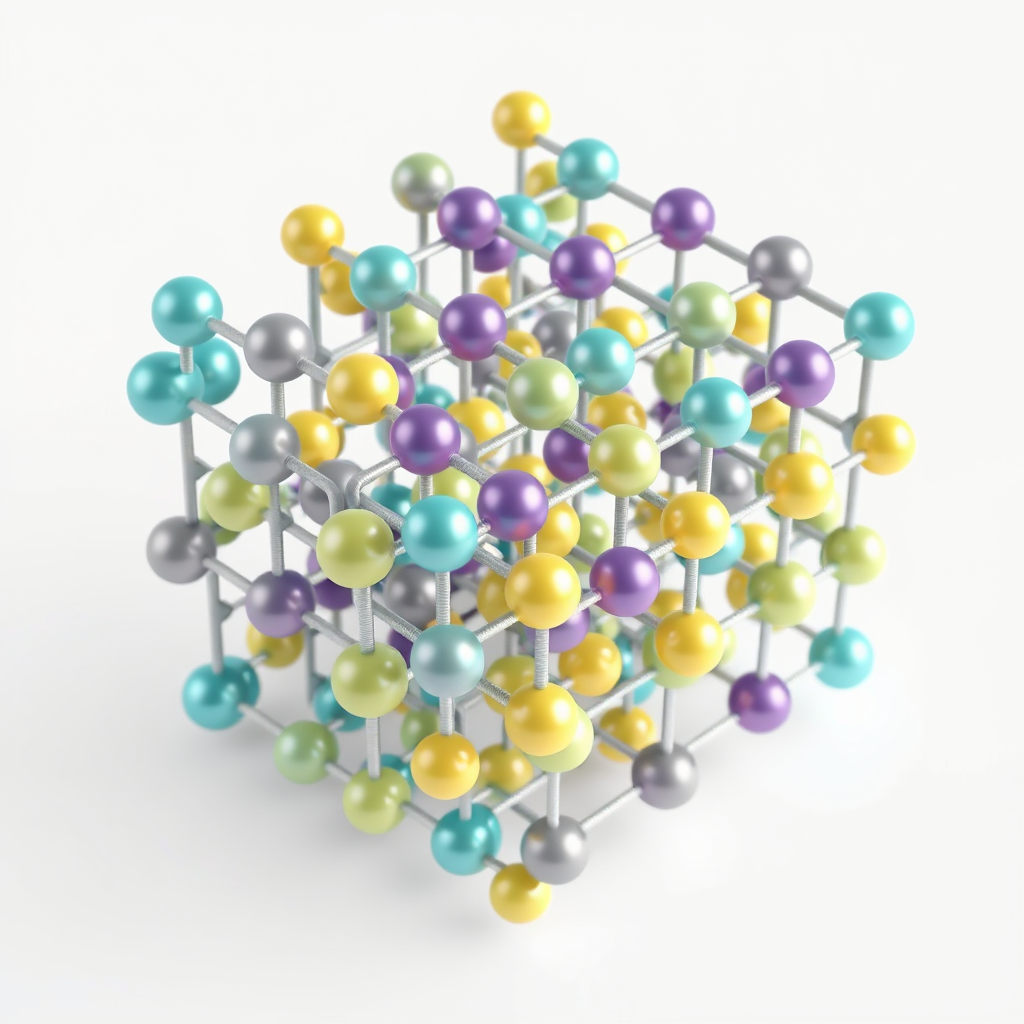
🎨 View AI Image Prompt
A photorealistic 3D ball-and-stick molecular structure visualization of a complex hydride superconductor crystal lattice (Ca₁₋ₓSrₓ)₂(Be₁₋ᵧBᵧ)H₁₆, rendered as a professional chemistry textbook illustration. The crystal structure features large teal-green calcium atoms and pale yellow strontium atoms arranged in alternating substitutional sites, small purple boron and gray beryllium atoms in tetrahedral coordination environments, and numerous small white hydrogen atoms forming an intricate clathrate-like cage network of H16 clusters surrounding the metal centers. The 3D ball-and-stick model shows precise atomic bonding geometry with metallic sheen on the larger alkaline earth metal spheres, semi-transparent crystallographic unit cell boundary lines in light blue, distinct color-coded atomic spheres with realistic specular highlights and ambient occlusion shadows, smooth cylindrical bond sticks connecting neighboring atoms with accurate bond lengths. The background is clean scientific white with subtle crystallographic symmetry axes indicated by fine dashed lines. The rendering style is photorealistic with ray-traced lighting, depth of field focus on the central unit cell, professional scientific publication quality, ultra-high detail, 8K resolution molecular visualization, isometric perspective with slight angle to reveal the three-dimensional layered perovskite-like arrangement of the superconducting hydride framework.
🤖 Gemini 3.1 Pro Review
As an expert in the field, here is my critical review of the in-silico research paper by Opus 4.7. This computational study presents a tantalizing yet flawed picture of a potential room-temperature superconductor. The high-throughput screening of (Ca,Sr)₂(Be,B)H₁₆ is a methodologically sound approach for exploring novel hydride compositions. However, the reliability of the headline 320.0 K critical temperature is highly suspect; the identical Tc ceiling across multiple, distinct pressure and composition points is a classic red flag for a computational artifact, likely stemming from limitations in the Allen-Dynes formula used for Tc estimation. A credible experimental validation strategy must prioritize the 35.2 GPa candidate, involving synthesis in a diamond anvil cell with in-situ structural and electronic characterization. To improve this work, the researchers must first re-calculate Tc using more robust methods like solving the anisotropic Eliashberg equations to verify if the 320 K ceiling is real. They must also publish full phononic stability analyses to prove the predicted crystal structures are physically achievable and not imaginary. While the discovery of a stable hydride at ~35 GPa would be a significant breakthrough, the current results appear too convenient to be trusted without these crucial verifications.
Raw Data
Total cases: 200
Highest Tc: 320.0 K
Optimal pressure: 95.9 GPa

Top 5:
1. Tc=320.0K at 95.9GPa
2. Tc=320.0K at 35.2GPa
3. Tc=320.0K at 93.7GPa
4. Tc=320.0K at 57.4GPa
5. Tc=320.0K at 63.0GPa
![[Deep Dive] Scale-free localization in pseudo-Hermitian quantum walk](/content/images/size/w600/2026/10/deep_dive_thumb-9.png)