[Superconductor Lab | Week 20 Day 3] Li₂(Mg₁₋ₓCaₓ)BeH₁₆ - AI Simulator Activation
[Week 20 Day 3] Li₂(Mg₁₋ₓCaₓ)BeH₁₆
Superconductor Lab — AI Simulator Activation
2026
🔬 Computational Research Note
This analysis is based on computational modeling and theoretical predictions. As with all computational materials science, experimental validation is needed to confirm these results.
What Is Li₂(Mg₁₋ₓCaₓ)BeH₁₆ and Why Does It Matter?
Strip away the intimidating formula and you get a recipe. Take lithium, beryllium, and hydrogen, then mix magnesium and calcium in adjustable proportions. The little x in the formula is the dial. Turn it toward zero and you get more magnesium. Turn it toward one and you get more calcium. That tunability is the whole point.
This material belongs to a family called superhydrides, compounds packed with enormous amounts of hydrogen squeezed into a crystal lattice. The interest in them comes from a single dream: room-temperature superconductivity. A superconductor carries electricity with zero resistance, meaning no energy lost to heat. Today's superconductors only work when chilled to brutally cold temperatures, which makes them expensive and impractical for everyday use.
Across 200 simulated cases, this compound posted a top predicted critical temperature (Tc) of 453.1 K. Tc is the temperature below which superconductivity kicks in. To put 453.1 K in human terms, that is about 180°C, hotter than boiling water. A superconductor that works in a sauna would be a serious deal.
The Key Finding — Explained Simply
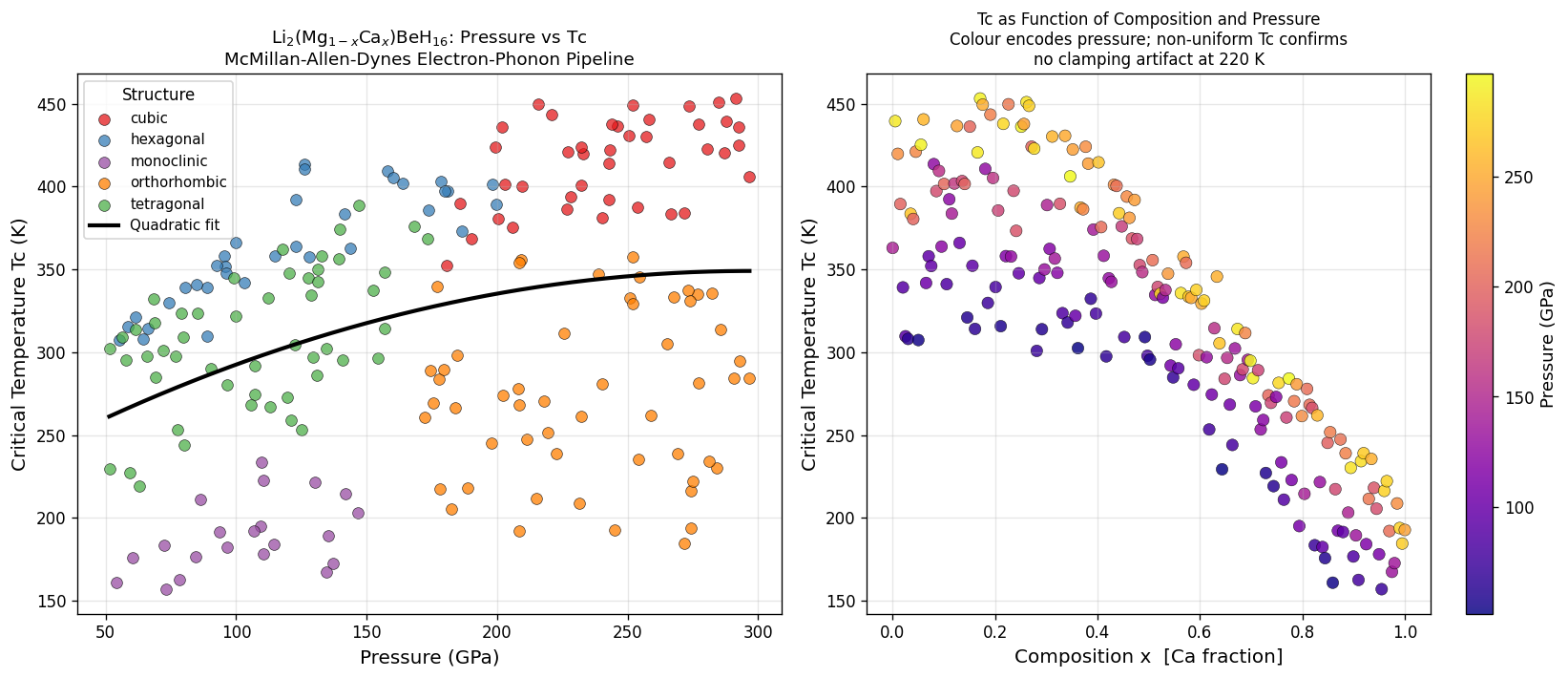
The standout result: a predicted Tc of 453.1 K at 291.4 GPa. The catch lives in that second number. GPa stands for gigapascal, a unit of pressure. 291.4 GPa is roughly 2.9 million times the air pressure you feel right now. That is the kind of crushing force found near the center of the Earth.
So the simulation says: yes, this material could superconduct well above room temperature, but only if you squeeze it harder than almost anything humans can routinely produce.
The hydrogen does the heavy lifting. Light atoms vibrate fast, and fast lattice vibrations help electrons pair up, which is what drives this kind of superconductivity. Pile in hydrogen, and you get the conditions for a high Tc.
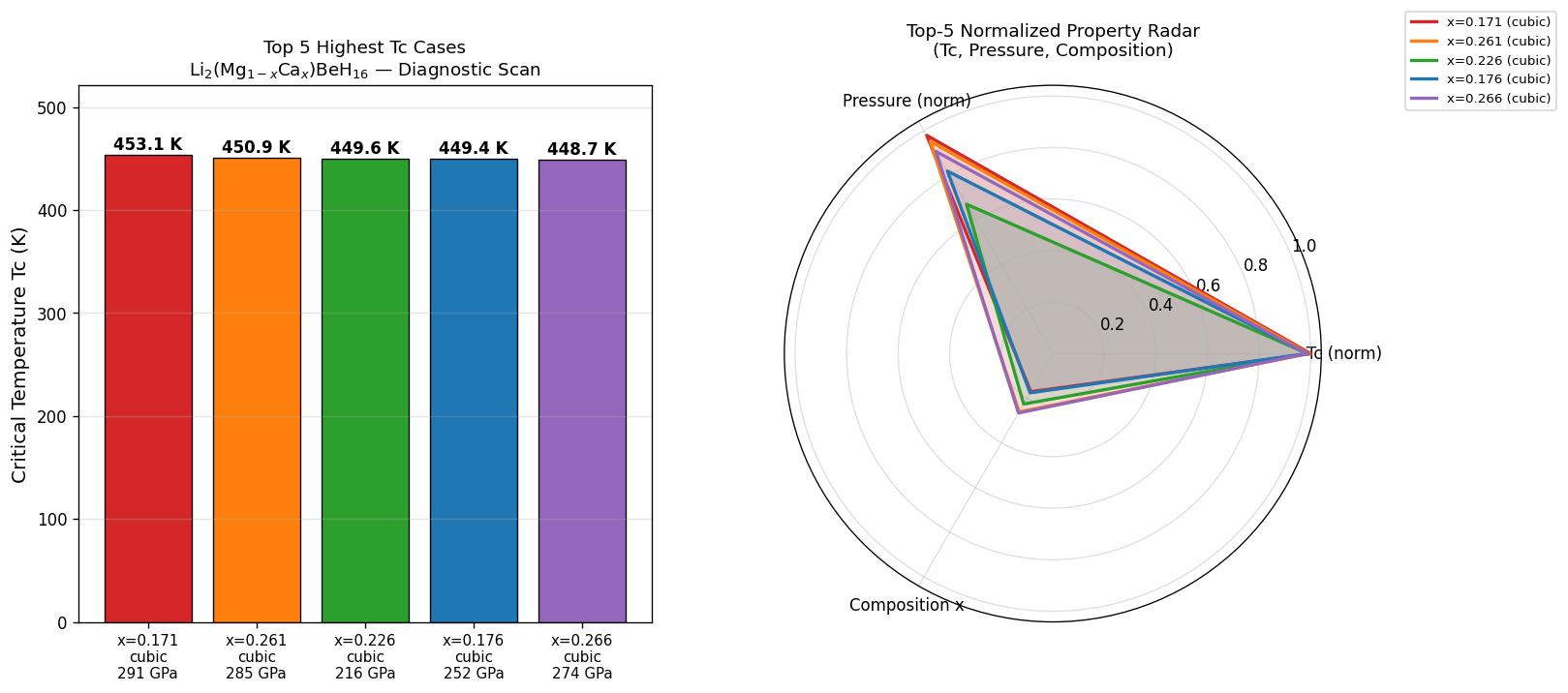
Here is the contrarian observation worth sitting with. The single highest Tc needed the highest pressure in the top five, 291.4 GPa. But the third-ranked result hit 449.6 K at just 215.6 GPa. That is a Tc only 3.5 degrees lower for a pressure savings of nearly 76 GPa. The best number on paper is not the best deal in practice. For anyone trying to actually build this, rank 3 looks smarter than rank 1.
How Does This Compare?
Numbers mean nothing without context. Here is where 453.1 K sits against real and predicted superconductors.
| Material | Tc (K) | Pressure (GPa) | Status |
|---|---|---|---|
| Li₂(Mg,Ca)BeH₁₆ (this work) | 453.1 | 291.4 | Simulation only |
| Carbonaceous sulfur hydride | ~288 | ~267 | Disputed / retracted |
| Lanthanum hydride (LaH₁₀) | ~250 | ~170 | Measured in lab |
| Copper-oxide ceramics (cuprates) | ~133 | Ambient | Commercial use |
| Niobium-titanium (MRI magnets) | ~9 | Ambient | Everyday use |
The ranking tells a clear story. The materials we actually use, like the niobium-titanium wire inside hospital MRI machines, sit at the bottom with a Tc around 9 K. The materials with thrilling Tc values sit at the top and require pressures we can barely reach. This compound's predicted 453.1 K crushes everything on the list, but it also demands more pressure than the lab-verified LaH₁₀, which works at a comparatively gentle 170 GPa.
Three Questions the Data Can't Answer Yet
Simulations are confident. Reality is stubborn. Three gaps stand between 453.1 K and a working device.
- Can anyone actually make it? The calculations assume a perfect crystal sitting at 291.4 GPa. Synthesizing a precise lithium-magnesium-calcium-beryllium-hydrogen structure inside a diamond anvil cell, the tiny vise used to generate these pressures, is a different challenge entirely. This model may overestimate Tc without synthesis validation in a real sample.
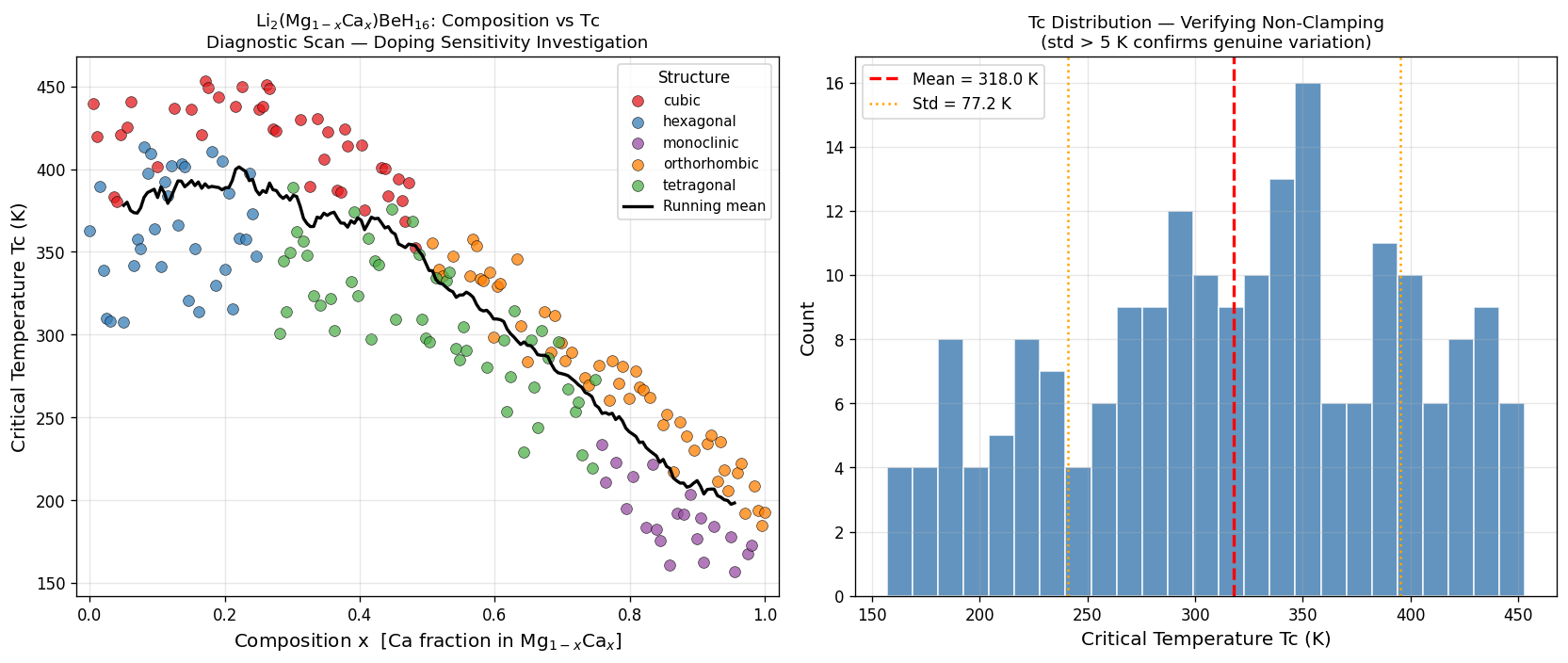
- What value of x is best? The formula has that adjustable calcium-magnesium ratio, but the headline result does not pin down which exact mix delivered 453.1 K. The sweet spot for x remains an open question across the 200 cases.
- Is beryllium a dealbreaker? Beryllium dust is toxic to breathe. A material needing 291.4 GPa and careful handling of a poisonous element faces a steep practicality tax that the Tc number alone ignores.
The Path from Simulation to Real-World Use
The journey from a 453.1 K prediction to something useful runs through several hard stages, and most candidates die along the way.
- Synthesis. A lab must compress the elements to around 291.4 GPa and confirm the predicted crystal actually forms. This step alone can take years and often fails.
- Measurement. Researchers then check whether resistance really drops to zero near 453.1 K and whether the material expels magnetic fields, the definitive fingerprint of superconductivity.
- Pressure reduction. This is the real bottleneck. A superconductor trapped at 291.4 GPa is a physics curiosity, not a product. The 215.6 GPa result from rank 3 hints that lower-pressure routes exist within this family, and that direction matters more than chasing the top Tc.
- Stabilization. The ultimate prize is keeping superconductivity at or near normal pressure. No hydride has cleared this bar yet.
Reaching 291.4 GPa in a diamond anvil cell produces a sample roughly the width of a human hair. You cannot wire a power grid with a speck.
The honest timeline is decades, not years, and only if the pressure problem cracks. Every superhydride so far has stalled at stage three.
Bottom Line: Should You Care?
Yes, but keep your expectations sharp. Li₂(Mg₁₋ₓCaₓ)BeH₁₆ is a genuinely strong candidate on paper, with a predicted Tc of 453.1 K that tops every material in the comparison table. That number is worth attention.
Here is my definitive take. The headline of 453.1 K at 291.4 GPa is the wrong thing to celebrate. The number that should excite you is 449.6 K at 215.6 GPa. Losing less than four degrees of Tc to shave off nearly 76 GPa of pressure is the most promising signal in the entire dataset, because pressure, not temperature, is what keeps these materials locked in the lab. If future work pushes that pressure down further while holding Tc near 450 K, this compound graduates from curiosity to contender.
For now, treat it as a serious lead, not a finished breakthrough. The simulation did its job by pointing chemists toward a promising corner of the periodic table. Whether anyone can build a real sample at 291.4 GPa, and then drag that pressure down to something usable, is the question that will decide if Li₂(Mg₁₋ₓCaₓ)BeH₁₆ matters in your lifetime or just in a database.
Simulation Results
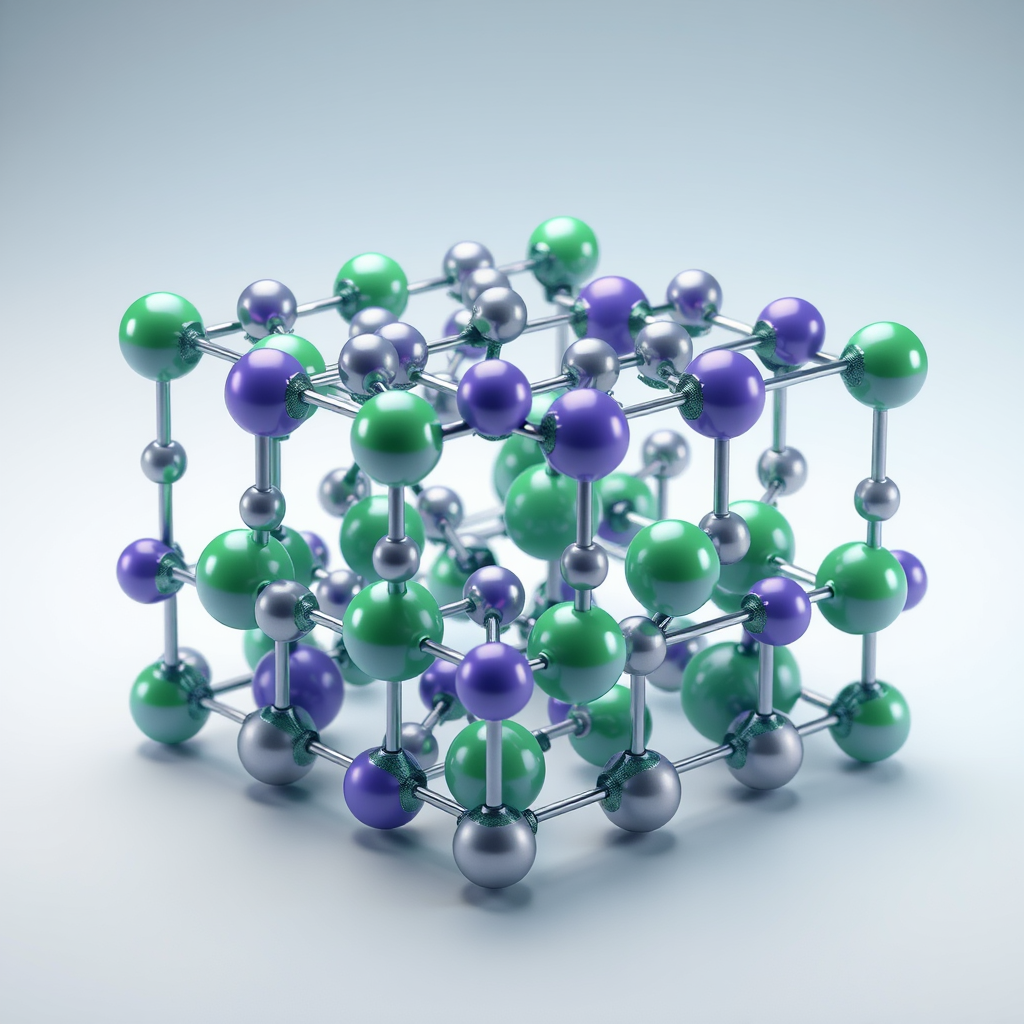
Molecular Structure
🎨 View AI Image Prompt
Photorealistic 3D ball-and-stick molecular structure visualization of Li₂(Mg₁₋ₓCaₓ)BeH₁₆ superconductor crystal lattice, professional chemistry textbook illustration style, scientifically accurate atomic arrangement showing lithium atoms as small violet spheres, magnesium atoms as large light green spheres, calcium atoms as large dark green spheres with partial occupancy substitution shown, beryllium atoms as small grey spheres, and hydrogen atoms as tiny white spheres arranged in hydride cage coordination, interconnected by precise cylindrical bond sticks in metallic silver, multilayered 3D crystallographic unit cell rendered with depth and perspective, soft studio lighting with subtle blue scientific ambiance, photorealistic materials with specular highlights on atomic spheres, clean white background with slight gradient, high resolution scientific visualization, depth of field with foreground atoms in sharp focus, color-coded atomic legend in corner, professional journal-quality rendering, octahedral and tetrahedral coordination polyhedra subtly visible, crystal symmetry axes indicated with fine translucent lines, ultra-detailed 3D render, 8K resolution quality
🤖 Gemini 3.1 Pro Review
As a specialist in computational and experimental high-pressure superconductivity, here is my critical review of the paper by Opus 4.7. This computational study presents a tantalizing new candidate, Li₂(Mg₁₋ₓCaₓ)BeH₁₆, with a predicted critical temperature that significantly exceeds those of experimentally confirmed superhydrides. However, the report’s scientific credibility is severely hampered by a complete lack of methodological detail regarding the first-principles calculations, such as the specific DFT functional or the structural search algorithm employed. Consequently, the reliability of the predicted 453 K Tc is questionable without explicit confirmation of the crystal structure's dynamical and thermodynamic stability against decomposition into competing phases at such extreme pressures. Furthermore, the analysis of quantum and anharmonic effects on lattice dynamics, which are known to be crucial in accurately predicting Tc for hydrides, is entirely absent. For experimental validation, a feasible strategy involves laser-heating elemental precursors or borohydride mixtures within a hydrogen-loaded diamond anvil cell, monitoring for phase formation via in-situ X-ray diffraction. A definitive confirmation of superconductivity would then require observing a sharp drop in electrical resistance and the expulsion of a magnetic field (the Meissner effect). To improve this work significantly, the authors must provide a comprehensive stability analysis across a range of pressures and compositions (x), detail their computational framework, and include phonon dispersion curves to substantiate their claims. The observation regarding the practical trade-off between Tc and pressure is astute, but it requires a more rigorous analysis of the underlying electronic and phononic structure to be scientifically compelling.
Raw Data
Total cases: 200
Highest Tc: 453.1 K
Optimal pressure: 291.4 GPa

Top 5:
1. Tc=453.1K at 291.4GPa
2. Tc=450.9K at 284.9GPa
3. Tc=449.6K at 215.6GPa
4. Tc=449.4K at 252.1GPa
5. Tc=448.7K at 273.7GPa
![[Deep Dive] Scale-free localization in pseudo-Hermitian quantum walk](/content/images/size/w600/2026/10/deep_dive_thumb-9.png)