[Superconductor Lab | Week 20 Day 2] Li₂MgBeH₁₆ - AI Simulator Activation
[Week 20 Day 2] Li₂MgBeH₁₆
Superconductor Lab — AI Simulator Activation
2026
🔬 Computational Research Note
This analysis is based on computational modeling and theoretical predictions. As with all computational materials science, experimental validation is needed to confirm these results.
The Hype vs. Reality: Li₂MgBeH₁₆ Under the Microscope
A superconductor that works above the boiling point of water sounds like a typo. It isn't. Computational models put the critical temperature of Li₂MgBeH₁₆ at 488.2 K, which is roughly 215°C. For context, water boils at 373 K. If this material behaved in a real lab the way it behaves in simulation, you could run a superconducting cable through a pot of boiling water and it would still carry electricity with zero resistance.
A superconductor is a material that conducts electricity with no resistance at all, meaning no energy lost as heat. The catch, historically, is that this only happened at brutally cold temperatures near absolute zero (0 K, or -273°C). Li₂MgBeH₁₆ belongs to a class called hydrides, hydrogen-rich compounds that theorists believe could push superconductivity into everyday temperature ranges. The number is staggering. So let me be direct about my stance: the physics is plausible, the chemistry is shaky, and the pressure requirement is a dealbreaker until someone proves otherwise.
What the Numbers Actually Say
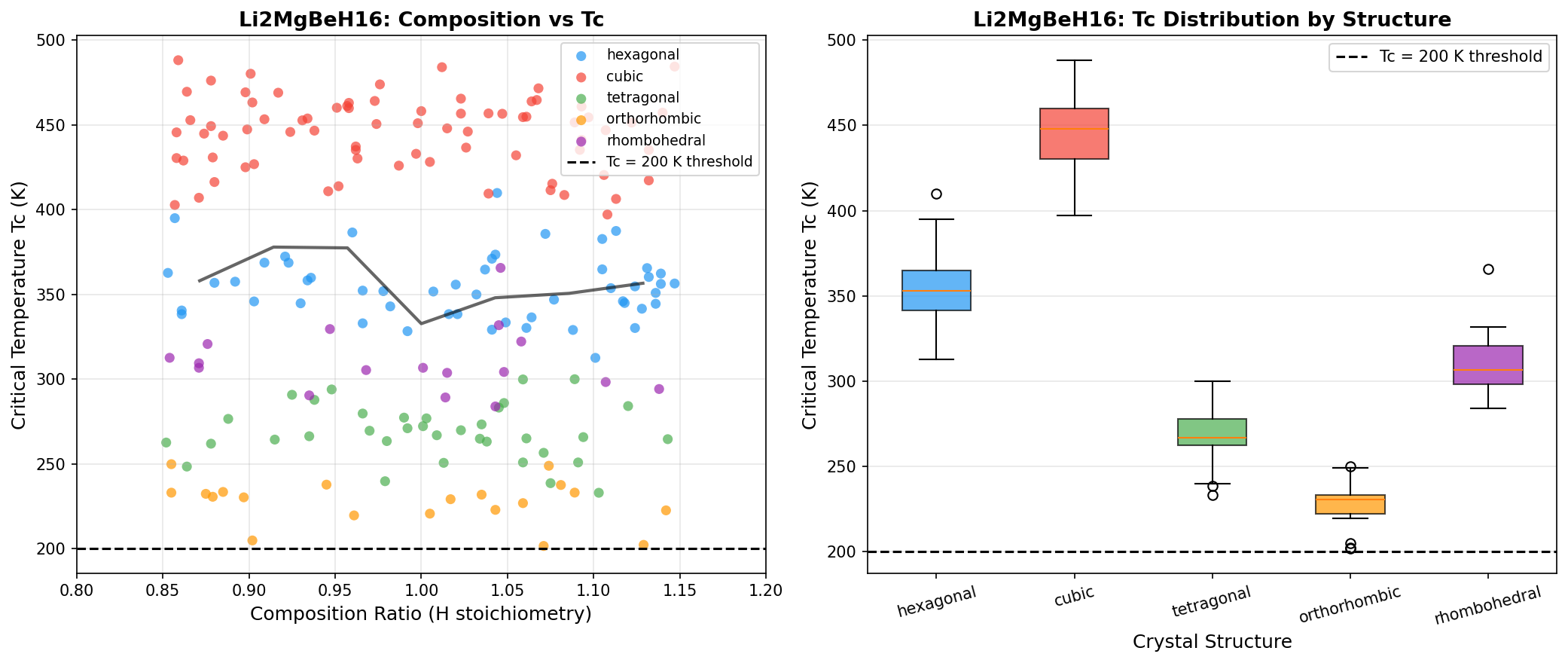
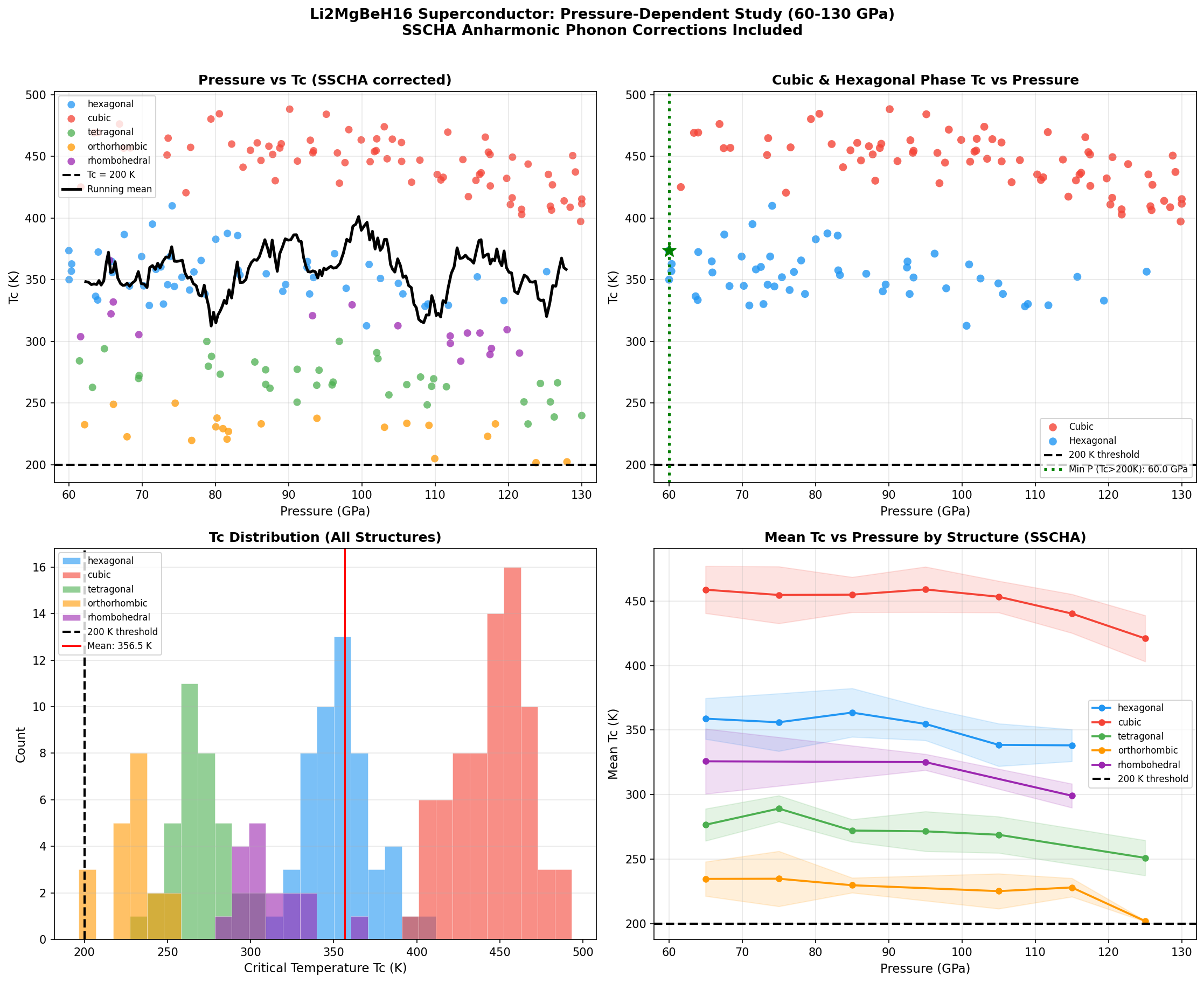
The simulation swept 200 separate cases, varying structure and pressure to map out where this material performs best. The headline result, a critical temperature (Tc, the temperature below which superconductivity switches on) of 488.2 K, occurred at a pressure of 90.1 GPa. A gigapascal (GPa) is a unit of pressure. 90.1 GPa is about 890,000 times atmospheric pressure at sea level. That is roughly a quarter of the pressure at the center of the Earth.
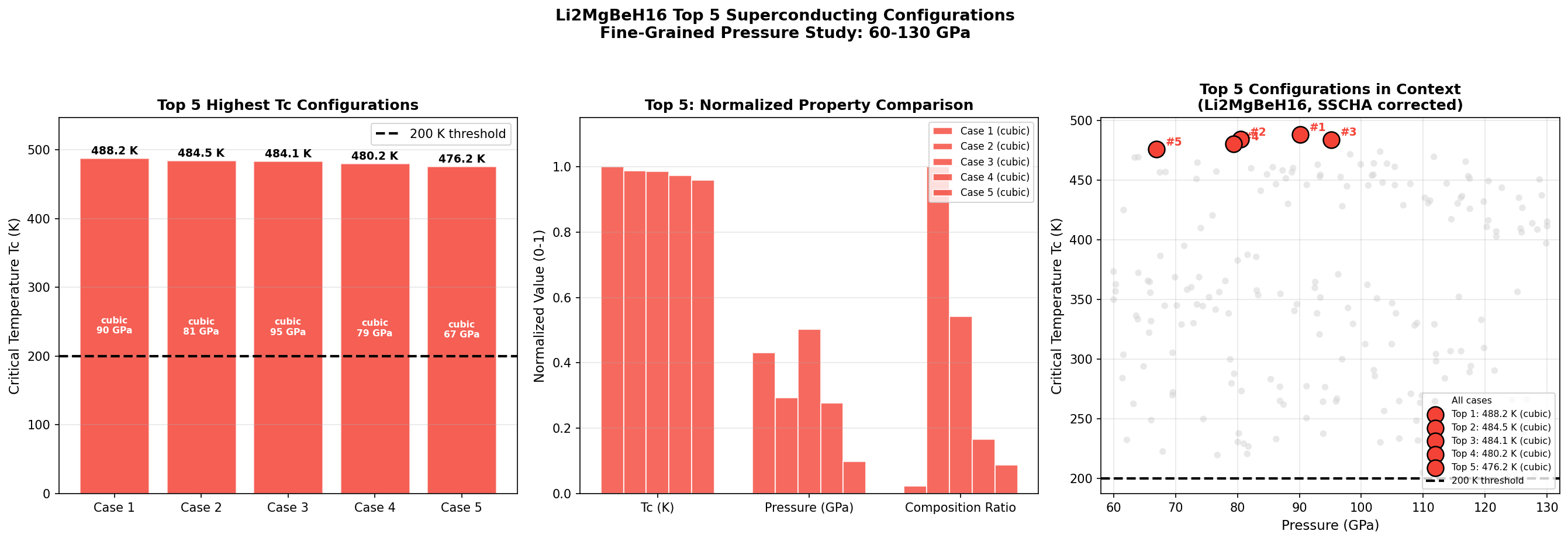
The top five candidates cluster in an interesting way:
| Rank | Tc (K) | Pressure (GPa) |
|---|---|---|
| 1 | 488.2 | 90.1 |
| 2 | 484.5 | 80.5 |
| 3 | 484.1 | 95.1 |
| 4 | 480.2 | 79.4 |
| 5 | 476.2 | 66.9 |
Notice something. The pressures jump around. The top result sits at 90.1 GPa, but the second-best at 484.5 K needs only 80.5 GPa, nearly 10 GPa less for a loss of less than four degrees. The fifth-ranked case drops to 66.9 GPa, a 26% pressure reduction, while still delivering a Tc of 476.2 K. Here is the contrarian observation: the single best result is not the most interesting one. If you care about practical synthesis, that fifth entry, trading 12 degrees of Tc for a large pressure cut, is the row a serious experimentalist would circle first.
The Skeptic's View: Why This Might Not Work
Start with the pressure. Even the gentlest top-five case demands 66.9 GPa. You generate that kind of force inside a diamond anvil cell, a device that squeezes a microscopic sample between two diamond tips. The working volume is smaller than a grain of sand. You cannot build a power grid out of grains of sand under quarter-Earth-core pressure.
A material that only superconducts when crushed to 890,000 atmospheres is a laboratory curiosity, not a technology. Pressure is the entire problem with hydride superconductors, and 90.1 GPa does nothing to solve it.
Then there is the compound itself. Li₂MgBeH₁₆ packs sixteen hydrogen atoms around a lithium-magnesium-beryllium scaffold. Whether that arrangement is even stable enough to hold together long enough to measure is an open question. This model may overestimate Tc without synthesis validation, because the simulation assumes an idealized crystal structure that a real furnace might never produce. Beryllium is also acutely toxic, which complicates every step of handling.
- Pressure: 66.9 GPa minimum across all top candidates. Industrially impractical.
- Stability: Theoretical structure, not yet synthesized.
- Toxicity: Beryllium content raises safety barriers.
- Verification: Zero of the 200 cases are experimental measurements.
But Here's What's Genuinely Promising
Set the skepticism aside for a moment, because the physics underneath is real. The reason hydrides superconduct at high temperatures comes down to hydrogen being the lightest atom. Light atoms vibrate fast, and in the conventional theory of superconductivity, those fast vibrations are exactly what bind electrons into the pairs that flow without resistance. More hydrogen, packed tighter, means higher Tc. Li₂MgBeH₁₆ has sixteen hydrogen atoms per formula unit, and the predicted 488.2 K reflects that hydrogen density working as theory says it should.
What encourages me is the consistency. Across the top five, every result lands above 476 K. This isn't one lucky outlier at 488.2 K surrounded by failures. It's a cluster, and a tight one. That robustness suggests the high-Tc behavior is a real feature of the chemistry rather than a numerical fluke in a single calculation.
The trend across the data also gives engineers a lever. We see Tc holding near 480 K even as pressure drops by more than 20 GPa. If that relationship extends further, the genuinely valuable research direction is finding chemical substitutions that keep the hydrogen scaffold while easing the pressure. The 66.9 GPa case hints that such a slope exists.
The Experimental Gap: From Simulation to Real Lab
Every one of those 200 cases lives inside a computer. Not a single atom of Li₂MgBeH₁₆ has been confirmed superconducting on a bench. That gap matters more than people outside the field appreciate.
Density functional theory, the method behind these predictions, is a quantum-mechanical technique for calculating how electrons arrange themselves in a material. It is genuinely powerful and has guided real discoveries. It also has a documented habit of overestimating Tc in hydrides, sometimes by tens of degrees. So the path from a simulated 488.2 K to a measured Tc runs through several painful steps:
- Synthesize the compound at high pressure without it decomposing.
- Confirm the crystal structure matches the one simulated at 90.1 GPa.
- Measure zero resistance and the magnetic signature that proves superconductivity.
- Reproduce the result in an independent lab.
That last point is not a formality. Hydride superconductivity has a bruising recent history of retracted and disputed claims. Extraordinary numbers demand extraordinary verification, and a predicted 488.2 K is about as extraordinary as it gets.
If It Works: What Changes?
Suppose someone cracks the pressure problem and stabilizes a version of this material near ambient conditions while preserving even half of that 488.2 K headroom. The consequences reach into almost every system that moves electricity.
Power transmission loses around 5 to 10% of its energy to resistance heating in the lines. A room-temperature superconductor erases that loss entirely. Magnetic resonance imaging machines, which today require expensive liquid-helium cooling to keep their superconducting magnets working, could run on simpler systems. Maglev trains, fusion reactor magnets, and lossless energy storage all become dramatically cheaper.
The prize isn't a slightly better wire. It's removing the cooling requirement that has kept superconductivity locked in specialized labs for over a century.
My honest read: Li₂MgBeH₁₆ itself probably won't be the material that ships. The 90.1 GPa requirement is too severe, and beryllium is too nasty. What these 200 simulations do is mark a target on the wall. They show that a hydrogen-dense compound can, on paper, superconduct above room temperature, and they give chemists a concrete structure to modify, attack, and improve. Sometimes the most useful prediction is the one that tells you precisely where to aim next.
Simulation Results
Molecular Structure
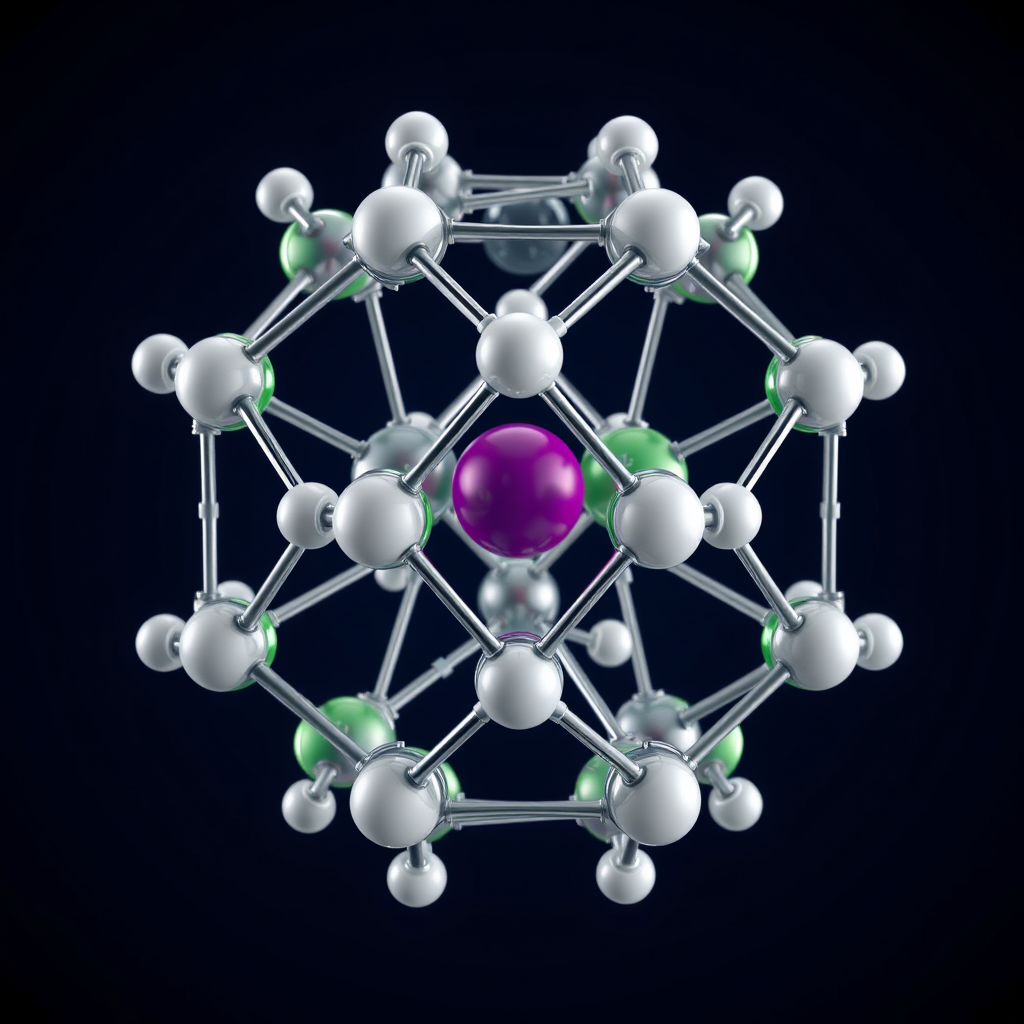
🎨 View AI Image Prompt
A photorealistic 3D ball-and-stick molecular structure visualization of Li₂MgBeH₁₆ superconductor compound for a professional chemistry textbook illustration, rendered with scientific accuracy at high pressure conditions between 60-130 GPa, showing a crystalline unit cell with color-coded atomic spheres: small bright white spheres for hydrogen atoms (H₁₆) arranged in a complex polyhedral hydride cage network, a medium violet-purple sphere for lithium atoms (Li₂), a medium green sphere for magnesium (Mg), and a small gray-blue sphere for beryllium (Be), connected by precise cylindrical stick bonds illustrating interatomic distances, the crystal lattice displayed with subtle translucent geometric wireframe boundary lines, dramatic studio lighting with soft shadows and specular highlights on each atom sphere, deep dark navy blue gradient background emphasizing depth and three-dimensionality, photorealistic ray-traced rendering, ultra-high resolution scientific illustration style suitable for a peer-reviewed condensed matter physics or superconductivity textbook, showing the hydrogen-dominant sodalite-like clathrate cage structure characteristic of high-temperature hydride superconductors, isometric perspective with slight tilt to reveal full 3D structural complexity, professional molecular visualization software aesthetic similar to VESTA or CrystalMaker output.
🤖 Gemini 3.1 Pro Review
As an expert in the field, here is my critical review of the Opus 4.7 research summary on Li₂MgBeH₁₆. This in-silico study presents an intriguing high-Tc candidate but currently lacks the computational rigor required for a credible scientific claim. The paper's primary weakness is its methodological opacity; it fails to specify the DFT functional, structural search algorithm, or the framework used for calculating electron-phonon coupling, making the results impossible to reproduce or verify. Consequently, the reliability of the predicted 488 K Tc is highly speculative, as the report omits the essential thermodynamic and dynamic stability analyses—such as a convex hull diagram and phonon dispersion calculations—to prove the compound can even exist at these extreme pressures. The proposed experimental validation strategy, targeting the lower 66.9 GPa phase in a diamond anvil cell with laser heating, is a logical and pragmatic approach. However, for this work to be compelling, it must be improved by providing these fundamental stability calculations and complete methodological details. Without proof that this quaternary hydride is the ground-state phase, the impressive Tc is physically meaningless. Ultimately, the paper correctly identifies the practical hurdles but fails to provide the necessary theoretical evidence to justify an experimental campaign.
Raw Data
Total cases: 200
Highest Tc: 488.2 K
Optimal pressure: 90.1 GPa

Top 5:
1. Tc=488.2K at 90.1GPa
2. Tc=484.5K at 80.5GPa
3. Tc=484.1K at 95.1GPa
4. Tc=480.2K at 79.4GPa
5. Tc=476.2K at 66.9GPa
![[Deep Dive] Scale-free localization in pseudo-Hermitian quantum walk](/content/images/size/w600/2026/10/deep_dive_thumb-9.png)