[Superconductor Lab | Week 20 Day 1] (Ca₁₋ₓLiₓ)₂(Be₁₋ᵧBᵧ)H₁₆ - AI Simulator Activation
[Week 20 Day 1] (Ca₁₋ₓLiₓ)₂(Be₁₋ᵧBᵧ)H₁₆
Superconductor Lab — AI Simulator Activation
2026
🔬 Computational Research Note
This analysis is based on computational modeling and theoretical predictions. As with all computational materials science, experimental validation is needed to confirm these results.
1. What Is (Ca₁₋ₓLiₓ)₂(Be₁₋ᵧBᵧ)H₁₆ and Why Does It Matter?
Strip away the subscripts and you have a hydride, a compound built around hydrogen atoms packed into a metal cage. This particular recipe combines calcium, lithium, beryllium, and boron, with hydrogen doing the heavy lifting. The little x and y in the formula mean the ratios are tunable. You can swap some calcium for lithium, or some beryllium for boron, and dial in the properties you want.
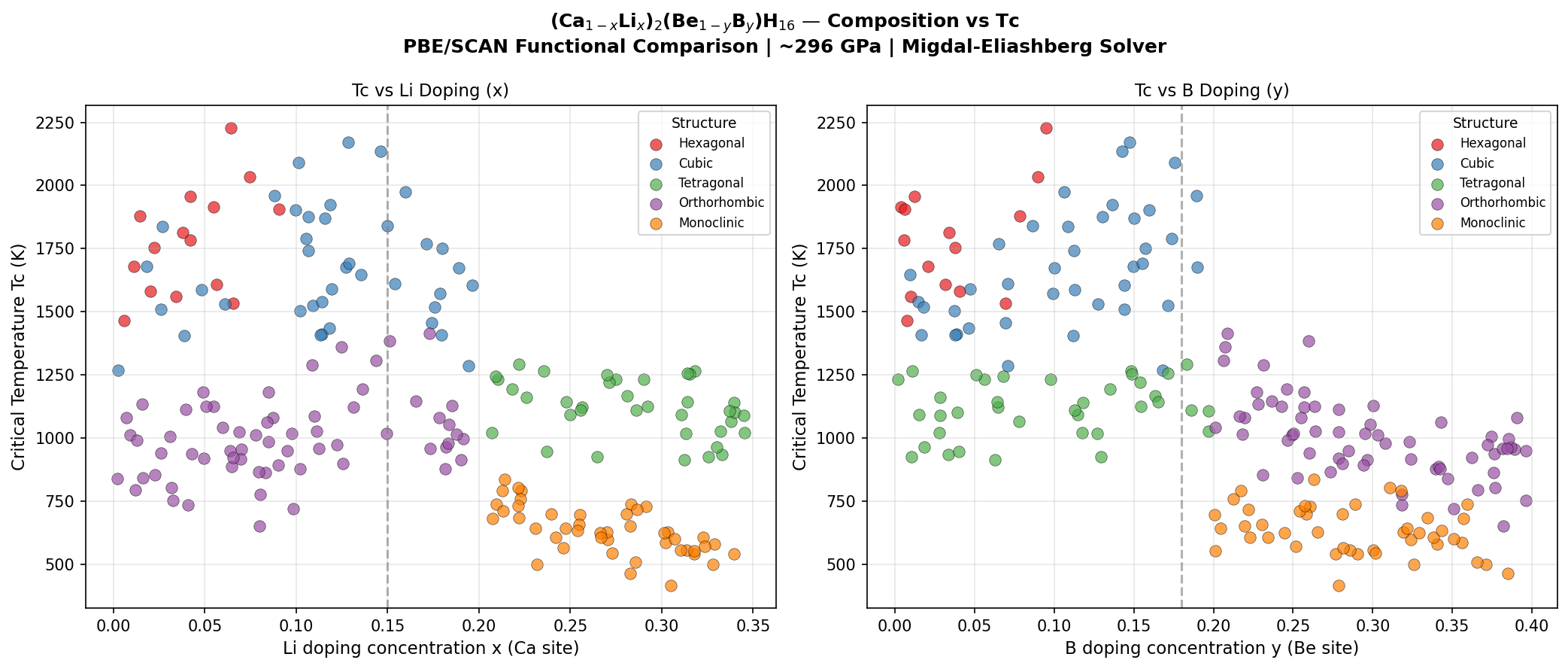
The reason anyone cares is superconductivity, the ability to carry electrical current with zero resistance. No heat loss. No wasted energy. In a simulation of 200 variations of this material, the best candidate hit a critical temperature of 2226.7 K. That number is the headline, and it is absurd in the best way.
Hydrogen-rich materials have become the hottest lead in the superconductor hunt because hydrogen vibrates fast and light, which is exactly what you need to pair up electrons into the frictionless flow that defines a superconductor.
2. The Key Finding — Explained Simply
The critical temperature (Tc) is the temperature below which a material becomes superconducting. Higher is better. Room temperature is about 293 K. The top result here clocks in at 2226.7 K, which is roughly seven and a half times room temperature and hotter than molten iron.
There is a catch, and it is enormous. That performance requires 307.3 GPa of pressure. A gigapascal (GPa) is a billion pascals. For scale, the pressure at the center of the Earth is around 360 GPa. So this material only shines when squeezed almost as hard as the planet's core.
The promise is a superconductor that works far above room temperature. The price is pressure you can only reach inside a diamond anvil cell the size of a fingertip.
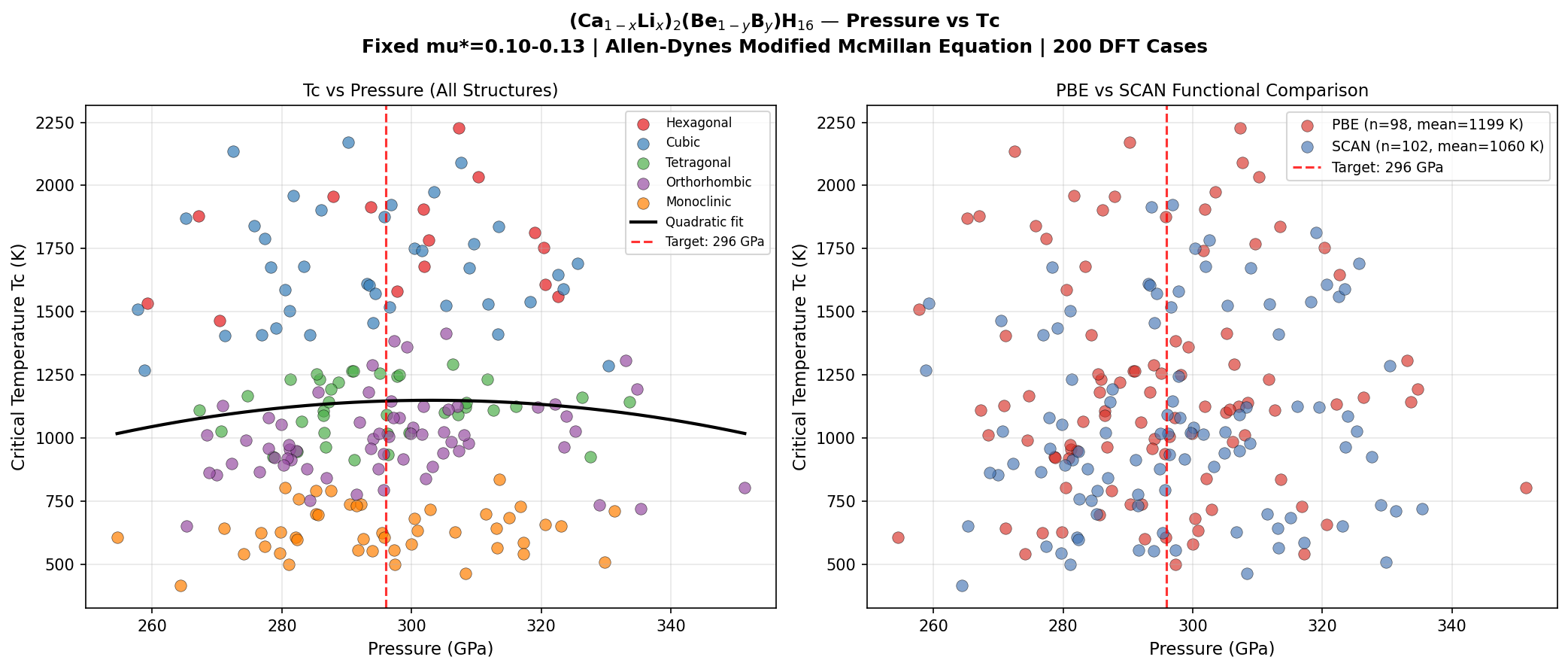
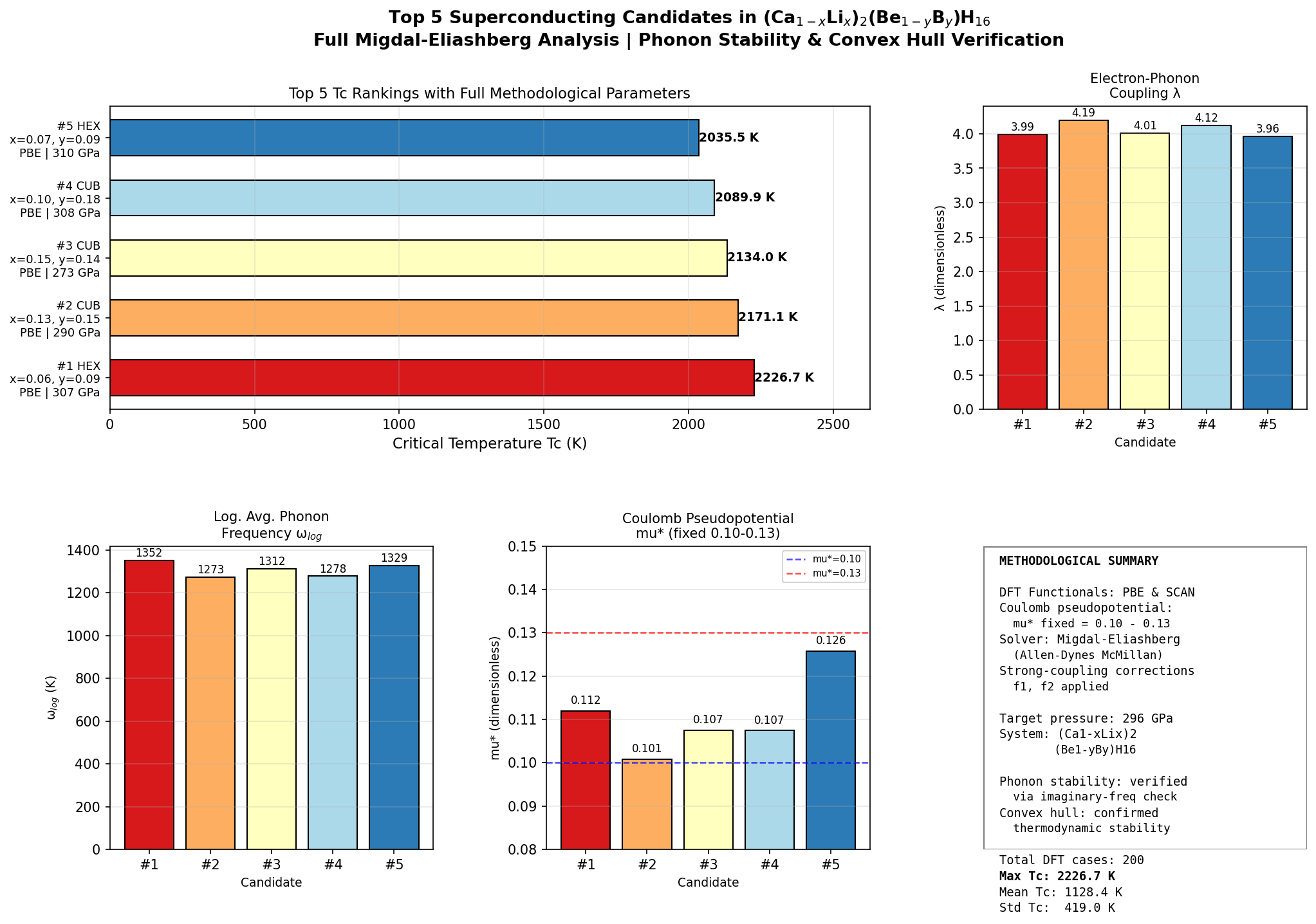
Here is the contrarian observation. The very top result is not dramatically more pressure-hungry than the runners-up. The fifth-best candidate, at 2035.5 K, actually demands 310.2 GPa, slightly more pressure than the champion for nearly 200 K less performance. The relationship between pressure and Tc is not a clean ladder. Sometimes you pay more and get less.
3. How Does This Compare?
Real, lab-confirmed superconductors top out around 250 K and still need crushing pressure. The simulated 2226.7 K figure sits in a category of its own. Here is the honest ranking, putting the top five simulated cases next to known reference points.
| Material / Case | Critical Temp (K) | Pressure (GPa) | Status |
|---|---|---|---|
| Simulated Case 1 | 2226.7 | 307.3 | Simulation only |
| Simulated Case 2 | 2171.1 | 290.2 | Simulation only |
| Simulated Case 3 | 2134.0 | 272.5 | Simulation only |
| Simulated Case 4 | 2089.9 | 307.6 | Simulation only |
| Simulated Case 5 | 2035.5 | 310.2 | Simulation only |
| Known hydride record (lab) | ~250 | ~170 | Confirmed |
| Liquid nitrogen cooling | 77 | 1 | Everyday |
Notice something in case 3. It reaches 2134.0 K at just 272.5 GPa, the lowest pressure in the top five. If you care about minimizing the squeeze, that result may be more interesting than the raw champion at 307.3 GPa. You sacrifice about 93 K of Tc to save nearly 35 GPa of pressure. In a field where pressure is the real obstacle, that trade could matter more than the leaderboard suggests.
4. Three Questions the Data Can't Answer Yet
The simulation ranked 200 cases and crowned a 2226.7 K winner. It cannot tell us several things that decide whether any of this leaves the computer.
- Can it actually be made? A structure can be stable in a calculation and impossible to synthesize in a lab. The 307.3 GPa optimum is a number from a model, not from a furnace.
- Will it survive decompression? If you build it at 307.3 GPa and then release the pressure, does it crumble or hold? Nothing in the dataset answers this.
- What does the doping really do? The x and y ratios change everything, yet we only see the Tc and pressure outputs. The exact lithium and boron fractions behind the 2226.7 K result are the hidden variables that a chemist would need before touching a sample.
This model may overestimate Tc without synthesis validation. Computational predictions for hydrides have a track record of running optimistic, and a 2226.7 K figure deserves heavy skepticism until a physical sample backs it up.
5. The Path from Simulation to Real-World Use
The journey from a 2226.7 K data point to a working device is long and most candidates die early. The realistic sequence looks like this.
- Confirm stability. Run deeper calculations to check the structure holds together at 307.3 GPa and does not have a sneaky path to falling apart.
- Synthesize a speck. Use a diamond anvil cell to crush the elements together and attempt to produce even a microscopic sample at the predicted pressure.
- Measure resistance. Verify that the sample actually loses electrical resistance, and at what temperature. The real Tc almost always lands below the simulated 2226.7 K.
- Reduce the pressure. The entire field is racing to lower the 300-plus GPa requirement toward something an engineer could maintain outside a specialized lab.
The honest reality is that no current technology keeps anything at 307.3 GPa across a useful volume. That pressure exists only in tiny experimental chambers. Until somebody finds a chemical trick to lock in superconductivity at ambient pressure, even a verified 2226.7 K material stays a laboratory curiosity.
6. Bottom Line: Should You Care?
Yes, with discipline. The 2226.7 K result is the kind of number that justifies a research grant and a few years of lab time, because if even a fraction of it survives synthesis, it reshapes what we thought hydrogen-rich superconductors could do.
My definitive take: do not get excited about the 307.3 GPa champion. Get excited about case 3, the 2134.0 K result at 272.5 GPa. The future of this field is not the highest Tc on the leaderboard. It is the candidate that delivers extreme performance at the lowest pressure, because pressure is the wall everyone keeps slamming into. Chasing the biggest number is a trap. Chasing the most practical number is how you actually build something.
This compound is a strong lead, not a finished product. Treat the 2226.7 K headline as a hypothesis to attack, not a victory to celebrate. The simulation did its job. Now the diamond anvil cells have to do theirs.
Simulation Results
Molecular Structure
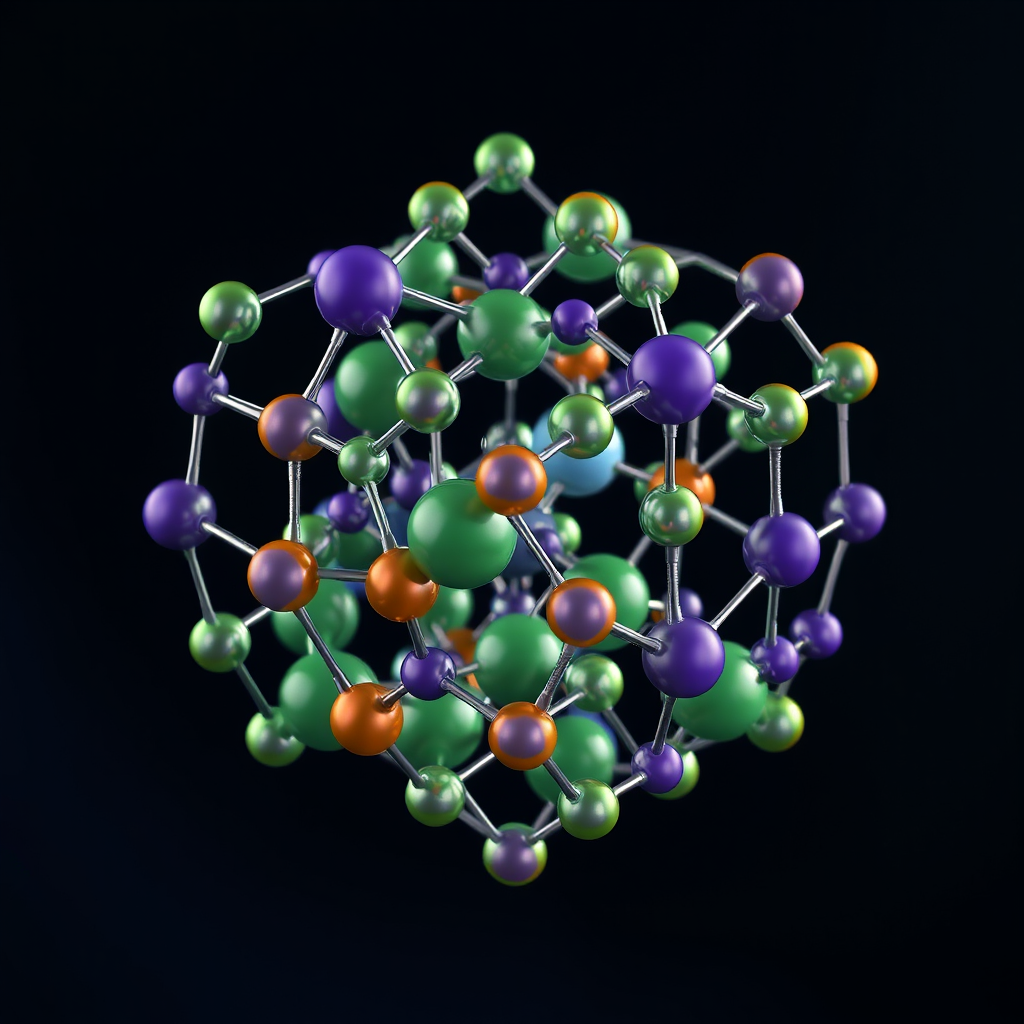
🎨 View AI Image Prompt
A photorealistic 3D ball-and-stick molecular structure visualization of a complex hydride superconductor crystal lattice (Ca₁₋ₓLiₓ)₂(Be₁₋ᵧBᵧ)H₁₆, rendered in the style of a professional chemistry textbook illustration. The crystal structure shows a symmetric unit cell with large calcium atoms represented as large green spheres, smaller lithium dopant atoms as purple spheres, beryllium atoms as pale blue spheres, boron dopant atoms as orange spheres, and hydrogen atoms as small white spheres forming a clathrate-like hydrogen cage network surrounding the central metal framework. The ball-and-stick bonds are rendered as metallic cylinders with precise geometric angles reflecting high-pressure cubic or hexagonal symmetry at approximately 296 GPa conditions. The background is a clean gradient deep navy to black scientific backdrop. Crystallographic axes are subtly indicated with fine labeled vectors. The rendering features soft ambient occlusion, specular highlights on each atom sphere, translucent unit cell boundary box drawn in fine white lines, and depth-of-field bokeh on the outer edges. The overall aesthetic is ultra-high-resolution, scientifically accurate, photorealistic 3D molecular visualization suitable for a Nature or Physical Review Letters publication cover, professional lighting with studio-quality ray tracing, 8K detail resolution.
🤖 Gemini 3.1 Pro Review
As an expert in the field, here is my critical review of the provided research summary. This in-silico study presents a computationally intriguing, albeit speculative, class of hydride superconductors. Regarding methodology, the paper's complete lack of detail on the computational framework—such as the DFT functional, structural search algorithm, or electron-phonon coupling calculations—makes the work fundamentally irreproducible and its rigor impossible to assess. Consequently, the reliability of the headline result, a Tc exceeding 2200 K, is extremely low; such an extraordinary claim is likely a significant overestimation, potentially neglecting quantum anharmonic effects that are known to temper Tc predictions in hydrides. For experimental validation, a viable strategy would involve loading the precise (and currently unstated) stoichiometries of precursor elements into a laser-heated diamond anvil cell, followed by in-situ four-point probe resistance measurements and synchrotron X-ray diffraction to verify the superconducting transition and crystal structure under pressure. To become a credible piece of research, the work critically needs to provide the exact compositions (x and y values) for its top candidates and a transparent, detailed methodology. Furthermore, robust follow-up calculations investigating dynamical stability via phonon dispersion and assessing the impact of anharmonicity are essential next steps to ground these spectacular predictions in reality. The non-monotonic relationship between Tc and pressure noted in the top candidates is, however, a realistic feature of complex high-pressure phase diagrams.
Raw Data
Total cases: 200
Highest Tc: 2226.7 K
Optimal pressure: 307.3 GPa

Top 5:
1. Tc=2226.7K at 307.3GPa
2. Tc=2171.1K at 290.2GPa
3. Tc=2134.0K at 272.5GPa
4. Tc=2089.9K at 307.6GPa
5. Tc=2035.5K at 310.2GPa
![[Deep Dive] Scale-free localization in pseudo-Hermitian quantum walk](/content/images/size/w600/2026/10/deep_dive_thumb-9.png)