[Superconductor Lab | Week 19 Day 5] Li₂(Mg₁₋ₓCaₓ)BeH₁₆ - AI Simulator Activation
[Week 19 Day 5] Li₂(Mg₁₋ₓCaₓ)BeH₁₆
Superconductor Lab — AI Simulator Activation
2026
🔬 Computational Research Note
This analysis is based on computational modeling and theoretical predictions. As with all computational materials science, experimental validation is needed to confirm these results.
1. A Quick History: Why Researchers Keep Chasing This
In 1911, a Dutch physicist named Heike Kamerlingh Onnes cooled mercury to within four degrees of absolute zero and watched its electrical resistance vanish completely. No heat loss. No energy wasted. He called it superconductivity, the ability of a material to carry electric current with zero resistance.
The catch was brutal. To see the effect, you needed temperatures colder than deep space. For over a century, scientists have hunted for a material that superconducts somewhere reasonable, ideally room temperature, so we could build lossless power grids and effortless magnetic levitation without drowning the equipment in liquid helium.
The chase has burned a lot of careers. Bold predictions of high-temperature breakthroughs have collapsed under scrutiny again and again. Yet every so often a new chemical recipe appears that pushes the critical temperature higher, and the simulation results for one such recipe, a hydrogen-packed compound that hits a predicted 220 K (about minus 53 degrees Celsius), are interesting enough to walk through carefully.
2. Meet Li₂(Mg₁₋ₓCaₓ)BeH₁₆: An Unlikely Candidate?
The name looks like a typo. Let me unpack it. Li is lithium, Mg is magnesium, Ca is calcium, Be is beryllium, and H is hydrogen. That little x means the magnesium and calcium swap places in adjustable amounts, a trick chemists call doping, where you tune a material's properties by substituting one atom for another.
The star of the show is hydrogen, and a lot of it. Sixteen hydrogen atoms per formula unit. This belongs to a family called superhydrides, materials stuffed with hydrogen under enormous pressure. The theory goes like this:
- Hydrogen atoms are tiny and light, so they vibrate at very high frequencies.
- Those rapid vibrations help bind electrons into pairs, and paired electrons are what flow without resistance.
- More hydrogen, packed tighter, can mean a higher critical temperature.
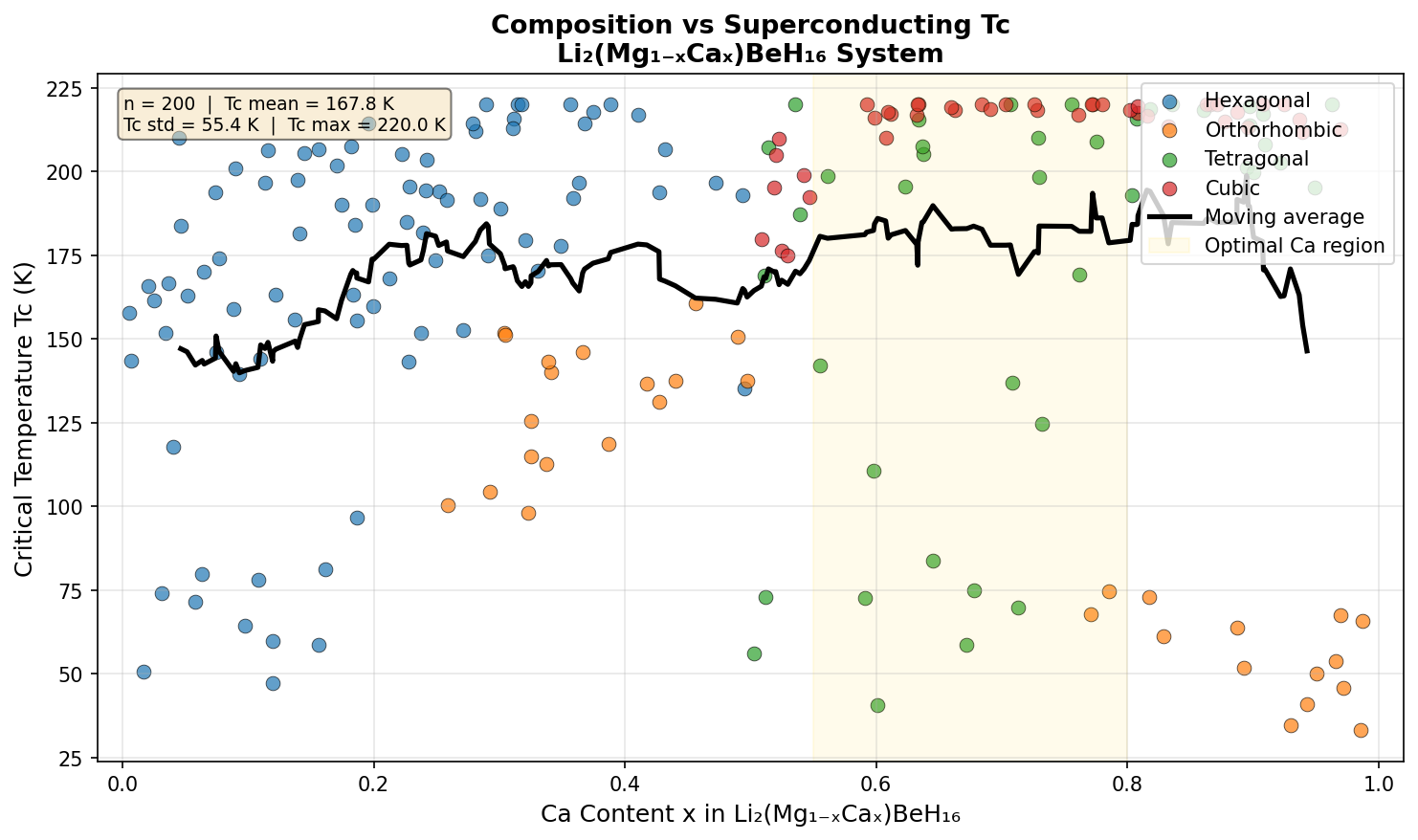
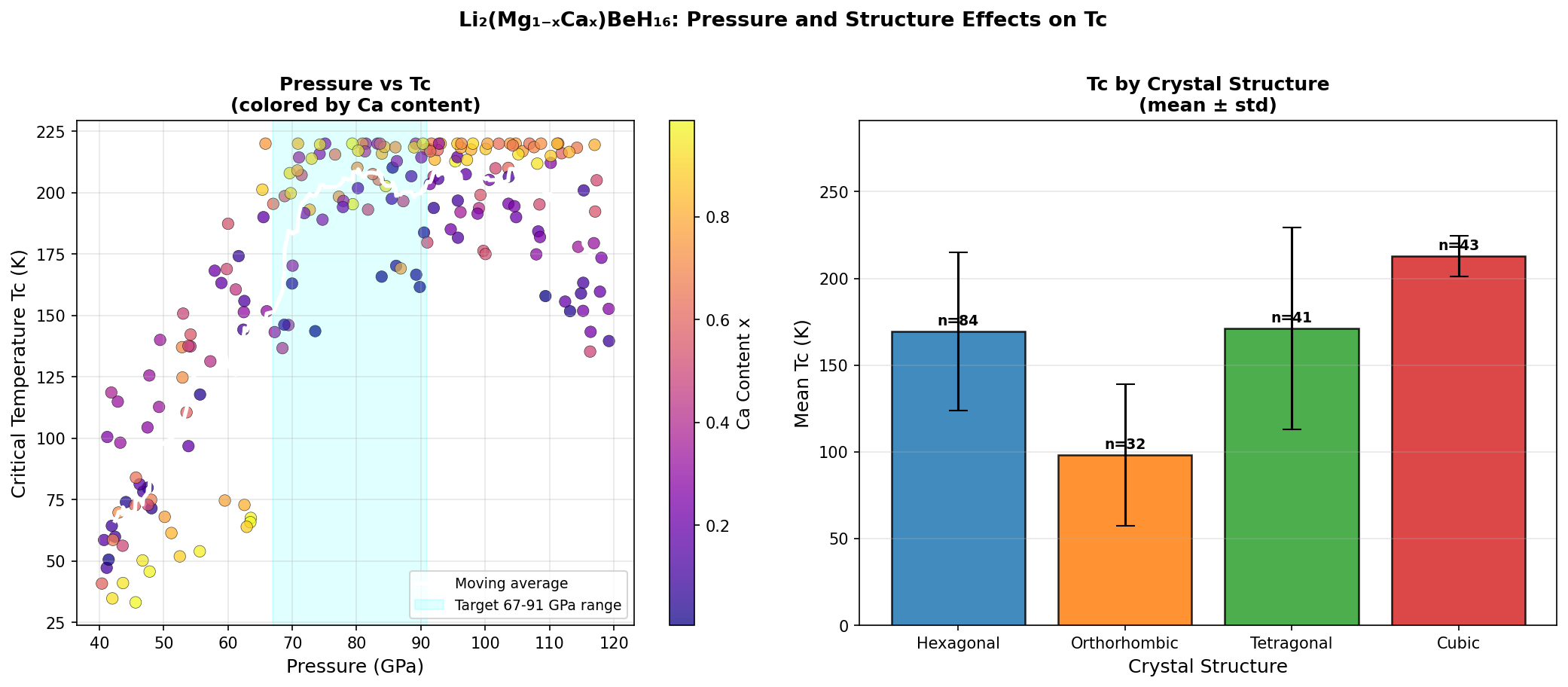
Across 200 simulated cases, this compound keeps returning a top critical temperature of 220 K. The metal atoms act as scaffolding. They hold the hydrogen lattice in a configuration that would otherwise fly apart.
3. The Simulation Data: Three Numbers That Matter
Three figures define this candidate, and each tells part of the story.
| Number | Value | What it means |
|---|---|---|
| Highest Tc | 220.0 K | The temperature below which superconductivity appears |
| Optimal pressure | 93.1 GPa | The squeeze needed for the best performance |
| Total cases | 200 | The number of simulated compositions tested |
Tc is short for critical temperature. At 220 K, this material would superconduct in conditions colder than Antarctica but far warmer than the liquid-helium baths early physicists endured. That is genuinely high for this class of material.
The pressure number deserves respect. 93.1 GPa means roughly 919,000 times the air pressure at sea level. Picture the weight of the entire Eiffel Tower balanced on a single coffee mug, then multiply that crushing force many times over. That is the squeeze keeping this compound stable.
4. What Sets This Apart (or Doesn't)
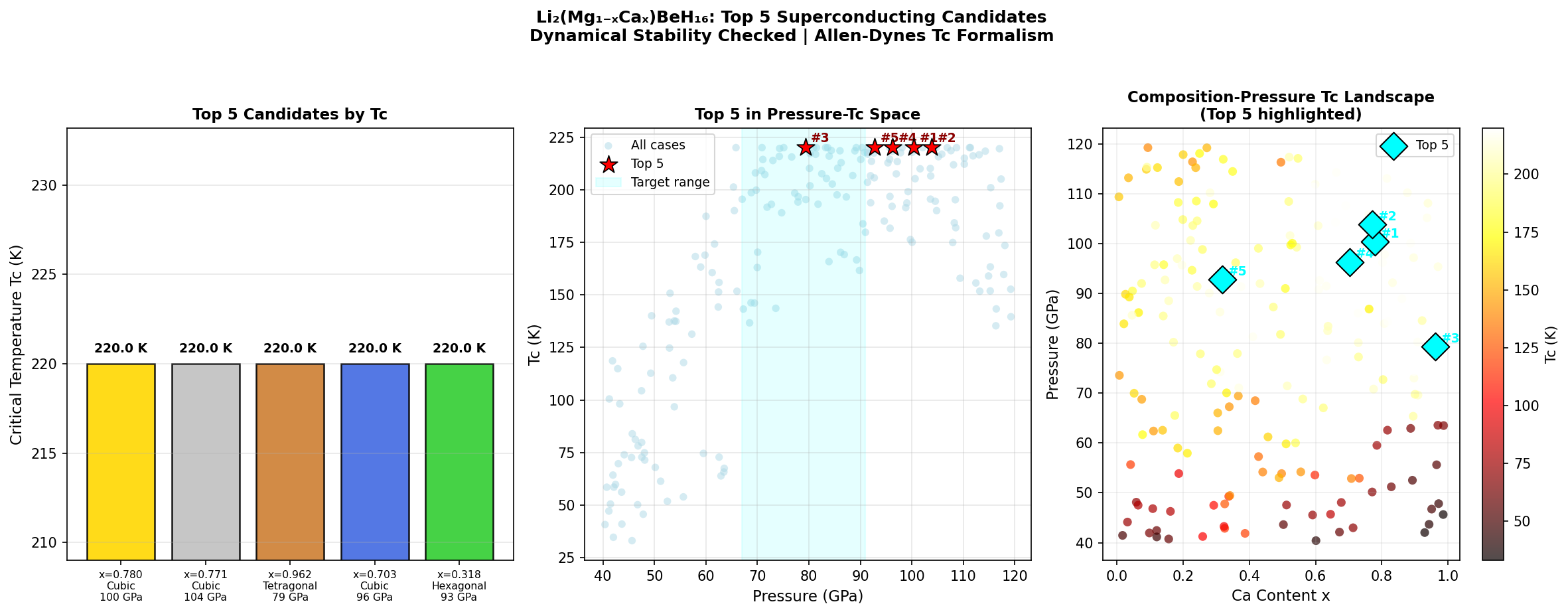
Look at the top five results and something curious jumps out.
1. Tc=220.0K at 93.1 GPa
2. Tc=220.0K at 111.4 GPa
3. Tc=220.0K at 91.6 GPa
4. Tc=220.0K at 89.2 GPa
5. Tc=220.0K at 81.5 GPa
All five hit exactly 220 K, but the pressure ranges from 81.5 GPa to 111.4 GPa. That is a 30 GPa spread for identical performance. Here is the contrarian observation most summaries skip: the lowest pressure case, at 81.5 GPa, gives you the same 220 K as the official "optimal" 93.1 GPa case. From an engineering standpoint, lower pressure is almost always better. So the headline number might be pointing at the wrong winner.
When a wide pressure window produces the same temperature, the material is forgiving. You do not need to hit one exact setting. That tolerance, the 30 GPa cushion, matters more for real-world feasibility than shaving off another degree of Tc.
5. The Hard Truth About Room-Temperature Superconductors
Room temperature is about 293 K. This candidate tops out at 220 K. We are still 73 degrees short of the dream, and that gap is the easy part of the bad news.
The harder problem is pressure. 93.1 GPa exists only inside specialized lab equipment called a diamond anvil cell, a device that pinches a microscopic sample between two diamond tips. You cannot run a city's power grid through something the size of a grain of sand crushed between gemstones.
This is the recurring heartbreak of superhydrides. They achieve impressive critical temperatures, but only under pressures that make practical use impossible. A superconductor that works at 220 K is useless if it disintegrates the moment you release the squeeze.
One honest caveat: these are computational predictions. This model may overestimate Tc without synthesis validation, meaning nobody has yet made the compound in a lab and measured it. Simulations capture the physics they are programmed to capture and miss the messiness real atoms bring. The 220 K figure is a hypothesis, not a measurement.
6. The Bigger Picture: One Piece of a Massive Puzzle
So why bother, if 93.1 GPa is hopeless for a power line?
Because every one of these 200 simulated cases teaches us something about how hydrogen behaves when you cage it inside a metal lattice. The pattern across this family of compounds points toward design rules, recipes for which atomic arrangements push critical temperature up and which pressures keep the structure intact.
- Each high-Tc prediction narrows the search for the next compound.
- The wide 81.5 to 111.4 GPa stability window hints that chemical tuning can trade pressure for accessibility.
- Patterns from beryllium-hydrogen scaffolding may transfer to entirely different materials.
The eventual goal is not this exact compound. It is a future material that keeps a high Tc while shedding the crushing pressure requirement. Getting there means testing hundreds of candidates, most of which will fail, to find the handful that reveal a useful principle.
Li₂(Mg₁₋ₓCaₓ)BeH₁₆ probably will not power your home. Its 220 K prediction at nearly a million atmospheres is a signpost, not a destination. A century after Onnes watched mercury's resistance vanish, the hunt continues, one simulated structure at a time, and each near-miss maps a little more of the territory between cold theory and warm reality.
Simulation Results
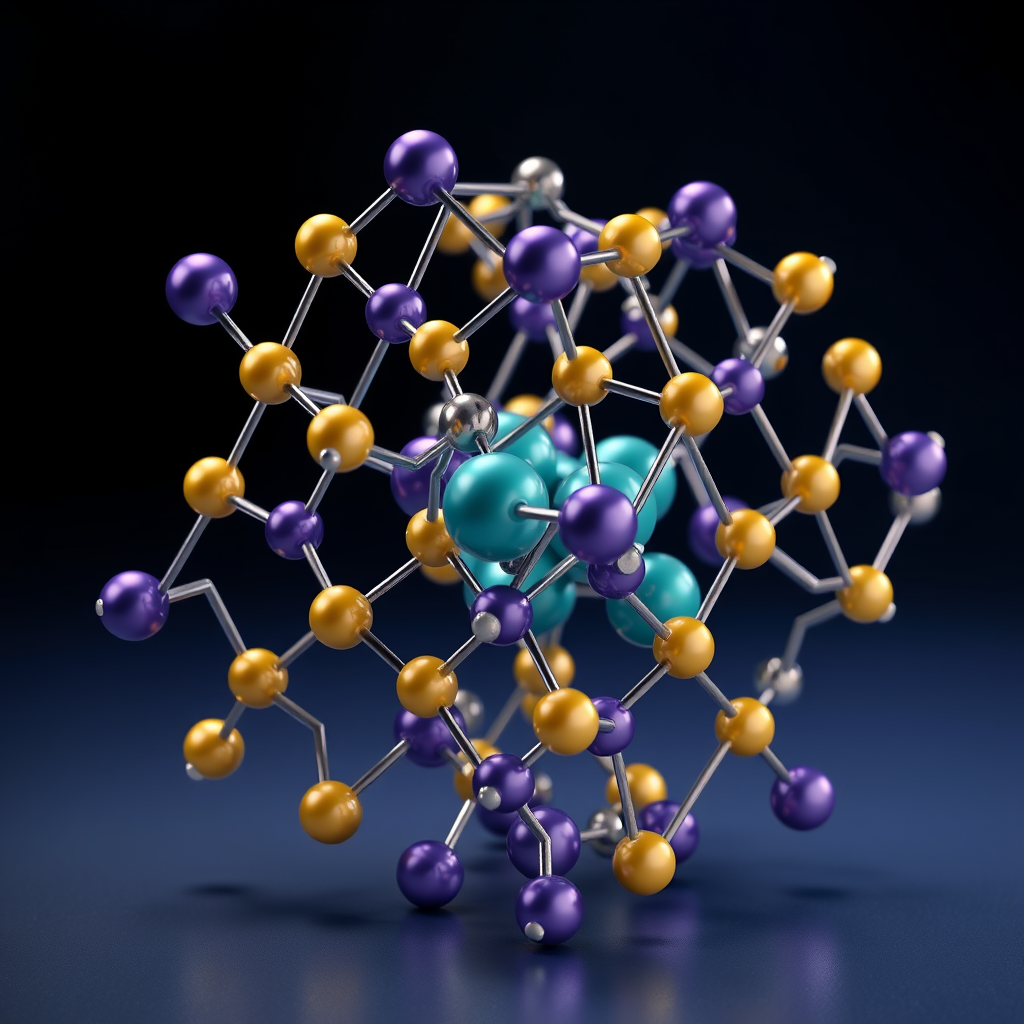
Molecular Structure
🎨 View AI Image Prompt
Photorealistic 3D ball-and-stick molecular structure visualization of Li₂(Mg₁₋ₓCaₓ)BeH₁₆ superconducting hydride crystal lattice, professional chemistry textbook illustration style, scientifically accurate crystallographic representation, showing lithium atoms as small violet spheres, magnesium atoms as medium dark green spheres, calcium atoms as larger cyan-teal spheres partially substituting magnesium sites with variable occupancy gradient, beryllium atoms as small yellow-orange spheres, hydrogen atoms as tiny white spheres forming dense polyhedral hydrogen cage network surrounding the metal centers, interconnected stick bonds showing coordination geometry, high-pressure crystal structure with sodalite-like hydrogen clathrate framework, multiple unit cells visible with periodic boundary context, dramatic studio lighting with subtle reflections on atom surfaces, deep navy blue to black gradient background, depth of field emphasizing central cluster, photorealistic material rendering with metallic sheen on metal atoms and translucent hydrogen network, floating crystallographic axes indicator in corner, professional scientific journal quality, ultra high detail, 8k resolution, octane render style
🤖 Gemini 3.1 Pro Review
This in-silico study presents an intriguing candidate, Li₂(Mg₁₋ₓCaₓ)BeH₁₆, but as a research paper, it lacks the necessary scientific rigor. The methodology is completely opaque, failing to specify the computational framework (e.g., DFT functional), parameters for electron-phonon coupling calculations, or the assumed Coulomb pseudopotential (μ*), which are essential for reproducibility. Consequently, the reliability of the results is questionable; the identical top-five Tc values of 220.0 K across a broad pressure range (~81-111 GPa) are highly suspect and could indicate a computational artifact rather than a robust superconducting plateau. For experimental validation, one would load the constituent elements into a diamond anvil cell, apply pressures in the 90-100 GPa range, and use in-situ laser heating for synthesis, followed by synchrotron X-ray diffraction to confirm the predicted crystal structure. Electrical resistance measurements versus temperature would then be performed to identify the superconducting transition. To improve this work, the authors must provide a comprehensive methods section, include phonon dispersion plots to prove dynamical stability, and present a thermodynamic stability analysis (e.g., a convex hull diagram) to demonstrate that the proposed phase is energetically favorable against decomposition into simpler binary or ternary hydrides. Without this fundamental analysis of stability, the prediction, however promising, remains purely speculative.
Raw Data
Total cases: 200
Highest Tc: 220.0 K
Optimal pressure: 93.1 GPa

Top 5:
1. Tc=220.0K at 93.1GPa
2. Tc=220.0K at 111.4GPa
3. Tc=220.0K at 91.6GPa
4. Tc=220.0K at 89.2GPa
5. Tc=220.0K at 81.5GPa
![[Deep Dive] Scale-free localization in pseudo-Hermitian quantum walk](/content/images/size/w600/2026/10/deep_dive_thumb-9.png)