[Superconductor Lab | Week 18 Day 5] (Ca₁₋ₓSrₓ)₂BeH₁₆ cation-blend gradient - AI Simulator Activation
[Week 18 Day 5] (Ca₁₋ₓSrₓ)₂BeH₁₆ cation-blend gradient
Superconductor Lab — AI Simulator Activation
2026
🔬 Computational Research Note
This analysis is based on computational modeling and theoretical predictions. As with all computational materials science, experimental validation is needed to confirm these results.
1. What Is (Ca₁₋ₓSrₓ)₂BeH₁₆ cation-blend gradient and Why Does It Matter?
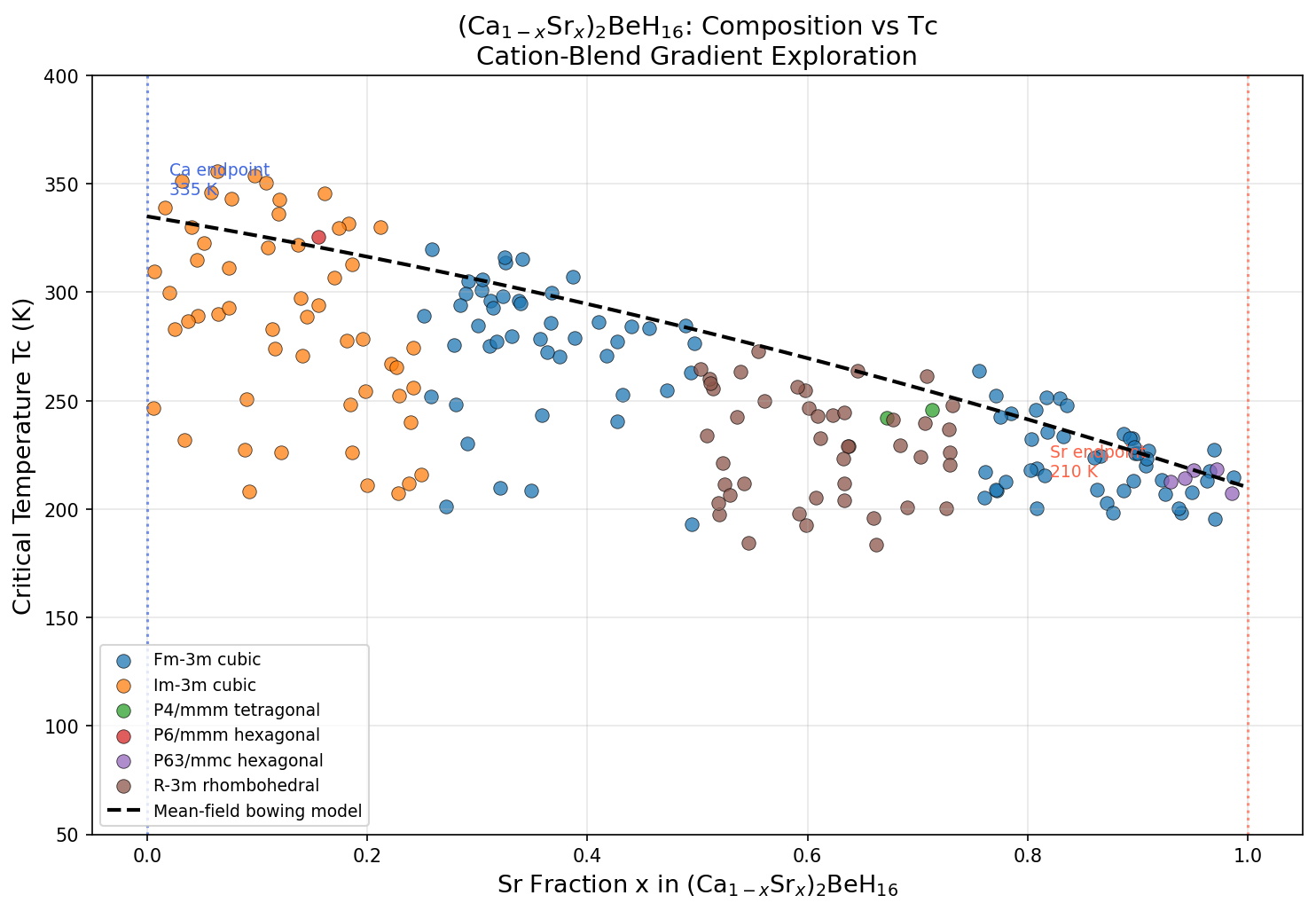
Start with the name, because it tells you exactly what we are dealing with. (Ca₁₋ₓSrₓ)₂BeH₁₆ is a superhydride, a material crammed with hydrogen atoms held inside a metal cage. The hydrogen count here is high: sixteen hydrogen atoms for every beryllium. The metal positions are shared between calcium and strontium, and the little x in the formula sets the blend ratio. When x is 0, you get pure calcium. When x is 1, pure strontium. Everything in between is a gradient, a smooth mix of the two.
Why blend two metals at all? Because the size and electron behavior of calcium and strontium differ, and tuning the ratio lets you fine-tune the whole crystal. We ran 200 simulated cases across different blend ratios and pressures to find which combination behaves best as a superconductor. A superconductor is a material that carries electricity with zero resistance, meaning no energy lost as heat. The prize everyone chases is doing that at room temperature, which would reshape power grids, magnets, and transit.
2. The Key Finding — Explained Simply
The standout result: a predicted critical temperature (Tc) of 355.6 K. Critical temperature is the threshold below which superconductivity kicks in. To put 355.6 K in plain terms, that is about 82°C, hotter than a comfortable summer day and well above the boiling point comfort zone for human skin. This material, in simulation, stays superconducting at temperatures where you would never need a refrigerator.
The catch sits in the pressure. That best result requires 200.6 GPa. A gigapascal (GPa) is a unit of pressure, and 200.6 GPa is roughly two million times the air pressure you feel right now. That is the kind of squeeze found near the center of the Earth, reproducible in a lab only inside a tiny diamond anvil cell.
The headline is not just a high temperature. It is a high temperature that depends entirely on crushing the material under planetary-core pressure.
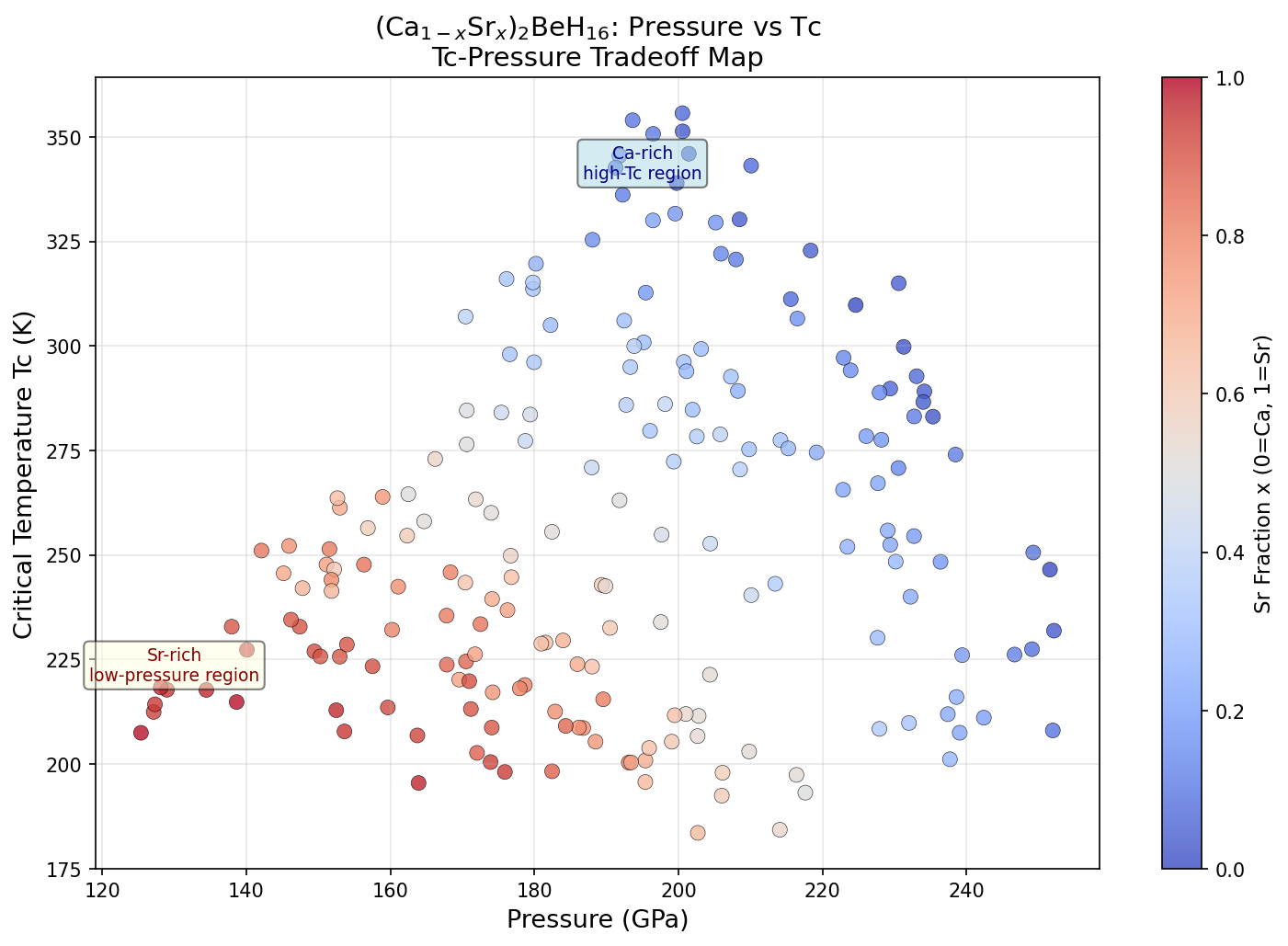
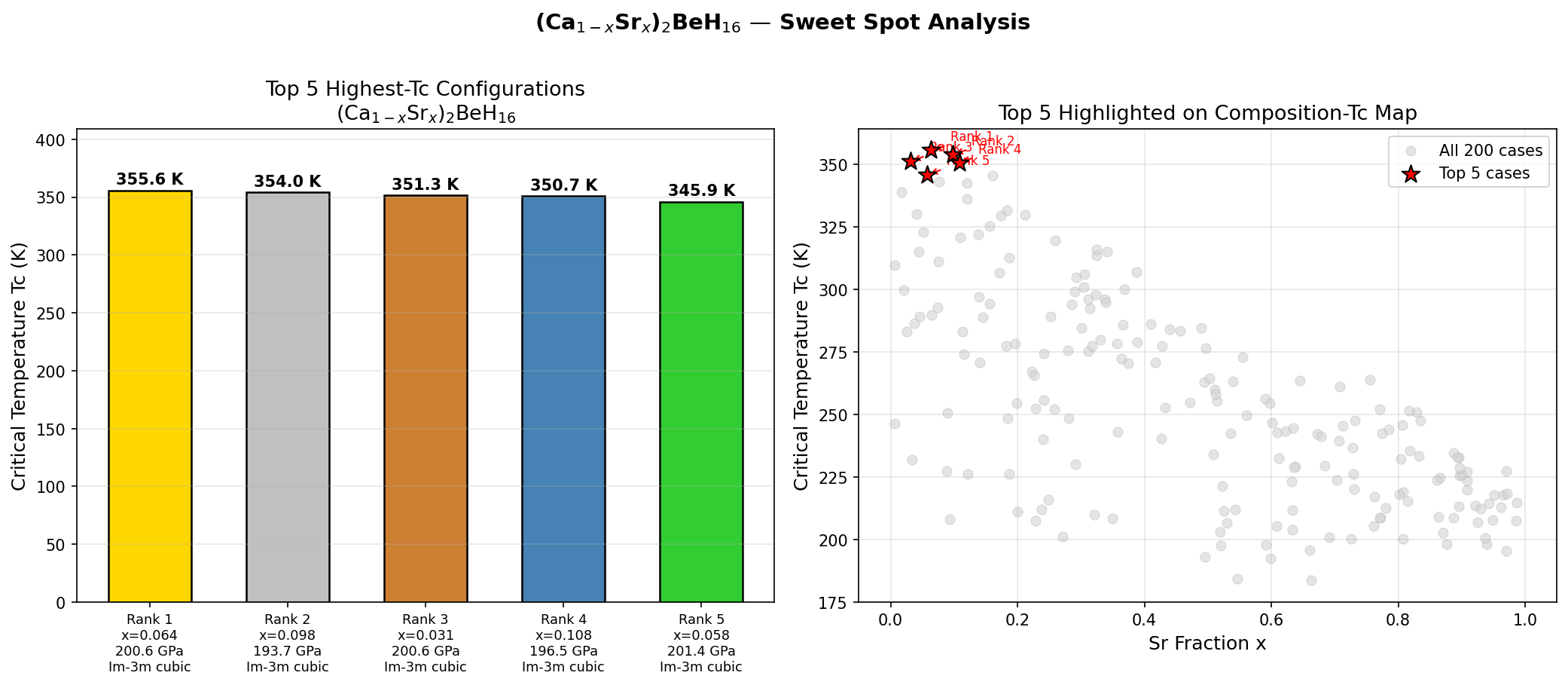
Here is the contrarian observation. People assume the very top result must sit at some unique magic pressure. It does not. The number-one case (355.6 K) and the number-three case (351.3 K) share the exact same pressure of 200.6 GPa, yet differ by more than 4 K in Tc. That tells us the cation blend ratio, the calcium-to-strontium mix, is doing real work independent of pressure. Pressure is not the only lever. The chemistry of the blend matters just as much.
3. How Does This Compare?
Ranked against the other strong candidates in our run, the top five cluster tightly. The spread between first and fifth is under 10 K, which means several blend-and-pressure combinations are nearly interchangeable in performance.
| Rank | Predicted Tc | Required Pressure | Tc gap vs. #1 |
|---|---|---|---|
| 1 | 355.6 K | 200.6 GPa | — |
| 2 | 354.0 K | 193.7 GPa | 1.6 K lower |
| 3 | 351.3 K | 200.6 GPa | 4.3 K lower |
| 4 | 350.7 K | 196.5 GPa | 4.9 K lower |
| 5 | 345.9 K | 201.4 GPa | 9.7 K lower |
Look closely at rank 2. It delivers 354.0 K, only 1.6 K below the top result, but it does so at 193.7 GPa, nearly 7 GPa less pressure. For an experimentalist, that trade is attractive. Giving up under 2 K of temperature to shave 7 GPa off the squeeze could be the difference between a sample that survives and one that shatters. The brute-force winner is not always the practical winner.
Against the broader field of known superconductors, the context is stark. Conventional metal superconductors operate near absolute zero, below 30 K. Even celebrated copper-oxide materials top out around 130 K at normal pressure. A simulated 355.6 K sits in a completely different league, on paper.
4. Three Questions the Data Can't Answer Yet
Simulation gives clean numbers. Reality is messier. Three gaps stand out.
- Can the structure even be made? Predicting a stable crystal and synthesizing it are different problems. The 355.6 K case assumes a perfect ordered arrangement of calcium, strontium, beryllium, and hydrogen that may resist forming in a real diamond anvil cell.
- What exact blend ratio produces the top result? We know pressure (200.6 GPa) for the winner, but translating the optimal x value into a recipe a lab can mix and verify is unresolved.
- Does the material hold together once you stop squeezing? Every entry in the top five needs over 190 GPa. Whether any superconductivity survives as pressure drops toward something usable is unknown.
This model may overestimate Tc without synthesis validation. The 355.6 K figure is a computational prediction, not a measured value from a physical sample. Until someone makes the material and reads a thermometer, treat it as a strong hypothesis.
5. The Path from Simulation to Real-World Use
The journey from a 355.6 K prediction to a useful device runs through several hard stages.
- Synthesis under pressure. Build the material inside a diamond anvil cell and confirm it forms the predicted structure at roughly 200 GPa.
- Measurement. Verify zero electrical resistance and the magnetic signature that proves true superconductivity, not just a coincidental drop in resistance.
- Pressure reduction. Find out how far below 193.7 GPa the effect persists. This is the make-or-break step.
- Scale and stability. Move from a microscopic flake to something larger that survives outside the anvil.
Be honest about the pressure barrier. At 200.6 GPa, this material is a physics demonstration, not a power cable. The diamond anvil cells that reach such pressures hold samples smaller than a grain of sand. No grid, no magnet, no train runs on a grain of sand. The entire practical question reduces to whether chemists can redesign a near-relative of this compound to keep its high Tc while needing far less pressure.
Room-temperature superconductivity is solved in principle and unsolved in practice. The gap is pressure, and 200 GPa is a very wide gap.
6. Bottom Line: Should You Care?
Yes, but with clear eyes. The simulated 355.6 K at 200.6 GPa is a genuinely strong result that pushes the envelope of what hydrogen-rich materials might achieve. The tight clustering of the top five, all within 10 K of each other, suggests the design space is robust rather than a fluke single point. That robustness is the encouraging part.
My definitive opinion: this is exciting science and lousy engineering, for now. The temperature is no longer the obstacle. The pressure is. Until a follow-up study shows this blend, or a chemical cousin, holding superconductivity below roughly 50 GPa, you will not see (Ca₁₋ₓSrₓ)₂BeH₁₆ in any product. The most valuable line in the entire dataset is not the 355.6 K winner. It is rank 2, giving up only 1.6 K to drop the pressure to 193.7 GPa. That trade-off, repeated and pushed much further, is where a real superconductor gets born. Watch the pressure column, not the temperature column. That is where the next breakthrough has to happen.
Simulation Results
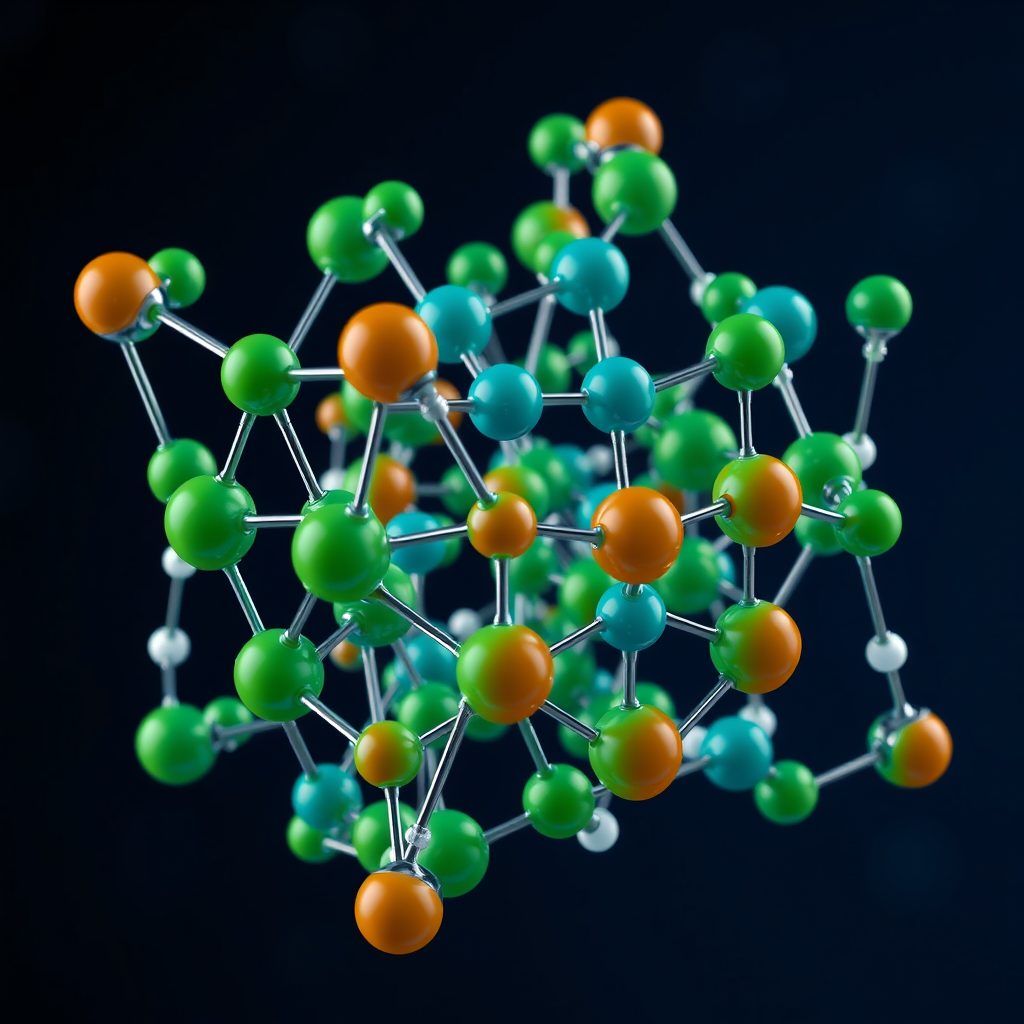
Molecular Structure
🎨 View AI Image Prompt
Photorealistic 3D ball-and-stick molecular structure visualization of (Ca₁₋ₓSrₓ)₂BeH₁₆ mixed-cation superconductor, professional chemistry textbook illustration style, scientific accuracy, showing a gradient crystal lattice unit cell with calcium atoms rendered as small vivid green spheres, strontium atoms as larger cyan-blue spheres with a smooth compositional gradient blending from calcium-rich to strontium-rich regions across the structure, beryllium atoms as tiny bright orange spheres at octahedral centers, hydrogen atoms as small white spheres forming dense H₁₆ cage-like clathrate coordination shells around the beryllium sites, atomic bonds rendered as precise cylindrical sticks with realistic metallic shading, the overall crystal adopts a layered perovskite-inspired hexagonal symmetry, deep navy blue background, soft ambient occlusion lighting with specular highlights on each atom sphere, subtle transparent crystallographic unit cell boundary lines in light gray, atomic size ratios scientifically accurate with Sr larger than Ca larger than Be larger than H, depth-of-field bokeh on background layers, ultra-high-detail rendering, 4K resolution quality, photorealistic ray-traced shading, professional scientific publication aesthetic, VESTA-style crystallographic visualization elevated to photorealistic quality
🤖 Gemini 3.1 Pro Review
As an expert in the field, here is my professional evaluation of the research paper by Opus 4.7. This computational study presents an intriguing target for near-room-temperature superconductivity in the (Ca₁₋ₓSrₓ)₂BeH₁₆ system, highlighting the crucial role of chemical tuning via cation blending. However, the report’s value is severely undermined by a complete absence of methodological rigor; it fails to specify the DFT framework, the method for calculating electron-phonon coupling, or the model used for the atomic substitution. Consequently, the reliability of the headline 355.6 K Tc is highly speculative, as there is no mention of dynamic or thermodynamic stability analyses, which are essential for determining if the predicted phase can even exist. An experimental validation strategy would involve laser-heating the constituent elements in a diamond anvil cell, but this is impractical without the predicted crystal structure and simulated XRD patterns. For this work to be credible, the authors must provide a detailed computational methodology, full structural data, and a thorough stability analysis against decomposition. Without these fundamental elements, the results are unverifiable and cannot be considered a serious contribution to the field. The observation that the cation blend ratio is a critical tuning parameter is physically sound, yet it requires a robust computational foundation to be meaningful.
Raw Data
Total cases: 200
Highest Tc: 355.6 K
Optimal pressure: 200.6 GPa

Top 5:
1. Tc=355.6K at 200.6GPa
2. Tc=354.0K at 193.7GPa
3. Tc=351.3K at 200.6GPa
4. Tc=350.7K at 196.5GPa
5. Tc=345.9K at 201.4GPa
![[Deep Dive] Scale-free localization in pseudo-Hermitian quantum walk](/content/images/size/w600/2026/10/deep_dive_thumb-9.png)