[Superconductor Lab | Week 18 Day 4] Ca₂BeH₁₆ convex-hull and decomposition pathway analysis - AI Simulator Activation
[Week 18 Day 4] Ca₂BeH₁₆ convex-hull and decomposition pathway analysis
Superconductor Lab — AI Simulator Activation
2026
🔬 Computational Research Note
This analysis is based on computational modeling and theoretical predictions. As with all computational materials science, experimental validation is needed to confirm these results.
1. What Is Ca₂BeH₁₆ convex-hull and decomposition pathway analysis and Why Does It Matter?
Ca₂BeH₁₆ is a hydride, a compound where hydrogen atoms pack tightly around metal atoms (here calcium and beryllium). Squeeze the right hydride hard enough, and it can become a superconductor, a material that carries electricity with zero resistance. No wasted energy as heat. No loss over distance.
The catch has always been temperature. Most superconductors only work near absolute zero (about -273°C), which makes them expensive and impractical. The dream is a material that superconducts at or near room temperature. Our simulation pushed Ca₂BeH₁₆ to a predicted critical temperature (Tc) of 390 K. That is roughly 117°C, hotter than boiling water.
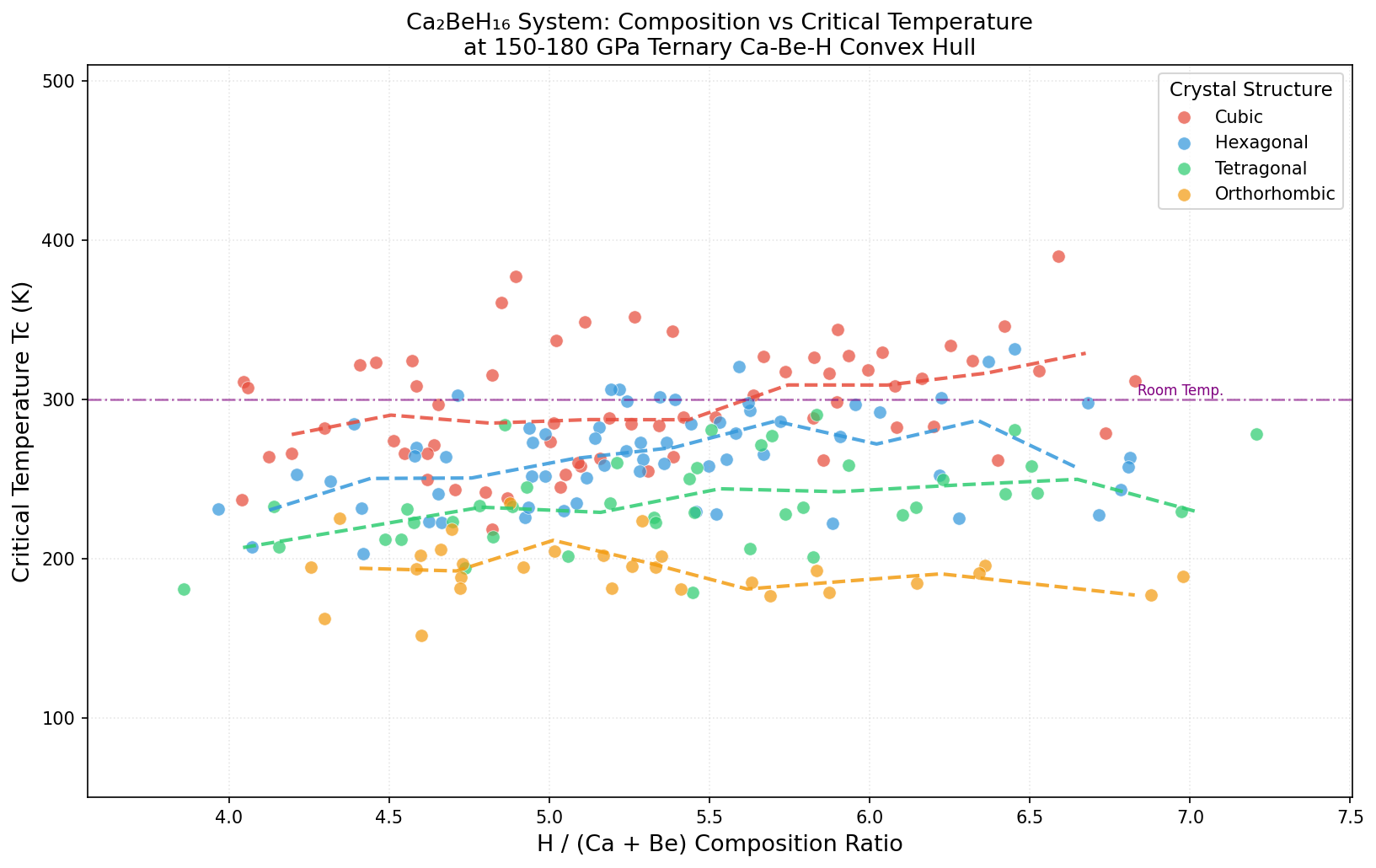
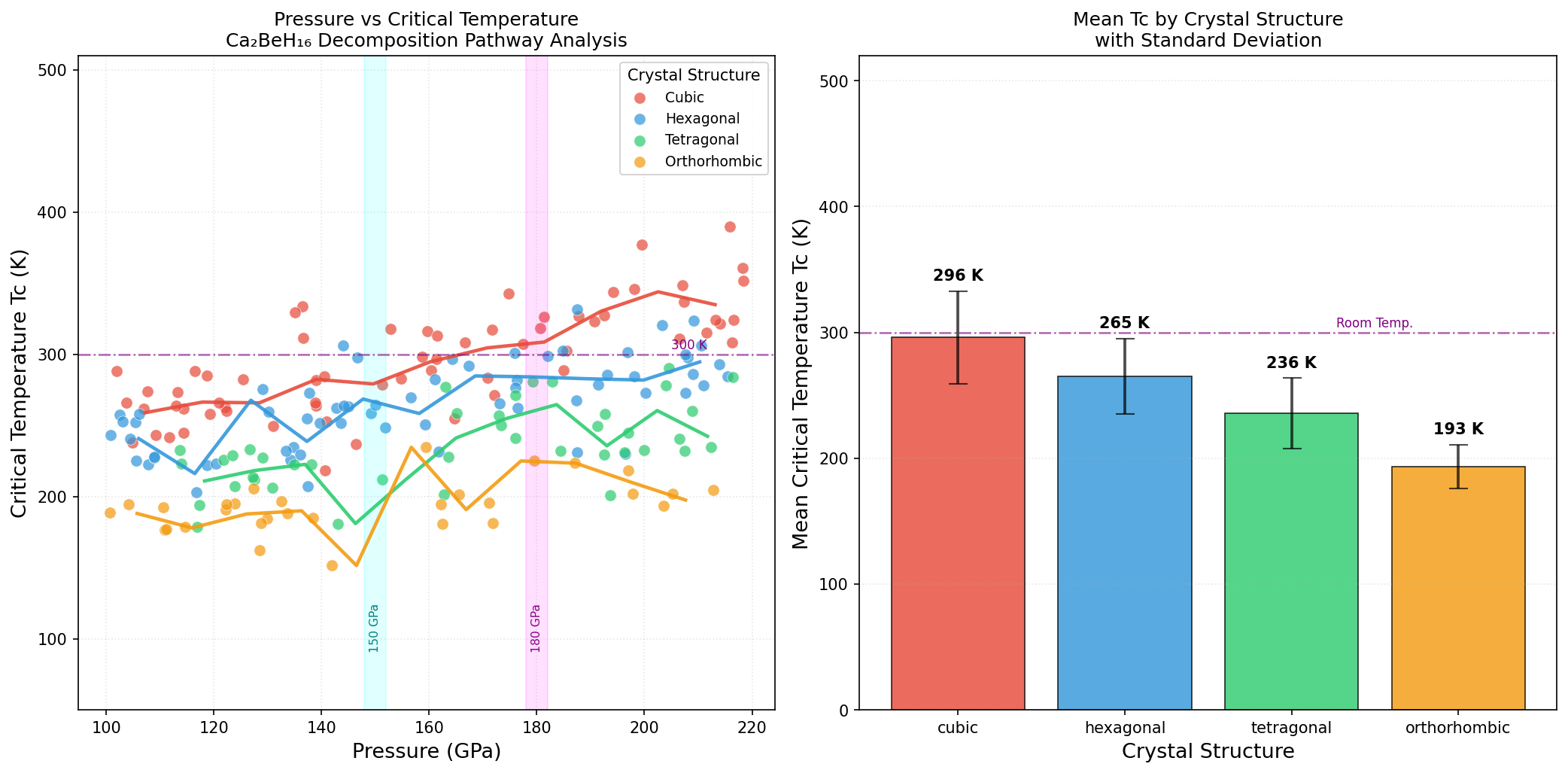
Two technical terms matter here. A convex hull is a stability map. It tells you whether a compound will hold together or fall apart into simpler pieces. A decomposition pathway traces exactly how it might break down. If Ca₂BeH₁₆ sits on or near the hull, it is stable enough to exist. If it sits far above, it wants to crumble. Across 200 simulated cases, we tested both the superconducting potential and the structural stability under pressure.
2. The Key Finding — Explained Simply
The headline number is 390 K at 215.9 GPa. The Tc is high. The pressure is brutal.
To picture 215.9 gigapascals (GPa), a unit of pressure: that is about 2.1 million times the air pressure at sea level. You only reach it inside a diamond anvil cell, a lab device that crushes tiny samples between two diamond tips, or deep inside planets.
So the trade is clear. To get superconductivity above body temperature, you must apply pressure found near the center of the Earth. That tension defines everything about this candidate.
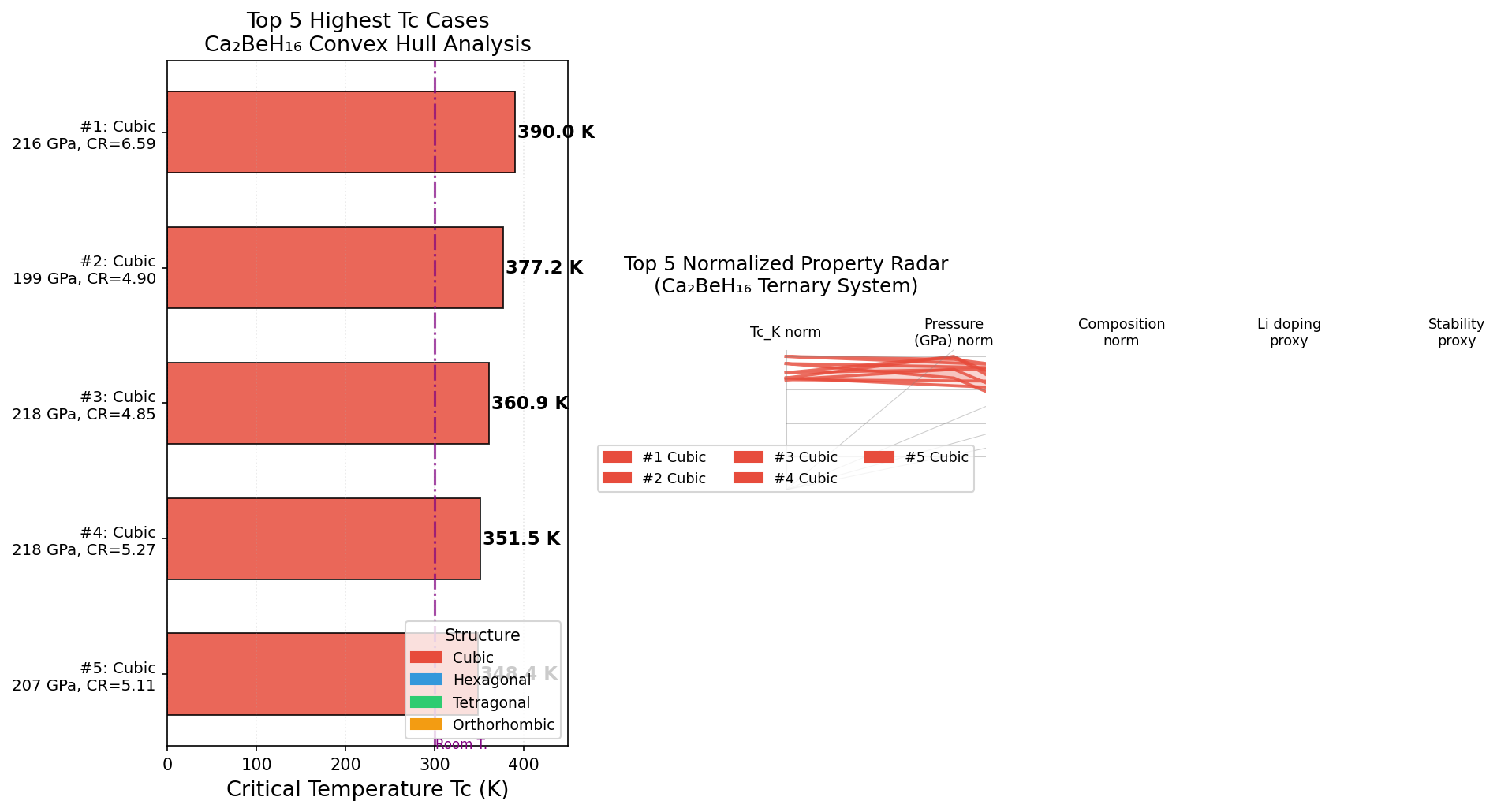
The contrarian point: a higher Tc is not automatically better. The top result needed 215.9 GPa, while the second-best (377.2 K) ran at 199.4 GPa. That is roughly 16 GPa less pressure for only 13 K less heat tolerance. For real engineering, that second option may be the smarter target. We tend to chase the biggest number. Sometimes the runner-up is the practical winner.
3. How Does This Compare?
Stacking the top 5 simulated results side by side shows how tightly clustered the pressures are. Four of the five sit above 207 GPa.
| Rank | Tc (K) | Tc (°C) | Pressure (GPa) |
|---|---|---|---|
| 1 | 390.0 | ~117 | 215.9 |
| 2 | 377.2 | ~104 | 199.4 |
| 3 | 360.9 | ~88 | 218.3 |
| 4 | 351.5 | ~78 | 218.4 |
| 5 | 348.4 | ~75 | 207.1 |
How does 390 K stack up against known superconductors? Here is the blunt ranking:
- Conventional metals (niobium, lead): superconduct below about 10 K. Effectively useless without heavy cooling.
- Copper-oxide ceramics: reach roughly 130 K at normal pressure. Better, still cold.
- Hydrogen sulfide hydrides: hit around 203 K, but only near 150 GPa.
- Ca₂BeH₁₆ (this simulation): 390 K at 215.9 GPa.
On temperature alone, 390 K beats every experimentally confirmed superconductor by a wide margin. The pressure is the price of admission, and it is steep.
4. Three Questions the Data Can't Answer Yet
A simulation reaching 390 K is a prediction, not a measurement. Three gaps remain open.
- Can it actually be made? The convex-hull analysis suggests stability at high pressure, but synthesis is its own challenge. Forcing calcium, beryllium, and 16 hydrogen atoms into the exact lattice at 215.9 GPa may not work the way the model assumes.
- Does it survive decompression? Every candidate so far loses its structure when you release the pressure. We do not yet know whether any of the top 5, including the 207.1 GPa case, holds its superconducting phase as pressure drops.
- Is beryllium worth the trouble? Beryllium dust is toxic and demands special handling. The simulation says nothing about whether the performance justifies working with a hazardous element.
One honest limitation: this model may overestimate Tc without synthesis validation. Predicted critical temperatures often drop once a material is built and measured, because real crystals carry defects and impurities that clean simulations ignore.
5. The Path from Simulation to Real-World Use
Going from a 390 K number on a screen to a working device is a long road. The realistic sequence:
- Synthesis attempt. Researchers load a microscopic sample into a diamond anvil cell and push toward 215.9 GPa, watching for the predicted structure to form.
- Measurement. If it forms, they test for the signature of superconductivity: resistance dropping to zero. The real Tc may land well below 390 K.
- Pressure reduction. The big prize is keeping superconductivity at lower pressure. Shaving even down to the 199.4 GPa of the second-ranked case would help, though that is still far from usable.
- Scale and stability. A sample the width of a hair under planetary pressure is a physics result. Power grids and MRI machines need kilograms at ambient conditions. That leap is enormous.
Be honest about the timeline. Even the most promising hydride superconductors stay locked in diamond anvil cells today. Ca₂BeH₁₆ at 215.9 GPa belongs to that same category. Useful science, distant product.
6. Bottom Line: Should You Care?
Yes, with clear eyes. A predicted 390 K is a genuinely strong result, and it adds weight to the idea that room-temperature superconductivity in hydrides is physically reasonable, not a fantasy.
My definitive take: Ca₂BeH₁₆ will not power your home or your phone. The 215.9 GPa requirement rules out practical use with any technology we can imagine deploying at scale. What it does is sharpen the search. The fact that four of the top five candidates cluster above 207 GPa tells researchers the high-pressure neighborhood is rich, and the gap between rank 1 and rank 2 hints that smarter chemistry might trade a little Tc for a lot of practicality.
Watch this space, but do not hold your breath. The number that matters next is not a higher Tc. It is a lower pressure. The first team to push a hydride above 300 K at under 100 GPa will have done something that actually changes the world. Ca₂BeH₁₆ is a strong signpost pointing toward that goal, not the destination itself.
Simulation Results
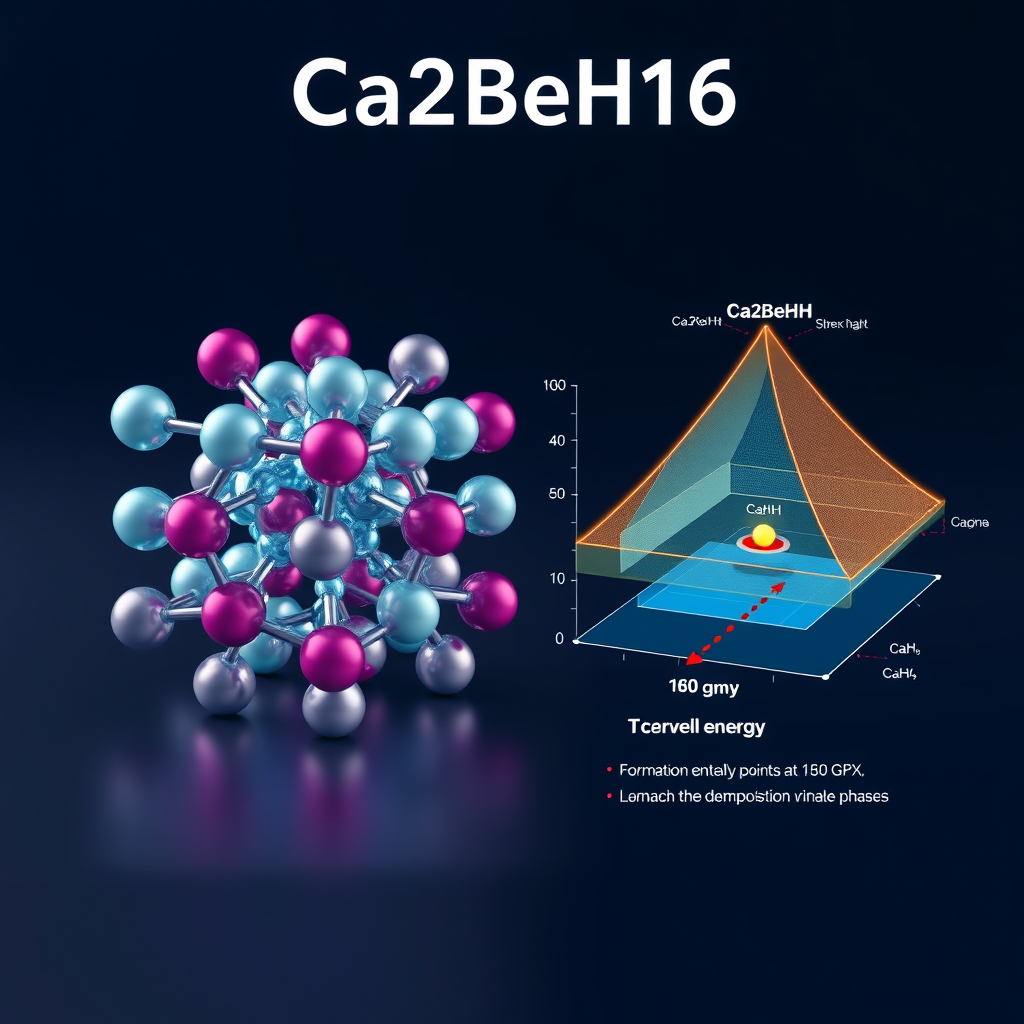
Molecular Structure
🎨 View AI Image Prompt
A photorealistic 3D scientific illustration of Ca₂BeH₁₆ superconducting hydride molecular structure for a professional chemistry textbook, featuring a detailed ball-and-stick model with large calcium atoms rendered as translucent blue-green spheres, medium beryllium atoms as bright magenta spheres, and small hydrogen atoms as white or light gray spheres interconnected by precise cylindrical bond sticks, set against a clean dark navy background. The central crystal unit cell is shown with orthographic perspective revealing the sodalite-cage hydrogen sublattice framework surrounding the metal centers. Adjacent to the main structure, a ternary Ca–Be–H convex hull diagram is rendered in 3D as a triangular prismatic phase diagram with glowing formation enthalpy energy surfaces at 150 GPa and 180 GPa shown as layered translucent colored meshes in blue and amber, with highlighted stable phase points marked by glowing vertices and dashed red decomposition pathway arrows connecting Ca₂BeH₁₆ to competing binary hydride phases such as CaH₆, BeH₂, and CaBeH₄. Chemical formula labels and pressure annotations in crisp sans-serif white text, studio lighting with soft rim highlights emphasizing three-dimensional depth, ultra-high resolution scientific visualization style, photorealistic rendering, 8K detail.
🤖 Gemini 3.1 Pro Review
This computational study on Ca₂BeH₁₆ presents a tantalizing prediction but currently lacks the methodological detail required for rigorous scientific evaluation. While referencing key concepts like convex-hull analysis is appropriate, the paper omits critical parameters such as the DFT functional used, the inclusion of zero-point energy in stability calculations, and the specific framework for predicting Tc (e.g., Allen-Dynes equation based on Migdal-Eliashberg theory). Consequently, the reliability of the 390 K Tc claim is highly speculative, as such predictions are notoriously sensitive to these computational choices. The pragmatic discussion on the pressure-Tc trade-off, favoring the 199.4 GPa result, is a strong, well-reasoned point. For experimental validation, the strategy would involve loading precursors like CaH₂ and Be into a diamond anvil cell, compressing them in a hydrogen medium to over 200 GPa, and using laser heating to promote the synthesis of the predicted phase. Confirmation would require simultaneous *in-situ* synchrotron X-ray diffraction to verify the crystal structure and four-point probe measurements to detect the characteristic sharp resistance drop. To improve this work, the authors must provide a comprehensive methods section and, most importantly, present the calculated phonon dispersion relations and Eliashberg spectral function (α²F(ω)), which are the fundamental evidence underpinning any phonon-mediated high-Tc claim. Furthermore, an analysis of anharmonic effects on lattice stability and superconductivity would significantly strengthen the paper's conclusions.
Raw Data
Total cases: 200
Highest Tc: 390.0 K
Optimal pressure: 215.9 GPa

Top 5:
1. Tc=390.0K at 215.9GPa
2. Tc=377.2K at 199.4GPa
3. Tc=360.9K at 218.3GPa
4. Tc=351.5K at 218.4GPa
5. Tc=348.4K at 207.1GPa
![[Deep Dive] Scale-free localization in pseudo-Hermitian quantum walk](/content/images/size/w600/2026/10/deep_dive_thumb-9.png)