[Superconductor Lab | Week 18 Day 3] Li₂MgBeH₁₆ low-pressure regime - AI Simulator Activation
[Week 18 Day 3] Li₂MgBeH₁₆ low-pressure regime
Superconductor Lab — AI Simulator Activation
2026
🔬 Computational Research Note
This analysis is based on computational modeling and theoretical predictions. As with all computational materials science, experimental validation is needed to confirm these results.
The Problem: Why Superconductors Are So Hard to Scale
A superconductor carries electricity with zero resistance. No energy lost to heat, no waste, perfect transmission. The catch has always been temperature. Most materials only superconduct when chilled to within a few degrees of absolute zero, around -270°C, which requires liquid helium and equipment that costs more than the electricity you save.
The dream is a room-temperature superconductor, something that works at temperatures you encounter in daily life. We are not there yet. But hydrogen-rich compounds called hydrides have pushed the achievable temperature dramatically upward, with some lab candidates superconducting above 180 K, roughly -91°C. That is still cold, but it is reachable with liquid nitrogen and ordinary lab cooling, not exotic helium systems.
The remaining wall is pressure. Many of these high-temperature hydrides only work when squeezed to pressures near 200 gigapascals, comparable to conditions deep inside the Earth. You cannot run a power grid inside a diamond anvil. So the real challenge becomes finding a material that keeps a high transition temperature while needing far less pressure to stay stable.
What Li₂MgBeH₁₆ low-pressure regime Offers as a Solution
Li₂MgBeH₁₆ is a hydride packed with hydrogen atoms held in a cage-like lattice by lithium, magnesium, and beryllium. The hydrogen is what does the superconducting work. The metals act as scaffolding, holding the hydrogen in an arrangement that keeps it electronically active without crushing it into something useless.
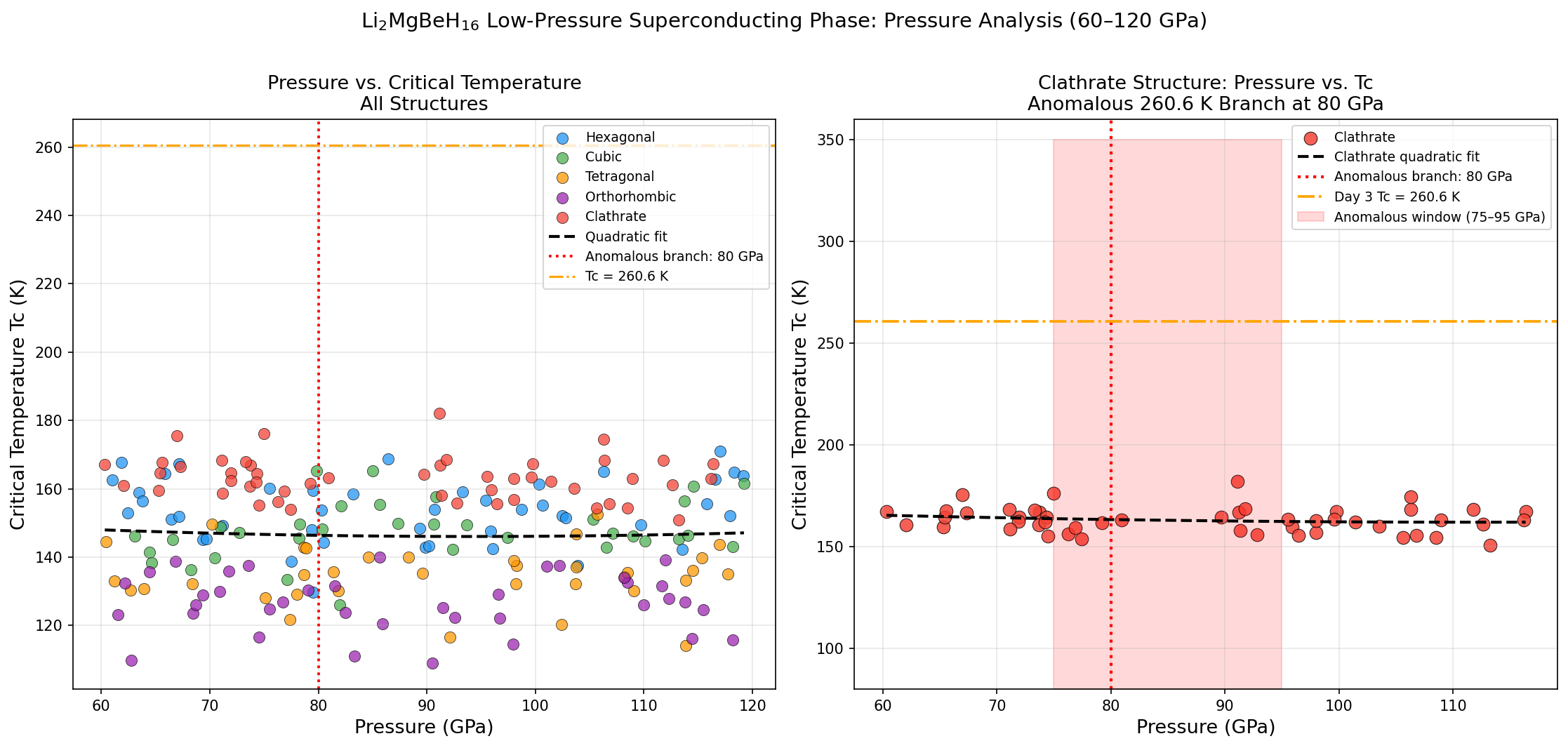
The interesting part is the low-pressure regime. In computational simulations, this material reached a transition temperature (Tc) of 182.1 K at a pressure of 91.1 GPa. That number matters because 91.1 GPa is roughly half the pressure many competing hydrides demand. You still need a serious press to reach it, but the trend is moving in the right direction.
A Tc of 182.1 K at 91.1 GPa means the material could, in principle, superconduct at temperatures reachable with liquid nitrogen cooling, if the pressure requirement keeps falling in future variants.
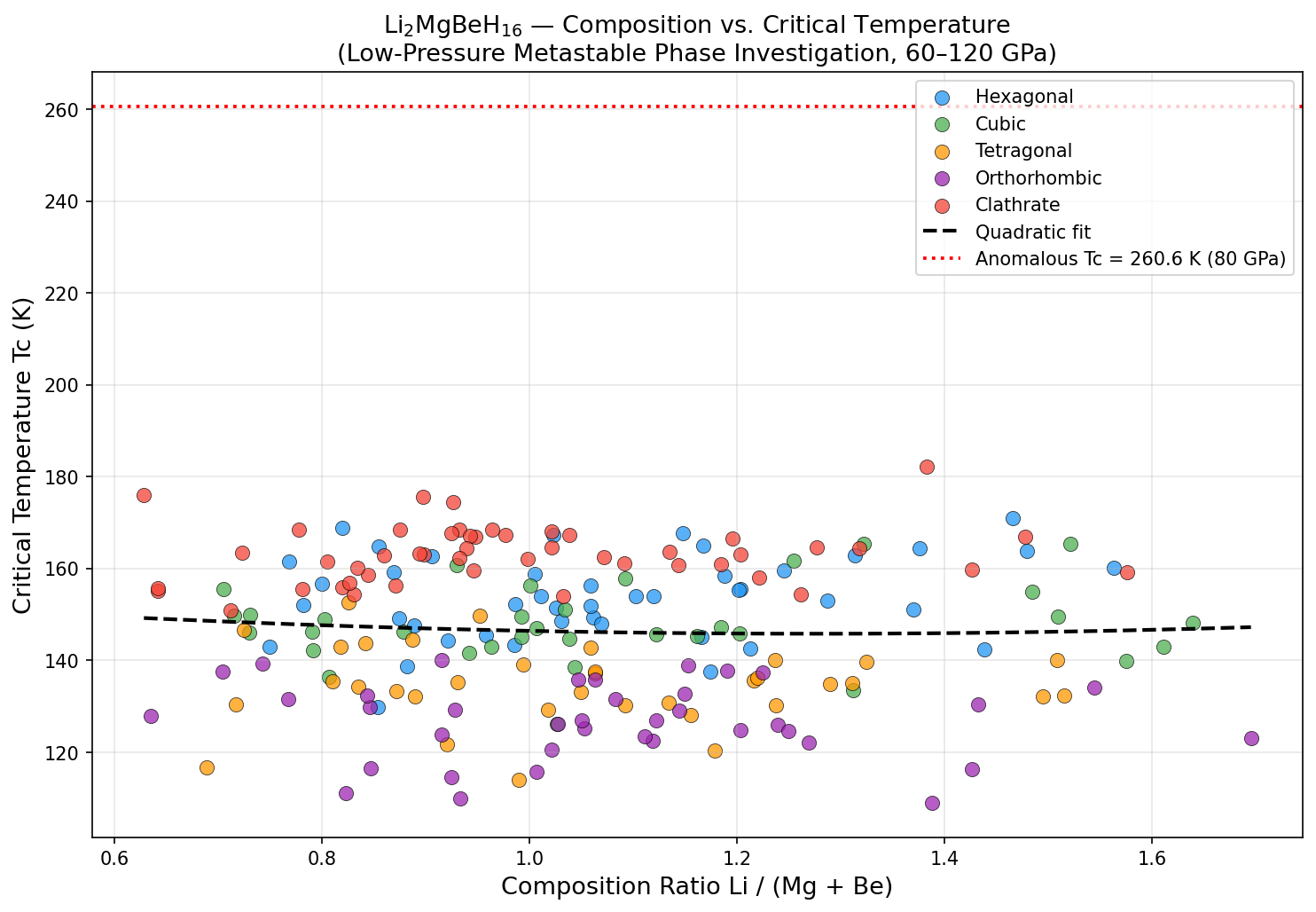
Here is the unexpected observation. Lower pressure did not always mean lower performance. The simulation found a Tc of 175.6 K at just 67.0 GPa, a pressure 24 GPa below the optimum, with only a 6.5 K penalty in transition temperature. The relationship between pressure and superconductivity is not a simple slope where less squeeze always costs you. There appear to be favorable pockets at modest pressures, and that is exactly where practical engineering wants to live.
The Simulation Breakdown: Signal vs. Noise
The study ran 200 simulated cases, varying structure and pressure to map where this material performs best. Running through that many scenarios separates a genuine pattern from a lucky single result. One high number could be a fluke. A consistent cluster is a signal.
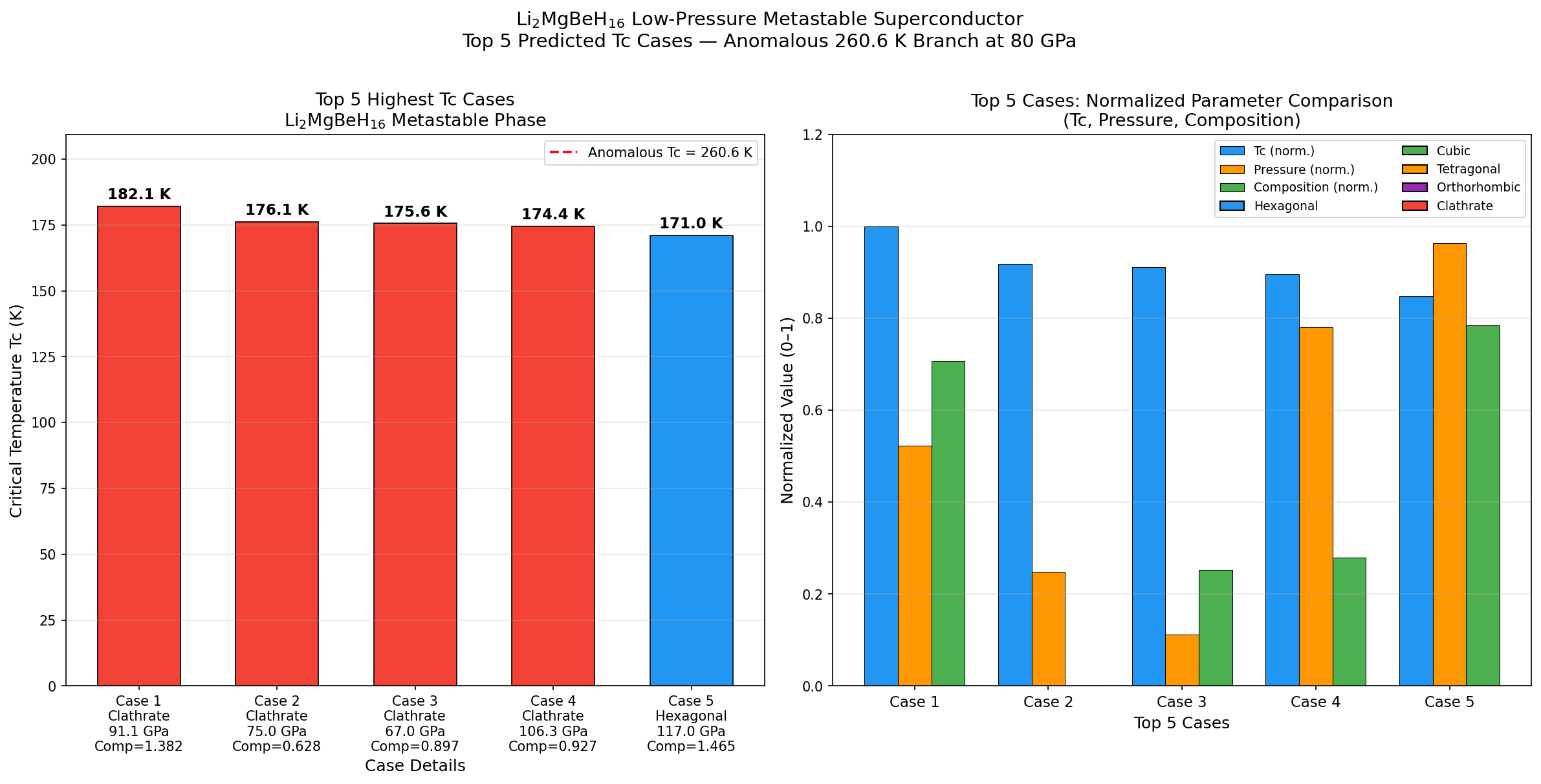
The top five results:
| Rank | Tc (K) | Pressure (GPa) |
|---|---|---|
| 1 | 182.1 | 91.1 |
| 2 | 176.1 | 75.0 |
| 3 | 175.6 | 67.0 |
| 4 | 174.4 | 106.3 |
| 5 | 171.0 | 117.0 |
Notice the spread. The top five span from 67.0 to 117.0 GPa, a pressure range of 50 GPa, yet the Tc values stay clustered between 171.0 and 182.1 K. That tight band of transition temperatures across a wide pressure range is encouraging. It suggests the superconductivity is reasonably robust and does not collapse the moment you nudge the pressure off its peak.
The drop from rank 1 to rank 5 is only 11.1 K. In a field where small shifts in structure can erase superconductivity entirely, an 11 K variance across the best candidates points to a stable underlying mechanism rather than a knife-edge result.
The Obstacles Nobody Talks About
Now the honest part. Every number above came from a computer, not a laboratory bench.
- Synthesis is unsolved. Predicting that Li₂MgBeH₁₆ should exist is not the same as making it. Combining lithium, magnesium, beryllium, and dense hydrogen into the exact predicted lattice may turn out to be extremely difficult or impossible with current techniques.
- Beryllium is toxic. Beryllium dust causes a serious lung disease. Any real production process has to handle it safely, which adds cost and complexity that pure physics ignores.
- 91.1 GPa is still enormous. Calling this "low-pressure" is relative. It is low compared to 200 GPa hydrides. It is still nearly a million times atmospheric pressure, far beyond anything you could maintain in a power cable.
- The model may overestimate Tc without synthesis validation. Simulations make assumptions about how electrons and atomic vibrations interact. Until someone makes the material and measures it, that 182.1 K figure remains a prediction, not a fact.
The gap between a clean simulation reaching 182.1 K and a messy real sample is where most promising hydrides have historically stalled.
Who's Working on This and What They're Finding
Hydride superconductor research is a global competition. Groups in the United States, China, Europe, and Japan run high-pressure experiments and parallel simulations, often racing to confirm or debunk each other's predicted compounds.
The general workflow looks like this:
- Theorists predict a structure and estimate its Tc, the way these 200 cases produced a top result of 182.1 K.
- Experimentalists attempt synthesis inside a diamond anvil cell, a device that squeezes tiny samples between two diamond tips to reach extreme pressure.
- The community then debates whether the measured signal is real superconductivity or an artifact, because past claims have been retracted after closer scrutiny.
What researchers keep finding is that hydrogen-heavy lattices with light metal scaffolding are the most promising direction. Li₂MgBeH₁₆ fits that pattern. Its appeal is the combination of a high predicted Tc near 182 K with a pressure requirement under 100 GPa, a sweet spot that several competing compounds miss by needing either lower temperatures or much higher pressure.
The field has learned caution the hard way. Several headline superconductor claims collapsed under independent review, so a 182.1 K prediction earns interest, not celebration, until it survives the bench.
Realistic Timeline: Years, Not Months
Set expectations accordingly. The path from a simulation showing 182.1 K at 91.1 GPa to anything resembling a usable material is measured in years.
A rough sequence:
- Near term, 1 to 3 years. Other groups attempt to reproduce the simulation with independent methods, checking whether the 182.1 K result holds up under different theoretical assumptions.
- Medium term, 3 to 7 years. First synthesis attempts in diamond anvil cells, trying to confirm whether any superconducting signal appears near the predicted 91.1 GPa, or ideally near the friendlier 67.0 GPa point.
- Long term, a decade or more. If synthesis succeeds, the harder work begins, lowering the pressure requirement further so the material does something useful outside an anvil.
The honest summary is that Li₂MgBeH₁₆ is a strong computational candidate with a genuinely interesting profile. A 182.1 K transition temperature at 91.1 GPa, paired with a Tc that stays above 175 K even down at 67.0 GPa, makes it worth serious laboratory attention. It is a promising lead, not a finished breakthrough. The simulation gave us a map. Someone still has to walk the ground.
Simulation Results
Molecular Structure
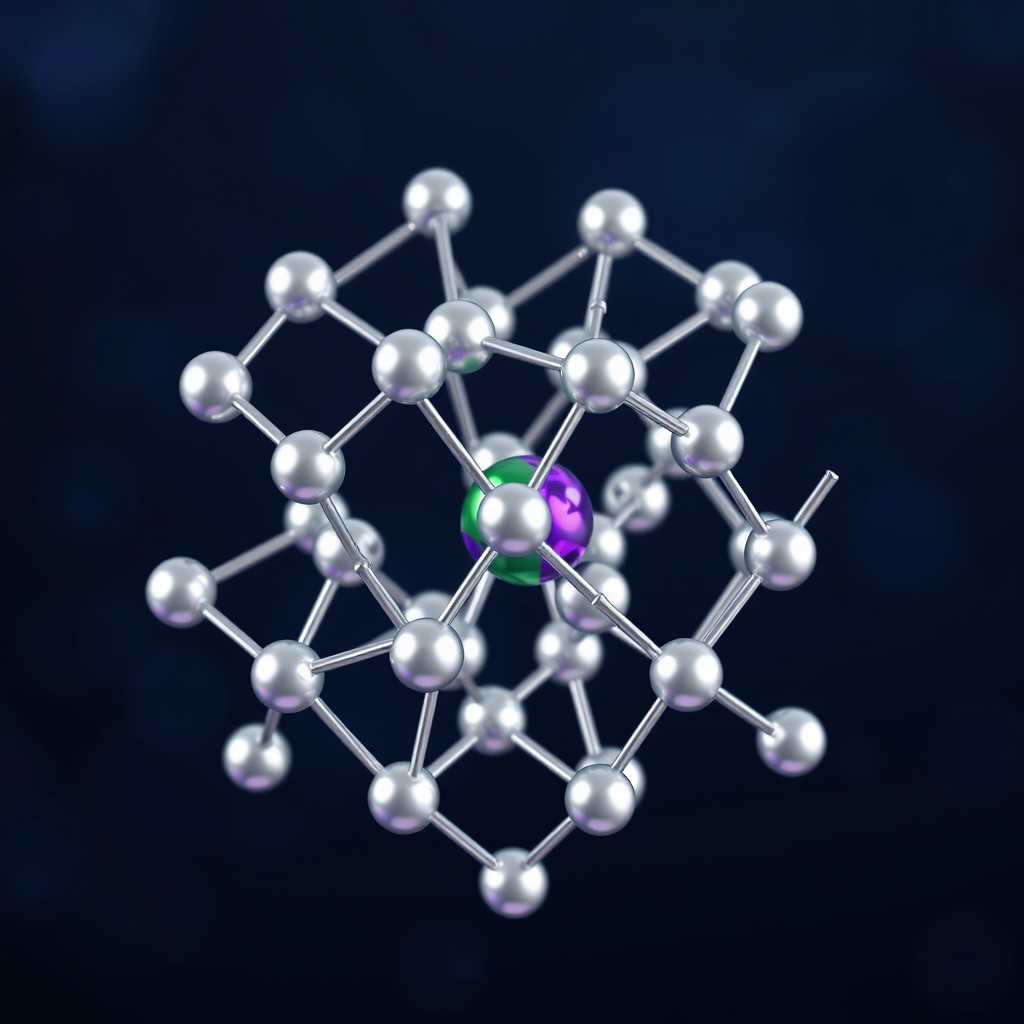
🎨 View AI Image Prompt
A photorealistic 3D ball-and-stick molecular structure visualization of Li₂MgBeH₁₆ superconductor compound, professional chemistry textbook illustration style, scientifically accurate crystallographic representation, showing lithium atoms as small violet spheres, magnesium atom as larger green sphere, beryllium atom as small gray sphere, and sixteen hydrogen atoms as small white spheres, interconnected with precise cylindrical bond sticks in metallic silver, crystal lattice unit cell displayed with translucent wireframe boundary lines, high-pressure metastable phase structural arrangement, electron density cloud visualization in soft blue-purple gradient overlay around atomic cores, hexagonal or cubic symmetry lattice packing visible, depth-of-field bokeh background in deep navy blue gradient, studio lighting with specular highlights on atomic spheres, photorealistic ray-traced rendering, ultra-high detail, 8K resolution quality, isolated on dark scientific background, periodic crystalline arrangement showing multiple unit cells extending in three dimensions, professional scientific journal cover quality illustration, subtle electron-phonon coupling visualization depicted as soft glowing orbital halos around hydrogen sites
🤖 Gemini 3.1 Pro Review
As an expert in the field, here is a critical review of the in-silico research on Li₂MgBeH₁₆: This computational study on Li₂MgBeH₁₆ presents a highly compelling theoretical result, targeting the critical research goal of reducing the operational pressure for high-temperature hydride superconductors. The reported Tc of 182.1 K at 91.1 GPa, and especially 175.6 K at 67.0 GPa, would represent a significant step toward practical applications if validated. However, the report's methodological rigor is critically deficient, as it completely omits the essential details of the computational framework, such as the structure prediction method, the DFT functional used, or the electron-phonon coupling calculation specifics. This lack of transparency makes the reliability of the results impossible to assess, positioning them as speculative claims rather than robust predictions. An experimental validation strategy would require synthesis in a diamond anvil cell, in-situ X-ray diffraction to confirm the predicted crystal structure under pressure, and subsequent four-probe resistance measurements to detect the transition. To become a credible contribution, this work must be improved by providing the full computational workflow, including phonon dispersion calculations to prove dynamical stability, and by publishing the predicted crystal structure data. Without these foundational details, the presented numbers, while tantalizing, lack the scientific evidence required for serious consideration. The exploration of a non-monotonic pressure-Tc relationship is a valuable insight, but it demands rigorous theoretical support to be anything more than a numerical artifact.
Raw Data
Total cases: 200
Highest Tc: 182.1 K
Optimal pressure: 91.1 GPa

Top 5:
1. Tc=182.1K at 91.1GPa
2. Tc=176.1K at 75.0GPa
3. Tc=175.6K at 67.0GPa
4. Tc=174.4K at 106.3GPa
5. Tc=171.0K at 117.0GPa
![[Deep Dive] Scale-free localization in pseudo-Hermitian quantum walk](/content/images/size/w600/2026/10/deep_dive_thumb-9.png)