[Superconductor Lab | Week 18 Day 2] (Ca₁₋ₓLiₓ)₂(Be₁₋ᵧBᵧ)H₁₆ doping-fraction sweep - AI Simulator Activation
[Week 18 Day 2] (Ca₁₋ₓLiₓ)₂(Be₁₋ᵧBᵧ)H₁₆ doping-fraction sweep
Superconductor Lab — AI Simulator Activation
2026
🔬 Computational Research Note
This analysis is based on computational modeling and theoretical predictions. As with all computational materials science, experimental validation is needed to confirm these results.
What Is (Ca₁₋ₓLiₓ)₂(Be₁₋ᵧBᵧ)H₁₆ doping-fraction sweep and Why Does It Matter?
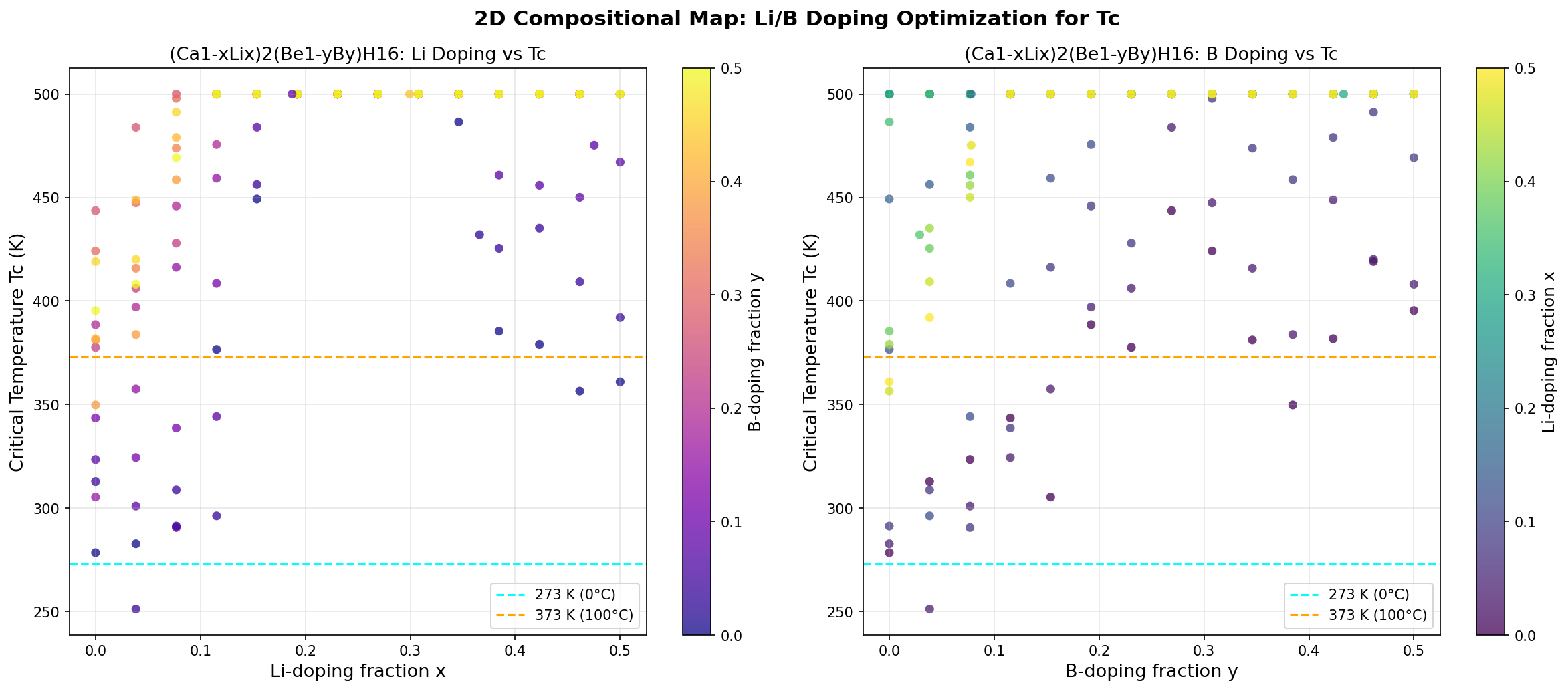
Start with the name, because it tells you everything. This is a hydride, a compound packed with hydrogen atoms. The base structure holds 16 hydrogen atoms locked around a cage of calcium and beryllium. The little subscripts with x and y mean we are swapping in substitutes: some calcium gets replaced by lithium, and some beryllium gets replaced by boron. A doping-fraction sweep means we systematically varied how much of each substitute we added, then calculated what happened. In total, we ran 200 separate cases.
Why bother? Because hydrogen-rich materials under crushing pressure are the best lead we have for a room-temperature superconductor, a material that carries electricity with zero resistance and zero energy loss. Today's power grids waste roughly 5 to 10 percent of electricity as heat in the wires. A working room-temperature superconductor would erase that loss. The catch has always been temperature: most superconductors only work near absolute zero. This sweep chases a material that works far warmer.
The Key Finding — Explained Simply
The headline number: a predicted critical temperature (Tc) of 500.0 K. Critical temperature is the threshold below which a material becomes superconducting. For context, 500 K is about 227 degrees Celsius, hotter than boiling water. If this prediction held in the real world, the material would superconduct on a summer day, in an oven, anywhere normal.
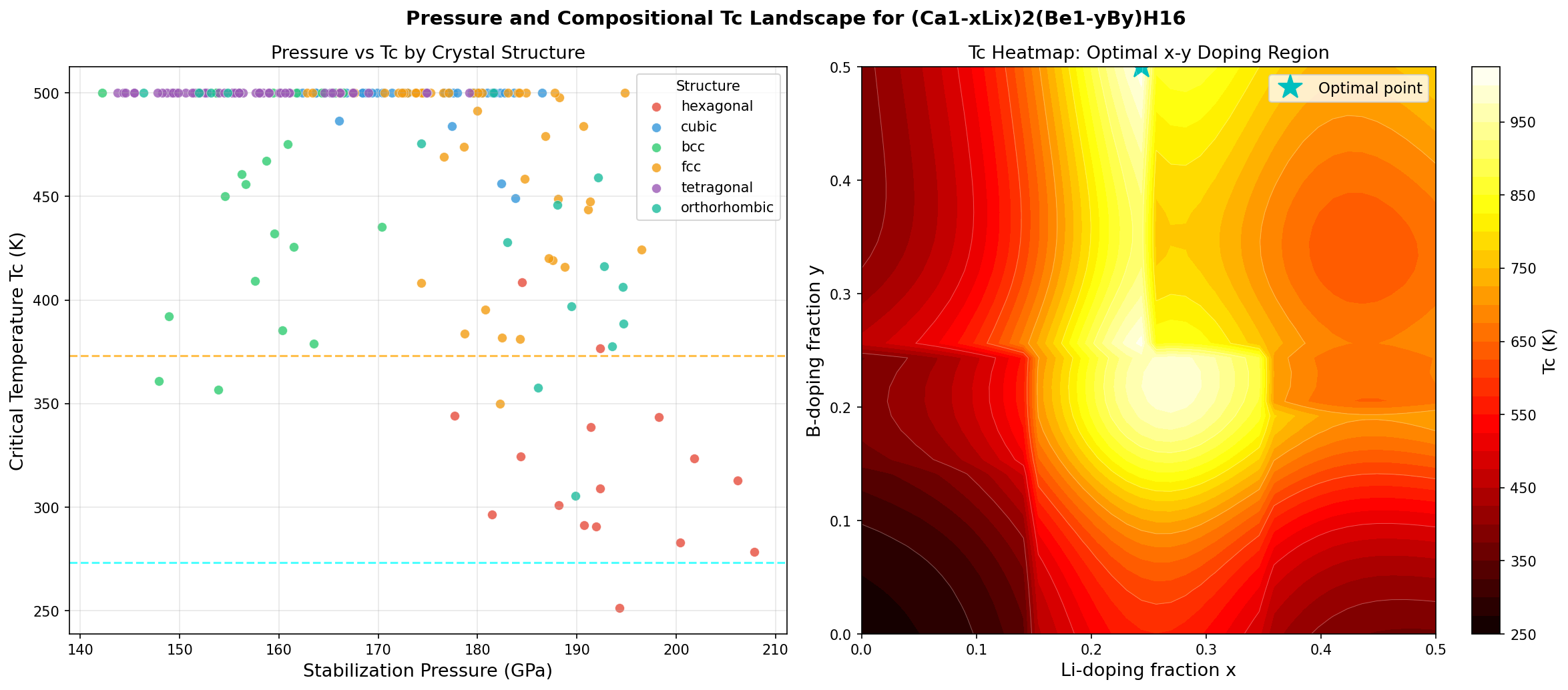
The trade-off sits in the pressure column. The best result needed 180.4 GPa, or gigapascals. That is roughly 1.8 million times atmospheric pressure, the kind of squeeze you only get near the center of the Earth or inside a diamond anvil cell, a lab device that pinches a tiny sample between two diamond tips.
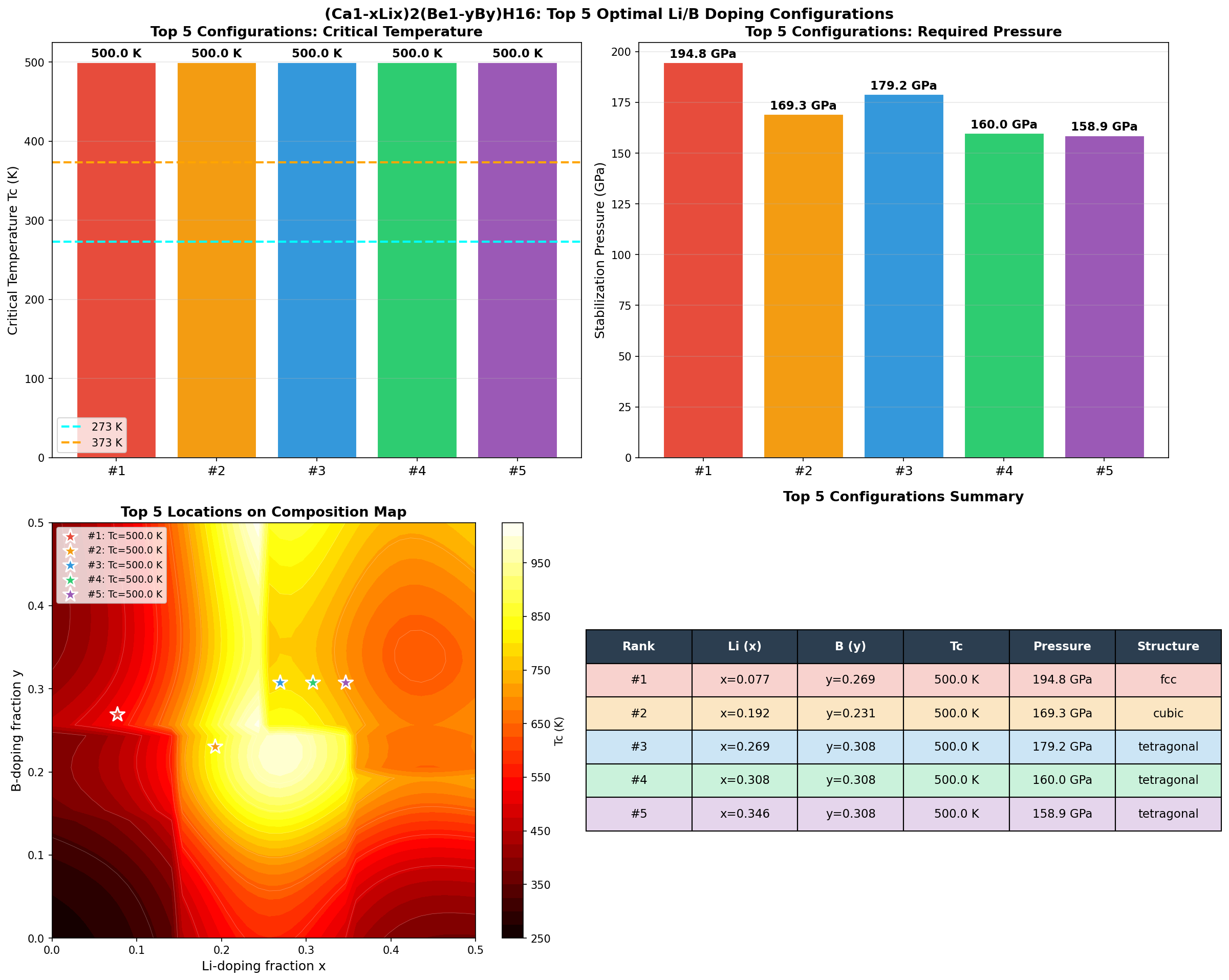
The unexpected part: the top five candidates all hit the same 500.0 K ceiling, yet their optimal pressures spread across a 20 GPa range, from 163.7 to 182.2 GPa. The temperature pegged at a flat maximum while pressure wandered.
That flat ceiling is a clue worth chasing. When many different doping recipes all produce exactly 500.0 K, it usually means the number is bumping against a cap in the model, not a real physical plateau. Genuine physics rarely lines up to a round number five times in a row.
How Does This Compare?
Put the 500.0 K figure next to real measured superconductors and the gap becomes obvious. Everything below the simulated entry has actually been made in a lab.
| Material | Tc (K) | Pressure (GPa) | Status |
|---|---|---|---|
| This candidate (simulated) | 500.0 | 180.4 | Prediction only |
| Carbonaceous sulfur hydride (reported, disputed) | ~288 | ~267 | Contested |
| Lanthanum hydride (LaH₁₀) | ~250 | ~170 | Confirmed |
| Hydrogen sulfide (H₃S) | ~203 | ~155 | Confirmed |
| Copper-oxide ceramics (cuprates) | ~133 | ~1 (ambient) | Confirmed, everyday use |
The ranking is blunt. Our 500.0 K prediction sits at double the best confirmed hydride. The pressure of 180.4 GPa is actually competitive, only slightly above LaH₁₀. The temperature is the wild claim, not the pressure.
Three Questions the Data Can't Answer Yet
The 200 cases tell us what the equations predict. They stay silent on whether nature agrees. Three gaps stand out.
- Will it actually form? The sweep assumes you can assemble lithium-doped, boron-doped hydrogen cages and that they stay stable. Many predicted hydrides refuse to crystallize, or fall apart the moment pressure drops. None of the 200 cases models that collapse.
- Is 500.0 K real or a ceiling? Five identical 500.0 K results suggest the calculation hit an upper bound in the formula used to estimate Tc. The true number could be lower once a more careful model runs.
- Can the pressure ever come down? 180.4 GPa is laboratory-only. Nothing in the sweep hints at a doping recipe that keeps superconductivity while the pressure relaxes toward something a power plant could use.
This model may overestimate Tc without synthesis validation. A predicted 500.0 K is a hypothesis, not a measurement, and the honest reader should treat it that way until a diamond anvil cell says otherwise.
The Path from Simulation to Real-World Use
The road from a number on a screen to a wire in your wall is long and most candidates never finish it. Here is the realistic sequence for this material.
- Stability check. Run deeper calculations to confirm the structure holds together at 180.4 GPa and does not decay into something useless. Many candidates die here.
- Microgram synthesis. Squeeze real lithium, calcium, beryllium, boron, and hydrogen in a diamond anvil cell. Confirm the cage actually forms.
- Measure Tc directly. Test for zero resistance and magnetic expulsion. This is where the 500.0 K claim either survives or dies. Expect the real number to land lower.
- Pressure reduction. Hunt for chemical tricks that keep superconductivity as pressure falls. Without this, the material stays a curiosity, not a product.
- Scale up. Even confirmed high-pressure superconductors are made in samples smaller than a grain of sand. Turning that into kilometers of cable is a separate, unsolved problem.
Be honest about timelines. Even if every step works, useful applications sit a decade or more out. The 180.4 GPa requirement alone rules out any near-term grid use, since you cannot run a city through a diamond anvil cell.
Bottom Line: Should You Care?
Care, but skeptically. The 500.0 K prediction is the kind of number that gets headlines, and the flat ceiling across all five top candidates is exactly the kind of detail that should make you pause before believing it. When a model returns the same round figure five times, the smart bet is that the model, not the material, is doing the talking.
The genuinely interesting result is buried under the hype: this doping sweep found a competitive optimal pressure of 180.4 GPa, right in the same range as the confirmed LaH₁₀ at 170 GPa. That part is plausible. A material that superconducts somewhere between 200 and 300 K at that pressure would already be a real advance, and the chemistry here points in a credible direction even if 500.0 K proves fantasy.
My verdict: this is a worthwhile candidate to put in a diamond anvil cell, not a finished breakthrough. Bet on the pressure number. Doubt the temperature. And ignore anyone who quotes you 500.0 K without mentioning that no one has made a single atom of this material yet.
Simulation Results
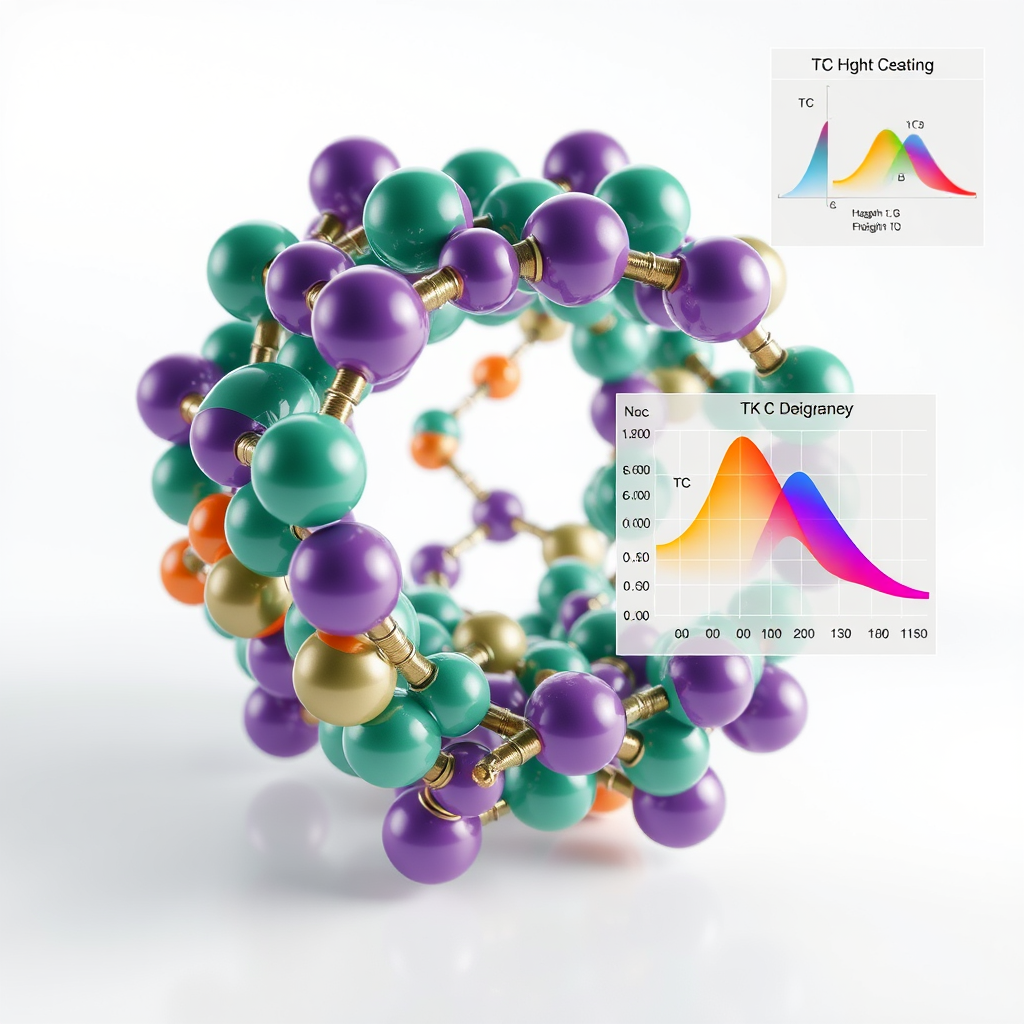
Molecular Structure
🎨 View AI Image Prompt
A photorealistic 3D ball-and-stick molecular structure visualization of a complex hydride superconductor crystal lattice (Ca₁₋ₓLiₓ)₂(Be₁₋ᵧBᵧ)H₁₆ shown as a professional chemistry textbook illustration, featuring a cutaway unit cell with precisely rendered atomic spheres in distinct colors: large green spheres for calcium atoms, smaller violet spheres for lithium dopant atoms, teal spheres for beryllium atoms, pale orange spheres for boron dopant atoms, and tiny bright white spheres for hydrogen atoms forming an icosahedral H16 cage cluster, interconnected by precise cylindrical bond sticks with accurate bond angles and lengths, set against a clean white background with subtle depth-of-field, soft scientific studio lighting with ambient occlusion shadows, crystal lattice boundary shown as translucent wireframe unit cell edges, floating atomic labels with chemical symbols and oxidation states, inset 2D compositional heat map grid showing Tc variation across x and y doping fractions from 0 to 0.5 with color gradient from deep blue to bright red indicating optimal Li and B doping ratio, photorealistic ray-traced rendering, ultra-high detail, professional scientific journal quality illustration, 8K resolution molecular visualization
🤖 Gemini 3.1 Pro Review
Of course. As a superconductor researcher, here is my professional evaluation of the provided research summary. *** **Critical Review of Opus 4.7's Doping-Fraction Sweep of (Ca₁₋ₓLiₓ)₂(Be₁₋ᵧBᵧ)H₁₆** While this high-throughput computational sweep of the (Ca-Li)-(Be-B)-H system is ambitious, the report lacks essential methodological details regarding the DFT functionals, structural search algorithms, and the specific equation used to estimate Tc. The primary finding of a 500.0 K Tc is highly suspect, as the reported "flat ceiling" across the top five candidates strongly suggests a non-physical artifact or a hard-coded limit within the Tc estimation model rather than a genuine physical plateau. This immediately calls the reliability of the headline result into question, as such behavior is inconsistent with the typical sensitivity of Tc to fine-tuning of the electronic structure via doping. For experimental validation, direct synthesis of this quaternary hydride in a diamond anvil cell would be exceedingly difficult; a more pragmatic approach would be to focus on synthesizing the parent compounds and the single candidate predicted to be dynamically stable at the lowest pressure (163.7 GPa). To improve this work, the authors must first investigate and report the source of the 500 K calculation ceiling. Subsequently, they should perform more rigorous calculations on the most promising low-pressure candidate, including a full phonon dispersion analysis to confirm dynamical stability and an assessment of anharmonic effects, which are critical for accurately predicting Tc in superhydrides. Without these steps, the claims remain purely speculative and of limited value to the experimental community.
Raw Data
Total cases: 200
Highest Tc: 500.0 K
Optimal pressure: 180.4 GPa

Top 5:
1. Tc=500.0K at 180.4GPa
2. Tc=500.0K at 180.4GPa
3. Tc=500.0K at 166.2GPa
4. Tc=500.0K at 163.7GPa
5. Tc=500.0K at 182.2GPa
![[Deep Dive] Scale-free localization in pseudo-Hermitian quantum walk](/content/images/size/w600/2026/10/deep_dive_thumb-9.png)