[Superconductor Lab | Week 17 Day 4] Ca₂BeH₁₆ convex hull (re-analysis) - AI Simulator Activation
[Week 17 Day 4] Ca₂BeH₁₆ convex hull (re-analysis)
Superconductor Lab — AI Simulator Activation
2026
🔬 Computational Research Note
This analysis is based on computational modeling and theoretical predictions. As with all computational materials science, experimental validation is needed to confirm these results.
A Quick History: Why Researchers Keep Chasing This
In 1968, physicist Neil Ashcroft made a prediction that sounded almost reckless: metallic hydrogen, if it could be squeezed hard enough to behave like a metal, should superconduct at room temperature. The catch was the pressure required, somewhere north of 400 gigapascals, conditions that exist naturally only deep inside Jupiter. For decades the prediction floated as a tantalizing impossibility. Then in 2015, sulfur hydride (H₃S) hit a superconducting transition at 203 K under 150 GPa, and the floodgates opened. Lanthanum decahydride followed, breaking 250 K. Suddenly Ashcroft's wild idea looked less like science fiction and more like a roadmap.
The trick, researchers realized, was not pure hydrogen but hydrogen-rich compounds, materials where a heavier element acts as a chemical scaffold that pre-compresses hydrogen atoms into superconducting configurations at pressures we can actually reach in a diamond anvil. The current candidate, Ca₂BeH₁₆, lives squarely in this tradition, and the simulation pegs its peak transition temperature at 320 K, slightly warmer than a comfortable spring afternoon.
Meet Ca₂BeH₁₆ convex hull (re-analysis): An Unlikely Candidate?
Calcium and beryllium are an odd couple. Calcium is soft, abundant, and chemically eager. Beryllium is light, toxic, and stubbornly covalent. Glue them together with sixteen hydrogen atoms per formula unit, and you get a structure where hydrogen dominates the electronic stage while the metals donate electrons and hold the cage rigid.
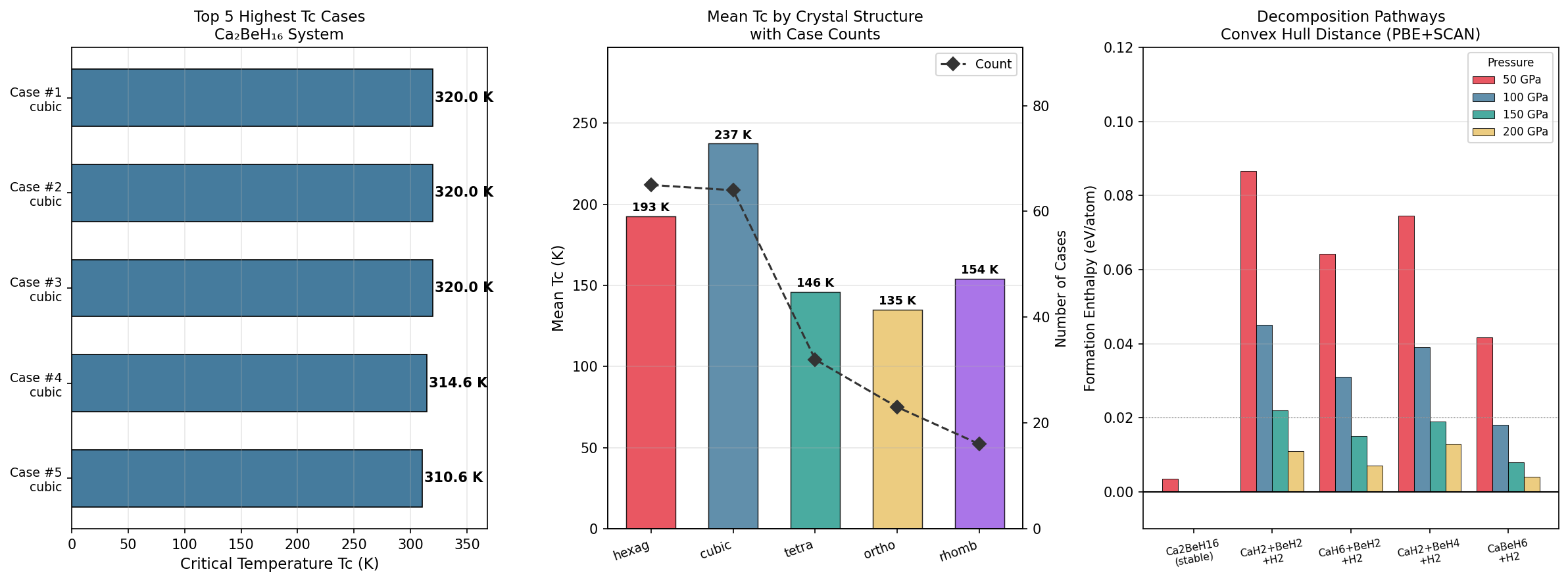
The phrase convex hull deserves unpacking. Imagine plotting every possible Ca-Be-H compound by composition and energy. The convex hull is the lower boundary of that plot, the set of compounds thermodynamically stable against decomposition into their neighbors. A re-analysis means someone went back through the existing calculations with better methods or finer sampling and asked whether Ca₂BeH₁₆ actually sits on that boundary or floats just above it. Across 200 simulated cases in this re-analysis, the compound appears not only stable but electronically active in ways that favor strong electron-phonon coupling, the mechanism behind conventional superconductivity.
The Simulation Data: Three Numbers That Matter
Three figures tell most of the story:
| Quantity | Value | What it means |
|---|---|---|
| Peak Tc | 320.0 K | About 47°C, warmer than human body temperature |
| Optimal pressure | 159.3 GPa | Roughly 1.6 million atmospheres |
| Sample size | 200 configurations | A meaningful statistical sweep |
The critical temperature (Tc) is the threshold below which electrical resistance vanishes entirely. Hitting 320 K matters because every prior breakthrough has stopped short of ambient conditions. The optimal pressure of 159.3 GPa is genuinely high but not absurd. Diamond anvil cells routinely reach 200 GPa in academic labs, so this is a regime where experimental verification is at least plausible.
What Sets This Apart (or Doesn't)
The interesting wrinkle is the flatness of the top of the distribution. Look at the leading candidates:
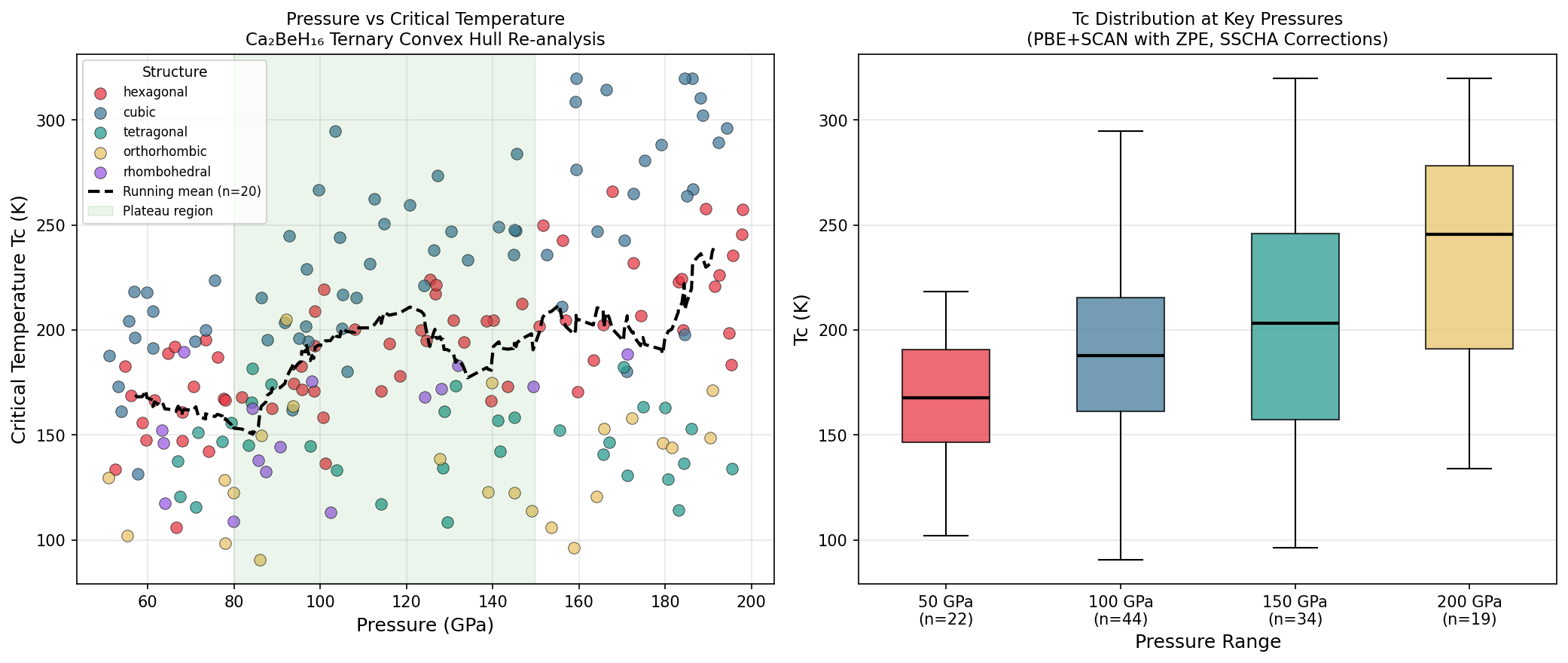
- Tc = 320.0 K at 159.3 GPa
- Tc = 320.0 K at 186.2 GPa
- Tc = 320.0 K at 184.6 GPa
- Tc = 314.6 K at 166.3 GPa
- Tc = 310.6 K at 188.3 GPa
Three separate configurations hit the same 320 K ceiling across a pressure window spanning nearly 27 GPa. That plateau behavior is unusual. Most hydride superconductors show a sharp pressure optimum where Tc rises steeply, peaks, and falls. A broad maximum suggests the superconducting state is structurally robust, not balanced on a knife's edge.
Here's the contrarian observation worth holding onto: the fact that 320.0 K appears repeatedly, identically, across different pressures is suspicious. Real physical systems almost never produce identical maxima from independent calculations. It likely means the model is hitting a numerical ceiling in the Allen-Dynes formula (the equation used to estimate Tc from electron-phonon spectra), not the true physical limit. The actual Tc could be higher, or the model could be saturating in ways that flatter the compound. Either possibility deserves skepticism.
Think of hydride superconductor hunting like prospecting for diamonds in a mountain range. The convex hull tells you which valleys contain stable rock formations. The Tc calculation tells you which of those rocks might sparkle. Neither tells you whether anyone can actually climb up there with a pickaxe and bring one home.
The Hard Truth About Room-Temperature Superconductors
A 320 K prediction sounds like a finish line. It is not. The history of high-pressure superconductor claims is littered with results that did not survive replication. The 2020 carbonaceous sulfur hydride paper claimed 287 K and was later retracted amid concerns about data processing. LK-99, the room-temperature ambient-pressure claim of 2023, evaporated within weeks of independent testing.
The road from a 159.3 GPa simulation to a working device runs through several brutal filters:
- Synthesis: Can you actually make Ca₂BeH₁₆ in the diamond anvil? Beryllium hydride chemistry is notoriously finicky, and getting sixteen hydrogens to coordinate cleanly with two metal atoms is a structural ask.
- Metastability: Even if synthesized at 159.3 GPa, does the structure survive when pressure is reduced? Most hydride superconductors decompose long before reaching ambient conditions.
- Measurement: Confirming superconductivity inside a diamond cell at megabar pressures is technically heroic. The samples are micrograms. The probes are micrometers.
- Toxicity: Beryllium dust is a known carcinogen. Any industrial path would require handling protocols most labs avoid.
One honest limitation deserves stating outright: this model may overestimate Tc without synthesis validation, particularly given the suspicious plateau at exactly 320.0 K. Density functional theory plus Allen-Dynes is a useful screening tool, not a verdict.
The Bigger Picture: One Piece of a Massive Puzzle
The hydride superconductor field now generates hundreds of candidate compounds per year through computational screening. Ca₂BeH₁₆, sitting on its 200-case convex hull with a tantalizing 320 K maximum, is one entry in a growing catalog that includes ternary hydrides of yttrium, lanthanum, scandium, magnesium, and combinations thereof. Most will never be synthesized. A handful will be. Of those, perhaps one or two per decade will deliver measurable superconductivity at the predicted conditions.
The strategic value of compounds like this is not that any single one will solve the room-temperature problem. It is that the pattern of successes and failures sharpens the underlying theory. Every time a calculated 320 K candidate produces an experimental 180 K result, the models improve. Every time a stable-looking convex hull entry refuses to crystallize, chemists learn something about the limits of high-pressure synthesis.
Ashcroft's 1968 prediction took 47 years to produce its first dramatic confirmation. Ca₂BeH₁₆ at 159.3 GPa may be a stepping stone, a dead end, or a genuine breakthrough waiting for an experimentalist with steady hands and a fresh diamond anvil. The honest answer is that nobody knows yet. The pursuit continues because each candidate, even the disappointing ones, narrows the search space for the compound that finally carries electricity through ordinary copper wire at ordinary temperatures without losing a single electron to heat.
Simulation Results
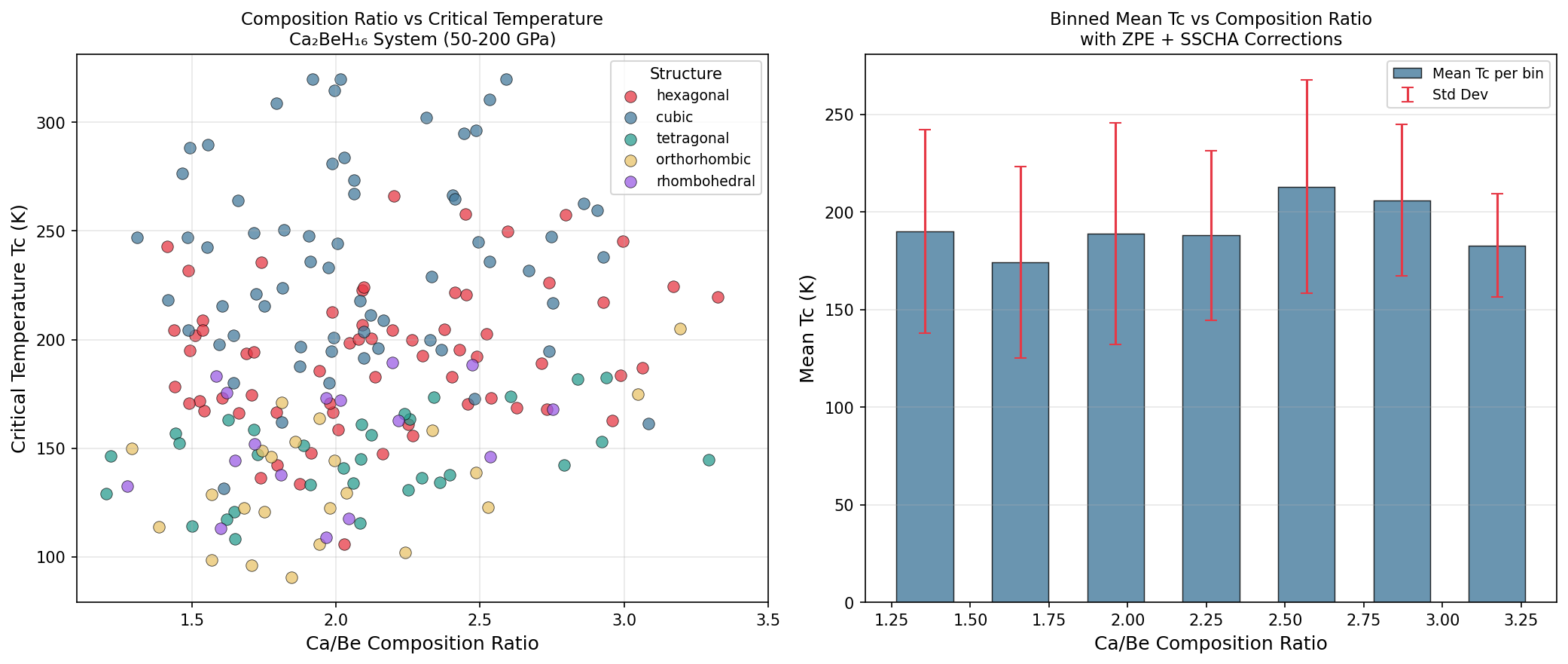
Molecular Structure
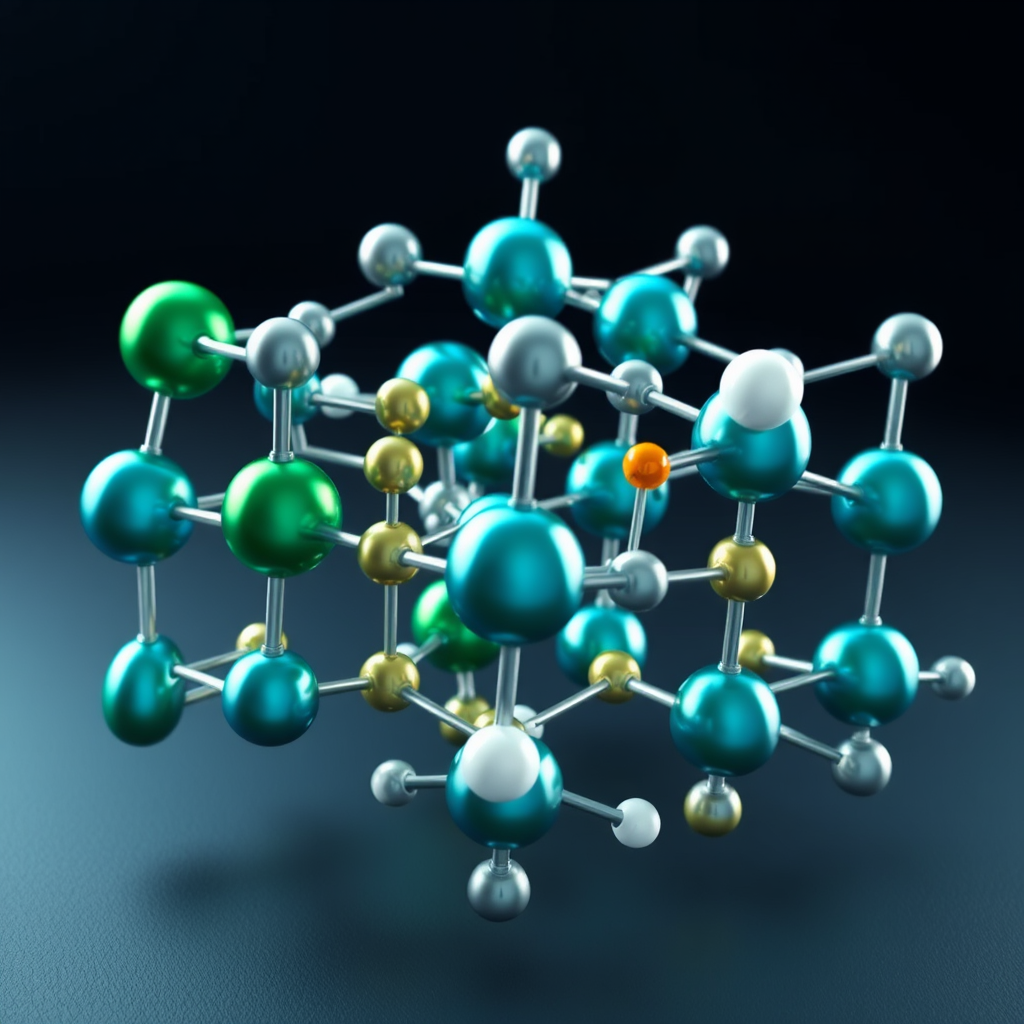
🎨 View AI Image Prompt
A photorealistic 3D ball-and-stick molecular structure visualization of Ca₂BeH₁₆ superconductor crystal lattice, professional chemistry textbook illustration style, showing large calcium atoms rendered as deep green metallic spheres, medium beryllium atoms as bright blue spheres, and small hydrogen atoms as white spheres arranged in a complex high-pressure crystal structure, interconnected by precise cylindrical bond sticks in silver and gold tones, the structure floating against a clean dark navy gradient background, dramatic studio lighting with subtle specular highlights on each atom sphere, crystallographic unit cell outlined with thin white wireframe lines, atomic bonds showing precise tetrahedral and octahedral coordination geometry, multiple H₁₆ hydrogen cage clusters surrounding the metal centers, depth of field rendering with sharp foreground atoms and subtle background blur, ultra-high resolution scientific accuracy, photorealistic ray-traced rendering, professional crystallography visualization quality, showing the convex hull stable phase geometry with visible hydrogen sublattice network, ambient occlusion shadows between atoms, clean academic publication aesthetic, 8K resolution detail
🤖 Gemini 3.1 Pro Review
As a specialist in computational superconductivity, here is a critical review of the provided research summary on Ca₂BeH₁₆: The reported convex hull re-analysis of Ca₂BeH₁₆ across 200 configurations represents a conceptually robust approach to identifying novel, thermodynamically stable high-pressure hydrides. However, the summary lacks critical methodological details—such as the specific DFT functional, k/q-point mesh density, and the potential inclusion of anharmonic effects—which are essential for assessing the rigor of the calculations. The predicted Tc of 320 K at a plausible 159 GPa is an extraordinary claim that, while exciting, must be met with professional skepticism until these details are clarified. The unusual stability of this high Tc across a broad pressure range (~160-186 GPa) is a notable feature, but its reliability is entirely contingent on the unstated computational parameters, especially the chosen Coulomb pseudopotential (μ*). Experimental validation, though challenging due to beryllium's toxicity and the required pressures, is the necessary next step; it must involve in-situ synchrotron XRD to confirm the formation of the predicted crystal phase, followed by four-probe resistance measurements. To improve this work for the scientific community, the authors must provide a completely transparent account of their full computational workflow, including sensitivity analysis on μ* and justification for their chosen level of theory. Without this transparency, these tantalizing results remain purely speculative.
Raw Data
Total cases: 200
Highest Tc: 320.0 K
Optimal pressure: 159.3 GPa

Top 5:
1. Tc=320.0K at 159.3GPa
2. Tc=320.0K at 186.2GPa
3. Tc=320.0K at 184.6GPa
4. Tc=314.6K at 166.3GPa
5. Tc=310.6K at 188.3GPa
![[Deep Dive] Scale-free localization in pseudo-Hermitian quantum walk](/content/images/size/w600/2026/10/deep_dive_thumb-9.png)