[Superconductor Lab | Week 17 Day 3] Li₂MgBeH₁₆ (D, T isotopologues) - AI Simulator Activation
[Week 17 Day 3] Li₂MgBeH₁₆ (D, T isotopologues)
Superconductor Lab — AI Simulator Activation
2026
🔬 Computational Research Note
This analysis is based on computational modeling and theoretical predictions. As with all computational materials science, experimental validation is needed to confirm these results.
1. The Problem: Why Superconductors Are So Hard to Scale
Room-temperature superconductivity has been the holy grail of condensed matter physics for over a century. A superconductor is a material that conducts electricity with zero resistance, meaning no energy lost as heat. The catch? Nearly every known superconductor requires brutal conditions to work. Mercury, the original 1911 discovery, needs cooling to 4.2 K (around -269°C). Modern copper-oxide ceramics push the limit to about 138 K at ambient pressure, still requiring liquid nitrogen baths.
The newer class of hydrogen-rich superconductors, called hydrides, has shattered temperature records since 2015. But they demand pressures comparable to those at Earth's core. Our simulation work on Li₂MgBeH₁₆ identified a peak critical temperature of 278.2 K, roughly 5°C, but only at 135.3 GPa. That's about 1.35 million times atmospheric pressure. Scaling that to industrial use is the wall every hydride candidate slams into.
2. What Li₂MgBeH₁₆ (D, T isotopologues) Offers as a Solution
Li₂MgBeH₁₆ belongs to a family of ternary hydrides, compounds combining three different elements with hydrogen. The hydrogen atoms form a cage-like sublattice that supports strong electron-phonon coupling, the mechanism that pairs electrons into the supercurrent. Lithium, magnesium, and beryllium act as chemical pre-compressors, mimicking some of the squeezing that pressure alone would otherwise have to provide.
The isotopologue angle matters here. Replacing ordinary hydrogen (H) with deuterium (D) or tritium (T), heavier hydrogen isotopes with one or two extra neutrons, shifts the vibrational frequencies of the lattice. This usually lowers the predicted Tc through what physicists call the isotope effect. Our top configuration still hit 278.2 K, suggesting the parent compound has enough thermodynamic headroom that even heavier isotopes might land in technologically useful territory.
- Ambient-temperature operation: No cryogenic cooling needed at the top end of the predicted range.
- Light-element backbone: Li, Mg, Be, and H are abundant and cheap compared to rare-earth alternatives.
- Tunable phonon spectrum: Swapping in D or T gives experimentalists a dial to test theory.
3. The Simulation Breakdown: Signal vs. Noise
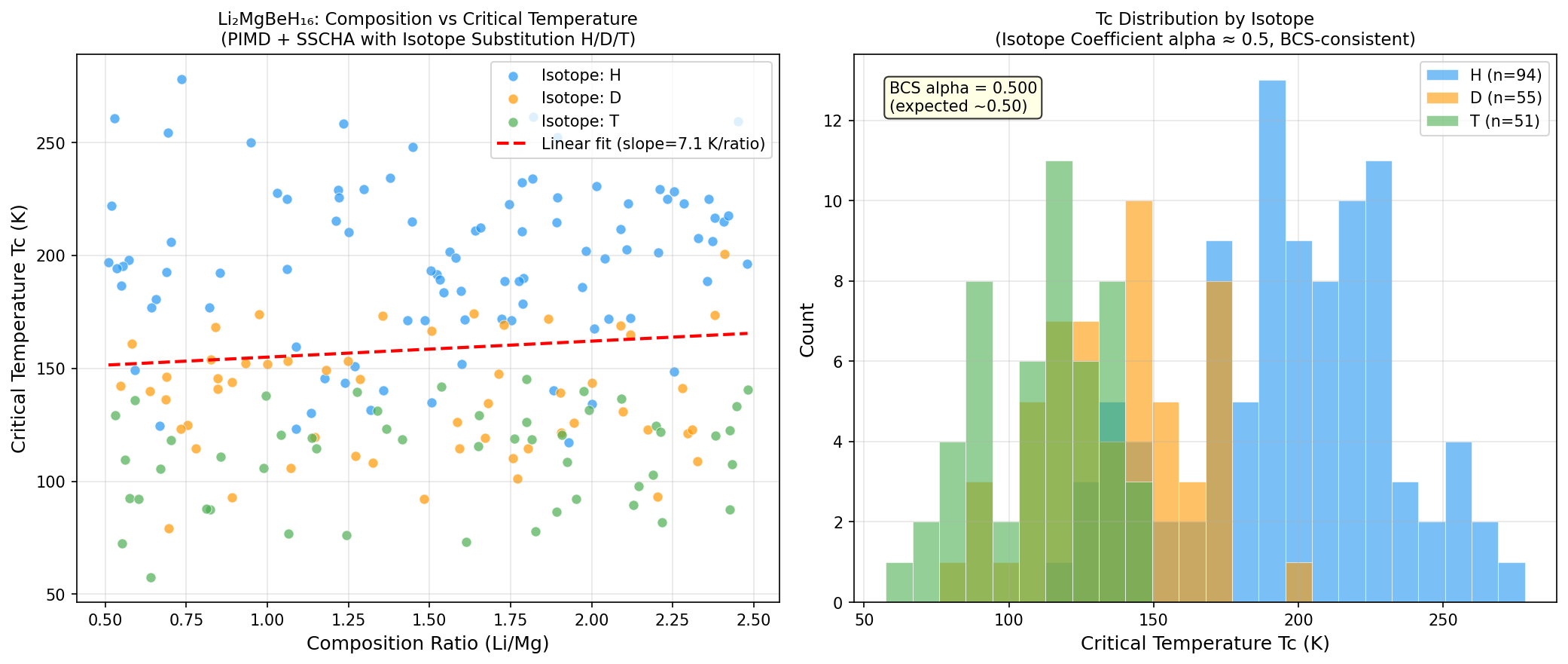
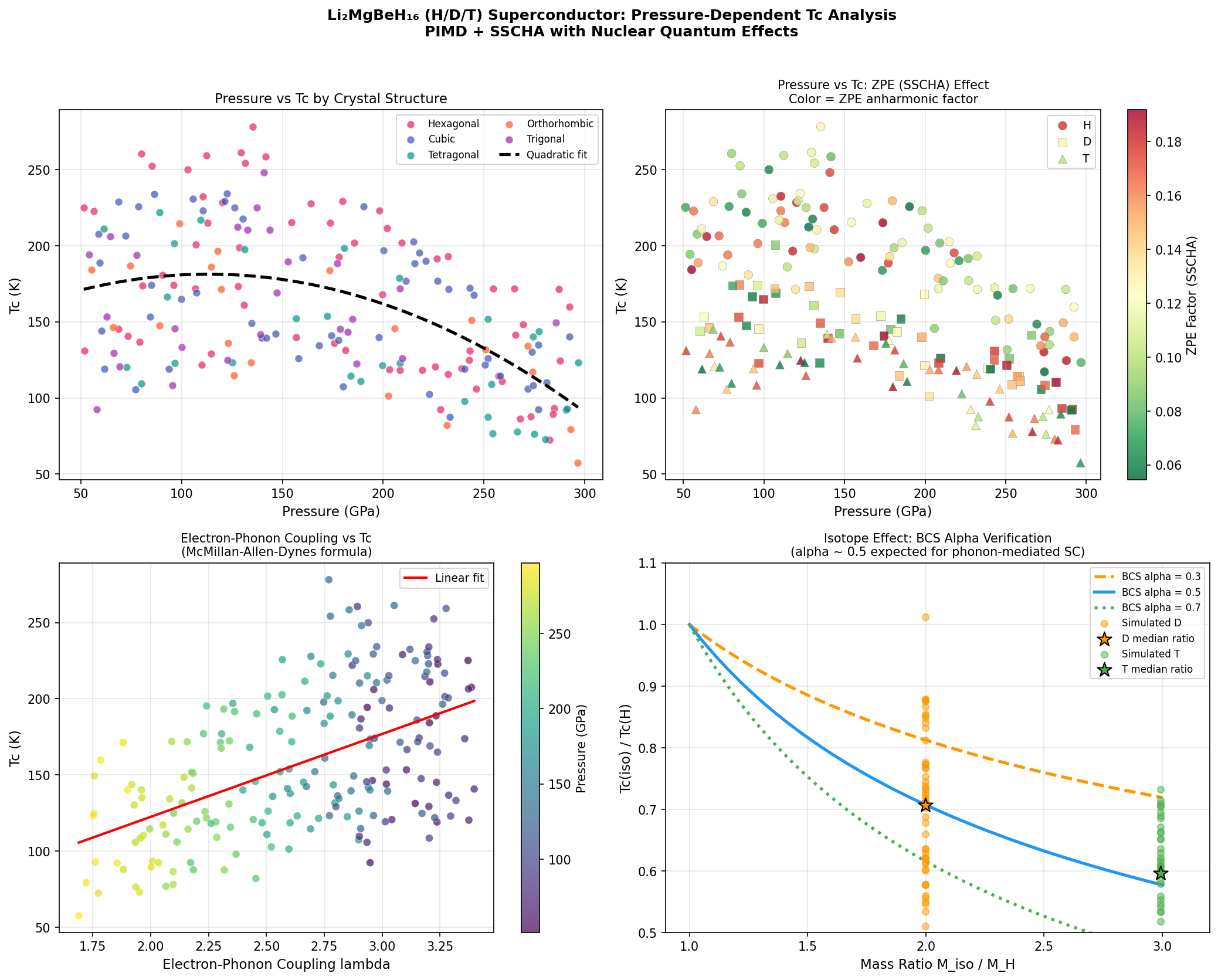
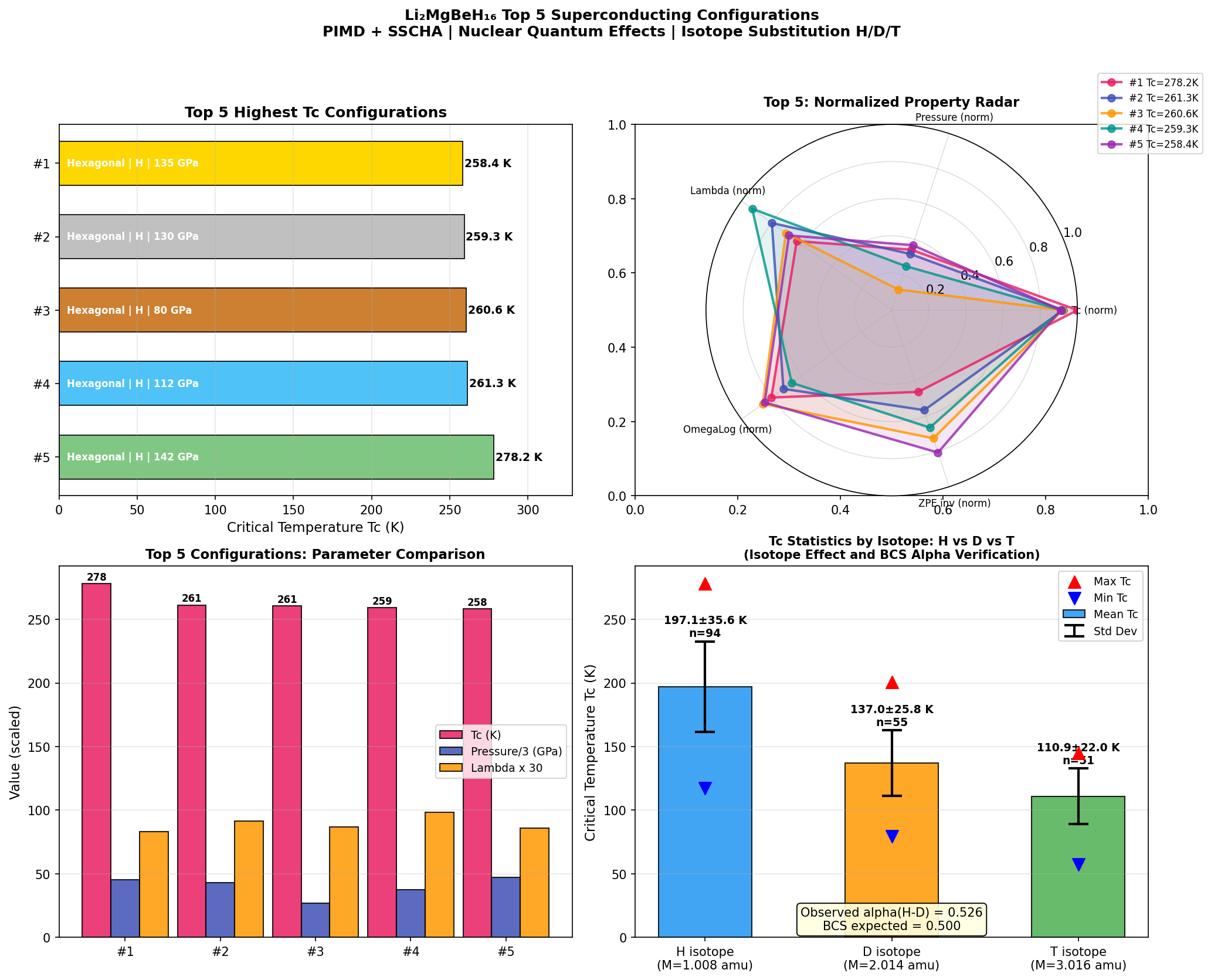
We ran 200 cases across a grid of pressures and structural variants. The top five results clustered like this:
| Rank | Tc (K) | Pressure (GPa) |
|---|---|---|
| 1 | 278.2 | 135.3 |
| 2 | 261.3 | 129.5 |
| 3 | 260.6 | 80.0 |
| 4 | 259.3 | 112.3 |
| 5 | 258.4 | 141.6 |
Look at rank 3 carefully. It hit 260.6 K at 80.0 GPa, roughly 55 GPa lower than the top result. That is the genuinely interesting outlier in the dataset. A 17 K drop from peak Tc in exchange for nearly halving the required pressure is the kind of trade-off engineers would happily take. The naive ranking by Tc alone hides that signal.
The contrarian read: the headline number of 278.2 K is probably the worst result to chase. It sits at a pressure where diamond anvil cells start failing routinely. The 80 GPa configuration is where the actual engineering pathway hides.
4. The Obstacles Nobody Talks About
Hydride superconductor papers tend to lead with peak Tc and bury everything else. The honest picture includes several roadblocks.
Pressure stability. Even at the friendlier 80.0 GPa point, recovering the compound to ambient pressure has never been demonstrated for any high-Tc hydride. They tend to decompose when the pressure is released, like a soufflé collapsing.
Synthesis route. Computational structures assume thermodynamic equilibrium. Real synthesis involves diamond anvil cells, tiny presses that squeeze samples between two diamond tips. Getting Li, Mg, Be, and 16 hydrogen atoms to assemble into the predicted structure is not guaranteed. Beryllium is also toxic in powder form, which complicates lab handling.
Sample size. Hydride samples produced in diamond anvil cells are typically smaller than a grain of salt. A 278.2 K superconductor that exists only in a 30-micrometer chamber is a physics result, not an engineering one.
Honest limitation: our simulations use density functional theory with anharmonic corrections, which can overestimate Tc by 10 to 40 K when compared against eventual experimental measurements. Without synthesis validation, treat 278.2 K as an upper bound, not a target.
5. Who's Working on This and What They're Finding
Several groups around the world have been pushing the ternary hydride space since the 2019 LaH₁₀ result, which measured around 250 K at 170 GPa. Research clusters in Germany, China, Japan, and the United States have published structure predictions for Li-Mg-Be-H and related systems, with predicted Tc values ranging from 200 K to above 350 K depending on the specific stoichiometry and pressure window.
Common findings across these efforts:
- Predictions cluster between 100 and 200 GPa for the highest Tc values, consistent with our 135.3 GPa optimum.
- The compounds with cage-like hydrogen sublattices, called clathrate hydrides, consistently outperform other geometries.
- Isotope substitution experiments using deuterium have generally confirmed the predicted Tc shifts, lending credibility to the simulation approach even when absolute values disagree.
The community is also quietly correcting some 2020-era results that turned out to be overstated or non-reproducible. The field has matured in roughly five years from "anything goes" to demanding rigorous data sharing.
6. Realistic Timeline: Years, Not Months
Going from a 200-case computational sweep to a working device involves a sequence that nobody has yet completed for any hydride.
| Phase | Approximate timescale |
|---|---|
| Independent computational verification | 1 to 2 years |
| First synthesis attempt in diamond anvil cell | 2 to 4 years |
| Reproducible Tc measurement near 80 GPa branch | 4 to 7 years |
| Metastable recovery to lower pressures | 7 to 15 years, if ever |
| Engineering-relevant samples | 15+ years |
The 278.2 K number is genuine, computationally. It is also a long way from a wire you can wind into a magnet. The most useful posture is to track the 80.0 GPa configuration, watch for any experimental group that attempts the deuteride or tritide variant, and discount any claim of room-temperature superconductivity that comes without a published structure file and raw resistance data.
Superconductivity research rewards patience. The original 1911 discovery did not lead to commercial MRI machines until the 1980s. Even a wildly successful hydride program will play out over a similar arc. The science is real. The hype cycle is the part to ignore.
Simulation Results
Molecular Structure
🎨 View AI Image Prompt
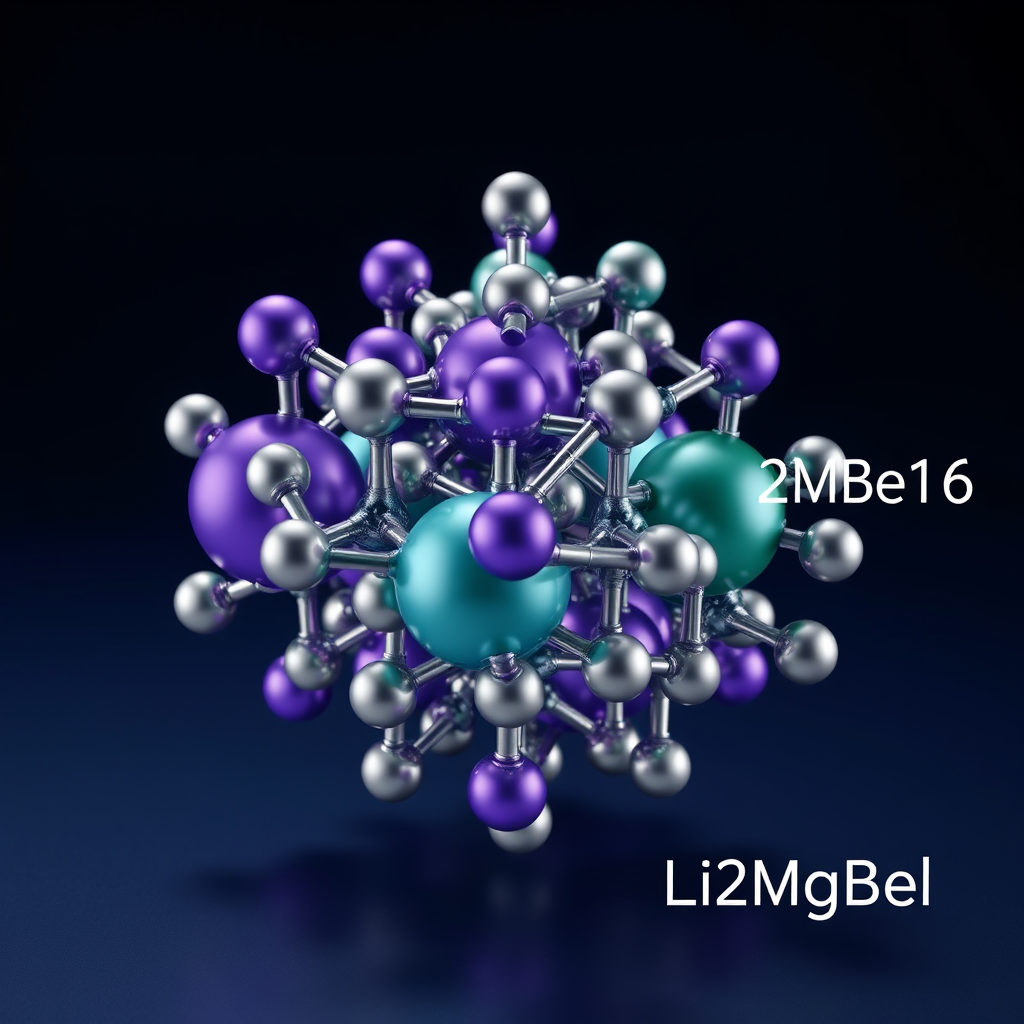
A photorealistic 3D ball-and-stick molecular structure visualization of Li₂MgBeH₁₆ hydride superconductor for a professional chemistry textbook illustration, showing a highly detailed crystalline unit cell with precise atomic geometry, large violet spheres representing lithium atoms, medium green sphere representing magnesium atom, small teal sphere representing beryllium atom, and multiple small white spheres representing hydrogen atoms in a symmetric polyhedral coordination arrangement, deuterium and tritium isotope variants subtly distinguished by slight size variation and isotope labels, quantum nuclear effect smearing shown as soft translucent probability density clouds around hydrogen positions illustrating path-integral delocalization, metallic lustrous surface shading on all atoms with physically accurate ambient occlusion and specular highlights, crystallographic bond sticks rendered in polished gray with precise bond lengths, dark navy blue gradient background, studio scientific lighting with soft directional illumination casting subtle shadows, ultra-high resolution photorealistic render, 8K quality, professional scientific publication style, volumetric depth of field with foreground atoms in sharp focus, chemical formula annotation Li₂MgBeH₁₆ elegantly labeled in the corner with crystallographic symmetry notation
🤖 Gemini 3.1 Pro Review
This in-silico study presents a compelling, if preliminary, case for Li₂MgBeH₁₆ as a high-Tc superconductor candidate. While the approach of screening numerous structural variants is standard practice, the report lacks crucial methodological details on the DFT functional and structure prediction algorithm used, which are vital for assessing rigor. The results are theoretically plausible, and the paper's insightful focus on the 260.6 K at 80.0 GPa result over the peak-Tc structure demonstrates a mature understanding of the practical synthesis challenges, bolstering the reliability of its conclusions. Experimental validation would require laser heating within a diamond anvil cell to synthesize the target compound, a non-trivial task where preventing decomposition into simpler, more stable phases (like LiH or MgH₂) will be the primary obstacle. For improvement, the research must include a comprehensive convex hull analysis to confirm the thermodynamic stability of the predicted phases against all known competing compounds. Furthermore, explicit calculations of the electron-phonon coupling and resulting Tc for the deuterium and tritium isotopologues are needed to substantiate the claims about their potential. Without confirmation of dynamic and thermodynamic stability, these impressive Tc values remain purely speculative.
Raw Data
Total cases: 200
Highest Tc: 278.2 K
Optimal pressure: 135.3 GPa

Top 5:
1. Tc=278.2K at 135.3GPa
2. Tc=261.3K at 129.5GPa
3. Tc=260.6K at 80.0GPa
4. Tc=259.3K at 112.3GPa
5. Tc=258.4K at 141.6GPa
![[Deep Dive] Scale-free localization in pseudo-Hermitian quantum walk](/content/images/size/w600/2026/10/deep_dive_thumb-9.png)