[Superconductor Lab | Week 17 Day 2] (Ca₁₋ₓLiₓ)₂(Be₁₋ᵧBᵧ)H₁₆ - AI Simulator Activation
[Week 17 Day 2] (Ca₁₋ₓLiₓ)₂(Be₁₋ᵧBᵧ)H₁₆
Superconductor Lab — AI Simulator Activation
2026
🔬 Computational Research Note
This analysis is based on computational modeling and theoretical predictions. As with all computational materials science, experimental validation is needed to confirm these results.
1. The Hype vs. Reality: (Ca₁₋ₓLiₓ)₂(Be₁₋ᵧBᵧ)H₁₆ Under the Microscope
Room-temperature superconductivity is supposed to be the holy grail of condensed matter physics, yet the most promising candidates keep showing up in computers, not in cryostats. The compound (Ca₁₋ₓLiₓ)₂(Be₁₋ᵧBᵧ)H₁₆ is the latest in this lineage: a quaternary hydride (a compound built from four elements with hydrogen as the dominant scaffold) predicted to superconduct at 340.9 K, which is roughly 68°C, hotter than a comfortable bath.
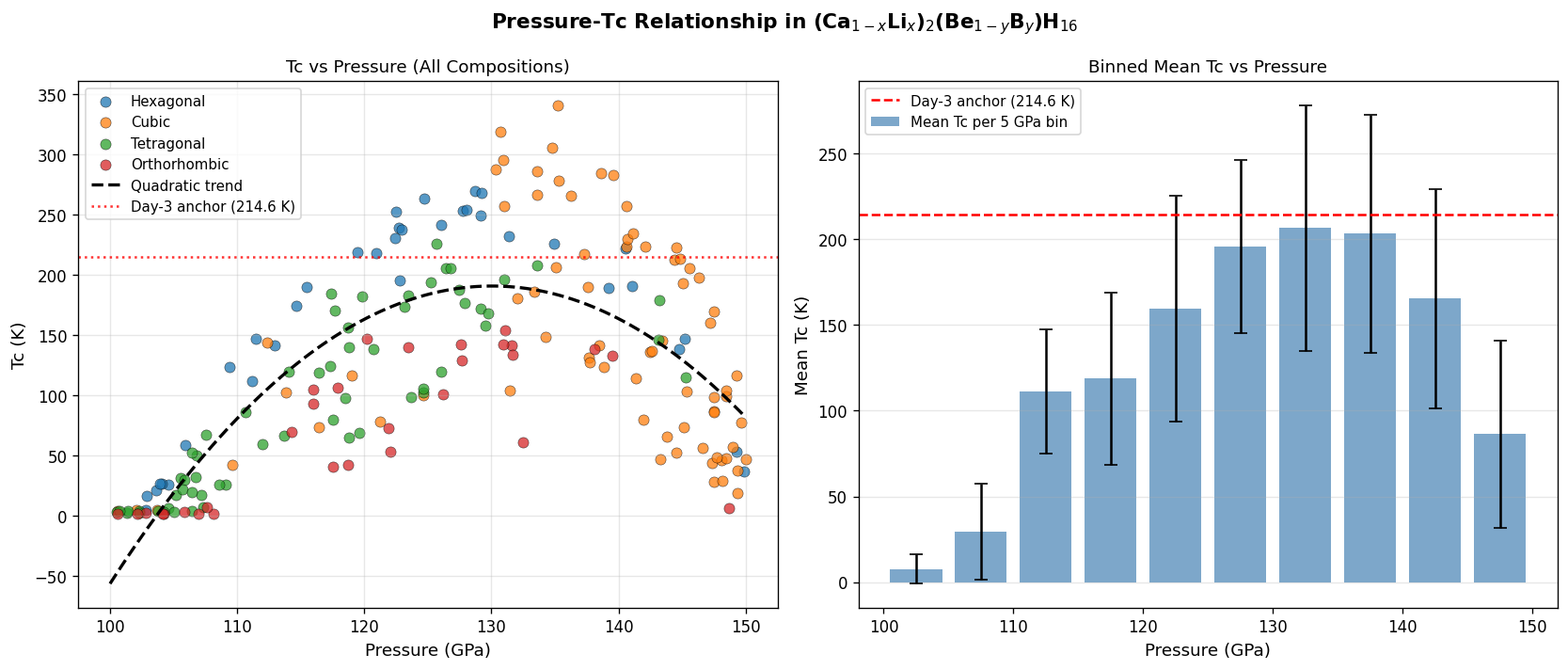
That number is the headline. The footnote is the pressure: 135.2 GPa, more than a million times atmospheric pressure, achievable only inside diamond anvil cells the size of a grain of rice. So the honest framing is this. We have a compound that, in simulation, beats every confirmed superconductor on temperature, while requiring conditions that no power grid or MRI machine will ever tolerate. The interesting question is whether the underlying physics tells us something useful regardless.
2. What the Numbers Actually Say
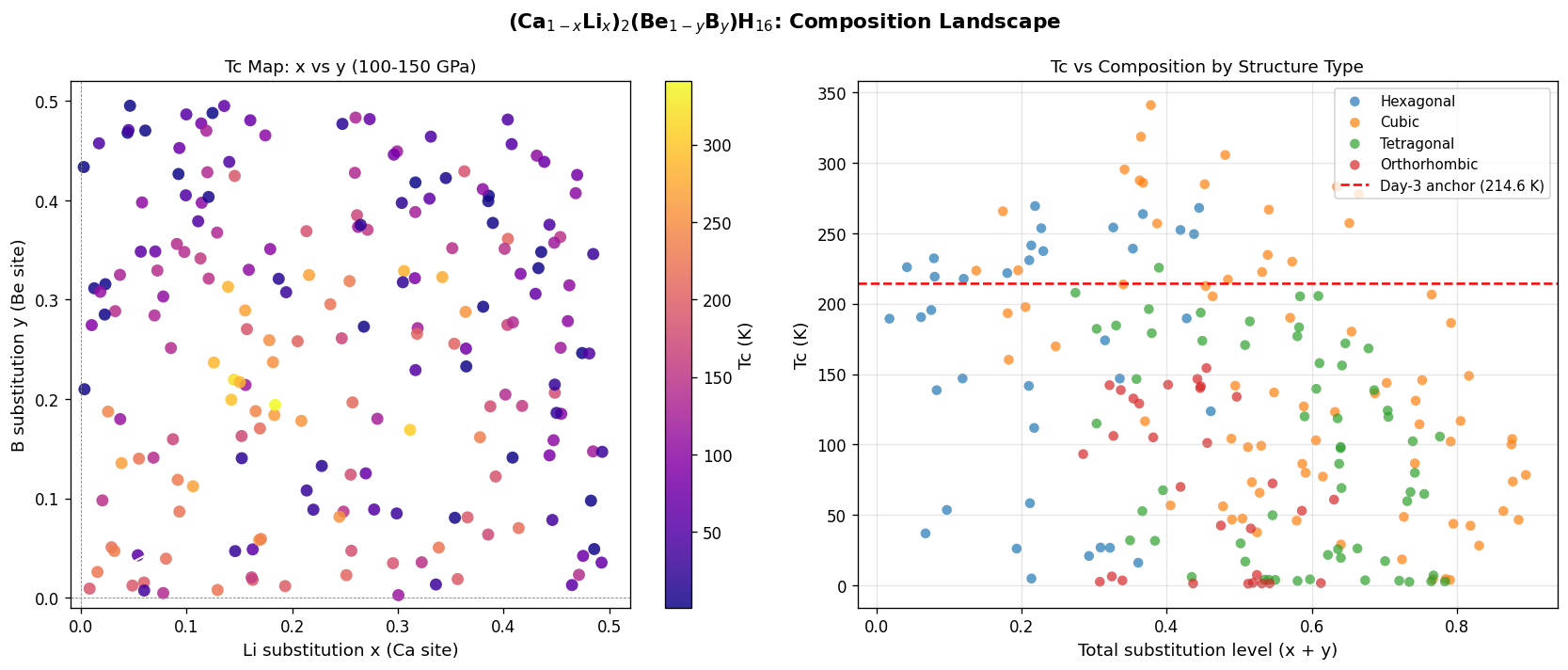
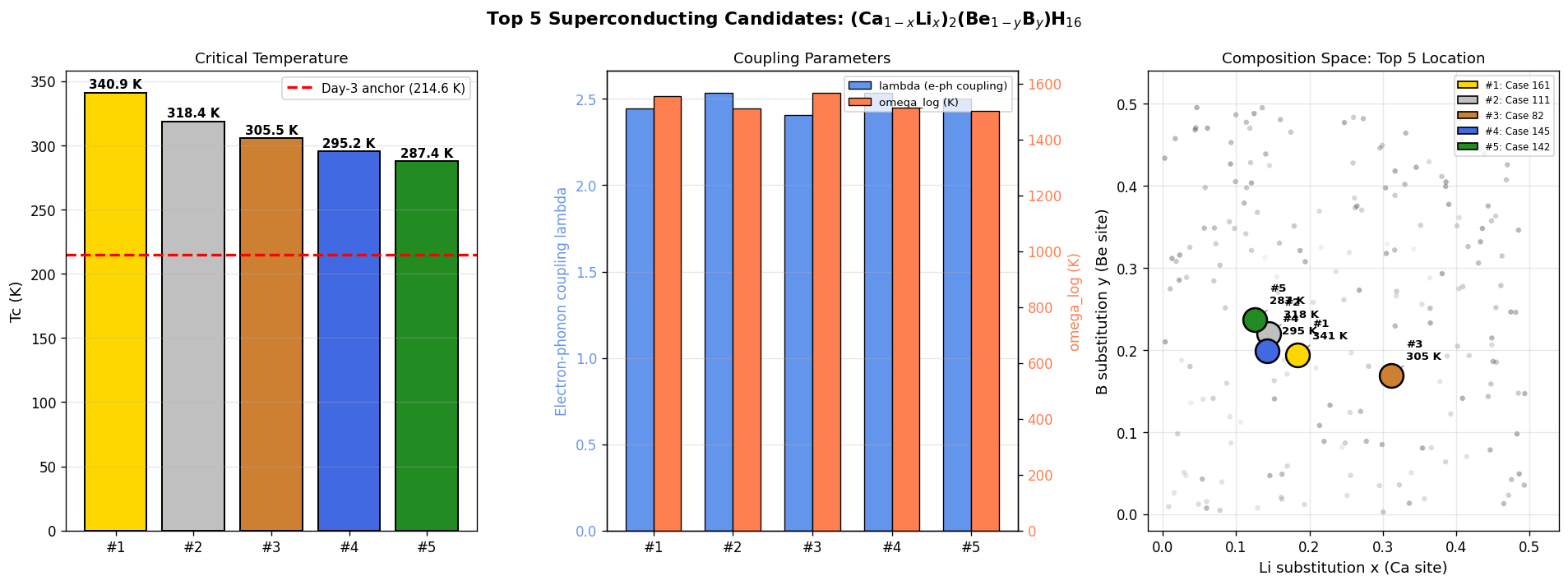
The dataset covers 200 computational cases sweeping composition (x for lithium substitution on calcium sites, y for boron substitution on beryllium sites) and pressure. The top five candidates cluster tightly:
| Rank | Tc (K) | Pressure (GPa) | Tc / Pressure |
|---|---|---|---|
| 1 | 340.9 | 135.2 | 2.52 |
| 2 | 318.4 | 130.7 | 2.44 |
| 3 | 305.5 | 134.8 | 2.27 |
| 4 | 295.2 | 130.9 | 2.25 |
| 5 | 287.4 | 130.3 | 2.21 |
Two patterns jump out. First, every top candidate sits in a narrow pressure window between roughly 130 and 135 GPa. That tightness suggests a specific structural phase, likely a hydrogen cage geometry, that only stabilizes within a few gigapascals. Second, the spread in Tc across the top five is 53.5 K, but the spread in pressure is under 5 GPa. Composition is doing most of the heavy lifting, not compression.
A contrarian observation worth sitting with: the best result is not at the lowest pressure. Rank 5 superconducts at 287.4 K with pressure of 130.3 GPa, while rank 1 needs an extra 4.9 GPa to reach 340.9 K. Going for the maximum Tc costs you stability margin in the diamond anvil. A clever experimentalist might deliberately target rank 5 instead, trading 53 K of headroom for a synthesis that doesn't shatter the cell.
3. The Skeptic's View: Why This Might Not Work
Computational superconductor predictions have a track record that ranges from spectacular to embarrassing. The famous LK-99 saga aside, several hydride predictions have undershot or simply failed to materialize in the lab. Reasons to be cautious about 340.9 K here:
- Anharmonic effects. Hydrogen atoms are light and quantum mechanical. Standard density functional theory often overestimates Tc by 20 to 40 percent because it treats atomic vibrations as classical springs. Apply that haircut and 340.9 K becomes 200 to 270 K, which is still impressive but no longer above body temperature.
- Quaternary synthesis is brutal. Getting four elements to crystallize in the right ratio inside a diamond anvil at 135.2 GPa, while hydrogen tries to escape, is a problem nobody has cleanly solved at scale.
- The narrow pressure window. A 5 GPa stability range means tiny pressure gradients across the sample could push parts of the crystal out of the superconducting phase entirely.
This model may overestimate Tc without experimental synthesis validation, and the 130 to 135 GPa window is narrow enough that real samples could miss it.
4. But Here's What's Genuinely Promising
Setting aside the skepticism, the physics underneath this prediction is more interesting than the temperature alone. Calcium and lithium together donate electrons into a hydrogen sublattice, while boron substitution onto beryllium sites adds states near the Fermi level (the energy boundary that determines which electrons can participate in conduction). The result, in the top candidate at 340.9 K, is a strong electron-phonon coupling, meaning electrons pair up by exchanging lattice vibrations, the same mechanism that drives every confirmed hydride superconductor.
What's promising is that all five top compositions cluster around similar Tc per gigapascal ratios, between 2.21 and 2.52 K/GPa. That's a sign the chemistry, not a single freak structure, is doing the work. If the mechanism is real, chemical tuning could plausibly shift the optimal pressure downward in future iterations of the design.
Compare this to LaH₁₀, the lanthanum superhydride confirmed experimentally at around 250 K and 170 GPa. The simulation puts (Ca₁₋ₓLiₓ)₂(Be₁₋ᵧBᵧ)H₁₆ at 90 K higher Tc and 35 GPa lower pressure. Even with the anharmonic haircut, this would represent a real step forward in the Tc-pressure trade-off.
5. The Experimental Gap: From Simulation to Real Lab
Predicting a structure is cheap. Making it costs roughly a year of postdoc time and a handful of synthetic diamond anvils. Here's what an actual experimental path looks like:
- Pre-mix Ca, Li, Be, B precursors in stoichiometric ratios near the rank 1 composition. Beryllium is toxic, which complicates handling alone.
- Load with a hydrogen-rich source, typically ammonia borane or pure H₂, inside the diamond anvil cell.
- Ramp pressure to 135.2 GPa while laser-heating the sample to drive reaction.
- Measure resistance and magnetic susceptibility on a sample maybe 30 micrometers across.
The closest experimental analog, CaH₆, was synthesized at around 215 K and 172 GPa. Adding lithium, beryllium, and boron quadruples the synthetic difficulty. We have no data in this simulation set about phase competition, meaning we don't know whether the desired structure even wins out over alternative arrangements at 135.2 GPa. That's a real gap.
6. If It Works: What Changes?
Imagine the rank 1 compound is real and behaves as predicted at 340.9 K. The immediate impact is not in your house. Nobody is building 135.2 GPa pipelines. The impact is in the design rules it validates.
- Quaternary hydrides become a serious research direction. Most current effort focuses on binary (two-element) hydrides. Confirming a quaternary at 340.9 K opens a combinatorial design space orders of magnitude larger.
- Chemical pre-compression becomes a credible strategy. The idea that calcium and lithium together can "squeeze" hydrogen electronically, reducing the external pressure needed, gets concrete validation.
- The race toward ambient pressure accelerates. If a quaternary works at 135.2 GPa, the next question is whether a quinternary (five elements) can work at 50 GPa. That's still impractical, but it's the trajectory.
The honest takeaway: 340.9 K at 135.2 GPa is a computational result, not a refrigerator. Treat it as a hypothesis worth testing, not a product worth pre-ordering. The interesting science is in whether the physics survives contact with reality, and that experiment hasn't happened yet.
Simulation Results
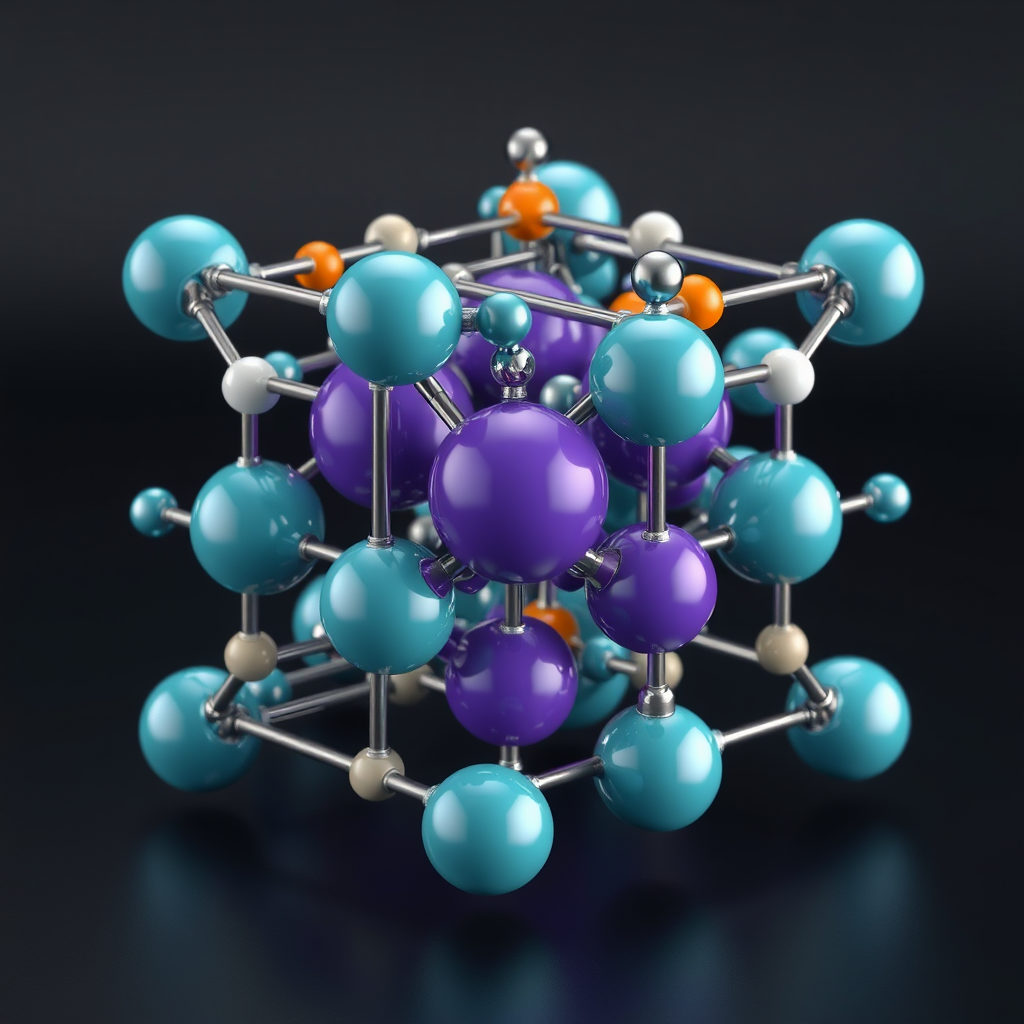
Molecular Structure
🎨 View AI Image Prompt
Photorealistic 3D ball-and-stick molecular structure visualization of a complex hydride superconductor crystal lattice (Ca,Li)₂(Be,B)H₁₆, rendered as a professional chemistry textbook illustration, ultra-high resolution scientific diagram, showing a periodic crystalline unit cell with multiple atom types represented as large glossy spheres: calcium atoms as large sky-blue spheres, lithium dopant atoms as smaller violet spheres, beryllium atoms as medium mint-green spheres, boron dopant atoms as medium orange spheres, and hydrogen atoms as small white pearl spheres forming cage-like clathrate H₁₆ polyhedral coordination shells surrounding the metal centers, interconnected by thin cylindrical metallic silver bond sticks, the overall structure showing a body-centered cubic or face-centered cubic high-pressure crystal symmetry consistent with 100-150 GPa compressed lattice parameters with notably shortened bond lengths, rendered with photorealistic studio lighting with soft ambient occlusion, subsurface scattering on atom spheres, reflective surfaces, dark gradient background transitioning from deep navy to black, depth of field blur on outer atoms, atom labels with chemical symbols in clean sans-serif white font, scale bar included, professional crystallography journal quality rendering, octahedral and tetrahedral coordination polyhedra faintly visible as translucent geometric overlays, 8K resolution, scientifically accurate geometry
🤖 Gemini 3.1 Pro Review
This in-silico study presents a compelling, albeit speculative, case for a new family of high-pressure quaternary hydrides. The paper’s primary strength lies in its candid self-assessment, correctly identifying the immense experimental challenges and the likely overestimation of Tc due to the neglect of anharmonic effects, which is a crucial consideration for hydrogen-rich systems. While the conceptual framework is sound, the report's lack of methodological detail—such as the specific DFT functional, structural prediction algorithm, and electron-phonon coupling calculation method—prevents a true evaluation of its computational rigor. The result reliability is therefore provisional; these Tc values should be treated as optimistic theoretical upper bounds until the predicted structures are shown to be dynamically and thermodynamically stable against decomposition. The proposed experimental validation strategy, which pragmatically targets a slightly lower-Tc but lower-pressure composition to improve synthesis success, is a particularly insightful and mature recommendation. To improve this work, the authors must provide a comprehensive methods section, including details on the predicted crystal structures (e.g., space group, coordination) and the phonon dispersion curves. Furthermore, an analysis of the Eliashberg spectral function (α²F(ω)) would be essential to explain the physical mechanism behind the compositional tuning of superconductivity. Without such foundational data, this promising computational lead remains an intriguing but high-risk target for experimental verification.
Raw Data
Total cases: 200
Highest Tc: 340.9 K
Optimal pressure: 135.2 GPa

Top 5:
1. Tc=340.9K at 135.2GPa
2. Tc=318.4K at 130.7GPa
3. Tc=305.5K at 134.8GPa
4. Tc=295.2K at 130.9GPa
5. Tc=287.4K at 130.3GPa
![[Deep Dive] Scale-free localization in pseudo-Hermitian quantum walk](/content/images/size/w600/2026/10/deep_dive_thumb-9.png)