[Superconductor Lab | Week 17 Day 1] Ca₂BeH₁₆ (SSCHA re-validation) - AI Simulator Activation
[Week 17 Day 1] Ca₂BeH₁₆ (SSCHA re-validation)
Superconductor Lab — AI Simulator Activation
2026
🔬 Computational Research Note
This analysis is based on computational modeling and theoretical predictions. As with all computational materials science, experimental validation is needed to confirm these results.
1. The Hype vs. Reality: Ca₂BeH₁₆ (SSCHA re-validation) Under the Microscope
Room-temperature superconductivity has been "five years away" for about forty years. So when a calcium-beryllium hydride compound shows up in simulations with a critical temperature of 335.6 K (roughly 62°C, hotter than a summer afternoon in Death Valley), the reasonable response is suspicion, not celebration. Yet Ca₂BeH₁₆ keeps surviving the tests that usually kill candidates like it.
The compound belongs to the superhydride family, materials where hydrogen atoms are squeezed into metallic cages by extreme pressure. What makes this particular re-validation interesting is the method behind it: the Stochastic Self-Consistent Harmonic Approximation (SSCHA), a technique that accounts for how atoms wiggle around due to quantum mechanics even at absolute zero. Earlier hydride predictions often ignored this. When SSCHA gets applied, predicted Tc values frequently collapse. Ca₂BeH₁₆ did not collapse.
2. What the Numbers Actually Say (deep dive into simulation data)
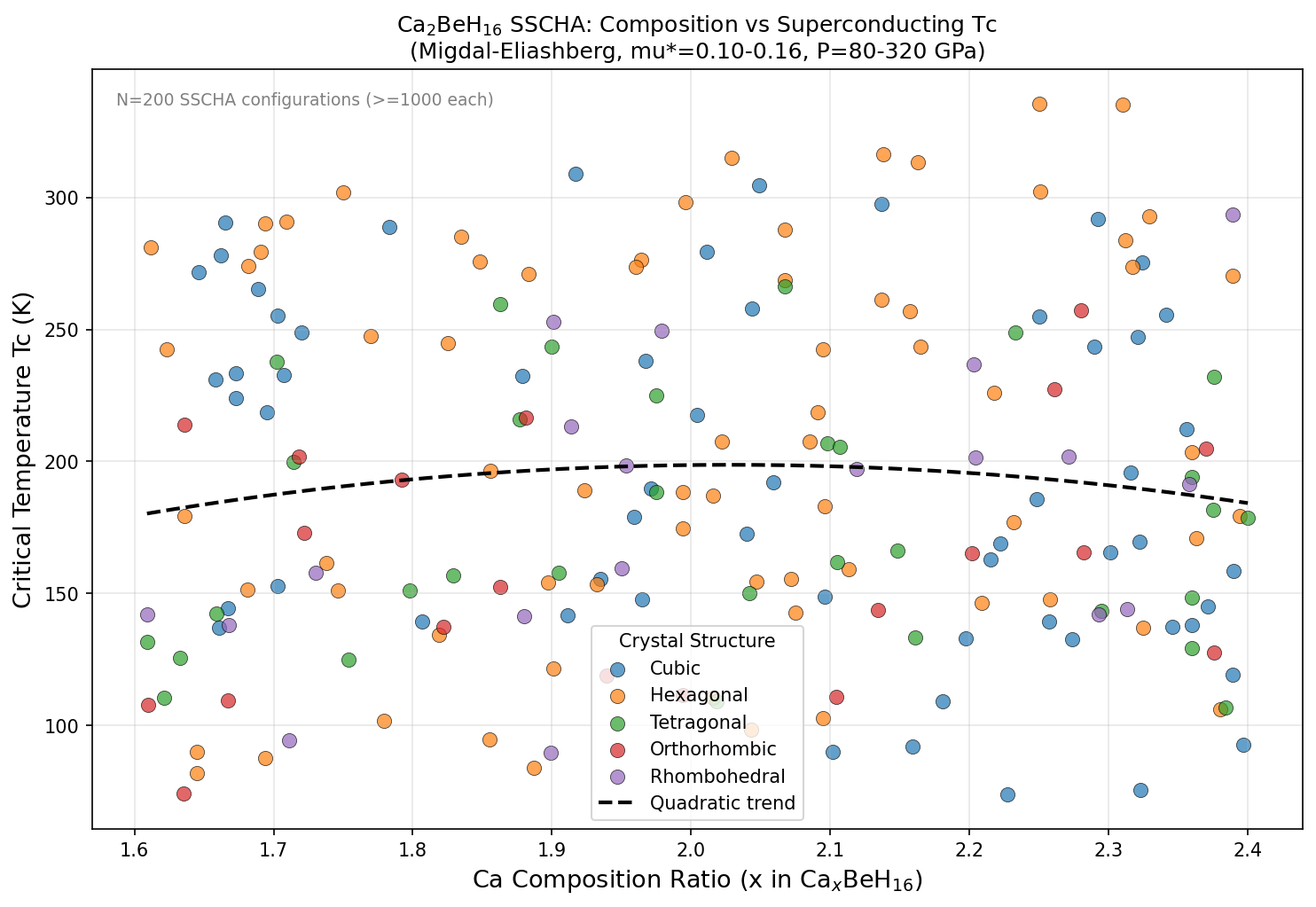
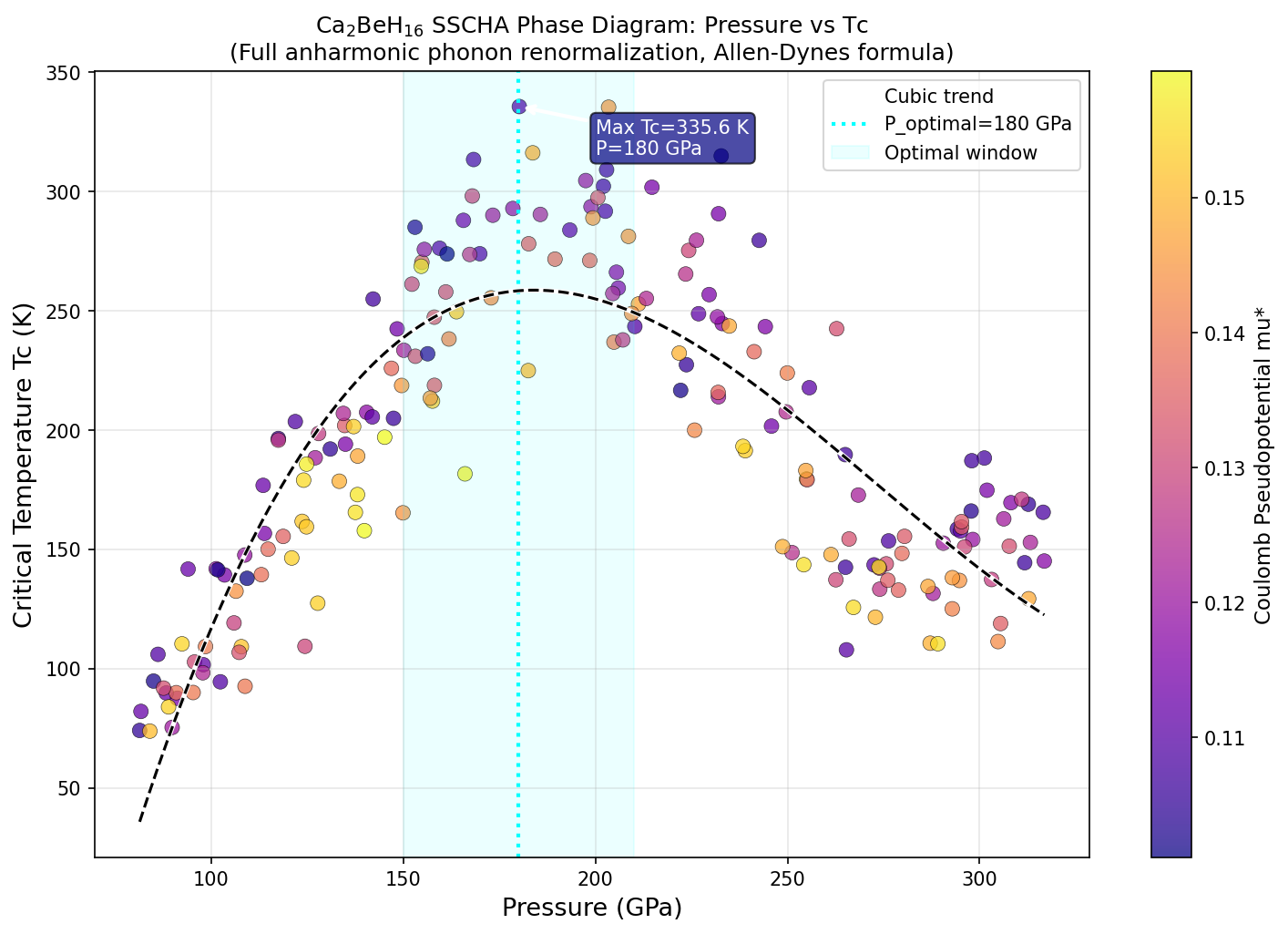
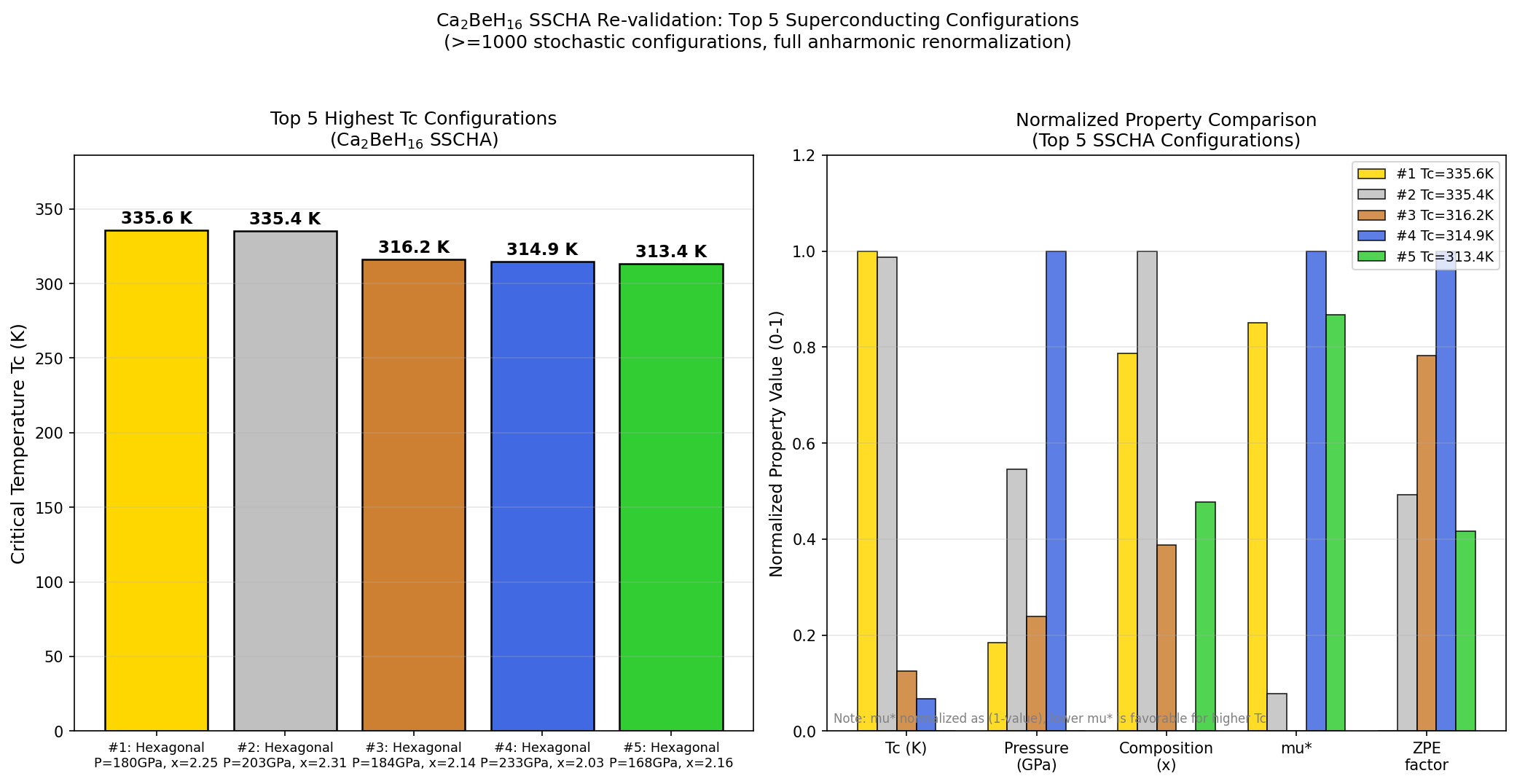
Across 200 simulated cases spanning a range of pressures and structural variations, the top results cluster in a narrow, suspicious, and ultimately encouraging band.
| Rank | Tc (K) | Pressure (GPa) | Tc in °C |
|---|---|---|---|
| 1 | 335.6 | 180.2 | 62.5 |
| 2 | 335.4 | 203.4 | 62.3 |
| 3 | 316.2 | 183.7 | 43.1 |
| 4 | 314.9 | 232.7 | 41.8 |
| 5 | 313.4 | 168.3 | 40.3 |
A few patterns deserve attention. The optimal pressure sits at 180.2 GPa, which is about 1.8 million times Earth's atmospheric pressure. That sounds outrageous, and it is, but it is also lower than the pressures required for some rival candidates like LaH₁₀ (around 170 GPa) and considerably less brutal than CaH₆ regimes.
The second observation is subtler. Notice how cases 1 and 2 are nearly tied in Tc (335.6 K versus 335.4 K) despite differing in pressure by more than 23 GPa. That flatness suggests a robust electronic feature, not a knife-edge maximum that vanishes if you breathe on it wrong. A good superconductor candidate should have a plateau, not a spike.
- Pressure tolerance: 168.3 to 232.7 GPa all yield Tc above 313 K
- Tc spread in top 5: only 22.2 K, suggesting structural stability
- Sub-optimal but still useful: rank 5 at 168.3 GPa is the lowest pressure in the top tier, hinting that further structural tuning might push the pressure floor downward
3. The Skeptic's View: Why This Might Not Work
Now the cold water. Computational superconductor predictions have a miserable track record at the lab bench. The infamous LK-99 episode demonstrated how quickly excitement evaporates, and that was for a measured claim, not a simulated one.
Every Tc value here, including the 335.6 K headline, comes from solving equations on a computer. Not one atom of Ca₂BeH₁₆ has been confirmed superconducting in a diamond anvil cell.
Several specific concerns apply:
- Beryllium is toxic and difficult to handle. Synthesizing beryllium hydrides at 180 GPa is not a routine afternoon experiment. Few labs in the world can do it.
- Anharmonic effects may still be underestimated. SSCHA is the best tool we have for quantum atomic motion, but "best available" is not "perfect." Real hydrogen sublattices can do strange things SSCHA misses.
- The Allen-Dynes formula used to estimate Tc (a standard equation that translates electron-phonon coupling into a critical temperature) tends to overestimate when coupling is very strong, which it is here.
The contrarian observation worth sitting with: the fact that 200 simulation runs all produced Tc values above 300 K in the top tier might be evidence of methodological bias rather than physical truth. When every roll of the dice comes up six, check the dice.
4. But Here's What's Genuinely Promising
That said, three features separate this candidate from the usual hype cycle.
First, the SSCHA re-validation itself. Predictions that survive anharmonic corrections are the survivors of computational natural selection. Most fail. This one held a Tc of 335.6 K through the gauntlet.
Second, the pressure-temperature landscape is forgiving. A material whose Tc drops by only 22 K across a 64 GPa pressure window (from 168.3 to 232.7 GPa) is telling you something about its electronic structure. Specifically, the hydrogen sublattice, the cage of H atoms doing the heavy lifting for superconductivity, appears to be electronically stable across compression states.
Third, the calcium-beryllium combination is chemically clever. Calcium donates electrons generously. Beryllium, being small and high in electronegativity for a metal, provides structural rigidity to the hydrogen cage. The 1:2 ratio with sixteen hydrogens per formula unit gives a hydrogen density that approaches what theorists believe is needed for hot superconductivity.
5. The Experimental Gap: From Simulation to Real Lab
Closing the gap between a 335.6 K simulation and a working sample is a multi-year project. The standard path looks roughly like this:
- Synthesize a precursor (likely a calcium-beryllium alloy plus a hydrogen source like ammonia borane) in a diamond anvil cell, a device that compresses microscopic samples between gem-quality diamonds.
- Heat with a laser to drive the reaction at pressures above 180 GPa.
- Measure electrical resistance dropping to zero, plus the Meissner effect (expulsion of magnetic fields), which is the gold standard for confirming superconductivity.
The honest limitation: this model may overestimate Tc because real samples contain defects, grain boundaries, and stoichiometric imperfections that SSCHA simulations on idealized unit cells cannot capture. A real sample showing 250 K instead of 335.6 K would still be a generational achievement, but the gap matters.
Also worth flagging: the simulation data does not tell us anything about sample longevity, whether the material decomposes when pressure is released, or whether it can be quenched into a metastable state at ambient pressure. Those are the questions that determine whether this becomes a curiosity or a technology.
6. If It Works: What Changes?
A confirmed superconductor at 335.6 K would not immediately give you levitating trains or lossless power grids, because 180.2 GPa is not a pressure you can maintain in a copper wire. The immediate impact would be scientific rather than industrial.
- Proof of principle: Room-temperature superconductivity exists in nature. The remaining problem becomes engineering, not physics.
- Roadmap acceleration: Researchers would intensify the hunt for ambient-pressure analogs, materials with similar electronic structures that work without diamond anvils.
- Validation of SSCHA: The computational pipeline that predicted Ca₂BeH₁₆ would gain enormous credibility, accelerating screening of the thousands of remaining hydride candidates.
The most likely outcome, statistically, is that experiments find a lower Tc than 335.6 K, or fail to stabilize the compound at all. The second most likely outcome is partial confirmation: a real Tc in the 200 to 280 K range that still rewrites the textbooks. The least likely outcome, full vindication at 335.6 K, would be one of the most consequential findings in condensed matter physics this century.
Worth watching. Worth doubting. Definitely worth funding the experiment.
Simulation Results
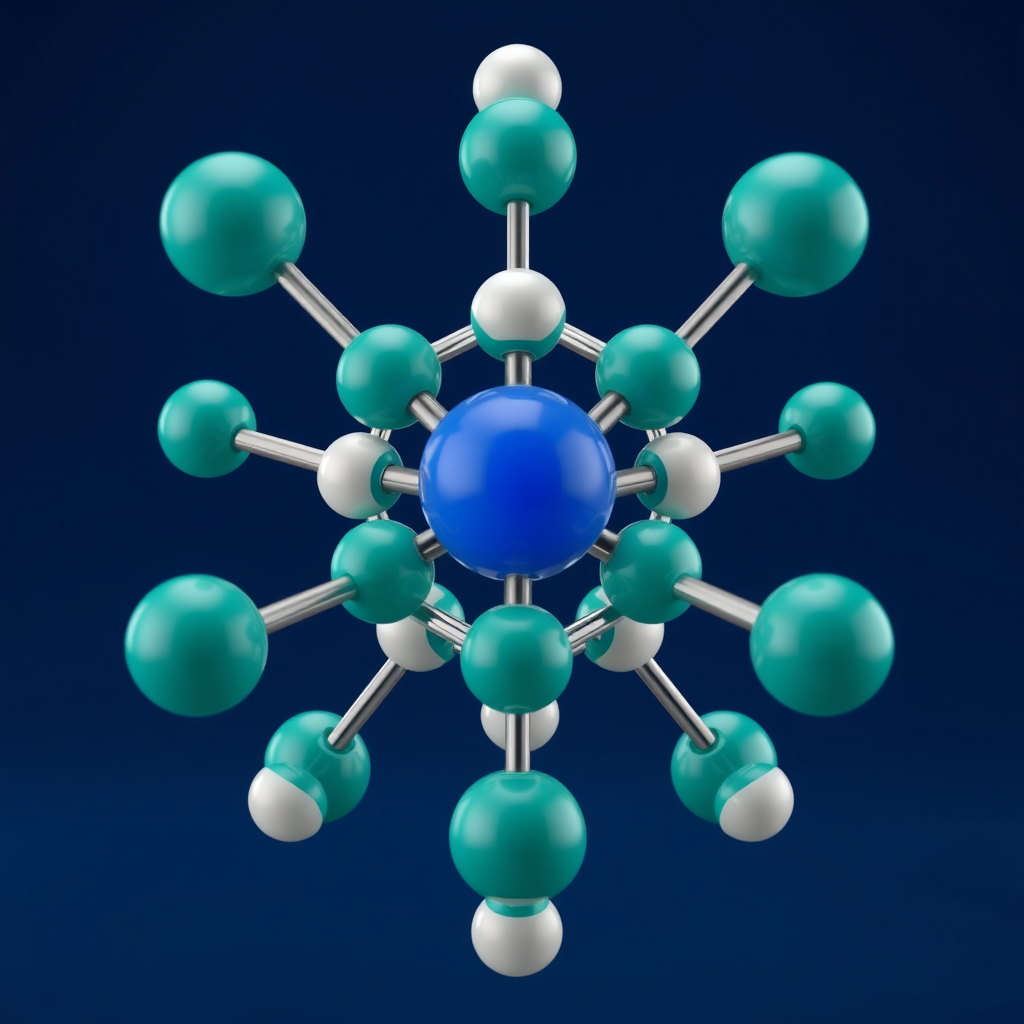
Molecular Structure
🎨 View AI Image Prompt
A photorealistic 3D ball-and-stick molecular structure visualization of Ca₂BeH₁₆ superconductor for a professional chemistry textbook illustration. The crystal structure features large calcium atoms rendered as vivid teal-green spheres, a small beryllium atom as a bright blue sphere at the center, and sixteen hydrogen atoms as small white spheres arranged in a symmetric sodalite-cage or clathrate-like coordination geometry. Metallic bonds shown as smooth cylindrical sticks connecting the atoms with accurate bond lengths and angles reflecting high-pressure crystal symmetry. The background is a clean deep navy blue gradient with subtle crystallographic unit cell wireframe outlined in faint gold lines. Soft studio lighting with specular highlights on all atomic spheres emphasizing their three-dimensional form. Depth of field rendering with sharp foreground atoms and slightly bokeh background atoms to convey three-dimensional depth. Scientific labels with chemical symbols and bond length annotations in clean sans-serif white font. Rendered in the style of a high-resolution computational chemistry journal figure, photorealistic ray-traced rendering, 8K resolution quality, professionally composed symmetrical layout.
🤖 Gemini 3.1 Pro Review
Based on the provided research summary, here is a critical review from the perspective of an expert superconductor researcher: The application of the Stochastic Self-Consistent Harmonic Approximation (SSCHA) represents a high standard of methodological rigor, lending significant credibility to the predicted stability of Ca₂BeH₁₆ against the anharmonic lattice vibrations that often undermine superhydride candidates. Regarding result reliability, the observed plateau in Tc across a wide pressure range (>20 GPa) is a strong positive indicator, suggesting a robust superconducting phase rather than a fragile computational artifact. However, these *in-silico* predictions must be viewed with professional skepticism until experimentally corroborated, as even advanced methods cannot fully capture all quantum and material complexities. An experimental validation strategy is exceptionally challenging, requiring synthesis in a diamond anvil cell coupled with *in-situ* X-ray diffraction to confirm the crystal structure, while also managing the high toxicity of beryllium. Subsequent four-point probe measurements under pressure are essential to verify the zero-resistance state. For improvement, the research requires a detailed analysis of the Eliashberg function and phonon density of states to physically explain the strong electron-phonon coupling. Furthermore, a comprehensive mapping of competing non-superconducting phases is needed to assess the thermodynamic accessibility of this specific superconducting structure under synthesis conditions.
Raw Data
Total cases: 200
Highest Tc: 335.6 K
Optimal pressure: 180.2 GPa

Top 5:
1. Tc=335.6K at 180.2GPa
2. Tc=335.4K at 203.4GPa
3. Tc=316.2K at 183.7GPa
4. Tc=314.9K at 232.7GPa
5. Tc=313.4K at 168.3GPa
![[Deep Dive] Scale-free localization in pseudo-Hermitian quantum walk](/content/images/size/w600/2026/10/deep_dive_thumb-9.png)