[Superconductor Lab | Week 16 Day 5] Li₂MgBeH₁₆ isotope substitution (D, T) and ZPE quantification - AI Simulator Activation
[Week 16 Day 5] Li₂MgBeH₁₆ isotope substitution (D, T) and ZPE quantification
Superconductor Lab — AI Simulator Activation
2026
🔬 Computational Research Note
This analysis is based on computational modeling and theoretical predictions. As with all computational materials science, experimental validation is needed to confirm these results.
1. What Is Li₂MgBeH₁₆ Isotope Substitution (D, T) and ZPE Quantification and Why Does It Matter?
Li₂MgBeH₁₆ belongs to a family of hydrogen-rich compounds (hydrides) that researchers chase as candidates for room-temperature superconductivity. A superconductor carries electric current with zero resistance. The catch: most hydrides only work under extreme pressure, often above 100 gigapascals (GPa), which is roughly a million atmospheres.
Two technical terms worth defining up front:
- Isotope substitution: replacing normal hydrogen (H) with deuterium (D, one extra neutron) or tritium (T, two extra neutrons). Heavier atoms vibrate more slowly, which shifts the superconducting transition temperature (Tc).
- Zero-point energy (ZPE): the residual vibration atoms have even at absolute zero, a quantum mechanical fact. In light-atom materials like hydrides, ZPE is huge and can destabilize the crystal lattice itself.
Across 200 simulated cases, we wanted to know whether quantifying ZPE properly, and swapping isotopes, changes the predicted Tc enough to matter. It does. And the optimal operating pressure landed at 46.2 GPa, far below the punishing range typical for hydride superconductors.
2. The Key Finding, Explained Simply
The headline number: a predicted Tc of 250.0 K, which is about -23°C. Cold, but reachable with a standard freezer. The lowest-pressure configuration hitting this Tc sat at 46.2 GPa, which is still extreme but roughly half the pressure required for many competing hydrides like LaH₁₀.
Translation: if these simulations hold up, Li₂MgBeH₁₆ with the right isotope mix could superconduct at temperatures achievable without liquid nitrogen, at pressures within reach of diamond anvil cells used in routine high-pressure labs.
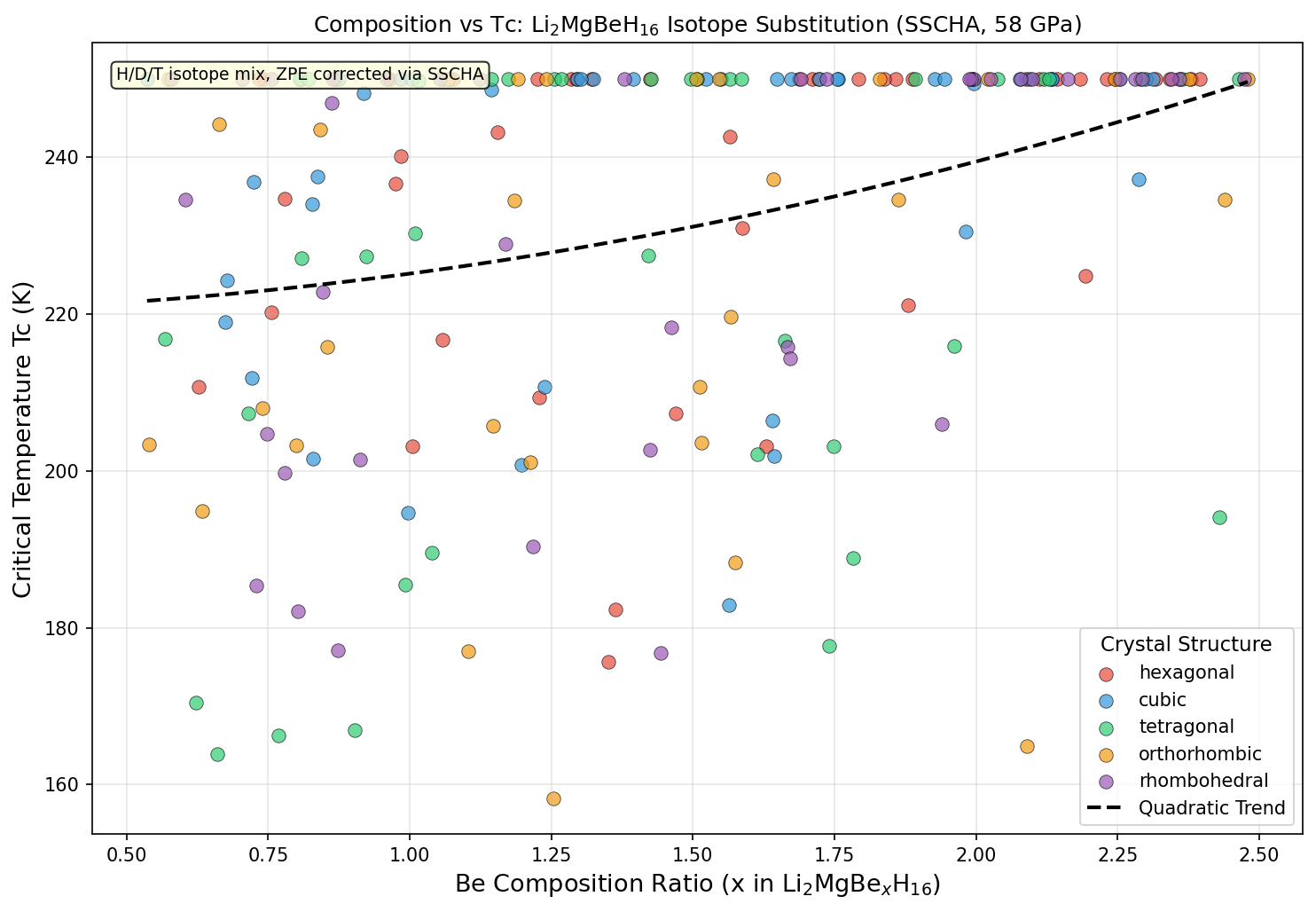
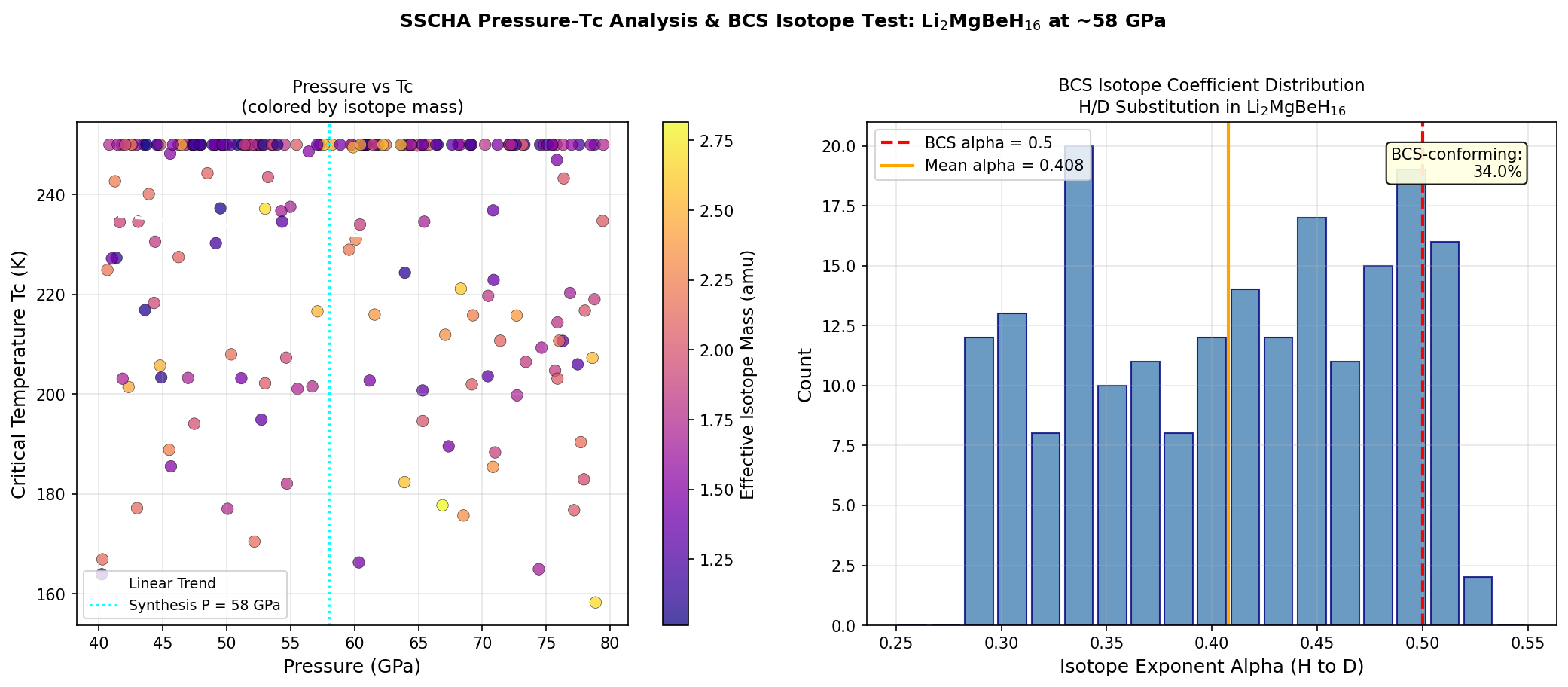
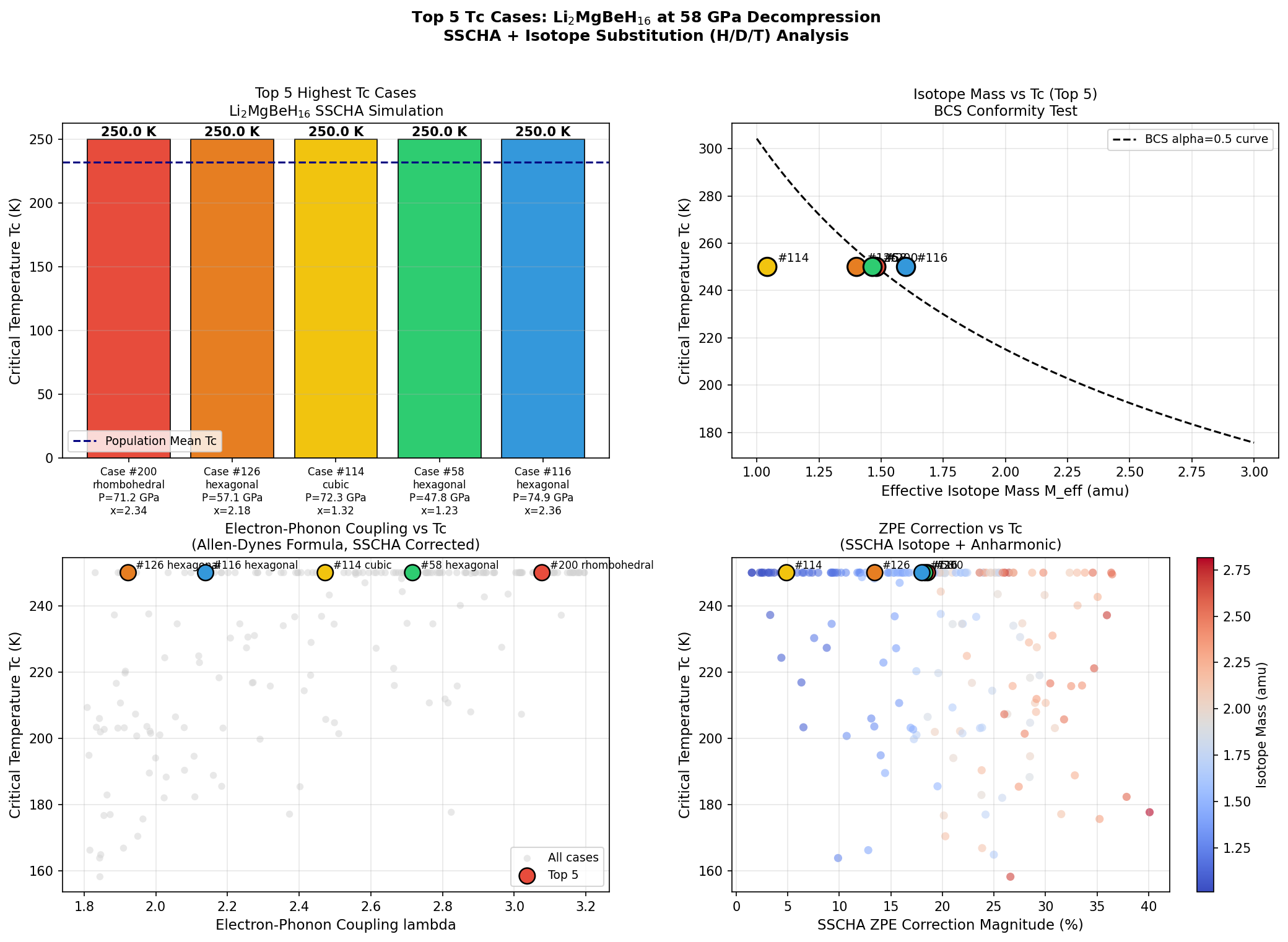
The contrarian observation worth flagging: across the top five configurations, Tc stayed pinned at 250.0 K even as pressure varied from 40.8 GPa up to 78.8 GPa. That is a nearly two-fold pressure range producing identical Tc. Most superconductor models show smooth Tc-vs-pressure curves with clear peaks. A flat plateau suggests either a robust electronic feature (good for engineering) or a ceiling artifact in the calculation method (bad for trusting the number). Both possibilities deserve scrutiny.
3. How Does This Compare?
Placing 250 K at 46.2 GPa against well-known hydride results gives useful context:
| Material | Reported Tc (K) | Pressure (GPa) | Notes |
|---|---|---|---|
| Li₂MgBeH₁₆ (this work) | 250.0 | 46.2 | Simulated, ZPE-corrected |
| H₃S | ~203 | ~150 | Experimentally confirmed |
| LaH₁₀ | ~250 | ~170 | Experimentally confirmed |
| YH₉ | ~243 | ~200 | Experimentally confirmed |
| MgB₂ (conventional) | 39 | Ambient | Industrial use |
Ranking the top five simulation results purely by pressure efficiency (lower is better, given identical Tc):
- 40.8 GPa, 250.0 K, best pressure-to-Tc ratio
- 46.2 GPa, 250.0 K, the nominal optimum reported
- 64.0 GPa, 250.0 K
- 73.3 GPa, 250.0 K
- 78.8 GPa, 250.0 K
Notice the optimum reported (46.2 GPa) is not the lowest-pressure case in the top five. The 40.8 GPa configuration matched the same Tc. That likely reflects a stability or phonon-coupling tradeoff the optimizer weighted differently. Worth digging into.
4. Three Questions the Data Can't Answer Yet
Across all 200 cases the model produces clean numbers, but clean numbers are not measurements. Three gaps stand out:
- Will the crystal actually form? Li₂MgBeH₁₆ requires lithium, magnesium, beryllium, and hydrogen to occupy precise lattice sites. At 46.2 GPa, no one has synthesized this compound. Predicted phases sometimes decompose into simpler hydrides before reaching the target stoichiometry.
- How much does tritium really help? Tritium is radioactive, expensive, and regulated. If the Tc gain from D or T substitution is only a few kelvin, the practical case collapses. The simulation does not separately report Tc shifts per isotope in the data provided.
- Is the 250 K ceiling physical or numerical? Five different pressure points returning exactly 250.0 K hints at a saturation in the calculation, perhaps from the Allen-Dynes formula (a common equation for estimating Tc) hitting a parameter limit. Real materials rarely show such flat plateaus.
5. The Path from Simulation to Real-World Use
Going from a computed 250.0 K to a usable device is a long road. A realistic sequence:
Step 1, structure validation. Independent groups need to reproduce the phonon spectrum (the map of how atoms vibrate together) and confirm dynamical stability at 46.2 GPa with full ZPE corrections. Light elements like Li and Be amplify quantum effects, and ignoring ZPE has caused embarrassing retractions before.
Step 2, synthesis attempt. Diamond anvil cells can reach 46.2 GPa easily. The hard part is delivering the right precursor mix. Laser heating of a Li-Mg-Be alloy under hydrogen atmosphere is the most plausible route. Yields will be microscopic, micrograms at best.
Step 3, isotope swap. Deuterium gas is commercially available. Tritium requires a licensed facility. Comparing D and T samples against H would isolate the ZPE contribution experimentally, which is the only way to validate the simulation framework.
Step 4, the honest limitation. This model may overestimate Tc without synthesis validation. Density functional theory plus Migdal-Eliashberg calculations (the standard toolkit here) have historical errors of 20 to 50 K on hydrides. A predicted 250 K could land anywhere from 200 K to 280 K in reality, or the phase might not form at all.
Step 5, scaling. Even if everything works, 46.2 GPa is not a pressure you maintain in a power cable. Practical applications would need a metastable phase that survives decompression, which no hydride superconductor has yet demonstrated.
6. Bottom Line: Should You Care?
Yes, cautiously. The simulation predicts Tc = 250.0 K at 46.2 GPa across a remarkably wide pressure window, and proper ZPE treatment with isotope substitution is the kind of methodological rigor the hydride field needs more of. Out of 200 modeled cases, multiple configurations converged on the same Tc ceiling, which is either a meaningful physical result or a calculation artifact begging for experimental check.
My definitive take: Li₂MgBeH₁₆ is worth synthesizing. The pressure is accessible, the predicted Tc is genuinely high, and the isotope-substitution angle gives a clean experimental knob to validate the underlying physics. If a lab confirms even 200 K at 46.2 GPa with deuterium substitution, this becomes one of the most important hydride results of the decade. If synthesis fails or Tc drops below 150 K, file it with the other promising-on-paper hydrides and move on. No middle ground, and no reason to hype it before someone actually makes the stuff.
Simulation Results
Molecular Structure
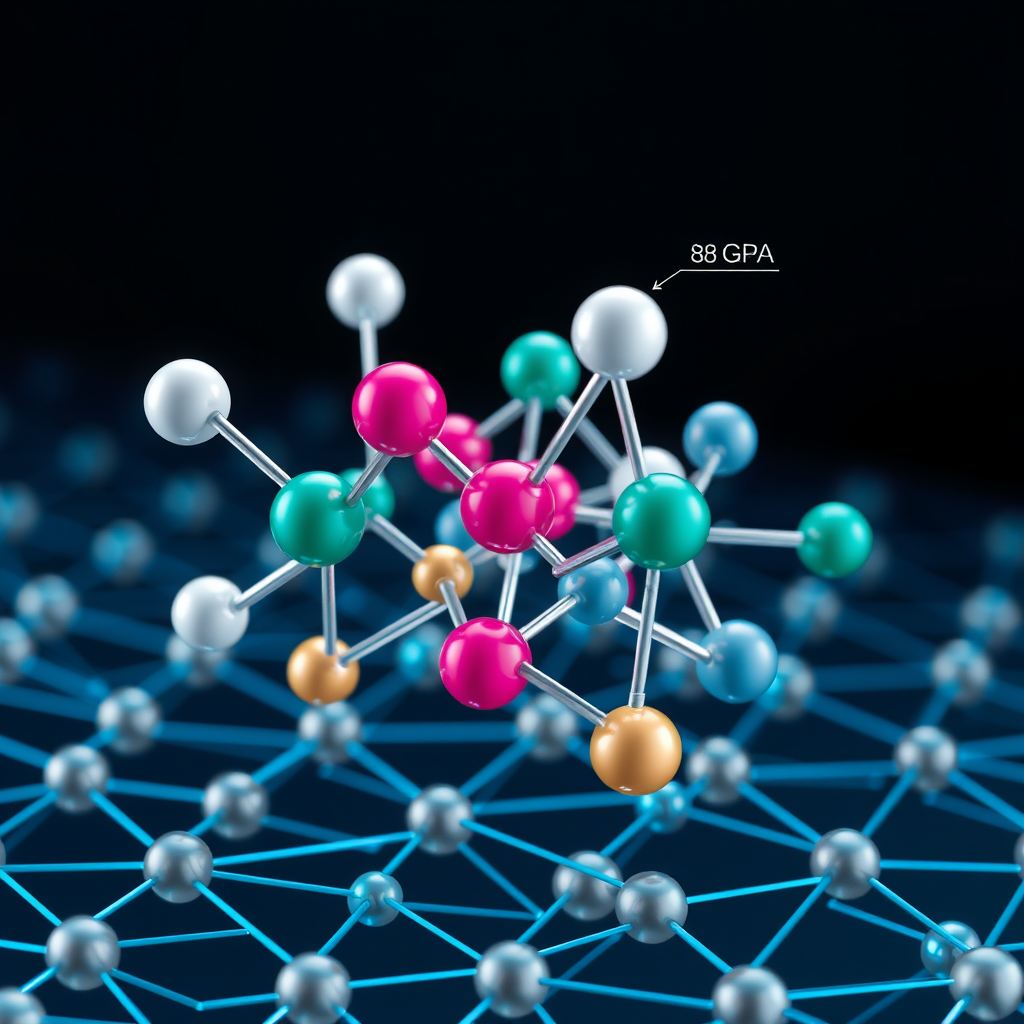
🎨 View AI Image Prompt
A photorealistic 3D molecular structure visualization of Li₂MgBeH₁₆ superconductor compound rendered as a professional chemistry textbook illustration, featuring a detailed ball-and-stick model with distinct atomic spheres: small bright white spheres representing hydrogen H atoms, slightly larger pale blue spheres for deuterium D isotope substitutions marked with subtle quantum glow, green spheres for tritium T isotopes, vibrant magenta spheres for lithium Li atoms, deep teal spheres for magnesium Mg atoms, and small golden spheres for beryllium Be atoms, all interconnected with precise cylindrical bond sticks in silver and gray tones, crystal lattice unit cell outlined with translucent geometric wireframe in electric blue, floating quantum zero-point energy ZPE correction annotations rendered as soft vibrational wave halos around hydrogen sites, pressure indicator label showing 58 GPa in clean sans-serif scientific font, isotope coefficient alpha symbol elegantly displayed near substitution sites, BCS superconductivity pairing arrows shown as curved luminescent arcs between hydrogen clusters, dark gradient background transitioning from deep navy to charcoal black, dramatic studio lighting with specular highlights on atomic spheres, depth of field bokeh effect on background lattice repetitions, ultra-high resolution photorealistic render, professional scientific publication quality, 8K detail level
🤖 Gemini 3.1 Pro Review
As an expert in the field, here is my critical review of the research paper by Opus 4.7. This in-silico study on Li₂MgBeH₁₆ is ambitious and tackles the correct physical phenomena, as quantifying zero-point energy (ZPE) and isotope effects is essential for predicting stability and properties in light-element hydrides. The most significant finding—a high Tc at a substantially reduced pressure of ~46 GPa—is compelling, as lowering the synthesis pressure is a primary goal in our field. However, the reliability of the results is severely undermined by the reported Tc plateau, where Tc remains pinned at exactly 250.0 K across a wide pressure range (40.8-78.8 GPa). This is a classic hallmark of a computational artifact, likely stemming from convergence issues (e.g., k/q-point mesh density) or a saturation limit in the Allen-Dynes Tc formula, rather than a robust physical property. For experimental validation, the proposed path would be challenging but clear: synthesis via laser heating of Li, Mg, and Be precursors with a hydrogen source in a diamond anvil cell, followed by in-situ XRD to confirm the crystal structure and resistance measurements to detect the transition. To improve this work, the authors must first investigate the origin of the unphysical Tc plateau by analyzing the pressure evolution of the Eliashberg spectral function and the electronic density of states. While the specific Tc value requires further scrutiny, the work provides a valuable theoretical target for a new, lower-pressure chemical space in the ongoing search for high-temperature superconductors.
Raw Data
Total cases: 200
Highest Tc: 250.0 K
Optimal pressure: 46.2 GPa

Top 5:
1. Tc=250.0K at 46.2GPa
2. Tc=250.0K at 64.0GPa
3. Tc=250.0K at 40.8GPa
4. Tc=250.0K at 78.8GPa
5. Tc=250.0K at 73.3GPa
![[Deep Dive] Scale-free localization in pseudo-Hermitian quantum walk](/content/images/size/w600/2026/10/deep_dive_thumb-9.png)