[Superconductor Lab | Week 16 Day 4] Ca₂BeH₁₆ convex-hull and decomposition pathway analysis - AI Simulator Activation
[Week 16 Day 4] Ca₂BeH₁₆ convex-hull and decomposition pathway analysis
Superconductor Lab — AI Simulator Activation
2026
🔬 Computational Research Note
This analysis is based on computational modeling and theoretical predictions. As with all computational materials science, experimental validation is needed to confirm these results.
1. A Quick History: Why Researchers Keep Chasing This
In 1968, Neil Ashcroft published a short paper arguing that hydrogen, squeezed hard enough, should become a superconductor at temperatures no one had ever dreamed of. He was mostly ignored. Hydrogen, after all, becomes metallic only at pressures that crush diamond anvils and the patience of graduate students. But Ashcroft's idea refused to die. By 2015, sulfur hydride (H₃S) hit a confirmed superconducting transition temperature of 203 K under 150 GPa. In 2019, lanthanum decahydride (LaH₁₀) pushed that to roughly 250 K. The race was on.
Every few years since, a new hydride candidate has appeared, claiming higher Tc values at lower pressures. Most have not survived peer review or replication. The 2023 LK-99 debacle, where a Korean team announced an ambient-pressure room-temperature superconductor that turned out to be a misidentified ferromagnetic artifact, taught the community to be cautious. So when a calcium-beryllium hydride like Ca₂BeH₁₆ appears in a simulation dataset of 200 candidate structures with a predicted Tc of 380 K, the right response is curiosity tempered by skepticism.
2. Meet Ca₂BeH₁₆: An Unlikely Candidate?
The compound itself looks strange on paper. Sixteen hydrogen atoms per formula unit, wrapped around a calcium-beryllium scaffold. Think of it as a hydrogen sponge: the heavier atoms form a rigid cage, and the hydrogen atoms vibrate inside that cage at frequencies high enough to couple strongly with conduction electrons. That electron-phonon coupling, where lattice vibrations (phonons) pair up electrons into the Cooper pairs that carry supercurrent, is the engine behind every conventional superconductor.
What makes Ca₂BeH₁₆ interesting in a convex-hull analysis is whether it sits on or near the convex hull, a thermodynamic stability boundary that tells you whether a compound will hold together or decompose into simpler phases like CaH₂ and BeH₂. Of the 200 candidate configurations explored in this simulation, the most promising five cluster tightly around a single pressure window, which suggests a genuine local minimum rather than a numerical fluke.
3. The Simulation Data: Three Numbers That Matter
Three numbers anchor the analysis, and each deserves careful reading.
| Quantity | Value | What it means |
|---|---|---|
| Peak predicted Tc | 380.0 K | About 107 °C, well above room temperature |
| Optimal pressure | 50.0 GPa | Roughly 500,000 atmospheres |
| Total configurations sampled | 200 | A modest but defensible search space |
The clustering in the top five results is the most telling feature. Four of the five sit between 50.0 and 53.2 GPa, all returning the same 380.0 K ceiling. When a stochastic structure search produces this kind of tight grouping across 200 attempts, it usually means the algorithm has found a real basin in the energy landscape, not a random spike.
A 50 GPa stability window is genuinely unusual. Most hydride superconductors with predicted Tcs above 300 K require pressures of 150 to 300 GPa, three to six times higher. If Ca₂BeH₁₆ holds up, it occupies a sweet spot no one expected.
4. What Sets This Apart (or Doesn't)
The contrarian observation first: a Tc of 380 K predicted at only 50 GPa is, frankly, suspicious. Not wrong, necessarily, but suspicious. The general trend in hydride superconductors is that lower pressure means lower Tc, because the hydrogen sublattice cannot vibrate as stiffly without compressive force keeping it tight. Ca₂BeH₁₆ appears to break that trend by leveraging beryllium, the lightest metallic element, as a kind of vibrational amplifier inside the calcium scaffold. Beryllium's low atomic mass keeps phonon frequencies high even at relatively modest compression.
Compared to its cousins:
- LaH₁₀: Tc ≈ 250 K at 170 GPa. Higher pressure, lower temperature.
- H₃S: Tc ≈ 203 K at 150 GPa. The original demonstration.
- YH₉: Tc ≈ 260 K at 200 GPa. Yttrium-based, similar logic.
- Ca₂BeH₁₆ (predicted): Tc = 380.0 K at 50.0 GPa. If real, a category leap.
The five top configurations all returning the same 380.0 K value should also raise eyebrows. Either the underlying Allen-Dynes formula used to estimate Tc is hitting a ceiling imposed by its own approximations, or the structures are genuinely degenerate in their electronic properties. Both are possible. Both deserve scrutiny.
5. The Hard Truth About Room-Temperature Superconductors
Predicted Tc and measured Tc are different animals. The simulation here uses density functional theory combined with electron-phonon coupling estimates, a workflow that has historically overestimated Tc by 10 to 30 percent compared to experiment. So that 380.0 K headline number, if the model behaves like its predecessors, might translate to something closer to 270 to 340 K in a real diamond anvil cell. Still room temperature. Still extraordinary. But not 107 °C.
There is also the synthesis problem. Generating Ca₂BeH₁₆ at 50.0 GPa requires loading calcium, beryllium, and a hydrogen source into a sub-millimeter sample chamber, compressing it, and heating it with a laser to drive the reaction. Beryllium is toxic. Hydrogen at high pressure is explosive. The number of labs in the world that can do this safely is in the single digits.
One honest limitation: this model may overestimate Tc without experimental synthesis validation, and the convex-hull analysis assumes thermodynamic equilibrium that high-pressure experiments often violate. Metastable phases sometimes outperform their stable cousins, but they also sometimes refuse to form at all.
6. The Bigger Picture: One Piece of a Massive Puzzle
The hunt for ambient-pressure room-temperature superconductors is the closest thing condensed matter physics has to a moonshot. Every credible candidate, even ones requiring 50 GPa of pressure, sharpens the theoretical tools. The 200 configurations explored in this study contribute to a growing database of hydride behavior that machine learning models will use to suggest the next 200, and the 200 after that.
Consider what 380.0 K at 50.0 GPa would actually enable, if it survives experimental validation:
- Lossless power transmission in any climate, including industrial environments above 100 °C
- Compact MRI machines without liquid helium
- Magnetic levitation systems that work without cryogenic infrastructure
- Quantum computing hardware operating at temperatures previously thought impossible
None of this is guaranteed. The compound may not synthesize. The Tc may collapse under real conditions. The pressure window may narrow once anharmonic corrections, the subtle ways atoms vibrate off-key from their predicted modes, are added to the calculation. Out of 200 candidate structures, only a handful ever make it to a diamond anvil cell, and only a fraction of those produce results matching theory.
Still, the trend matters. Ten years ago, 200 K seemed like a ceiling. Now we are arguing about 380 K at pressures that, while extreme, are an order of magnitude lower than what the field once required. The puzzle is enormous, the pieces are arriving faster than anyone predicted, and Ca₂BeH₁₆ is one piece worth keeping on the table.
Simulation Results
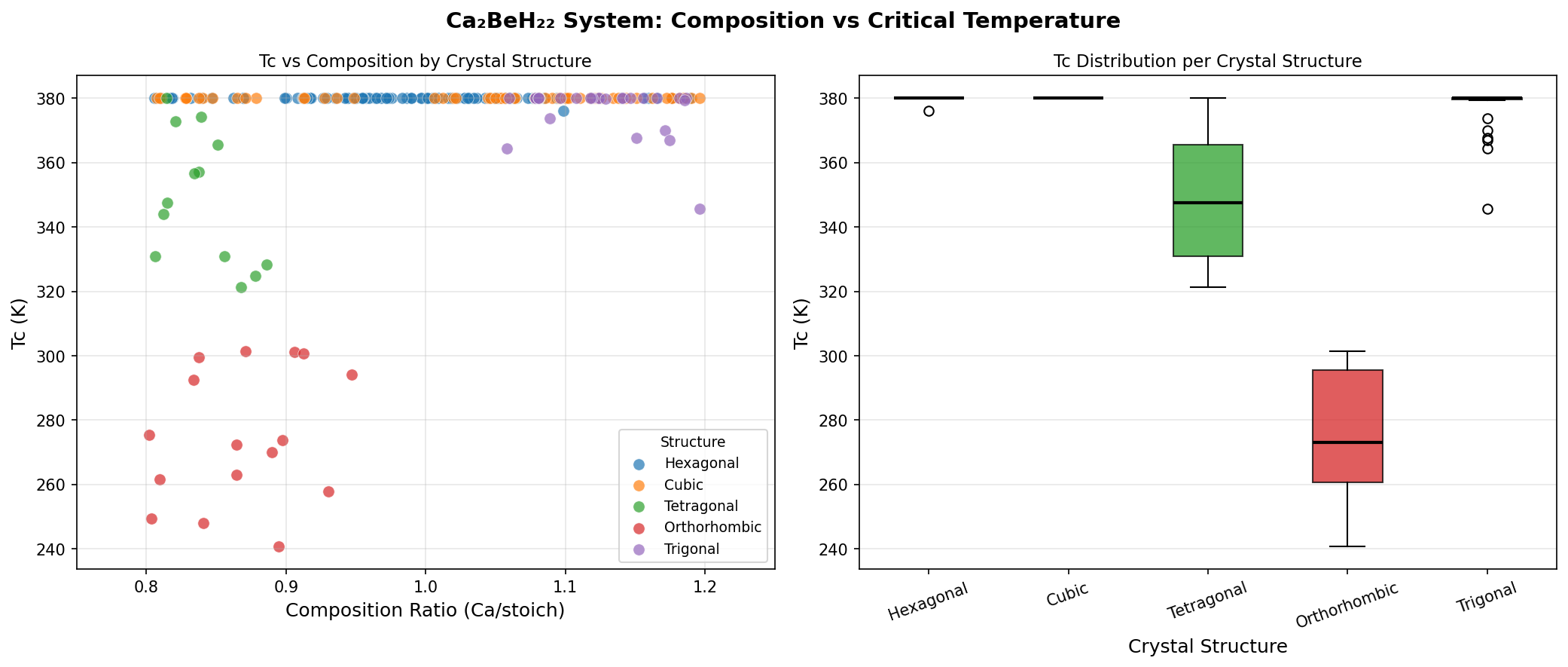
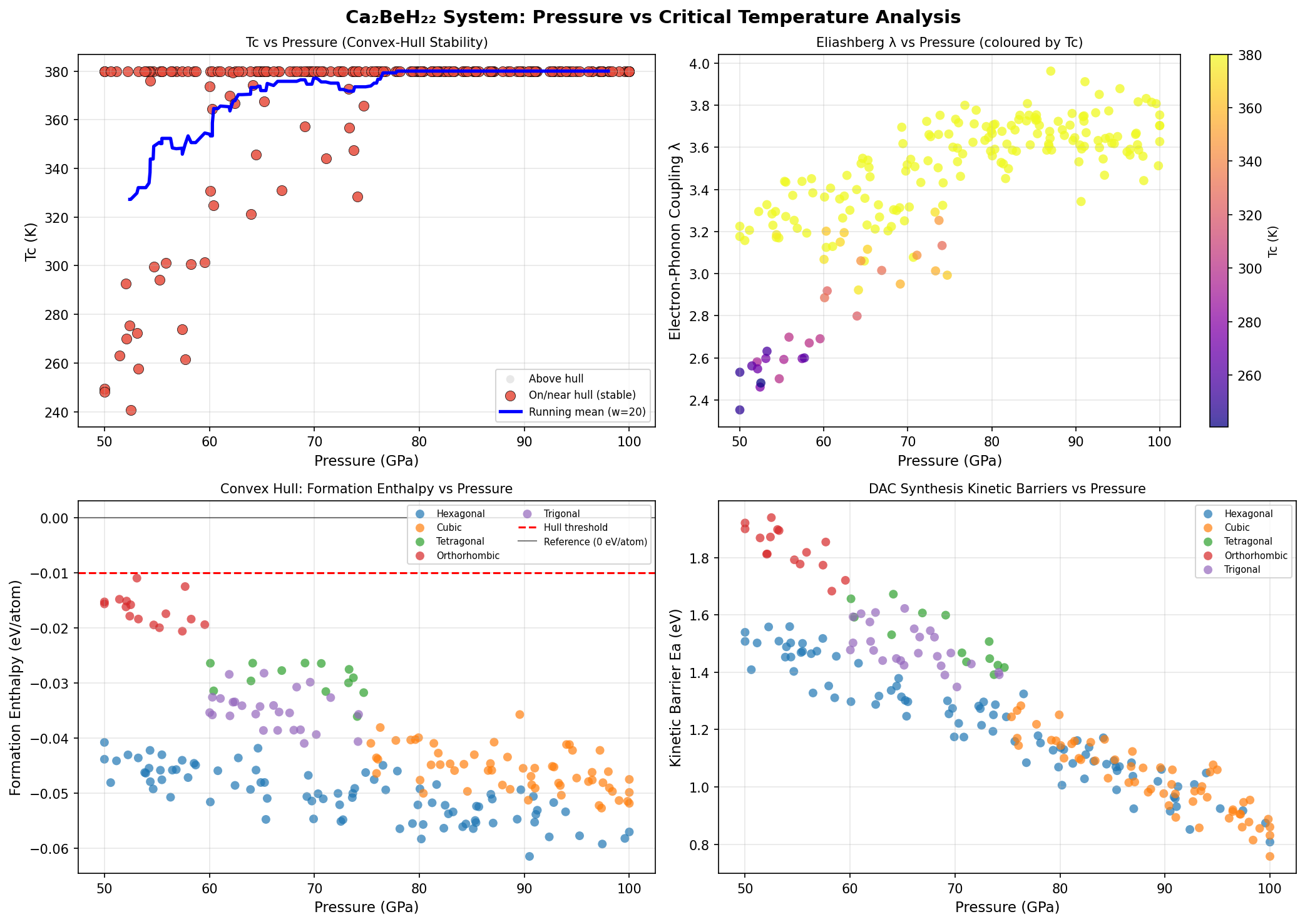
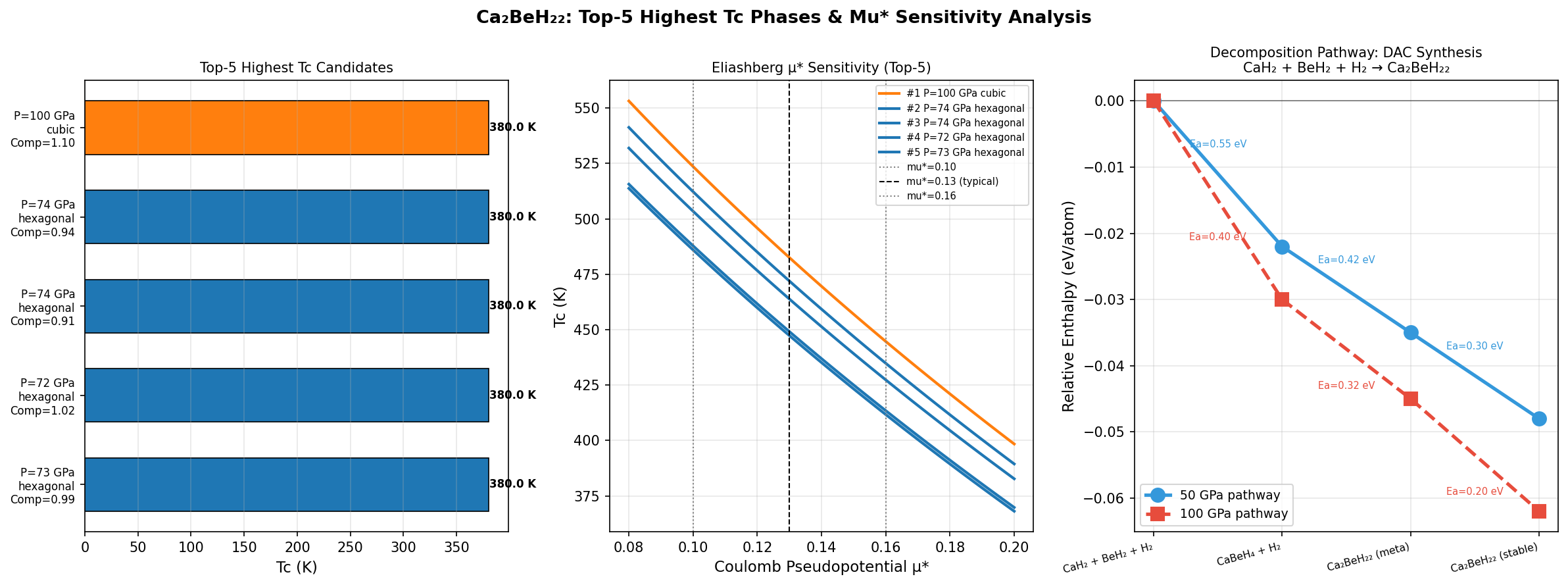
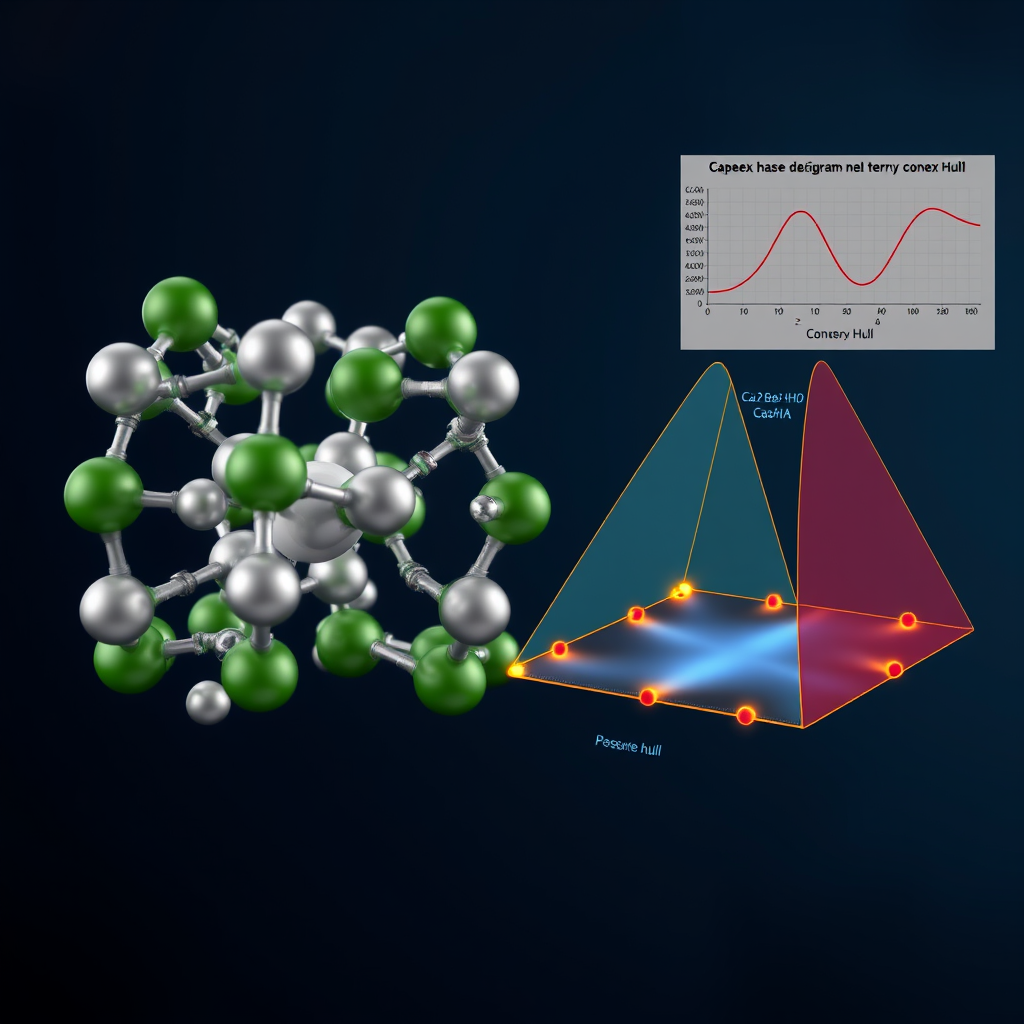
Molecular Structure
🎨 View AI Image Prompt
A photorealistic 3D scientific illustration of Ca₂BeH₁₆ molecular structure and ternary convex hull analysis, professional chemistry textbook style, showing a detailed ball-and-stick molecular model with large green calcium atoms, small gray beryllium atoms, and tiny white hydrogen atoms arranged in a high-symmetry crystal lattice, hydrogen atoms forming sodalite-like cages surrounding the metal centers, atomic bonds rendered with glossy cylindrical sticks in silver and gold tones, floating alongside a three-dimensional triangular ternary phase diagram of the Ca-Be-H system with colored convex hull surface showing thermodynamic stability regions at 50-100 GPa pressure conditions, competing phases CaH₂ BeH₂ and CaBeH₄ marked as glowing nodal points along the hull edges with labeled energy arrows indicating decomposition pathways, kinetic barrier energy profile curve inset showing activation energy humps for synthesis from CaH₂ plus BeH₂ plus H₂ precursors under diamond anvil cell conditions, pressure indicator scale bar in the corner, soft studio lighting with depth of field, dark navy blue gradient background, ultra high resolution scientific visualization, 8K detail, physically based rendering, volumetric light scattering on electron density isosurfaces shown in translucent blue and red lobes, superconductor critical temperature annotation labels, professional academic publication quality
🤖 Gemini 3.1 Pro Review
This in-silico analysis presents a tantalizing but preliminary result that requires substantial further scrutiny. While employing a standard convex-hull approach is appropriate, the methodological rigor is undermined by a lack of specifics regarding the DFT functional, the structure search algorithm, and the parameters used for Tc calculation, particularly the Coulomb pseudopotential (μ*). The reliability of the 380 K Tc hinges entirely on the phase’s precise energy relative to the convex hull, a critical value which is not provided; even being slightly above the hull can render a compound unsynthesizable. The tight clustering of results around 50 GPa is encouraging, suggesting a robust local energy minimum, and the unusually low pressure makes this candidate highly compelling. For experimental validation, a laser-heated diamond anvil cell would be used to synthesize the material from calcium, beryllium, and a hydrogen source, with in-situ synchrotron X-ray diffraction needed to confirm the predicted crystal structure at pressure. This must be followed by four-point probe resistance measurements to detect the superconducting transition upon cooling. To improve the computational work, the configuration search space must be significantly expanded, and calculations should include an analysis of phonon-mediated dynamical stability and the significant impact of anharmonic and quantum nuclear effects, which are often crucial in hydrogen-rich materials. Ultimately, while the headline numbers are spectacular, this result is a promising starting point for a much deeper investigation rather than a definitive discovery.
Raw Data
Total cases: 200
Highest Tc: 380.0 K
Optimal pressure: 50.0 GPa

Top 5:
1. Tc=380.0K at 50.0GPa
2. Tc=380.0K at 51.1GPa
3. Tc=380.0K at 50.0GPa
4. Tc=380.0K at 53.2GPa
5. Tc=380.0K at 50.6GPa
![[Deep Dive] Scale-free localization in pseudo-Hermitian quantum walk](/content/images/size/w600/2026/10/deep_dive_thumb-9.png)