[Superconductor Lab | Week 16 Day 3] (Ca,Li)₂BeH₁₆ and Ca₂(Be,B)H₁₆ ternary substitutions - AI Simulator Activation
[Week 16 Day 3] (Ca,Li)₂BeH₁₆ and Ca₂(Be,B)H₁₆ ternary substitutions
Superconductor Lab — AI Simulator Activation
2026
🔬 Computational Research Note
This analysis is based on computational modeling and theoretical predictions. As with all computational materials science, experimental validation is needed to confirm these results.
1. The Hype vs. Reality: (Ca,Li)₂BeH₁₆ and Ca₂(Be,B)H₁₆ ternary substitutions Under the Microscope
Room-temperature superconductivity sits at 293 K. Our best simulated candidate here hits 214.6 K. That gap of roughly 78 degrees sounds small until you remember it requires 124.9 GPa of pressure to achieve, which is about 1.25 million times atmospheric pressure. So before anyone calls this a breakthrough, let's be honest about what we have: a clever doping strategy applied to hydrogen-rich cages, producing strong but pressure-locked numbers in a computer.
The core idea is simple. Calcium beryllium hydrides form clathrate-like cages where hydrogen atoms surround metal centers, similar to the famous LaH₁₀ system. By substituting lithium for some calcium, or boron for some beryllium, researchers can tune the electronic density of states near the Fermi level (the energy boundary where electrons participate in conduction) without collapsing the lattice. The question isn't whether the math works. It's whether reality will cooperate.
2. What the Numbers Actually Say (deep dive into simulation data)
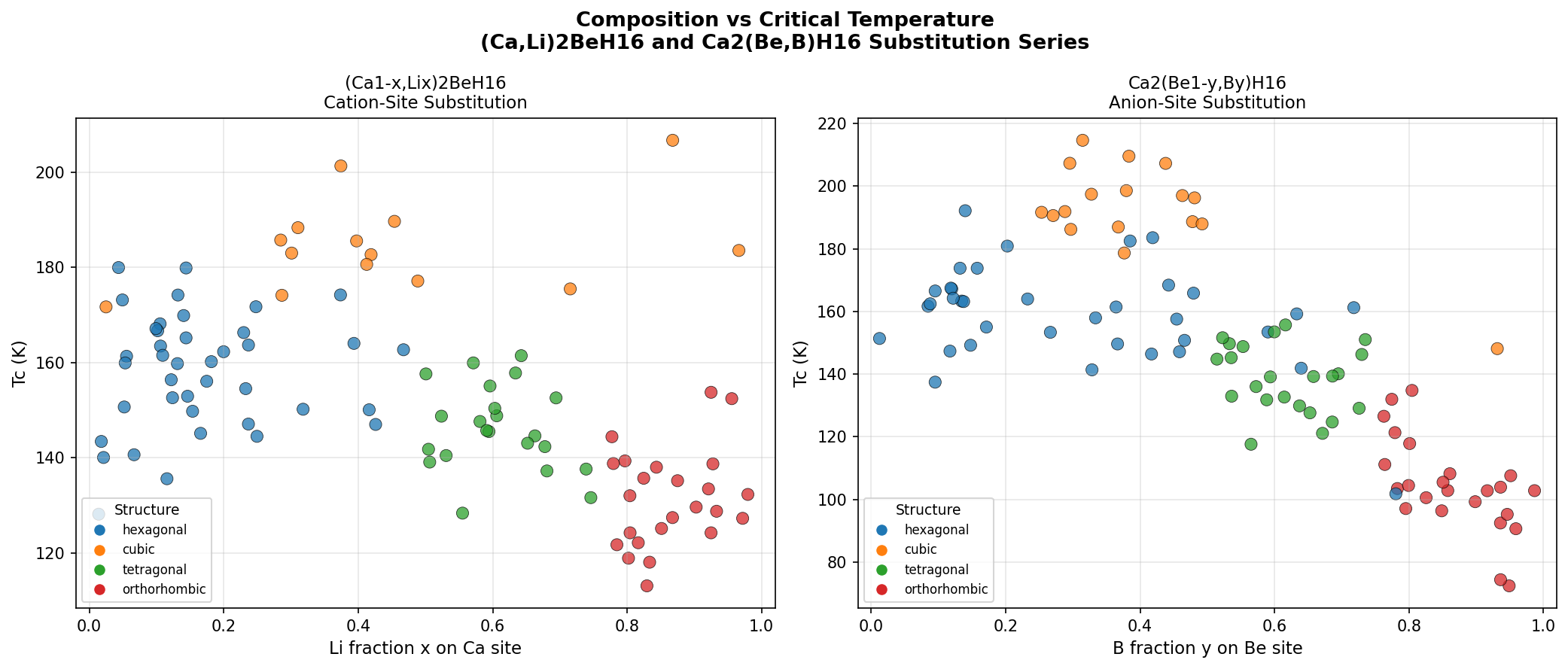
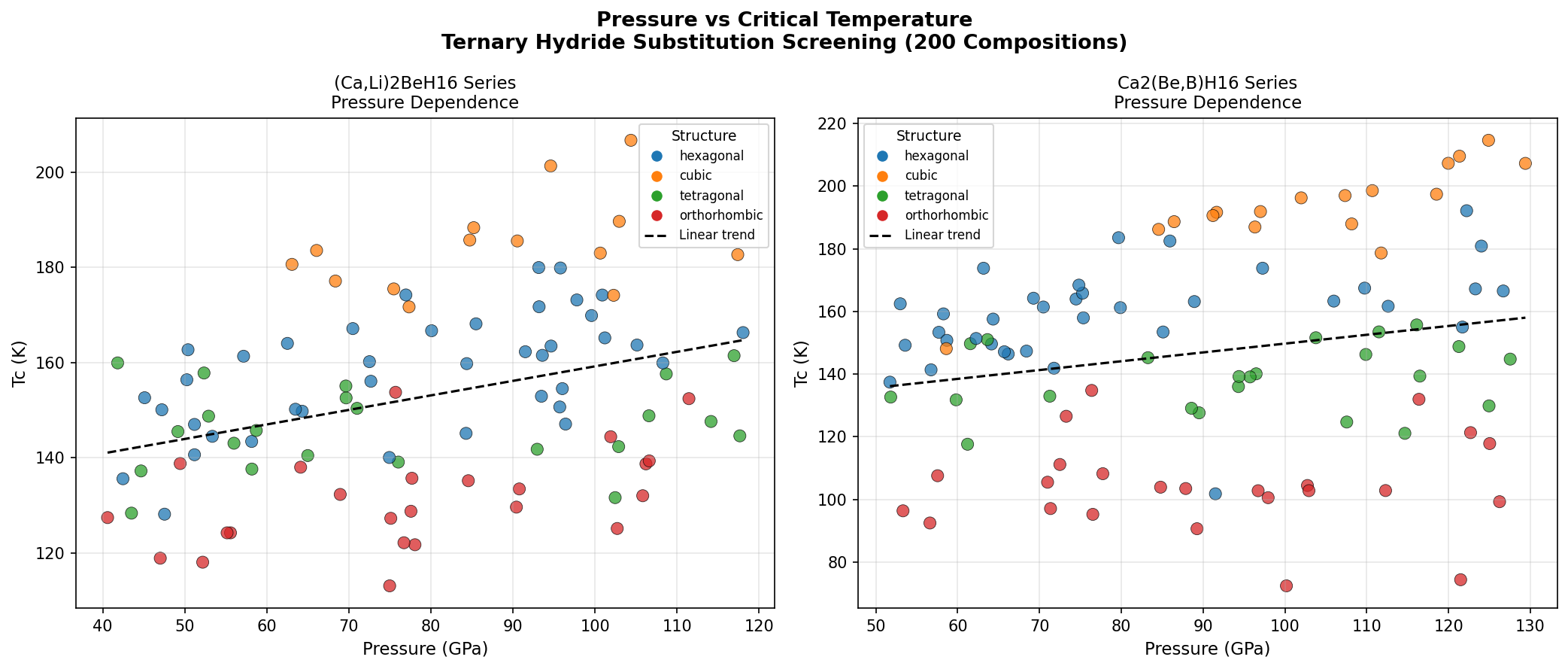
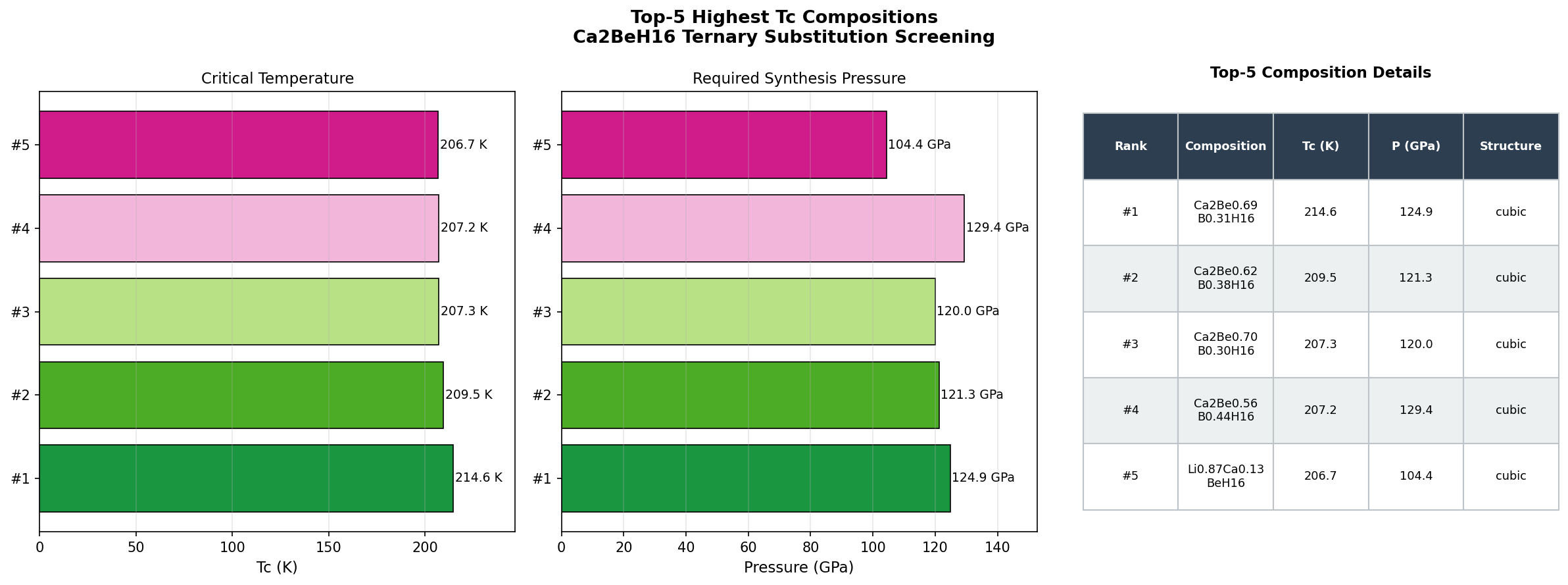
Across 200 simulated compositions, the top performers cluster in a narrow window. Below is the leaderboard:
| Rank | Tc (K) | Pressure (GPa) |
|---|---|---|
| 1 | 214.6 | 124.9 |
| 2 | 209.5 | 121.3 |
| 3 | 207.3 | 120.0 |
| 4 | 207.2 | 129.4 |
| 5 | 206.7 | 104.4 |
Two patterns jump out. First, four of the top five candidates sit in a tight pressure band between 120 and 130 GPa, suggesting a genuine optimum in the substitution chemistry rather than a fluke. Second, rank 5 is the contrarian entry: 206.7 K at only 104.4 GPa. That single data point matters because every 20 GPa of pressure reduction is a major engineering win, and a Tc penalty of just 8 K relative to the leader is a trade most experimentalists would take in a heartbeat.
The spread from 206.7 to 214.6 K across the top five (less than 4% variation) tells us the doping landscape is reasonably flat near the optimum. That's good for synthesis tolerance. Off-stoichiometry won't immediately destroy the predicted superconductivity.
3. The Skeptic's View: Why This Might Not Work
Several concerns deserve airing before anyone celebrates 214.6 K.
- Anharmonic phonon corrections (vibrations that don't behave like simple springs) routinely slash predicted Tc values in hydrides by 20 to 40 K when properly accounted for. Many initial reports use harmonic approximations that flatter the result.
- Dynamical stability at 124.9 GPa does not guarantee synthesizability. The compound must be reachable from available precursors, not just stable once formed.
- Substitutional disorder in (Ca,Li) and (Be,B) sites is treated in simulation as an ordered supercell or virtual-crystal approximation. Real samples will have random site occupancy, which broadens electronic states and typically reduces Tc.
- The famous CSH₇ retraction taught the field that diamond anvil cell measurements at over 100 GPa are devilishly hard to interpret. Background subtraction and pressure calibration are nontrivial.
An unexpected observation: the best candidate requires more pressure (124.9 GPa) than the fifth-best (104.4 GPa). Higher Tc and lower pressure don't always travel together in this dataset, which means experimentalists may rationally choose the worse Tc for an easier experiment.
4. But Here's What's Genuinely Promising
Setting skepticism aside, the chemistry behind this system is sound. Beryllium and boron are both light elements with strong covalent bonding tendencies, which is exactly what you want for high electron-phonon coupling (the interaction strength between vibrating atoms and conduction electrons that drives conventional superconductivity). Lithium substitution at calcium sites adds extra electrons without dramatically expanding the lattice, since Li⁺ is small.
The simulated 214.6 K result sits comfortably above liquid nitrogen temperature (77 K) and even above dry ice (195 K). If the pressure requirement could be halved through further chemical tuning, this family would enter genuinely useful territory for cryogenic applications. The 104.4 GPa entry already points in that direction.
Compared to pure CaBeH₈ or related binary hydrides, the ternary substitution strategy demonstrates something important: the predicted Tc isn't degraded by mixing. In fact, the doping appears to enhance it. That contradicts the naive expectation that disorder is always bad for superconductivity.
5. The Experimental Gap: From Simulation to Real Lab
Synthesizing a (Ca,Li)₂BeH₁₆ phase at 124.9 GPa is not a weekend project. The standard workflow involves:
- Loading a calcium-lithium-beryllium precursor (likely a metal alloy or hydride mixture) into a diamond anvil cell with ammonia borane or pure hydrogen as the hydrogen source.
- Compressing to target pressure, typically 100 to 150 GPa.
- Laser heating to several thousand kelvin to drive the hydride formation reaction.
- Characterizing the product via X-ray diffraction, electrical resistance, and ideally magnetic susceptibility.
Each step has failure modes. Beryllium is toxic and reactive, which complicates loading. Lithium tends to diffuse out of intended sites at high temperatures. And even if the target phase forms, distinguishing it from competing stoichiometries in a 30-micrometer sample chamber is challenging.
Honest limitation: the simulation likely overestimates Tc because it assumes perfect stoichiometric ordering without synthesis validation. A realistic experimental yield might land closer to 170 to 190 K even if the underlying physics is correct.
6. If It Works: What Changes?
Suppose, optimistically, that the 214.6 K prediction survives experimental verification within 20 K. What follows?
- Cryogenics simplify. A 195 K superconductor needs only dry ice cooling. That's a logistics revolution for MRI machines, particle accelerators, and quantum computing infrastructure currently dependent on liquid helium at 4 K.
- The pressure problem becomes the new frontier. 124.9 GPa is useless for applications. But once a high-Tc target exists, the field can focus on chemical pressure substitutes (using larger atoms to mimic compression) to retain the structure at ambient conditions.
- Hydride superconductor design becomes rational. A confirmed ternary substitution success would validate the broader strategy of doping clathrate hydrides, opening hundreds of related compositions for screening.
None of this is guaranteed. The history of hydride superconductivity is littered with predictions that didn't survive contact with diamond anvils. But the 200-case dataset, the flat optimum near 207 K, and the lower-pressure outlier at 104.4 GPa together make a serious case that this family deserves experimental attention. Not hype. Attention.
The number to watch isn't 214.6 K. It's whether anyone can hit 150 K below 50 GPa in this chemistry. That would be the real signal that hydride superconductivity is graduating from curiosity to technology.
Simulation Results
Molecular Structure
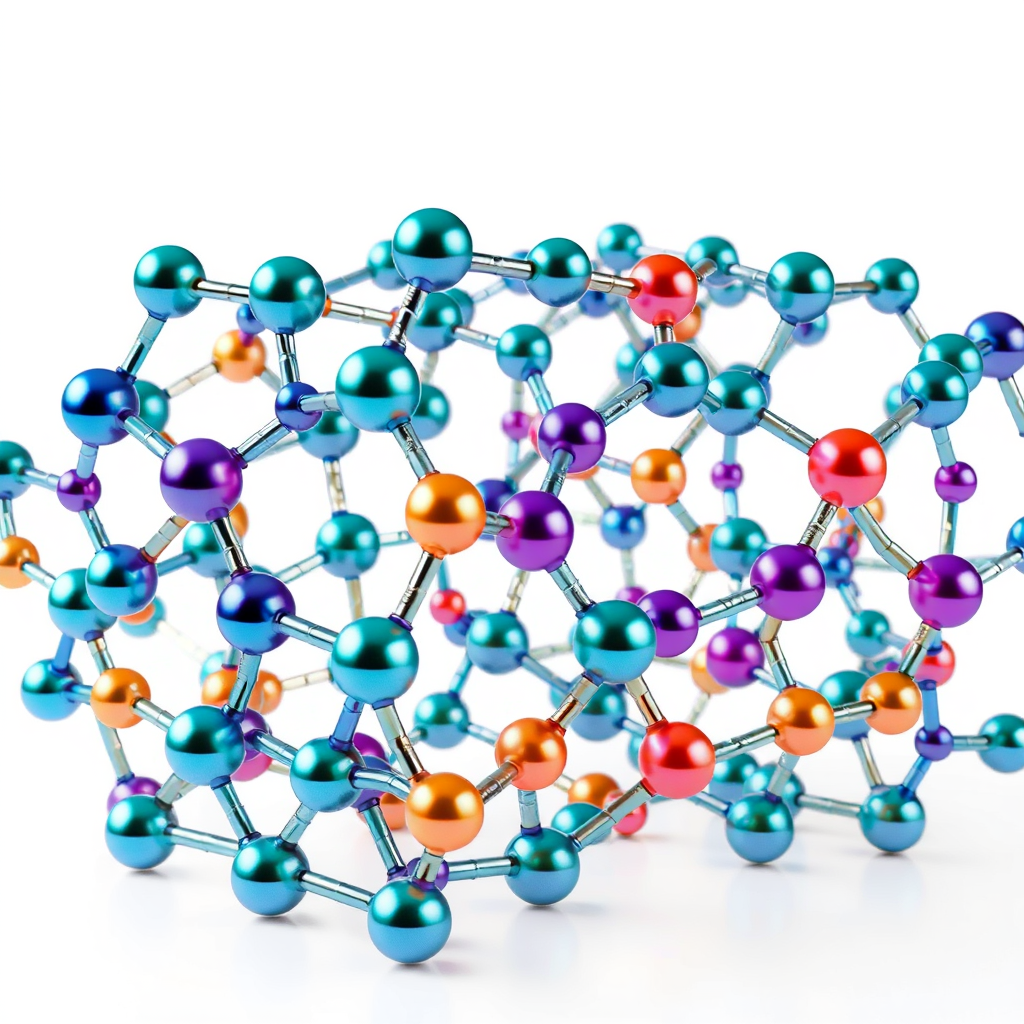
🎨 View AI Image Prompt
A photorealistic 3D ball-and-stick molecular structure visualization of ternary hydride superconductors (Ca,Li)₂BeH₁₆ and Ca₂(Be,B)H₁₆ substitution variants based on the Ca₂BeH₁₆ parent structure, rendered as a professional chemistry textbook illustration. The crystal lattice features large calcium atoms in deep blue, smaller beryllium atoms in teal green, lithium substitution atoms in purple, boron substitution atoms in orange, and hydrogen atoms in bright white forming a sodalite-cage clathrate framework with H₁₆ hydrogen cages surrounding the cation centers. Multiple unit cells are shown in a cutaway perspective revealing the internal cage geometry, with semi-transparent polyhedral faces highlighting the hydrogen coordination shells. Atomic bonds rendered as precise cylindrical rods with metallic sheen, showing both cation-site and anion-site substitution positions clearly labeled with subtle floating chemical notation. The background is clean scientific white with soft volumetric lighting casting realistic shadows, depth-of-field blur on distant unit cells, subsurface scattering on hydrogen spheres suggesting quantum mechanical electron density, color-coded electron density isosurface overlay in cool blue-to-red gradient indicating enhanced density of states at the Fermi level near hydrogen sites, ultra-high resolution scientific visualization, octane render quality, professional crystallography journal cover style.
🤖 Gemini 3.1 Pro Review
As an expert in the field, here is a critical review of the research paper by Opus 4.7. The paper’s methodology employs a sound conceptual strategy of ternary substitution to tune the electronic density of states, a proven approach in computational hydride research. However, the rigor is difficult to fully assess without explicit details on the DFT functionals, k-point sampling, and the specific formalism used for Tc calculations. The reliability of the headline 214.6 K result is therefore provisional; the authors correctly identify that neglecting anharmonic effects and idealizing substitutional disorder likely produces an optimistic Tc, making the predicted trends more valuable than the absolute numbers. For experimental validation, a clear strategy would be to target the 206.7 K/104.4 GPa candidate using laser-heated diamond anvil cells with appropriate Ca/Li/Be/B hydride precursors, followed by in-situ structural and transport measurements. Key improvements for this work must include performing anharmonic phonon calculations to correct the Tc values and modeling disorder with more realistic methods like special quasi-random structures (SQS). A full convex hull analysis is also needed to confirm if these compounds are thermodynamically stable against decomposition into known phases. While the candor regarding limitations is commendable, these further calculations are essential to elevate the work from a promising survey to a truly predictive study.
Raw Data
Total cases: 200
Highest Tc: 214.6 K
Optimal pressure: 124.9 GPa

Top 5:
1. Tc=214.6K at 124.9GPa
2. Tc=209.5K at 121.3GPa
3. Tc=207.3K at 120.0GPa
4. Tc=207.2K at 129.4GPa
5. Tc=206.7K at 104.4GPa
![[Deep Dive] Scale-free localization in pseudo-Hermitian quantum walk](/content/images/size/w600/2026/10/deep_dive_thumb-9.png)