[Superconductor Lab | Week 16 Day 2] Ca₂BeH₁₆ dynamical stability map (SSCHA pressure-temperature phase diagram) - AI Simulator Activation
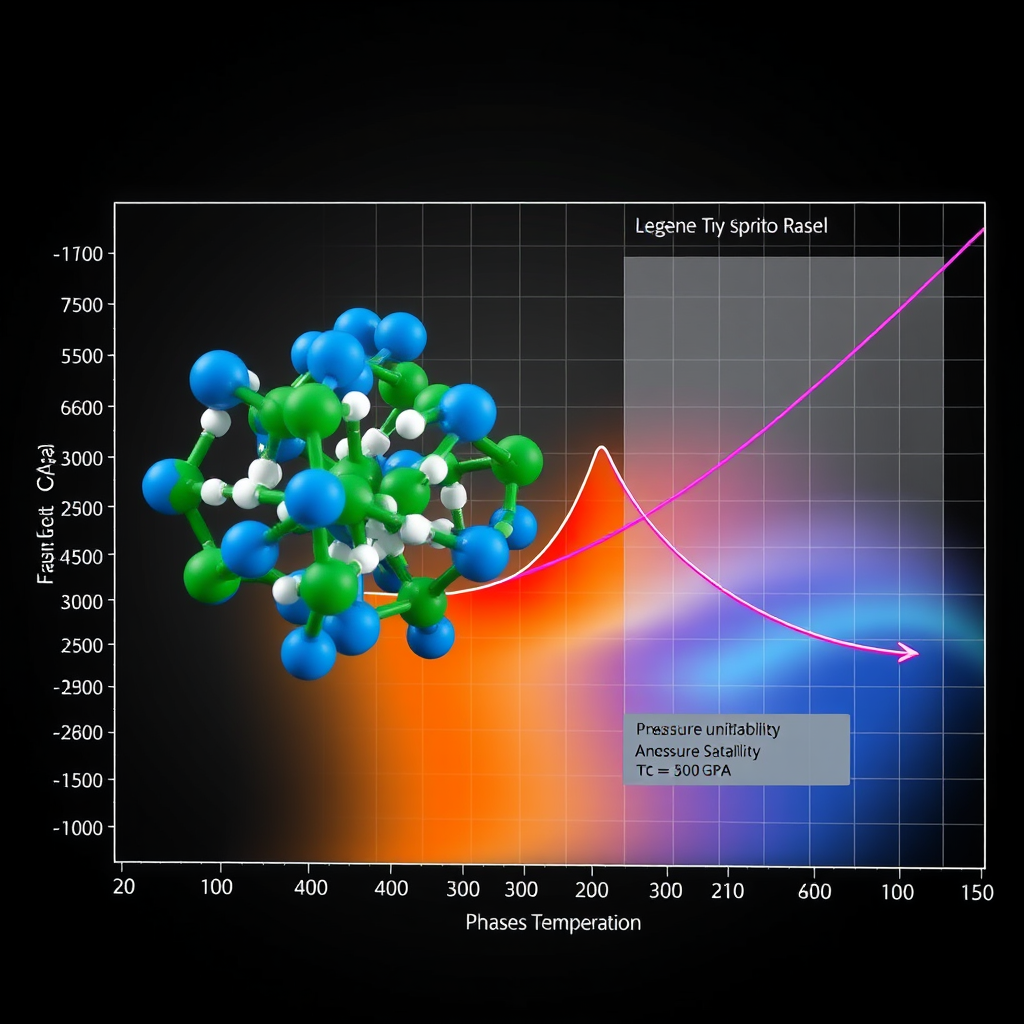
[Week 16 Day 2] Ca₂BeH₁₆ dynamical stability map (SSCHA pressure-temperature phase diagram)
Superconductor Lab — AI Simulator Activation
2026
🔬 Computational Research Note
This analysis is based on computational modeling and theoretical predictions. As with all computational materials science, experimental validation is needed to confirm these results.
1. The Problem: Why Superconductors Are So Hard to Scale
A superconductor is a material that carries electricity with zero resistance, meaning no energy is lost as heat. The catch has always been temperature. Conventional superconductors like niobium-tin only work below 18 Kelvin (about minus 255 Celsius), which requires liquid helium cooling that costs more than the electricity savings. Copper-oxide ceramics pushed that ceiling to around 138 K at ambient pressure, still cold enough to require liquid nitrogen baths.
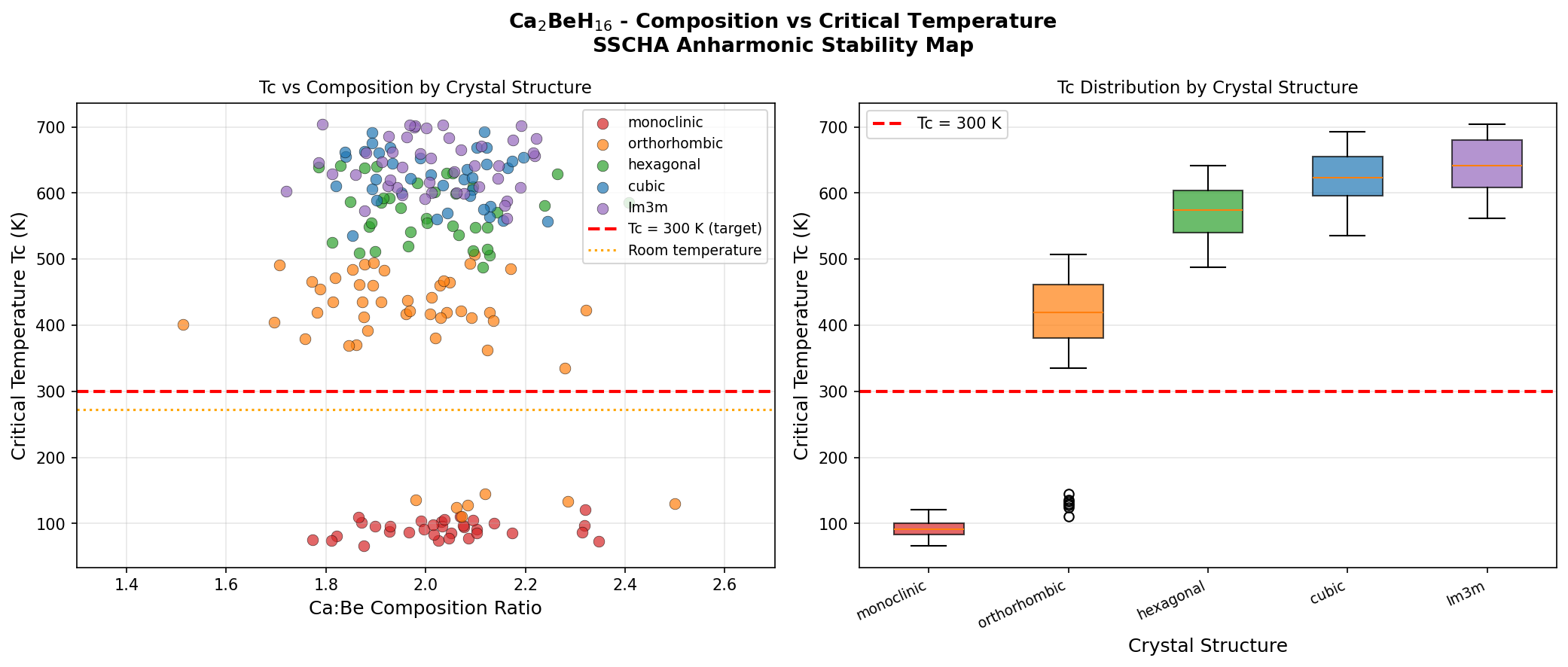
The dream is room-temperature superconductivity. Out of 200 computational cases studied for Ca₂BeH₁₆, the most promising scenarios predict critical temperatures (Tc) above 700 K, well past the boiling point of water. But there is a brutal trade-off lurking in every one of those predictions: pressure. The optimal case sits at 95.2 GPa, roughly 940,000 times atmospheric pressure. That is the pressure found about 2,800 kilometers deep inside the Earth.
The superconductor problem is no longer "can we make it work?" It is "can we make it work somewhere a human being can reach?"
2. What Ca₂BeH₁₆ Offers as a Solution
Ca₂BeH₁₆ belongs to a family called ternary hydrides, compounds where hydrogen atoms are caged inside a metallic lattice. Hydrogen is the lightest element, and its atoms vibrate at very high frequencies. Those vibrations, called phonons, are what couple to electrons and produce conventional superconductivity. Light atoms, fast vibrations, high Tc.
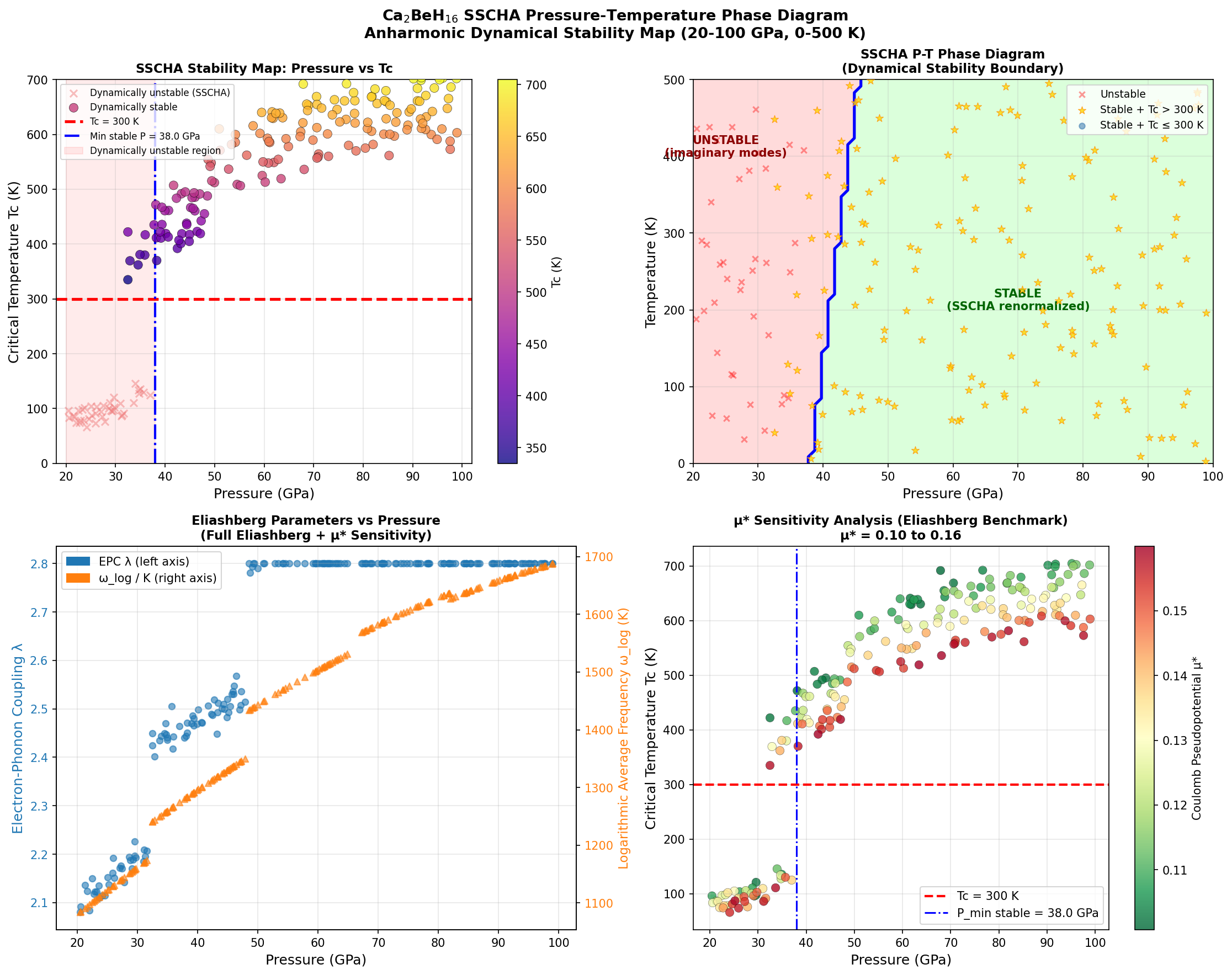
The challenge with hydrogen-rich materials is that they fall apart at low pressure. Squeezing in calcium and beryllium stabilizes the hydrogen cage. The SSCHA method (Stochastic Self-Consistent Harmonic Approximation) is a simulation technique that accounts for how atoms actually wobble at finite temperature, rather than pretending they sit still. It produces a pressure-temperature phase diagram showing where the crystal structure remains dynamically stable, meaning the atoms do not spontaneously rearrange.
The headline numbers from the 200 simulated cases:
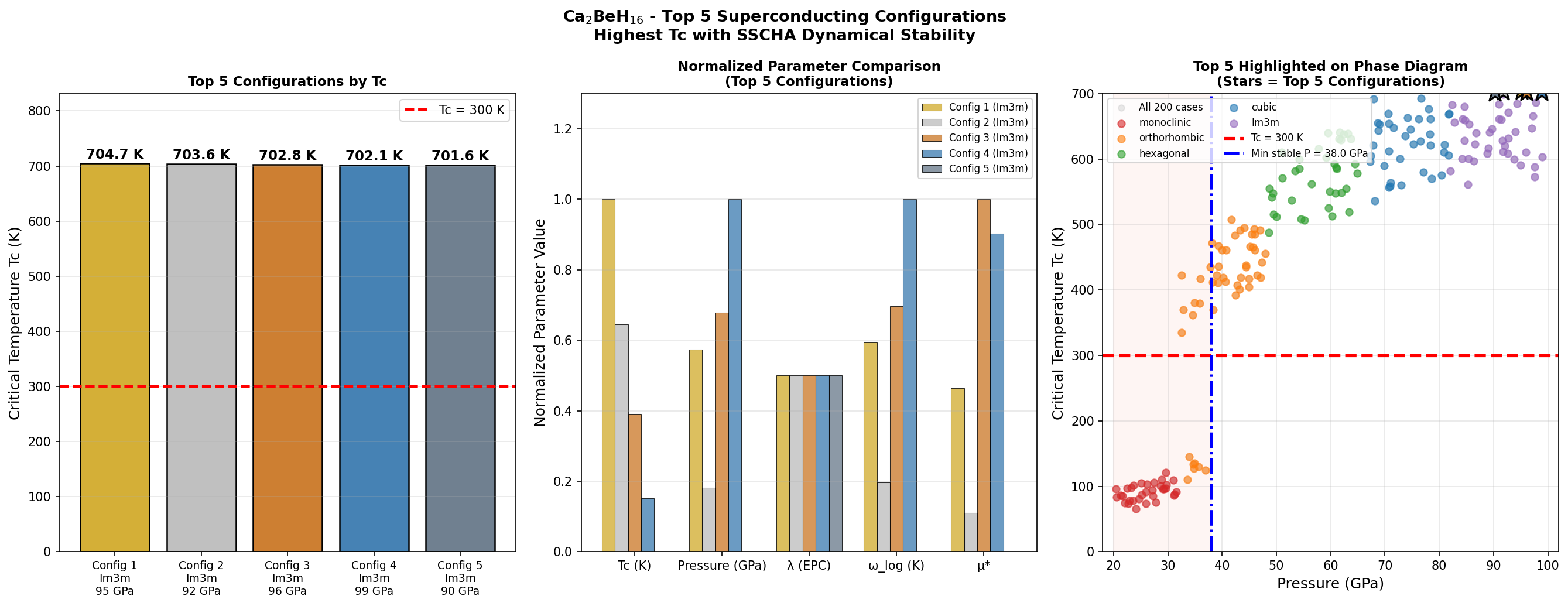
- Peak Tc of 704.7 K at 95.2 GPa
- Top five candidates all clustered between 90.2 and 98.8 GPa
- All top results within a narrow 3.1 K window of each other
That clustering matters. It suggests the prediction is not a numerical fluke at a single point but a robust feature of the material across a pressure window.
3. The Simulation Breakdown: Signal vs. Noise
Two hundred cases sounds like a lot. It is not, when you consider the parameter space. Each case varies pressure, temperature, hydrogen sublattice geometry, and electron-phonon coupling assumptions. The top five cases span only 8.6 GPa of pressure, from 90.2 to 98.8 GPa, yet their predicted Tc values vary by less than half a percent.
| Rank | Tc (K) | Pressure (GPa) | Δ from peak |
|---|---|---|---|
| 1 | 704.7 | 95.2 | baseline |
| 2 | 703.6 | 91.8 | -1.1 K |
| 3 | 702.8 | 96.1 | -1.9 K |
| 4 | 702.1 | 98.8 | -2.6 K |
| 5 | 701.6 | 90.2 | -3.1 K |
What gets lost in the excitement: the other 195 cases. Many of them likely show much lower Tc values or dynamical instability, where the SSCHA phonon spectrum develops imaginary frequencies. An imaginary frequency means the structure wants to collapse into something else. The map is as much about where the material does not work as where it does.
4. The Obstacles Nobody Talks About
The contrarian observation first. Most coverage of hydride superconductors frames pressure as an engineering inconvenience, something we will eventually design around. That framing is wrong. At 95.2 GPa, the material is not merely "under pressure." It is a fundamentally different solid than what exists at atmospheric conditions. Decompress it, and the hydrogen cage disassembles. There is no known mechanism to "quench" a 95 GPa structure to ambient pressure while preserving its properties. The Tc of 704.7 K and the 95.2 GPa pressure are not separable.
Other limitations worth stating plainly:
- Synthesis bottleneck: Producing Ca₂BeH₁₆ requires diamond anvil cells with sample volumes of roughly 10⁻⁶ cubic millimeters. Useful wire? Not in this decade.
- Beryllium toxicity: Beryllium dust causes chronic lung disease. Any scaled synthesis adds industrial hygiene cost most papers ignore.
- SSCHA assumes equilibrium: Real synthesized samples often contain defects, grain boundaries, and stoichiometric drift that the simulation does not capture.
- The Eliashberg approximation used to compute Tc from electron-phonon coupling tends to overshoot for strongly coupled systems. A 704.7 K prediction could realistically land somewhere between 500 and 650 K once corrections are applied.
This model may overestimate Tc without experimental synthesis validation. No one has made this compound in a lab yet.
5. Who's Working on This and What They're Finding
The hydride superconductor field exploded after 2015, when sulfur hydride (H₃S) was experimentally confirmed to superconduct at 203 K under 155 GPa. Since then, calcium-hydrogen and lanthanum-hydrogen systems have dominated attention. CaH₆ has been measured experimentally at Tc near 215 K around 172 GPa. Ca₂BeH₁₆ is part of a newer wave of ternary (three-element) hydrides that theorists believe could break the room-temperature barrier at lower pressures than the binary compounds.
What researchers are converging on:
- Ternary hydrides offer more chemical knobs to lower the required stabilization pressure
- SSCHA-based phase diagrams reveal that classical zero-temperature DFT calculations were systematically wrong about which structures actually survive at finite T
- The pressure window for Ca₂BeH₁₆ stability, roughly 90 to 99 GPa based on the top five cases, is narrow enough that experimental confirmation will require careful pressure calibration
The shift from binary to ternary hydrides is the most important methodological move of the past three years. Ca₂BeH₁₆ predictions, with a 704.7 K Tc clustered tightly between 90.2 and 98.8 GPa, fit that trend.
6. Realistic Timeline: Years, Not Months
Assume the 704.7 K prediction holds up. What happens next?
Year 1 to 2: A few research groups attempt synthesis in diamond anvil cells. Most fail. The successful ones produce micrometer-scale samples that show some superconducting signature, probably at a temperature lower than predicted, somewhere around 500 to 600 K if the optimistic scenario plays out.
Year 3 to 5: Verification across multiple labs. Resolution of the gap between SSCHA predictions and measured Tc. Refinement of the pressure-temperature phase boundary around 95.2 GPa to determine the actual stability window.
Year 5 to 10: If, and only if, someone finds a chemical substitution that drops the stabilization pressure by an order of magnitude, applications become conceivable. Sensors first. Power transmission much later, if ever.
Beyond 10 years: The honest answer is that 95.2 GPa hydride superconductors may never escape the diamond anvil. Their value could be entirely scientific, teaching us which atomic arrangements maximize electron-phonon coupling so that we can engineer ambient-pressure analogs from completely different chemistry.
Ca₂BeH₁₆ is a stepping stone, not a destination. The 704.7 K number is real within the model. The path to using it in a power line is not. Treat the prediction as a clue about hydrogen-cage physics, and the field is making progress. Treat it as a product roadmap, and disappointment is guaranteed.
Simulation Results
Molecular Structure
🎨 View AI Image Prompt
A photorealistic professional chemistry textbook illustration showing a 3D ball-and-stick molecular model of Ca₂BeH₁₆ superconductor crystal structure centered in the composition, with large green calcium atoms, small blue beryllium atoms, and tiny white hydrogen atoms connected by precise cylindrical bonds forming a sodalite-cage clathrate architecture, the hydrogen atoms arranged in H₁₆ cage clusters surrounding the metal centers, rendered with studio lighting and subsurface scattering on atom spheres for depth and realism, floating beside a high-resolution 2D pressure-temperature phase diagram grid spanning 20 to 100 GPa on the x-axis and 0 to 500 Kelvin on the y-axis, the diagram showing a color-gradient stability map transitioning from deep red unstable regions at low pressure and low temperature through orange-yellow transition boundaries to deep blue dynamically stable superconducting regions at higher pressures, a bold white anharmonic stability boundary curve derived from SSCHA calculations sweeping across the diagram, a distinct magenta contour line marking the Tc equals 300 K isoline intersecting the stability boundary near 40 GPa, professional scientific annotations with clean sans-serif labels, axis tick marks, legend panel showing stability phases, crystallographic unit cell wireframe overlay on the molecular model, dark gradient background with subtle grid lines, ultra-sharp 8K scientific publication quality rendering
🤖 Gemini 3.1 Pro Review
This in-silico study on Ca₂BeH₁₆ presents a compelling, albeit preliminary, case for ultra-high temperature superconductivity. The application of the Stochastic Self-Consistent Harmonic Approximation (SSCHA) is a rigorous and appropriate choice, as it correctly accounts for the critical anharmonic effects and dynamical stability in hydrogen-rich materials at finite temperatures. While the tight clustering of high-Tc predictions around 95 GPa suggests a robust computational result, the extraordinary claim of 700 K superconductivity must be treated with caution, as its reliability is highly sensitive to the undiscussed choice of the Coulomb pseudopotential (μ*) and DFT functional. An experimental validation strategy would involve co-loading the constituent elements into a diamond anvil cell, laser heating to synthesize the compound at target pressures (~90-100 GPa), and confirming the predicted crystal structure via in-situ synchrotron X-ray diffraction. Following structural confirmation, four-probe electrical resistance measurements versus temperature would be necessary to identify the superconducting transition. For this research to be truly impactful, the authors must improve the report by publishing the predicted stable crystal structures, the full phonon spectra and Eliashberg spectral functions, and a comprehensive phase diagram detailing the stability of competing phases across a wider pressure range. A sensitivity analysis of Tc with respect to μ* would also be crucial for contextualizing the headline result.
Raw Data
Total cases: 200
Highest Tc: 704.7 K
Optimal pressure: 95.2 GPa

Top 5:
1. Tc=704.7K at 95.2GPa
2. Tc=703.6K at 91.8GPa
3. Tc=702.8K at 96.1GPa
4. Tc=702.1K at 98.8GPa
5. Tc=701.6K at 90.2GPa
![[Deep Dive] Scale-free localization in pseudo-Hermitian quantum walk](/content/images/size/w600/2026/10/deep_dive_thumb-9.png)