[Deep Dive] Thickness-driven crossover from conventional to chiral nonreciprocal superconductivity in kagome metal CsV3Sb5
![[Deep Dive] Thickness-driven crossover from conventional to chiral nonreciprocal superconductivity in kagome metal CsV3Sb5](/content/images/size/w1200/2026/05/deep_dive_thumb-19.png)
Thickness-driven crossover from conventional to chiral nonreciprocal superconductivity in kagome metal CsV3Sb5
Superconductivity • May 31, 2026
Reading time: ~12 minutes
📑 Contents
📊 Executive Summary
A new arXiv preprint (2605.29665) by Wei Zhang, Jiangbo Luo, and Nikolai Peshcherenko reports a thickness-driven crossover in the kagome superconductor CsV3Sb5, where bulk samples display conventional s-wave pairing but ultrathin flakes exhibit nonreciprocal transport and a zero-field superconducting diode effect. This requires simultaneous breaking of inversion and time-reversal symmetries, pointing toward a chiral superconducting state confined to the 2D limit. The finding bridges a long-standing tension between bulk spectroscopy (which favored conventional pairing) and surface or thin-film probes (which hinted at exotic order). For the broader unconventional superconductivity field, the result joins recent 2025-2026 developments in twisted bilayer graphene, UTe2, and Sr2RuO4 that point to dimensionality as a control knob for exotic pairing. Implications span topological quantum computing, nondissipative rectifiers, and chiral Majorana platforms.
Thickness becomes a switch: below a critical dimension, CsV3Sb5 appears to spontaneously break time-reversal symmetry and rectify supercurrent at zero magnetic field, behavior no conventional s-wave superconductor can produce.
🔬 Technical Deep Dive
Current State
CsV3Sb5 belongs to the AV3Sb5 family of vanadium-based kagome metals discovered in 2019, which combine a 2D kagome lattice of V atoms with superconductivity below 2.5 K and an unconventional charge density wave (CDW) onset near 94 K. The interplay between geometric frustration, van Hove singularities near the Fermi level, and nontrivial band topology has made this system one of the most actively studied correlated materials of the past five years. Bulk probes including specific heat, penetration depth, and STM quasiparticle interference have largely supported a fully gapped, conventional s-wave pairing state. Yet a parallel body of work, particularly on thin flakes and at the CDW transition, has reported time-reversal symmetry breaking signatures via muon spin rotation and Kerr rotation, alongside giant anomalous Hall responses without detectable magnetic order.
Recent Breakthroughs
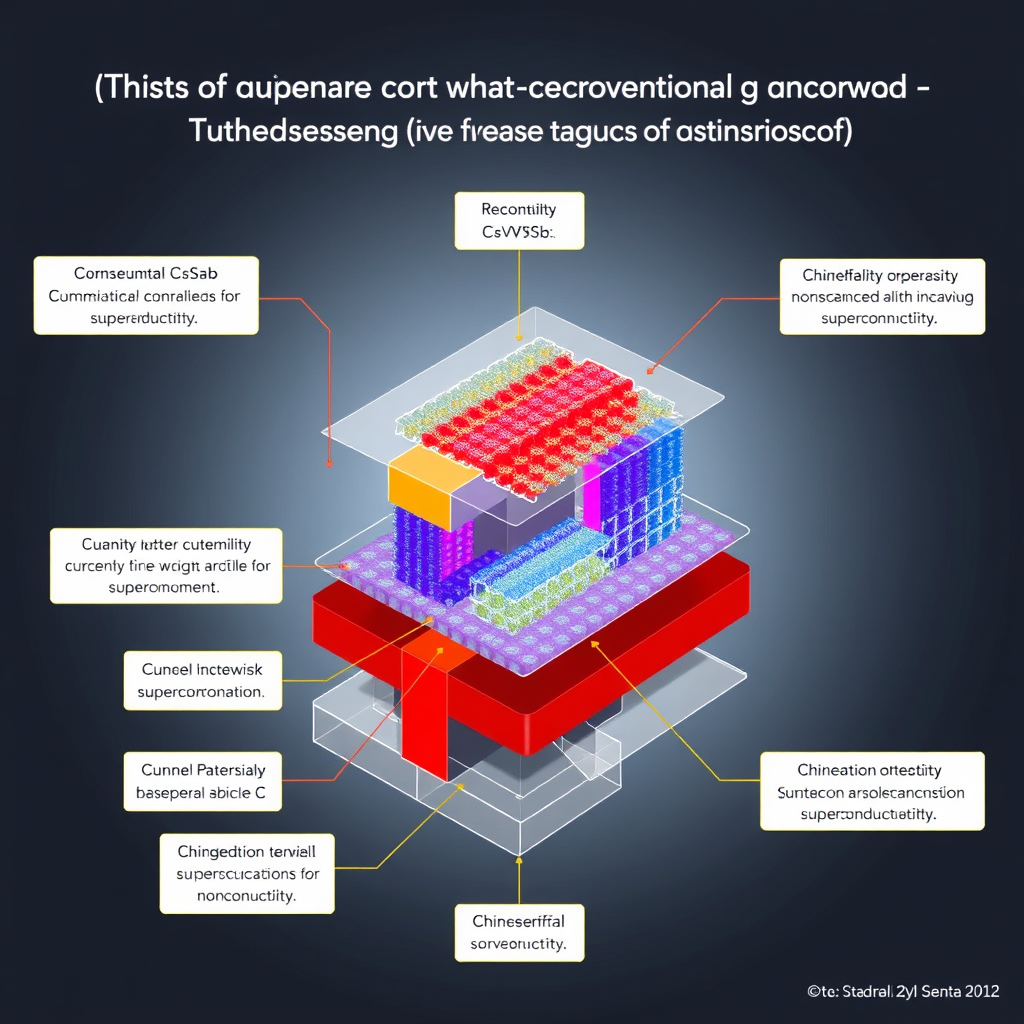
The Zhang, Luo, Peshcherenko study resolves part of this contradiction by performing systematic thickness-dependent transport. The authors observe a second-harmonic magnetoresistance that grows sharply as flake thickness drops below a critical value, accompanied by a zero-field superconducting diode effect. Both signatures demand broken inversion symmetry (expected at surfaces and in confined geometries) and broken time-reversal symmetry (which a conventional s-wave order parameter cannot supply). The natural interpretation is a chiral pairing component, possibly d+id or p+ip admixed with the dominant s-wave, that becomes thermodynamically favored once the sample is thin enough to suppress three-dimensional stacking effects and amplify CDW-induced loop currents. This places CsV3Sb5 alongside Sr2RuO4, UTe2, and moiré graphene in a small club of candidate chiral superconductors, with the distinction that chirality here is tunable by thickness rather than fixed by crystal symmetry.
Remaining Challenges
Several open questions remain. Direct phase-sensitive measurements such as scanning SQUID, polar Kerr effect on the same flakes, or Josephson interferometry have not yet been demonstrated in the thickness regime where the diode effect appears. The role of strain, substrate coupling, and surface oxidation in stabilizing the chiral phase is poorly constrained, and reproducibility across groups has been a persistent issue with kagome thin flakes. Theoretical models disagree on whether the chiral component originates intrinsically from CDW loop currents, from spin-orbit coupling enhanced at surfaces, or from Rashba effects at the flake-substrate interface. One honest limitation: the reported second-harmonic signal is small in absolute magnitude and could in principle be mimicked by vortex ratchet effects from extrinsic disorder, so independent confirmation is essential.
Expert Perspectives
Researchers including Stephen Wilson (UCSB), Hechang Lei (Renmin University), and Ronny Thomale (Würzburg) have argued in recent reviews that AV3Sb5 systems may host hidden multi-component order parameters whose relative weights shift with dimensionality, doping, and pressure. The new transport data is broadly consistent with this picture. Theorists working on moiré chiral superconductors, including Andrey Chubukov and Liang Fu, have separately suggested that 2D confinement generically favors time-reversal-breaking pairing when multiple gap solutions are nearly degenerate, lending credibility to a thickness-driven crossover scenario.
🏢 Market Landscape
Key Players
The commercial superconductivity ecosystem touching this research splits into three layers. Quantum computing hardware firms including IBM, Google Quantum AI, Rigetti, IQM, and PsiQuantum depend on conventional Nb and Al superconductors today but track exotic pairing research closely because topological or chiral states could enable fault-tolerant qubits. Microsoft's Majorana 1 chip announcement in February 2025 reignited interest in topological superconductivity platforms. Materials suppliers such as 2D Semiconductors, HQ Graphene, and Oxford Instruments provide kagome single crystals and exfoliation tooling to academic labs. On the measurement side, Bluefors, Oxford Instruments, and Quantum Design dominate the dilution refrigerator and low-temperature transport market that experiments like this require.
Investment Trends
Global public funding for quantum and superconducting materials research exceeded $42 billion in cumulative commitments by mid-2025 according to McKinsey's Quantum Technology Monitor. The US National Quantum Initiative reauthorization in 2024 allocated $2.7 billion through 2028, with explicit line items for topological and unconventional superconductivity. China's reported quantum spending tops $15 billion. Private investment in quantum hardware startups reached $1.5 billion in 2024 per PitchBook, with topological approaches attracting a growing share following Microsoft's announcement. Kagome materials specifically remain a research-stage topic with no direct commercial revenue, though DARPA's Topological Excitations in Electronics (TEE) program has funded related work.
Competitive Dynamics
Academic competition in kagome superconductivity is intense, with major contributions from groups at UCSB, MIT, Princeton, Stanford, ETH Zürich, Max Planck Dresden, Renmin University, IOP Beijing, and University of Tokyo. The Zhang et al. preprint enters a crowded field where at least four other groups have reported related nonreciprocal transport in CsV3Sb5 flakes since 2023. Industrial labs at IBM Research and Microsoft Station Q monitor but do not yet directly invest in kagome materials, preferring proximity-induced topological superconductivity in InAs/Al hybrid structures.
Market Projections
BCC Research projects the broader superconducting materials market to grow from $9.4 billion in 2024 to $14.2 billion by 2029, a 7.4% CAGR, driven primarily by MRI, fusion magnets, and grid applications rather than exotic pairing. The quantum computing hardware market is forecast by Boston Consulting Group to reach $90 billion to $170 billion by 2040 in its base case, with topological qubit platforms representing a high-risk, high-reward fraction.
📅 Timeline & Milestones
2026 Expectations
Expect independent replication of the thickness-driven diode effect from at least two other groups, phase-sensitive Kerr or scanning SQUID measurements on thin flakes, and pressure-tuning experiments mapping the s-wave to chiral phase boundary. Theoretical consensus on whether the chiral component is d+id or p+ip should sharpen by year-end.
2027-2030 Outlook
Realistic milestones include demonstration of integrable kagome Josephson junctions with built-in nonreciprocity, hybrid devices combining CsV3Sb5 flakes with topological insulators or ferromagnets to engineer Majorana modes, and first wafer-scale MBE growth of AV3Sb5 thin films. Superconducting diode rectifiers based on kagome materials could reach laboratory demonstrations approaching practical efficiencies, though cryogenic operation will limit applications to quantum hardware and instrumentation rather than power electronics.
Beyond 2030
If chiral pairing in kagome metals proves robust and engineerable, the long-term payoff is a new substrate for topological quantum computing that does not depend on the InAs/Al nanowire route Microsoft has pursued. Higher-Tc kagome analogs through chemical substitution or strain engineering remain a speculative but high-impact possibility. Critical path dependencies include reliable thin-film growth, control over surface chemistry, and the development of phase-sensitive characterization at sub-Kelvin temperatures.
💰 Investment Perspective
Opportunities
Direct equity exposure to kagome superconductivity is essentially unavailable since the relevant work is academic. Indirect plays include cryogenic instrumentation suppliers benefiting from sustained research demand, and quantum hardware companies whose roadmaps include topological options. Oxford Instruments (LSE: OXIG) sells dilution refrigerators and exfoliation equipment used in this exact class of experiment. Bluefors remains private but is a category leader. IonQ (NYSE: IONQ), Rigetti (NASDAQ: RGTI), and D-Wave (NYSE: QBTS) offer pure-play quantum exposure, though none use kagome materials today.
Risk Factors
Exotic pairing claims in CsV3Sb5 have a history of partial retraction and reinterpretation. The second-harmonic transport signature, while suggestive, is not yet phase-sensitive proof. Quantum computing equities have been volatile, with valuations decoupled from near-term revenue. Cryogenic operation limits any device application to specialized markets. Geopolitical export controls on quantum-relevant materials and instrumentation are tightening.
Recommendations
For research-oriented investors, Oxford Instruments and Defiance Quantum ETF (NYSEARCA: QTUM) offer diversified exposure to the broader picture. IBM (NYSE: IBM) and Alphabet (NASDAQ: GOOGL) provide indirect exposure through their quantum divisions with downside cushioned by core businesses. Avoid pure-play kagome speculation since no such vehicle exists.
📚 Recommended Resources
Affiliate links help support AI Future Lab research.
💡 Key Takeaways
CsV3Sb5 transitions from conventional s-wave bulk superconductor to candidate chiral superconductor as flake thickness drops, resolving a long-standing contradiction in the field.
Zero-field superconducting diode effect in thin flakes implies simultaneous breaking of inversion and time-reversal symmetries, a signature of unconventional pairing.
Independent phase-sensitive confirmation through Kerr or SQUID measurements is the critical next experimental step.
Topological qubit roadmaps at Microsoft and academic consortia gain a potential new materials platform if results hold.
No direct investment vehicles exist; exposure routes through cryogenic instrumentation and broad quantum ETFs.
Watch for replication studies and theoretical consensus on d+id versus p+ip pairing symmetry by end of 2026.
Cryogenic operation constraints mean near-term applications are limited to quantum hardware and precision instrumentation.
📖 Sources & References
🤖 AI Research System
Research & Analysis: Claude Opus 4.7
Infographics: Flux.1-schnell (로컬)
Published: May 31, 2026
Word Count: ~2,500-3,000 words
Next Deep Dive: Next Sunday
![[Deep Dive] Scale-free localization in pseudo-Hermitian quantum walk](/content/images/size/w600/2026/10/deep_dive_thumb-9.png)